
And remember, if you don't succeed, you can always try another sport.
(This is more words than anyone has ever heard him speak in English before ... even though it is only 2 1/2 minutes long.)
Showing posts with label 2021. Show all posts
Showing posts with label 2021. Show all posts
06 February 2022
Good Luck to the Speedskaters, from Primoz Roglic


31 December 2021
2021 "Festive 500"
 |
| The Pelso prays for world peace at the shrine just outside Haneda airport. |
After the 300/400/300km brevets I joined in late October through mid-November, I have taken a short vacation from longer rides, with only a few ~50km coffee rides with the Tokyo Cranks from November 20 and December 23. I will rejoin Audax events from next March, but hope to focus on swimming in January and February.
So I was not sure if I would be able to get in enough short rides to clear the Festive 500 (500kms during Dec 24 to Dec 31). I did so, finishing with a short spin this morning, the 31st. I ended up doing more than 60% of the distance on the Pelso recumbent.
The first ride was a flat trip to Soka City, Saitama to pick up a bicycle component and meet Sashikata-san, the only recumbent dealer in Kanto (who is very much on a part-time basis, his main business involving supply of classroom desks to schools). The next ride of significance was a trip to and from Mitaka for an appointment -- I headed down to Haneda, then up the Tamagawa, and on the way back went to Mitaka. Then on the 29th I took a short ride on the Parlee with Jerome and Peter, also the Tamagawa with "hospital hill" and "I-ro-ha-zaka". The last long ride, the longest of the week at 107kms, was again to Mitaka via Haneda and the Tamagawa ... with a return also via the extended, indirect route.
As always, when I ride the Pelso, I hear plenty of exclamations as I pass by groups of people. "Sugoi. Are nani?" (Wow. What is THAT?)
The Tamagawa looked as if it is ready for the New Year. I often feel like riding along the river is just the boring, same old route that one needs to get through in order to enjoy the "good stuff" once into the mountains further out of town. But on December 30, on the Pelso, the Tamagawa, and the sky with its changing colors as the day went on then faded away, was enough of a reward in and of itself.
The water skiier I saw near Kawasaki was the icing on the cake.


10 December 2021
Wheel No. 00028 -- First new SP dynamo hub in years!
 |
| This is around a 955g wheel, including the dynamo hub. About as light weight as imaginable for a 32-spoke, wide-rimmed, very sturdy wheel with a dynamo. |
As part of preparing the Ti Travel Bike, Voyage Voyage, for its second decade, I thought I also should replace my front wheel, built in December of 2014. The wheel and its Shutter Precision SV-9 dynamo hub has gone at least 20,000 kilometers over the past 7 years. The hub is a closed system -- can only be opened and maintained at the factory, in theory at least. So while it still "rolls good", the bearings must have worn a bit by now. I recently noticed a very slight degree of "play" in it, so I think it may be nearing time to replace. And the wheel's H Plus Son Archetype rim is showing definite wear on the brake track -- what started as a straight brake track is now noticeably sunken/concave on both sides. I think the rim could last another year or two, but if I am going to replace the hub I might as well do the rim at the same time. If I build a new wheel, it should be what I use with the Ti Travel bike for PBP 2023 and beyond.


The H Plus Son Archetype is always an easy wheel to build, and today was no exception. And the H Plus Son Archetype remains, in my view, one of the best looking aluminum clincher rims out there. Just some good wheel-building therapy!
05 December 2021
Wheel No. 00027
 |
| Wheel No. 00027 |
After a flurry of wheel building during 2012-2015, I have rebuilt a number of wheels in recent years ... but until today it has been quite awhile since I built up any entirely new ones.
In 2020/21, I rebuilt each of my Imezi wheels after damaging the rims (my fault).
In Spring 2019, after the rim died in Tasmania but before Paris-Brest-Paris and the other cycling planned for a European trip, I rebuilt Wheel No. 00024 with a new rim, but reused the lovely Dura Ace 9000 hub and the still okay Sapim CX-Ray spokes.*
My plan is to convert the Ti Travel bike to SRAM Force AXS eTap 12-speed groupset -- for the next decade of use. That requires a rear wheel with a SRAM XDR hub. I got an XDR conversion freehub adapter for my Imezi 167 carbon chincher wheels, but also wanted a new, aluminum clincher rim wheel for everyday use, travel, and Audax.
 |
| XDR freehub, DT Swiss 240 classic (J bend) rim brake hub |
I could find a DT Swiss 240 "classic" 28-hole hub and DT Swiss RR411 asymmetric rear rim, plus Sapim CX-Ray black spokes, on a German mail order retailer's website. The package arrived within two weeks and I built up the wheel.
The RR411 looks really nicely built. so does the DT Swiss 240 hub. The SRAM XDR cassette attaches really nicely to the freehub -- very secure and easy installation using the same tool as for a Shimano or legacy SRAM freehub.
I have not used an asymmetric rear rim before, but the idea is that the right and left sides can have more even spoke tension than a typical rear wheel build, where nearly all the tension is on the drive side. In the end, with the wheel tensioned and trued, the right side spokes are around 125kgf and left side around 75-80kgf. In a typical aluminum clincher rear wheel the right would be the same, 120-130kgf, and the left would be I think no more than 50kgf. My hope is that this design, plus the super-strong Sapim CX-Ray spokes and the long, brass spoke nipples that I used, will make this a very strong wheel despite the 28 (vs my usual 32) spokes.
The RR411 is 22mm wide outside, 18mm wide inside, not so different from the H Plus Son Archetype (23mm/17.5mm), but not as wide as many of the rims being made in the past few years for use with 28mm, 30mm or wider tires. (Velocity Aileron rims and Gokiso GD2 rims are 25mm wide on the exterior, the Imezi rims are 26mm). The RR411 width is just fine, as the Ti Travel bike's chain stays do not allow a tire wider than 26-27mm in any event. In recent years, I use a 28mm tire on the front of the bike, for extra comfort, and a 25/26mm rear. I also use a 27.2mm seat post with an adapter for a bit of added flex and comfort, as the bike feels a bit stiff for ultra-endurance with a 30.6 seat post.
I have DT Swiss 350 hubs on the Imezi wheels, but this is my first experience with the DT Swiss 240 -- the higher-end model, lighter weight for road racing, but I expect very similar in terms of maintenance and durability. The freehub is very quiet.
The fully built wheel, without cassette/tape/skewers, is 838 grams. That is excellent for an aluminum clincher rear wheel. For comparison, Wheel No. 00024 was 913 grams when new. The DT Swiss 240 rear hub is 212 grams (vs 247 for the Dura Ace 9000). There are 28 (vs 32) spokes. And the rim is 435g (vs 485g for the H Plus Son Archetype). I used slightly longer (and heavier, brass) spoke nipples as compared to the aluminum nipples that used to come paired with Sapim CX-Ray spokes.

And the DT Swiss RR411 rim came with washer-like supports (PHR washers) that fit around the inside edge of the spoke hole, where the spoke nipple presses into the rim, to compensate for a rim that does not have any grommets around the spoke holes. These supports are wider than the base/head of the spoke nipple and are shaped to fit snuggly into the inside of the rim bed and give additional support around the edge of the spoke hole.
I used the black brass Sapim Polyax 16mm spoke nipples I ordered with the spokes, rather than the set of DT Swiss silver alloy "Squorx" nipples that came with the rim. I now see some instructions on other retailers' sites to the that the wheels "must be built" with not only the PHR washers but the Squorx spoke nipples. Hmmm.
Did I mention that, with the right rim tape, the RR411 rims are "tubeless ready"?


The rim, hub, and spokes all made for an easy build. I expect this to be an excellent wheel with which to launch the second decade of the Ti Travel bike!
Did I mention that, with the right rim tape, the RR411 rims are "tubeless ready"?
The rim, hub, and spokes all made for an easy build. I expect this to be an excellent wheel with which to launch the second decade of the Ti Travel bike!
 |
| 10-36 12-speed SRAM Force 1270 Etap AXS hub (with QR skewer inserted). With 46-33 crankset and 10-36 cassette, the AXS drivetrain will offer a barely bigger high gear than my current 50-11 compact setup, and a much lower low gear (33-36 vs 34-32) for spinning up the steepest hills, exhausted and with some gear on the bike. |
*Wheel No 00024 now could use another rebuild, after thousands more kilometers. The rim probably could last another few years, though it is showing some wear along the brake tracks. But a number of the bladed spokes have bound up in the spoke nipple or are badly twisted from 6+ years of adjustments, and are essentially stuck. At this point, instead of mixing 7-year old and new spokes, I think it is best to again re-use the Dura Ace hub, with a new replacement H Plus Son rim and a full new set of spokes. Another winter project!
02 December 2021
Is a Bicycle a Political Symbol ... or Just a Bike?

I was amused to see this headline.
The conservatives apparently thought that this was just a way to make a political point, to show "environmental cred" ... instead of, say, the only place to store a bicycle out of the way, dry and safe, while inside.Well, when I do a Zoom meeting at home from my Zoom cave ... my background looks quite similar to his.

The bike, the bookcase, the photo, everything in view pre-dates the pandemic and the beginning of the Zoom era (though I did get the Gokiso wheels out of storage recently -- when my previous wheel wore out). This is the only way to store multiple bikes on the first floor of my house (the others are on the floor out of view). It is possible to blur everything so that there is only the outline of a bicycle/wheel visible -- I usually do so. But the Canadian parliament probably has a rule against that too.
26 November 2021
SRAM Revisited
 |
If you look back into the Positivo Espresso archives, or search some online forums, you can find some complaints that many of the first generation of SRAM eTap (wireless electronic) rear derailleurs failed, gradually or suddenly, within the first three to six months. Mine did also, in the middle of a ride. It was of questionable enough reliability that there was no way I was taking eTap for the trip to Europe that included 2019 PBP. I also, historically, have grumbled when, say, a SRAM crank-arm sheared off above the pedal, leaving my foot dangling in mid air, not to mention the many times that the rubber brifter covers have torn and worn on my SRAM brifters.
Overall, I had the impression that SRAM was trying to shave weight off of components in places where, perhaps, they should have focused on reliability. And that they rushed eTap to the market faster than they should have.
Of course, a search through the archives and the "equipment we broke" page will show plenty of Shimano brifters, Shimano Ultegra cranksets, etc., that were unrepairable after catastrophic failure. But overall, historically, Shimano seemed a bit more reliable and conservative than SRAM.
Then there was the very fast, sudden, jump from 1st generation eTap to the AXS eTap, with almost no backward/forward compatibility! Ouch - felt like a punishment for jumping in with both feet and getting the early product.
But I have now been using my warranty replacement SRAM eTap rear derailleur without any problems for the past 2+ years. At this point I would trust it enough to take it on a 1200km brevet outside Japan. It continues to have some great advantages, other than reliable, push-the-button shifting. The main one is ... no shift cables, mechanical or electrical. This is a compelling advantage for travel, when one needs to take apart and put together a bicycle several times to avoid damage and fit it as luggage.
And these days I find myself using an old SRAM Rival/Red mechanical groupset mix, with long cage (Wi Fli) rear derailleur and FSA/Ossymetric cranks, on the travel bike. Also, the Pelso came with a 1x SRAM GX groupset with hydraulic disk brakes (also 11 spd ... not the newer "Eagle" 12 spd version). These SRAM products work just fine, though they are not as effortless to use as eTap.
SRAM seems to be the "innovator" now. They led in bringing 1X systems from the MTB to the road/gravel bike market, including rear derailleurs with a clutch and a very wide gear range.
They led with wireless electronic shifting. Shimano is only now bringing out a "half" wireless product that, while it does not have wires running through the top nor down tubes, and so would work for a travel bicycle with couplers, still has plenty of cables within the front and rear parts of the bike, and a seat post battery that cannot just be swapped in and out in seconds as the SRAM batteries can.
And the AXS eTap seems reasonably well-regarded in the market. It has been out for several years, and has "trickled down" from Red, to Force, to Rival versions. The Rival one is affordable, the Force one at least not shock-the-conscience outrageously expensive. You can get a power meter in your crankset for a few hundred dollars extra -- a fraction of what the first Quarks or old SRMs cost a decade ago. And they have both 1X and 2X systems.
--I have read that SRAM is doing a firmware upgrade so that an older 11 speed eTap rear derailleur could function with a new AXS shifter, as they stop being able to supply the older shifters for replacement. Backward compatibility instead of forced obscelescence.
--The batteries and chargers also are compatible between first generation eTap and AXS. The 12 speed SRAM cassette free hub is different than the 11 speed SRAM/Shimano one, but at least it seems that many hub/wheel manufacturers (e.g. DT Swiss, Chris King) make adapters to allow continued use of old wheels/hubs with the new 12 speed cassettes.
--Rim brake versions are available. A hydraulic disk defeats the simplicity for travel of no shift cables/wires, simple brake cables with splitters, unless you use one of the mechanical/hydraulic disc brakes such as TRP or the Ultimo Yokozuna. If I were to transfer this groupset to a disc brake bike in the future, I could get some of those and continue to use everything else (and continue to use cable splitters for the brake cables to travel.
The main disadvantages for SRAM are, I think:
(1) the Shimano front derailleur performance continues to be noticeably smoother/faster than SRAM, and
(2) SRAM is very hard to find and expensive in Japan.
I bought my eTap from a German online retailer at the end of 2018. If I try today, the same site tells me the product is "not available for shipment to Japan". That said, it is usually possible to find someplace that will ship to Japan what I want and need, if I cannot find it locally. I just purchased a Force AXS upgrade (with Rival AXS crankset, including power meter) to install on my travel bike this winter. I was glad that they offer a rim brake version.
And the gearing will be 46-33 crankset, 10-36 rear cassette, compared to my current 50-34 and 11-32. So my top gear will be 4.6x instead of 4.54x, and the bottom will be 0.916 instead instead of 1.06. Total range is 502% instead of 428%. Also, I could find a merchant willing to ship to Japan. The bike's titanium frame is in its 10th year. I hope that with the new groupset, I will have at least another 10 years of relatively trouble-free travel around the globe with my Ti Travel bike, Voyage Voyage.
Finally, even if SRAM is made in Asia (mostly Taiwan), it is an American company, with a pretty cool looking HQ in Chicago. As an American overseas, it is nice, once in awhile, to fly the stars and stripes.
22 November 2021
Some Quality Time Alone with Sakamoto Ryoma
 |
| Sakamoto Ryoma contemplates the world outside Japan, looking out from Shimoda Harbor. (Always impressed with the iphone 11Pro's night vision-like camera. This scene was near pitch dark.) |
This weekend I joined an Audax Kanagawa 300km brevet, from Kamakura/Zushi to Minami Izu and back. This route, down Route 135 along the eastern coast of Izu, is known for very heavy traffic at least as far south as Atami or even Ito. There are cyclists on it, but it took me years before I dared it, and it is not fun to ride with a constant line of cars whizzing by, sometimes only inches away.
The solution -- ride it at night while the drivers are asleep in their beds! An 8PM start meant that around 12 hours (out of a 16 hour ride) were in low (or no) traffic. The last 45 minutes of the ride was next to a line of standing cars along the coast road from east of Enoshima all the way to Zushi -- so if you count riding through what is essentially a parking lot also as "low traffic", at least "low danger from traffic", that would make it nearly 13 out of 16 hours.
 |
| Pre-ride briefing, at the West entrance to Kamakura Station |
 |
| Organizers Maya Ide and Honda-san chat with riders |
 |
| Typical audax scene - at the turn around in Minami Izu. Warm enough to eat outside! (Family Mart just across from closed michi-no-eki) |
 |
| First photo of the night - heading south, at Usami just before Ito |
The ride included nearly 3000 meters of elevation gain, all of it in the "middle 220kms" along Izu, none in the first or last 40km. That would be too much for the recumbent, not to mention the stress it would have added riding the Pelso through the "parking lot" of traffic the last 20kms, so I was on Sky Blue Parlee. My usual brevet rear wheel is in need of a rebuild, so I got out the Gokiso rear wheel ... the bike felt fast, maneuverable, and stable. It advanced with minimal effort. And with this setup and at my current rather heavy body weight, I descended REALLY FAST. At one point I was doing an "accordion" ride with another randonneur, Ohno-san, who had done Okayama 1200 with us in April. He would distance me on the climb, and I would catch or pass him on the descent. Repeat. Repeat again.
This ride offered a chance to at least say hello to numerous friends. The organizers, Maya Ide and K. Honda, are longtime Kanagawa leaders, thanks to whom I have enjoyed countless brevets. Indeed, my first brevet ever was a Kanagawa 400k back in 2009. Ryu-san, the alongtime Saitama and AJ leader, was there. He has lost weight and grumbled about the headwinds, but looks as strong as ever. Joe Wein rode this one on his Elephant National Forest Explorer. Many others. Even a third "gaijin" rider -- a strong younger first time randonneur named Benedikt, from Iceland.
One highlight was the "foot bath" in the park next to Shimoda harbor. Ohno-san had stopped there on the outbound leg, and told me the location when he caught up again at the turnaround control point. Then there was also a big "FOOT BATH ->" sign in English at the park entrance, to help distinguish the gazebo with the hot spring water from others that had only benches. Looking out at the Ryoma statute, I could lie on my back on the ground, feet in the 15~20cm of water, it removed all the stress and strain of the ride in only a few minutes, and was just enough to warm my entire body on a night like this. I could have fallen asleep and stayed there until morning. But, this is a brevet. There is not a moment to waste! At least not any more than necessary. So the total stop was only 15-20 minutes, the time lying down even less. And it was back on the road!

 |
| Lovely, free, 24-hour public facility -- the hot spring is barely noticeable, inside the trench. |
Anyway, it was a lovely ride, except that patch of 3~4 hours of heavy traffic between Ito and Enoshima on the return. Riding at night, not to hot nor cold, a confident bicycle, smooth roads, good lighting, the calming sound of waves breaking against rocks, their white foam visible when all else is dark.
 |
| Moon over the Kawazugawa |
 |
| First light |
 |
| More first light |
 |
| On local route 109 between Izu Kogen and Ito - lovely road |


 |
| Still south of Atami, but back on the main road |

 |
| Surfers at Yugawara |
 |
| Reflective vest in normal light |
 |
| Reflective vest with camera flash |
This was my last scheduled audax event of the year. I really look forward to more "traditional" (not just "remote") brevets in 2022, riding with, or not far from, friends.
Which Bike is Faster, the Parlee or the Pelso?
On Strava, this ride on the Parlee showed an average moving speed of 22.3kph over 302 kms.
Last weekend on the Pelso, my average speed was 21.7kph according to Strava. And that was a much flatter course. So is the Pelso slower, even on a flat course? Not necessarily.
A number of adjustments are needed.
--First, recall that my GPS was turned off for probably the fastest 10km after Oume -- the descent to Hanno. That section could have boosted the average speed.
--The event on the Parlee was 100km shorter, and I rode another 25kms total to/from the start of the other event, on the Pelso.
My speed gradually drops over most rides, so the comparison is not at all even. On the Kanagawa/Parlee ride, I was going an average of 28.7kph to the first checkpoint, nearly 50kms in. And the first 150km, including almost 1500m of climbing, took only 6 hr 49 minutes. If I had just turned around and ridden back (without any rest, foot bath, nor drop in speed) I would have finished in 13 hrs 38 minutes, rather than, the actual 16 hrs 57 minutes. Add in another 100kms at the end with a slower, tired rider, and my average speed would likely have slipped significantly.
Also, I don't think the Pelso is fully optimized yet. Nor is the Pelso rider. I am going to try a shorter crankset (165mm instead of 170mm) as many prefer on a recumbent, and try a 44t crank instead of 42t, to get a wee bit more speed on the flats and descents. Finally, I want to try 700x30 or 700x32 tire, instead of the current 700x25 tires, to see if a bit more fork "trail" makes the bike more stable and comfortable when going at low speed.
15 November 2021
Brevet on the Brevet
This weekend I joined a Randonneurs Tokyo 400km brevet, riding the Pelso Brevet (carbon "high racer" recumbent).
How did it work out? Well, I made it, so that says something. And the flat run from west to east across Saitama and Ibaraki, after the last hills around Higashi Matsuyama until the Tsuchiura checkpoint, was definitely easier than it would have been on an upright bike. Likewise for the stretch into the wind along Kujukurihama. My overall time was probably about the same on the Pelso as it would have been on a road bike.
I have learned that the way to avoid the risk of going off balance on the Pelso at slow speed is to sit up straight, holding the bars tightly, and only recline onto the seat once I am gathering speed. That technique makes the bike very stable, and with it starting and stopping is no more risky than on a road bike. But it is not a position that I want to use for many kilometers when already quite tired, nor do I want to sit up and pull the bars 50-100 times over an hour. Indeed, the wonderful Ventisit seat pad is just coarse enough so that it grips and rubs against one's shorts and jersey. I wore out one pair of shorts already in recent months on the Pelso. Going through Chiba, I could feel the seat grabbing the shorts a bit as I "slid" up or down, over and over, on Sunday afternoon.
The trip to the north from Tsuchiura included some lovely farm houses, especially a collection of them that streched on for quite awhile, well-maintained, with beautiful plantings - flower or Japanese gardens. And the ride down the eastern edge of Lake Kasumigaura was also lovely.
The bridge we took over the Tonegawa and into Chiba had a 20 yen toll for walkers and cyclists. There was a toll box ... but I had brought no change with me. No electric money. and no one there to make change. I was struggling with whether to insert a 1000 yen note, or maybe walk across several lanes of traffic to the office on the far side and try to find someone to make change, when an older man passed. I mentioned my dilemma and he said "that's okay, just go ahead, even many Japanese do not pay here". So I went. I told him "next time I come here, I will bring 40 yen"..
The headwind had kicked in on the southern part of the ride down Lake Kasumigaura, and then were gale force on the bridge over the Tonegawa. The winds continued from SW until evening, slowing my progress some ... but not as much on the Pelso as would have been the case on an upright.
I survived the traffic on the eastern approach to Chiba City, got rewarded with a lovely view of Mt Fuji at dusk across the waters, enjoyed a trip through Ginza, and then was at the finish, a 7-11 on Nakahara Kaido just before Kanpachi.
 |
| Somewhere in Saitama, or Ibaraki in the wee hours of Sunday. I am thankful as always for my dynamo lighting -- SP Dynamo SD-8 hub and Supernove E3 Pro 2 light. |
 |
| Sunday Sunrise over Lake Kasumigaura |
 |
| Sunday Sunset, over Tokyo Bay from the promenade near Makuhari |
The Route
I signed up for the event despite a relatively familiar, relatively flat, less interesting, and heavier traffic course all within or on the edges of the Kanto plain.
 |
| The route -- 400 kms around the Kanto Plain. |
That said, the course was not without its highlights.
- The route it takes north of Oume to at least Moroyama reminds me that this is the "best" way S-N (or N-S) along the eastern edge of the mountains, with some nice minor twists such as getting away from Route 299 at kms 63-64, and the nice side road at kms 65-67 -- classic Audax hacks to enjoy a bit nicer ride than along the main highway -- as well as one of the best ways through Hanno. And there is that long downhill from Oume to Hanno after the short climb that follows Oume Station (when going S-N direction). My GPS was off for part of that section, but you can see it on the ride's route map, kms 50-72 or so.
- The route takes advantage of new cycling infrastructure, along bike paths in several places.
- The first was a 10 km stretch between Tsukuba and Tsuchiura (kms 179-190), where there is a new, nicely paved, dedicated bike path through the fields. The path goes much further to the NW, then N, and apparently includes an "optional" loop up onto Mt. Tsukuba.
- Next, we joined the Lake Kasumigaura "ring road" for much of our route to the SE alongside Lake Kasumigaura. This was delightful in the morning, warmed by the sun with a nice view across the Lake and plenty of waterfowl. Indeed, if I could make an easy change to the course for this brevet, I would have had us join the lakeside path earlier (as looks possible from around km 204 instead of km 220), and staying along the lake from kms 232-239 instead of rejoining the road, to save over 20 kms of short rolling hills and Ibaraki traffic (still relatively light for me at 630-830AM Sunday morning).
- Finally, there is now a decent bike (and running) path alongside Tokyo Bay in between Chiba City's harbor and the area west of Makuhari (approx kms 352-360). In a few stretches, it is a proper bayside promenade even. Now, if only Chiba and Tokyo Prefectures, together with Funabashi-shi, Ichikawa-shi, Edogawa-ku, and Koto-ku, could extend this type of infrastructure to create a link all the way between Tokyo and Chiba ... but I am not holding my breath. So Ibaraki competes with Izu, and the Shimanami Kaido, with new cycling infrastructure or support.
- The road along the coast on the northern portion of kujukuri-hama is narrow and has plenty of traffic on a Sunday afternoon. I wanted to try the bike path along the ocean whose signage I saw ... except that I did not want to delay, nor to ride into a headwind with full exposure, as opposed to a street lined by structures and trees. Then again, I was very happy with the route taken from Togane toward Chiba City, at least the first 15kms or so (kms 320-330). I usually have taken a route west from Togane on Chiba Route 301, that takes in Lakeside Hill/Hiyoshidai where I once developed a solar farm. The brevet took a route one valley toward the North -- pleasantly undeveloped with forests and fields after the first bit.
 |
| Up the valley west of Togane |
 |
| More internal Chiba just west of Togane |
The event was to be conducted under the Covid-19 pandemic-adjusted "N2" format. This means that while the event is registered for a morning start on Saturday November 13, riders can choose in advance their own start time during a designated window of a week or more. All check-ins are done via a smartphone. I had other obligations during the day on the 13th, so I selected a 745PM start-time. If the event will take approximately 24 hours, why not start at night? I could not ride it other than this weekend, and I did not want to finish in the wee hours of Monday morning.
Besides, this course includes some heavy traffic roads that are not a lot of fun, and some relatively monotonous scenery -- urban sprawl and flat farming areas of endless northern Kanto territory. I figured that as long as I was well-rested at the start, I could make good time and, if i could get through the first 250kms largely in the dark and before the arrival of peak Sunday mid-day and afternoon traffic, I would enjoy it more. In the end, I did the entire ride without seeing any other brevet riders. There were plenty of other cyclists during the day hours. There was even a brevet-like cyclist I was trading places with in the first 10kms, .but no rider had the distinctive reflective vest and required lighting that signals "Japan Audax".
The Randonneurs Tokyo N2 brevets use a "remote brevet card" to record progress. This involves uploading photos of convenience store receipts with a "frame badge" that shows one's registration number. The system works very well, once I decipher the Japanese instructions. I did a 200km version back in January, so this time only a short refresher is required and I do not need to worry too much about getting something wrong.
 |
| My "remote brevet card". |
 |
| Report of my Start |
This is a brevet format in line with the times -- no unnecessary human contact. I can do the entire event by just filling in forms, uploading photos, sending a bank transfer (of the $20 equivalent entry fee). Indeed, the closest thing to a human touch was a reminder email from the organizer that I had not paid my fee on time, and my application would be cancelled if I did not do so within 24 hours of notice. This is a far cry from 7 years ago, when I did the Randonneurs Tokyo Ise Itte Koi 1000km ride, got to know many of them and joined many familiar riders, ended up building and giving Tsumura-san a handmade (home made?) front wheel with SP Dynamo hub for testing by their core members, and got a bottle of Okinawa sake in thanks. The elimination of unnecessary paperwork is to be applauded -- and should be emulated by the government -- and probably removes much of the drudgery for the sponsors, but I hope that eventually they return to a "regular" format where we ride together, and the organizers appear at the start and finish.
Riding The Pelso [Brevet]
The other unique feature of this brevet is that I decided to ride the recumbent Pelso Brevet. A brevet on the Brevet. This was to be my first ride longer than 200km on the Pelso, and I was a bit worried (actually quite worried) whether I could do it. This is the main reason that I chose an event with a relatively flat course. I am slow climbing on the Pelso, and a long climb of steeper than 5-6%, especially when tired out from several hundred kms of a brevet, is out of the question. I can power up a short steep grade, or a longer gradual one, but trying to do a longer climb after many, many hours of riding ... is beyond my current capabilities. Hence, I chose an event with a course that stays out of the mountains, even if it does go through hills over the first 100kms (when I would be "fresh"), and has short up/down sections later on. I hoped to compensate by the Pelso's somewhat faster "cruising speed" on the long flat sections.
 |
| The Pelso, as I stopped for a fruit/nut bar somewhere NE of Moroyama on Saturday evening The Radical Designs rear bag fit everything I needed and more. |
How did it work out? Well, I made it, so that says something. And the flat run from west to east across Saitama and Ibaraki, after the last hills around Higashi Matsuyama until the Tsuchiura checkpoint, was definitely easier than it would have been on an upright bike. Likewise for the stretch into the wind along Kujukurihama. My overall time was probably about the same on the Pelso as it would have been on a road bike.
But I will need to change something if I am to use this bike much on climbs or in heavy traffic areas with lots of stops and starts.
Just after leaving the Oume checkpoint, the route hits a short steep climb over the ride to the north, or at least up to a tunnel through the ridge to the north. There is a short steep section (10-11% grade) that was too much for the Pelso and me. I could feel my heart racing and lactic acid in my legs burning ... so got off and walked a minute or three, up nearer the tunnel mouth. I was reassured that it took only a little while, saved my legs for later, and that this was the highest hill on the entire ride if the route map was to be trusted. An hour or two later I walked up one short hill in Saitama, as a way to catch some rest, and again the next day some nasty very short climbs in Chiba where the back roads dip through some hollows with +/- 10-15% grades, as well as part of the not-so-steep climb after crossing the Tonegawa. Otherwise, I stayed on the bicycle.
Thanks to the night start time and a nice wide shoulder on the busy highway while passing through Kamisu (kms 250-270), I did not hit nasty traffic until the approach to Chiba City (kms 330-345). At times there were cars streaming by me. At times there were LONG lines of cars sitting, waiting for a bottleneck intersection, with only a narrow area next to the gutter in which to slide by on the left. It was heavy traffic most of the way to the border with Tokyo, though I could avoid about half of it by utilizing the bike path / promenade in places. Getting by the lines of traffic in a narrow space is not so easy on a road bike, but it was definitely more difficult on the Pelso. The Pelso is longer and a bit less maneuverable than a road bike and my current handlebar setup is at least 6~8 cms wider. And it is less stable at low speed, and sometimes requires adjustments to keep it from going off its "line". In the absence of an adjustment, I must put a food down to stop from falling over if not careful, especially when starting uphill. In the last 100kms of the brevet, I needed to put a foot down several times. And I worried that I would strike a side view mirror or scratch a car when passing at close quarters. I did not do so, but I needed to focus on it in circumstances when I would have been watching the road ahead or the scenery had I been on a road bike.
 |
| I was expecting some kind of prominent signage, maybe an intersection with traffic light, and was getting a bit tired, so completely missed the entrance road to tiny Shingo Station. |
I have learned that the way to avoid the risk of going off balance on the Pelso at slow speed is to sit up straight, holding the bars tightly, and only recline onto the seat once I am gathering speed. That technique makes the bike very stable, and with it starting and stopping is no more risky than on a road bike. But it is not a position that I want to use for many kilometers when already quite tired, nor do I want to sit up and pull the bars 50-100 times over an hour. Indeed, the wonderful Ventisit seat pad is just coarse enough so that it grips and rubs against one's shorts and jersey. I wore out one pair of shorts already in recent months on the Pelso. Going through Chiba, I could feel the seat grabbing the shorts a bit as I "slid" up or down, over and over, on Sunday afternoon.
Of course, I took only 3 rides, none longer than 70km, on the Pelso the past two months, since my September U.S. trip and October quarantine. So the shortcomings that I mention can probably be overcome with a bit more recent training and preparation. And climbing would be far better if I lost 10-15 kgs. On the other hand, if I lost 10-15 kgs, I would be that much better climbing on an upright bike as well.
How did and do I feel?
Well, I have done plenty of 300/400km or longer brevets before where I felt great during and after the ride, and also my share of events where I had pain somewhere -- a stiff back, stiff neck, chaffing or saddle sores in the groin, searing pain of "hot feet", pain in the hands and even temporary numbness in the little fingers of one or both hands. I can remember a few earlier efforts (Rocky Mountain 1200) where I had trouble with my ankle (achilles tendon?) developing some pain and even a slight "click", and needed to take some ibuprofen. My first PBP I was a wreck. On the other hand, I gradually have developed muscles and adopted gear that get me through most events without any such difficulties. The right saddle, good insoles and more comfy/roomy shoes with thicker wool socks, the right bike "fit" for handlebar position, seat posts with a bit of flex, slightly wider tires with lower air pressure, frames that are not overly stiff -- all add up to the possibility of much longer rides in comfort.
The recumbent takes away all the stress on back, hands, and groin. With the recumbent, there is no getting off the bike and feeling like an "old man" as you try to straighten your back after hours in an aerodynamic position. The neck can suffer as much, or more, stress than on an upright bike, though on the Pelso you are trying to hold the head forward/upright, rather than backward/upright, to see ahead. The solution -- a neckrest at the top of the seat -- is easy for the recumbent. I used mine to rest my neck every so often, and could use it pretty much non-stop on long traffic-free sections in the wee hours of Sunday morning.
The recumbent does, however, put stress on the legs. A lot. And the pressure on my knees and ankles as I push in the pedals, pressing into a fixed carbon shell seat with my back, is far greater than even when I stomp on the pedals applying my body weight on an upright. So I need to be careful not to push too hard or ride in too heavy a gear. And to lighten the pressure, I ride the Pelso with flat pedals and regular athletic (running) shoes that have a sole designed to absorb impact.
I felt some mild pain in both knees and ankles during parts of the ride, not to mention the intense burn of lactic acid in my legs as I pushed hard on short climbs. I needed to remind myself to ride a somewhat lighter gear. At 275-300km, I was a bit worried that if my leg pain increased, my knees might start to swell, or my ankle suffer an obvious problem, and so I might not make it. Instead, though, I stretched my legs a bit then took my only real "nap" of the ride -- 15 minutes -- at a gazebo along a river by the sea just north of the jujukuri hama checkpoint. That seemed to do the trick. I could make it through without the symptoms worsening, and indeed improving. The day after the ride, my legs feel very heavy, my knees and ankles somewhat sore, but, as they say, "none the worse for wear"?
Despite the different style of bicycle, I still find that an intense, 24-hour effort such as this ... is rewarded with a beautiful, deep, 10 hours of sleep, and that the next day my body feels completely stress free and "detoxified".
Could I use the Pelso for PBP in 2023? I think the jury is still out. I would not rule it out, but to do so I would definitely need to be better at climbing. PBP does not have any mountains, and the longest climb, coming back out of Brest, is not steep. But there is a lot of up and down over 1200kms.
---------------------
Anyway, after an early dinner I left home at 7PM, arriving at the start (Musashi Nakahara Station in Kawasaki) 10 minutes ahead of my start time. My convenience store receipt shows 19:45 exactly, and after a few minutes taking my photo and uploading to the "remote brevet card", I was off!
The first 50km segment to Oume was uneventful, still some evening traffic, especially through Kawasaki's wards adjacent to the Tamagawa. I was at Oume just before 10PM. So far so good. It was cool but I did not feel a need to change to my warmer gloves or cap, yet. After a bit of invigorating chill on the descent to Hanno (and the minor panic of going a few kms off course and needing to backtrack), I made good time through the rest of the northern leg.
But I was tiring as I neared Shingo Station near Hanyu, the second checkpoint. My kilometer count was thrown off by the "off course" episode, and I was over 3kms beyond the checkpoint before I thought to pull out the map and cuesheet and look for it. So I circled back and did not arrive until 1:30AM, 3 1/2 hours after leaving Oume for what should have been a 74km stretch, in fact around 85kms for me.
At Shingo I put on my warm Q36.5 Anfibio "winter rain gloves" and a felt lined helmet liner. I passed one signboard that showed 2 degrees Celsius (37 fahreinheit) just before Shingo, but in fact it cannot have been colder than 5-6 degrees. I never needed a jacket over my long-sleeved winter jersey/leg warmers setup, nor did I use any of the "kairo" (chemical warmers) I had brought along.
I continued to make decent time to Tsuchiura in the wee hours. By 530AM (9hrs and 45 minus after start), I was at 190kms, actually closer to 200kms including my detours. That is faster than my recent 200km brevet times, definitely.
 |
| Mimura, in Ishioka-Shi, Ibaraki right here |
The trip to the north from Tsuchiura included some lovely farm houses, especially a collection of them that streched on for quite awhile, well-maintained, with beautiful plantings - flower or Japanese gardens. And the ride down the eastern edge of Lake Kasumigaura was also lovely.
 |
| Wetlands along Lake Kasumigaura |
I generally have a bad impression of cycling near Kashima and Kamisu, SE of Lake Kasumigaura.-- heavy traffic on limited roads. But traffic was not bad on Sunday morning, and the main route (124) we took had a wide shoulder.
 |
| In the 20 yen lane (sidewalk) on the Tone Kamome Bridge |
The bridge we took over the Tonegawa and into Chiba had a 20 yen toll for walkers and cyclists. There was a toll box ... but I had brought no change with me. No electric money. and no one there to make change. I was struggling with whether to insert a 1000 yen note, or maybe walk across several lanes of traffic to the office on the far side and try to find someone to make change, when an older man passed. I mentioned my dilemma and he said "that's okay, just go ahead, even many Japanese do not pay here". So I went. I told him "next time I come here, I will bring 40 yen"..
 |
| Along the Chiba coastline |
 |
| My view as I took a short nap Sunday afternoon |
The headwind had kicked in on the southern part of the ride down Lake Kasumigaura, and then were gale force on the bridge over the Tonegawa. The winds continued from SW until evening, slowing my progress some ... but not as much on the Pelso as would have been the case on an upright.
 |
| The Epic Ride Weather app does a good job at matching wind, precipitation, and temperature forecasts along a ride route ... just give it a start time, average speed, and link to a route that has been entered into any of the common GPS services. |
 |
| Central Chiba city. |
I survived the traffic on the eastern approach to Chiba City, got rewarded with a lovely view of Mt Fuji at dusk across the waters, enjoyed a trip through Ginza, and then was at the finish, a 7-11 on Nakahara Kaido just before Kanpachi.
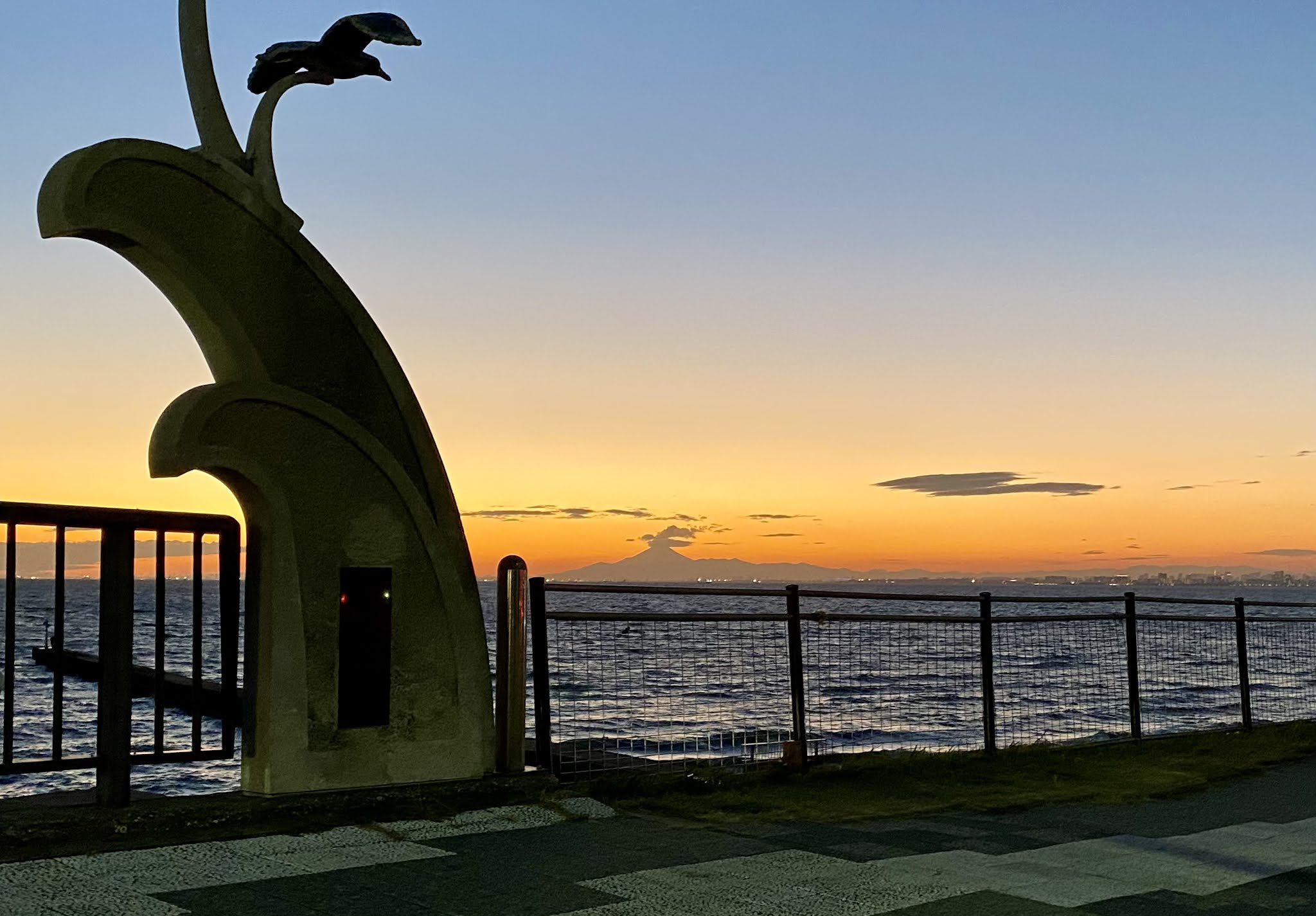 |
| Along the promenade approaching Makuhari |
 |
| Bright lights, big city (Tokyo), from Eitaidori bashi |
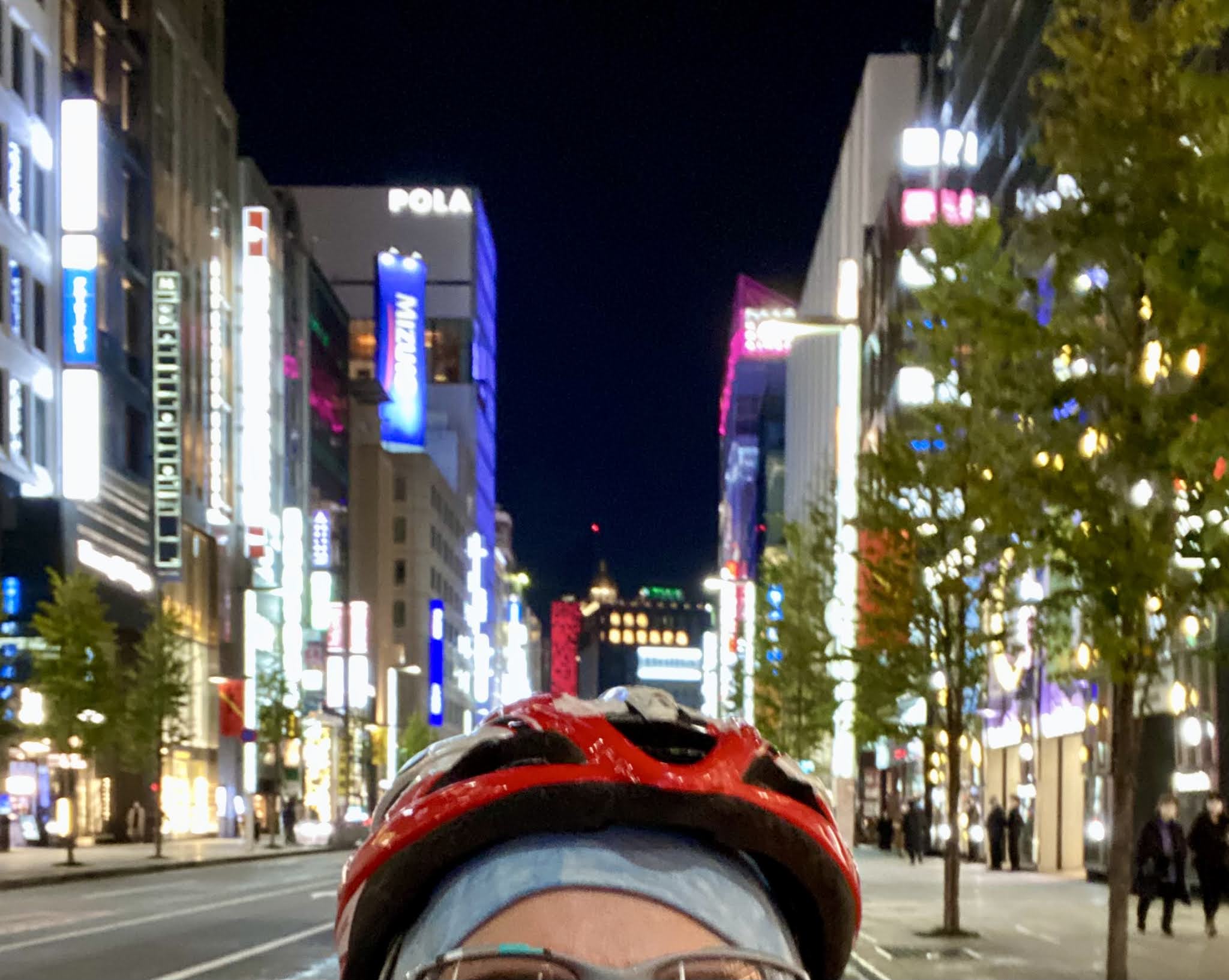 |
| I cruise through the Ginza. At this point my clothes are ... a wee bit smelly, so I don't stop for any shopping. |
In the end, I did not get to the goal before 8PM, over 24 hours after the start. I need to get faster again if I am going to enjoy - and get enough sleep - on the multi-day rides such as PBP.
As I rode the Pelso back into town from the goal, along Nakahara Kaido toward home, somehow the uphill sections did not seem so tough anymore.
Subscribe to:
Posts (Atom)


