Showing posts with label Yamabushi. Show all posts

10 May 2022

Golden Week Takenoko Ride to Akiyama via Wada, Suzugane, and Hinazuru Passes

Extra large takenoko -- MacGyver'ed to the seat tube.

I did not ride that much over Golden Week, using the time to recuperate a bit from doing the full 200, 300, 400, 600 km series of brevets over the preceding month, and with other commitments on top of a normal class schedule at my university.

On Saturday, April 30, I rode the rebuilt Voyage Voyage to Chichibu with Jerome, Peter J, and Peter's friend Daniel. After a 90+ minute soba lunch stop, the three of them headed for Shigasaka Pass and a long loop and evening return. I went a bit further, but then turned around and headed for Honjo Waseda and the shinkansen back to Tokyo. 

It was a very nice day all around, including the solo ride. You can see the photos and ride route on Strava. 167kms in all. I left home 25 minutes late after some last minute bicycle tweaks, and pushed hard to catch the others (including a Strava "PR" and 60/2200 all-time on the oft-traveled 5km stretch of Setagaya Dori west of Sangenjaya), met Jerome first at the end of the Tamagawa path in Fuchu, and Peter and Daniel at Oume. 

As I neared the end of the ride, I even got to race a steam locomotive full of tourists at Nagatoro.

It was easy to keep up with the train on Voyage Voyage along a flat roadway. Eventually, after taking this video, I raced ahead. But of course, I knew that eventually the train would win the race. I thought of the ballad of John Henry, who competed with a steam drill at pounding railroad ties to lay new track, and died with his hammer in his hand. But which version of the song? Johnny Cash? Paul Robeson? Bruce Springsteen? BB King, narrated by Denzel? Harry Belafonte? Mississippi John Hurt? Pete Seeger (folk / labor activist)? Leadbelly (blues)? Billy Strings (bluegrass)? It is an American classic.

-------------------------------

The other 100km+ ride was on Friday, May 6, on the RAMAX. This was a Golden Week ride, but a few minutes after leaving home, I realized that it was no longer Golden Week! Friday was a workday and everyone was back at it. The early roads were full of trucks in town hauling massive pieces of buildings to construction sites ... but empty of vacationers in the countryside! Of course, Monday also had been a workday ... but had been nothing like this. Apparently many companies had taken Monday off, but all were back at work on Friday. Schools also seemed back in session -- not just my university but elementary school students heading on their commutes before 7AM.

A headwind slowed me, and was a few minutes late to meet Peter J at our regular starting point along the Tamagawa just northwest of Komae. We called Jerome. He was still in bed, having ridden several days mid-week, and was not coming along. Peter J said he would head out with me and then, as planned turn around so as not to push an iffy knee too much. We decided to head for Wada Pass via Daigo Rindo.

The last time I went up here, the road was partially washed away in places. Now it has all been restored with nice new asphalt. It is still a rindo, however, with moss, plenty of leaves and some rocks. I like to go up Wada this way (no traffic at all), but prefer other routes down. Peter J climbed with me to 500m elevation, then turned back for the trip home. I pressed on to the top (~740m elevation) and then down to the pass (~700m elevation). I did not climb quickly, but at least I did the entire climb without a foot down. The descent down the west side (Ura Wada) was exhilarating, as usual.  The RAMAX was "fun to ride" going both up and down.

No GW traffic on the rindo climb to Wada!

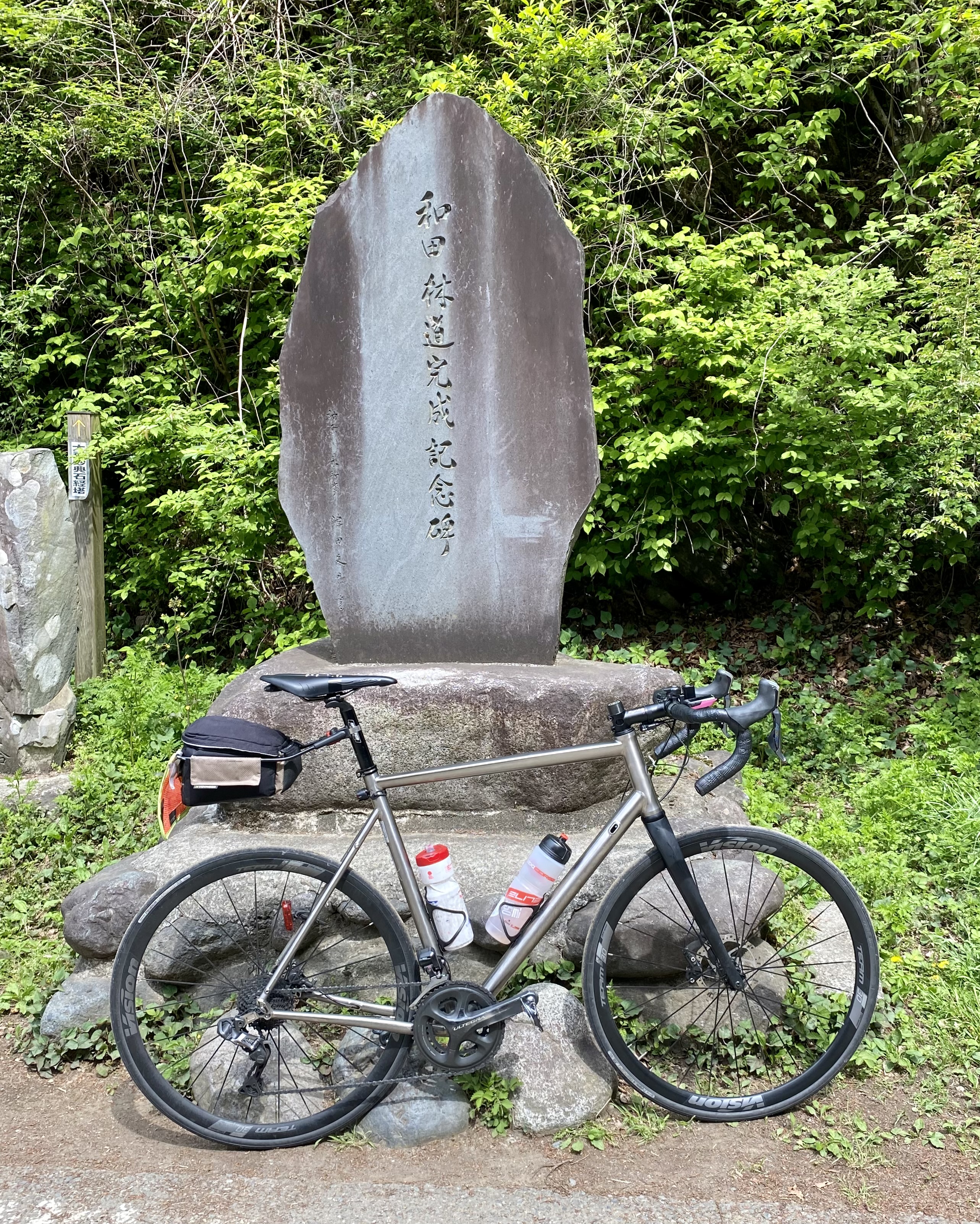
RAMAX at Wada Pass -- the classic photo spot

Koi Nobori on Ura Wada

I then faced a difficult issue. Where to go next? Kobu Tunnel? Or Tsuru Pass? Or Bijotani? Or head south to Route 76 and Doshi? In the end, I decided to head toward Uenohara and further west from there. Maybe I would go over Sasago Pass? Or I could try one of the climbs south of Sarubashi area that I had never done. Now that I was alone, I was aiming for a most-of-day ride, home before dinner. 

I decided to try Suzugane Pass, a route I had somehow never taken in all these years! I could see on my smartphone that after cresting the pass and descending to the south, I would need to then do the shorter climb to the tunnel at Hinazuru Pass and down through Akiyama in order to return toward Tokyo. This was a lovely route. The only real traffic after leaving Tokyo was on Route 20 between Uenohara and Sarubashi, and that was far lighter than normal. The weather was perfect. 

Looking back at Uenohara from Route 20

At Suzugane Pass

Maglev track descends valley, Hazy Fuji in the background

Looking back downhill and downstream, toward Tsuru

Once in Akiyama, I stopped at Tsuruya, better known to expat cyclists as "the manju place in Akiyama."  I ordered a Miso Manju. 150 yen ($1.15). It was , served with vegetables and green tea. I could digest fully while riding as the descent continued for at least the next 8-10kms.  There were flatter sections and -10% ramps--reminding me how hard this little valley is to climb up in the other direction especially on a hot day. I passed one tunnel entrance on my left that led back to Uenohara. ... I don't remember ever having taken that either. But I kept going down the valley. At the bottom, instead of climbing up the South rim of the valley to meet Route 76, as I have always done in the past, I continued on a road that would loop around to the North, eventually meeting the route I would have taken if I had gone through the tunnel ... in time to go through another tunnel and onto a descent to Uenohara. 

Tsuruya, The Manju Shop

Always lovely flowers here, and little/no traffic.

Vegetable and tea make the manju go down, make the manju go down

GW traffic on Route 35 in Akiyama

We used to call this spot "The Vending Machines" in Akiyama.
Now it is just another "Happy Drink Shop".
 
Beautiful Akiyama

Along the way, I came across an unmanned roadside vegetable stand. The only offering was takenoko -- bamboo shoots. 3 huge shoots, priced at 300 or 400 yen. Takenoko is my wife's favorite Spring delicacy ... so I wanted to take one home and see if I could learn to cook it. But I had not brought a rucksack, and the huge shoots were too big for my jersey pockets or my underseat bag.

One of the shoots, the thinnest of the three, looked as if it might fit inverted into my bottle cage. I deposited 300 yen in the coin box, and put the takenoko in the bottle cage, moving the empty water bottle to my rear jersey pocket. The inverted takenoko fit the bottle cage, but I realized it was so top heavy and large that it would flop around and fall out. But wait, I had some zip ties, for exactly this purpose -- to secure items to the bicycle! Two daisy-chained zip ties worked to secure the stalk, and I could ride, with only a modest rub of the takenoko against the inside of each leg.

By the time I approached Uenohara, I realized that I would seriously chafe my legs if I went too much further, ... so I decided to get a snack and hop the train. My timing was not great ... after I rinkoed the RAMAX and got to the ticket gate, I could see the next train was not for 35 minutes. I bought and drank a cold beer. Only 125 kms for the day, but real climbing up Wada (with its long 13-15% grades), Suzugane, and a shorter climb to Hinazuru Tunnel meant that I did get a decent workout. You can see the statistics and route here on Strava.

I bought the middle one.

d
Bike and Takenoko, leaning.


Thank you!

The lower 2/3 of the takenoko was wrapped in plastic, but it was quite a sight for the other passengers at the back of the local Chuo Line train. The first few minutes of the journey, it kept falling over on the floor of the train. Eventually, one man who had boarded with me at Uenohara reached in his briefcase and handed me a large paper shopping bag. I could fit almost the entire stalk into the bag, and thanked him. One of the hikers across the aisle handed me a smaller plastic bag that I could use to cover the top of the stalk that still protruded from the bag. I thanked her also. Everyone in the back of the last train car felt better about me and my takenoko. The "wa" had been restored.

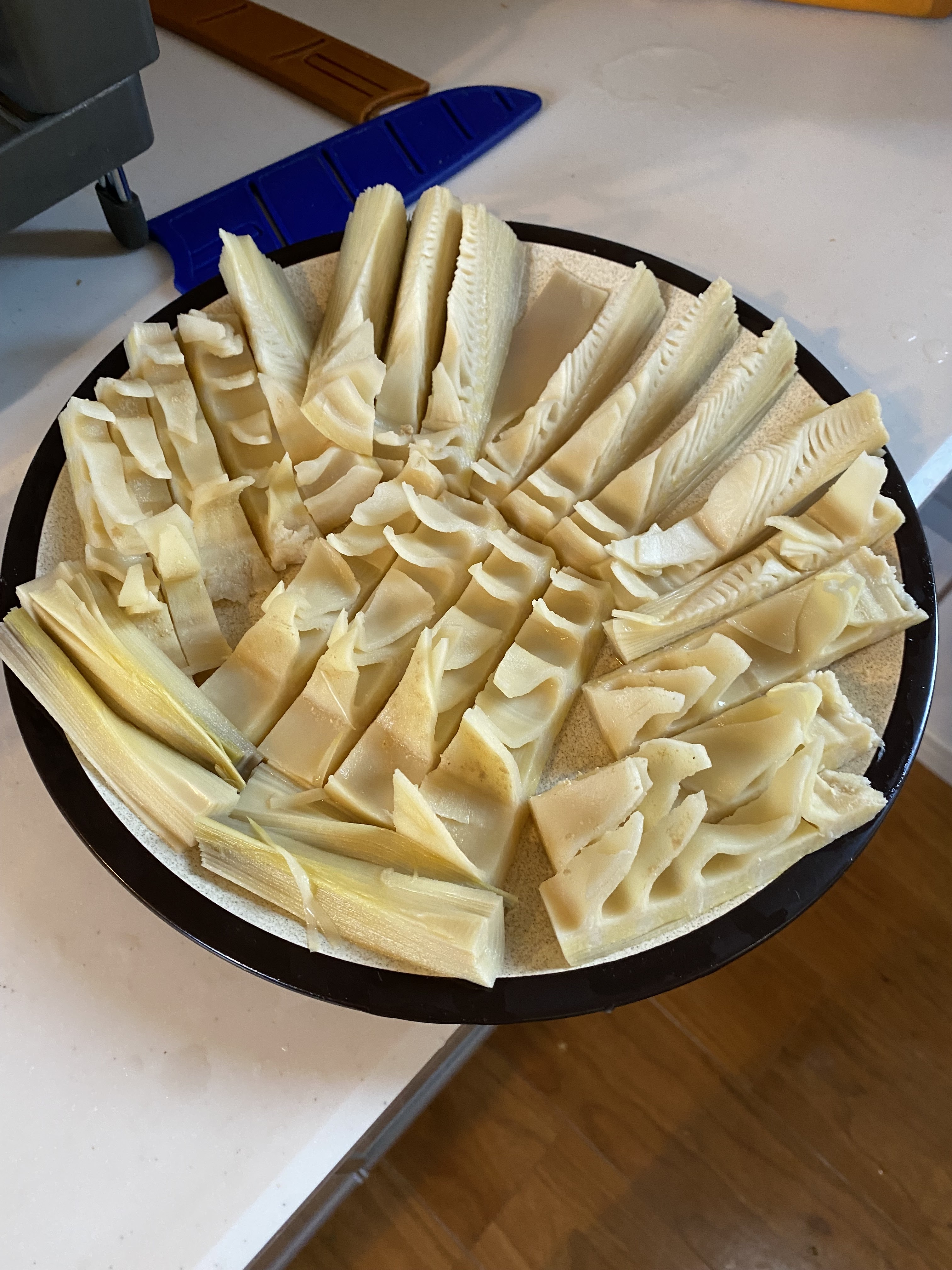
The next day, I got some "nuka" (ground up rice bran) at our local supermarket, and boiled the takenoko with nuka in a pressure cooker for 20 minutes to remove the "aku" bitterness. I could then slice the edible parts of the plant into pieces for grilling in a skillet. Grilling was the easy part, with some olive oil. They were served with salt to taste. The slices tasted pretty good, and my wife seemed happy with the saga.

Boiled and ready to grill

Grilled with olive oil and salted


25 October 2021

Beautiful Ride Back from Karuizawa

The first time I rode from Tokyo to Karuizawa, in 2010, Jerome and I went on a hot September day via Chichibu, Shigasaka Pass, Uenomura, the tunnel to Shimonita, and finally up the steep climb to Karuizawa from the South, expressway bridges soaring far above our heads. It was a memorably hard 175km one day ride.

Of course, each attempt at the SR600 Fuji -- finally completed in May 2015 -- also involved riding to Karuizawa, through Chichibu then up the valley through Tomioka and Annaka and via the easier, gradual climb up to Usui Pass. Numerous other brevets also have covered much of this route, in either or both directions.

But it does not take a rocket scientist to realize that it is a lot easier, and nearly as rewarding, to ride back from Karuizawa (elev. 950m) to Tokyo (sea level). I did it first in 2016, and again in 2019. Earlier this year, 2021, I rode back to Tokyo on the Pelso recumbent from Matsuida, just down the hill from Karuizawa on the Gunma side.

I still get a bit confused what is the best way to get through parts of Gunma, but the route is generally very familiar.

The route.

Elevation profile. Mostly downhill, but 1350m of climbing.


So after a Saturday overnight trip to Karuizawa to visit a close friend of my wife, a feast of a dinner, a leisurely Sunday breakfast, stroll around the Kumoba Ike ("cloud place pond") and nearby "bessou" areas of "old Karuizawa" with early Fall colors and dappled sunlight, then an early lunch near the Station, I hopped on my Sky Blue Parlee for the solo ride back to Tokyo.

The descent down old Route 18 from Usui Pass was lovely, though traffic slowed my speed a bit, a cautious rental car at the front of a line of cars. The traffic thinned once I got past the parking area at Meganebashi, and the weather remained spectacular.

Bike assembled in dappled sunshine outside hotel.

Only 1.5 kms from the shinkansen station, the descent starts.

Minimal work to Meganebashi. (Only some accelerations on straightaways.)

I took a short side trip at Sakamoto-juku to look at the day hot spring and a nice public park, then pretty much followed a typical brevet route onward, skipping GS Astuto this time as I needed to push onward.

View of Myogi-san from Sakamoto-juku and its day spa/park.

I managed to take a somewhat hilly but lovely road around the Kuriowa area and then south to Tomioka, back on track. Again, I lost the SR600 route and went a bit further East down the valley toward Kumagaya than I should have before bearing South through Fujioka toward Chichibu, but eventually found my way and found myself on familiar roads. 

Last view of the Takasaki/Maebashi plain

I was very glad that i took the Chichibu route, as traffic had picked up over the afternoon and I did not relish slogging through Saitama to get home. As soon as I turned onto the "Furusato Dori" that heads south into the hills, traffic volumes dropped quickly. Once past the Saitama border and onto the 150m elev climb on Route 13, I had the road almost to myself. I really enjoyed these short climbs ... legs still fresh after "only" 75kms with little climbing so far. 
That's my shadow. 
Same spot where I took the photo below as well.
Entering Saitama. First climb ahead.

Nearing Chichibu City from the North.

I made a quick stop at a convenience store in Chichibu City -- the Lawson that was one of the first convenience stores I recall seeing in Japan that had placed bike racks prominently in its parking area -- then started the slog on Route 299. All through Chichibu City I was traveling along a line of sitting cars. This continued until I passed the first 3 or 4 traffic signals leaving Chichibu to the SW. Only then did the road open up. All the way until the turn off to Yamabushi Pass I would be passed by waves of cars. This is not the most pleasant road to ride going uphill with traffic. But at least everyone kept a wide berth, the shoulder is decent in most places, and I knew that a reward waited just ahead.

Pitch dark at 6PM.

It was pitch dark by the time I turned off to Route 53 and continued the climb to Yamabushi Pass. A car would pass every minute or two, nearly always a "kei" light car or truck.  As I neared the turn off to Shomaru Pass, I could see a group of 5-6 very small deer hustling into the brush ahead of me on the left side of the road. There were also a few "kei" cars parked at odd intervals, the single driver sitting in the car, glued to his smartphone. But at least I was alone at the top of the climb. The signboard said it was now 9 degrees celsius (or around 48 fahrenheit), getting cold for a descent by bicycle. I rode down around the first section of the descent to a lighted area with a bit of a turn out, where I could put on my leg warmers and a helmet liner. I already was wearing a decent long sleeved jersey and wind block inner layer, and wool socks with MTB shoes and mid-season long fingered gloves, so was just fine to get down the hill without putting on a jacket or anything warmer.

On the Yamabushi descent.

Same place, different angle, in daylight 

Once descending Yamabushi, it felt like a fast ride back to Oume, only a few short climbs to slow me down. I had just enough time to rinko my bike at Oume and get onto the 7:33PM train to Tachikawa. I thought about riding further, having covered only 130kms. But it had been a perfect day, off and on the bicycle, so no reason to slog on just to add a few more kms. I would enoy the train ride, then ride the bicycle home 6.5 kms from Yotsuya.

If you read this far, perhaps you would enjoy some photos from the morning stroll we took near our hotel, and our visit to a historical building the day before.


19 January 2017

Thank you for your service, Yamabushi

Yamabushi under construction
Photo after paint job
Closer to what it actually looks like these days ... a working bike, not a show one!
It is five years ago next month that I built a frame at UBI (bikeschool.com) in Portland, which once built up and back in Japan was christened the "Yamabushi". It was designed for cyclocross, which I have never really taken up. So instead carried me on the 1300 kms in Tohoku that I rode that Golden Week, many other trips on forest roads, gravel and smooth pathways. By late in 2012, it had become my commuter bike -- with fenders for keeping my legs and ass dry in the rain, dynamo lighting front and, eventually, rear, and a different fork with disk brake added to the front, for better (and more nuanced) stopping power in the city than the original canti brakes.

Then another 4 1/2 years of commuting use, over 100 kms almost every week, sometimes closer to 200, within the city. It has my name painted on the top tube (though wearing thin now), was very large for Japan, and looked just odd enough so I never worried about it being stolen (and it never was).

The latest overhaul was a few months ago -- new shifter cables, new chainrings on the crankset, new chain, and FD and RD adjustments.

So it was a disappointment when, on my commute home yesterday, the front derailleur cable broke, down near the derailleur itself.  I wrapped the loose cable around the top tube and rode on.  But something was wrong.  There was an odd motion and noises, as if the seat were not secured onto the post.

I dismounted and checked for broken spokes, loose seat, etc.  Nothing.  I rode further. The bike seemed normal when I did not apply my weight to the saddle and seat tube, but abnormal when I would sit.

I checked again and noticed a gaping crack around the seat tube at the BB joint.  Here:


When we built these at UBI, the final welding test before students were allowed to start work on their frames involved welding a tube to a BB shell. A large diameter metal rod was inserted into the tube, and the student applied all his or her weight to the metal rod, until it broke.  If the break was somewhere in the tube, the weld had "held" and you could start your frame.  If the break was at the joint with the BB shell, your weld had "failed" and it was back to the practice table.

Unlike most of the class, I did not pass the first time.  And looking at the crack on the Yamabushi frame, it reminds me of the broken tube after that first test.  A failed weld.

But at least it made it 5 years and tens of thousands of total kilometers, with a heavy rider, in urban stop/start conditions frequently with a heavy pack on my back full of books, computer, etc.

What bike will I commute on now?  Mmmm.  I picked up a couple bike registration stickers at the university so I can take my time in figuring out which will be my primary ... but unfortunately these stickers are pretty much permanent, or will ruin a paint job!
-----------------------
UPDATE: I may have been a little tough on myself and my weld in the above post. Hiroshi at C Speed showed me a Nagasawa frame that is broken in the same place after many years of service. "Metal fatigue", plain and simple. And, thinking back, I realize that I did go "off the bike" once in late December, when a delivery motorbike (trike?) made an illegal left turn -- cut through a line of standing cars on Komazawa Dori and pulled in front of me with me going at a normal speed (25kph?) and only a few meters to stop.  I was not injured nor did I see any damage to the bike, so accepted the shop owner's apology and went on my way. ... but a month later, I fear that maybe this started a crack in the frame. ...

04 August 2014

Positivo Espresso Nagano Training Weekend -- Climb Out of the Heat!

We planned to head to Nagano Prefecture in order to escape the ridiculous summer heat that has recently enveloped most of Japan.  On Saturday the morning paper showed a forecast of 34 degrees C for Tokyo.  Great to escape! .... but I was a bit shocked to see that the Nagano City Saturday forecast was for a high of an even higher 35 degrees C.

We rode to Tokyo Station in the morning weather.  It was not quite so scorching as midday, but hot enough to sap one's energy completely over a 40-minute ride.  In any event, we caught the 7:52AM Shinkansen to Nagano as planned.  At Nagano Station we transferred to a very local private train line to Suzaka, to skip the first 10-15 kms of urban sprawl riding.
On the local train from Nagano Station to Suzaka 
Juliane wields Jerome's new "bear bell" -- a Canada souvenir
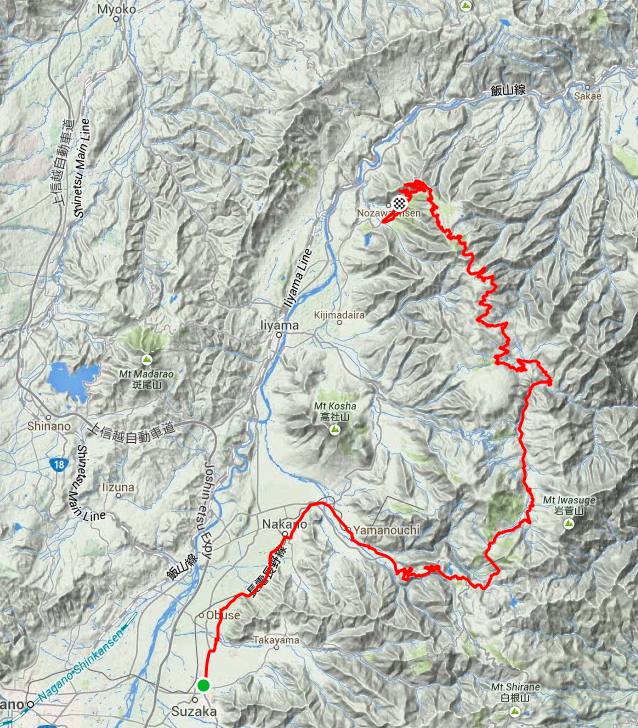
Before long we were on the SR600 Fuji course heading North toward Nakano and Yudanaka.  The lower climb up to Yudanaka (elev. 600) was painfully hot.  We rested at Yudanaka Station, admiring the old station building, the foot soaking onsen (great ... in a different season of the year), and soaking ourselves by splashing cold faucet water over our heads.


Then it was onto the main climb to Shiga Kogen, nearly 1500 meters elevation!  After we joined Route 292, David J. suffered a mechanical (chain slipped inside large cog and jammed) on the bike I had lent him.  Juliane told me she would fix it and I should go on (I could use the head start).  I did so, and the others followed 20 minutes later, fixing the chain with help of a borrowed screwdriver from the resident closest to where we had stopped.  This assistance was typical of our visit -- everywhere people chatted and helped.

I need not have hurried, as I was climbing reasonably well on the Yamabushi.  David J., meanwhile, suffered under the weight of his backpack.  Jerome struggled in the heat -- until a mountain lake refresher charged him up.  Juliane "the gazelle" Prechtl zoomed up the hill at will.  Finally, clouds arrived, and slightly cooler temps.

We reconnected for lunch at the Restaurant Mont Moi.  Elev. 1460m, and cool weather now.  The restaurant was empty, about to close for lunch, but took pity on us hungry foreigner cyclists.  In this respect, I think we do much better traveling with Juliane and David J. than just Jerome and me.  Juliane gets a very positive reaction in the Japanese countryside.  Just the figure of a 180+cm blond lady on a road bicycle is something they do not see every day.  The lady who served our lunch (huge portions of curried rice and omelet rice) struck up a conversation.  When we told her we were headed for Nozawa Onsen she said we had best hurry.  Still a LONG way and after 3PM already!  She said she cycled.
At the high point in Shiga Kogen on Route 471 looking South
At the high point in Shiga Kogen on Route 471 looking North
Indeed, after the restaurant, we climbed another 200 meters on Route 471 to the pass (Elev. 1670) at another ski area.  There was a brass/wind ensemble (band?) playing outdoors in front of a hotel.  The hotel next door had a banner welcoming students of "Waseda Academy" cramming for their entrance exams.

Then almost 60 kilometers with no services, almost no traffic, just a beautiful ribbon of concrete surrounded by green, high up in a valley or along the crest of a ridge, with trees, streams and some impressive vistas.

Unfortunately, I cannot recommend this road to others.  I hope as few people use it in the future as did this weekend.  Indeed, please stay away!  Some reasons:

--  No services. For a large stretch you will be without convenience stores and other services of modern Japanese life.
--  You might get caught in a thunderstorm. We were!  Indeed, we went through a brief 10-minute storm, then a much, much longer one that continued over the last hour plus of our ride.
--  The road is under repair in several places.  We passed numerous "road closed" signs, but fortunately, on a Sunday in early August, the construction was shut down and road still passable, a small sticker on top of the "road closed" signs so noting.
--  At times the rain was so heavy it was as if we were riding up a river.  It was possible to see splits and bumps or holes in the road only from the line of eddies in the flowing water.
--  Cool.  Yes, we had managed to find a cool place to ride on one of the hottest days of the year.  But as you will learn if you read on, this could even mean hypothermia when heavy rain and then a descent is mixed in.
--  Yabu, Yabu, Yabu!  (my mistake, they are "Abu" (虻) ... Japanese biting flies.)  As Tom has noted before, he and Manfred suffered numerous Abu attacks around this area of Japan.  Abu bites can be like bee stings -- causing serious difficulties if one has an allergy.  We did not see any Abu or feel their sting, but IT COULD HAPPEN, so please stay away from these spectacular hills and leave them to us.

Finally, there was a long descent from around 1500 meters elevation down to Nozawa Onsen, most of it weaving through the ski areas, and we were at our destination.
Above Nozawa Onsen.  Ski jump in the distance to left.
In case you were not impressed with the last photo, this one points out that the view of Nozawa Onsen from here is one of Japan's 100 famous sunset spots.
I stopped and waited at the famous viewpoint above the onsen town, the rain now warmer since I was at a lower elevation.  Finally Jerome arrived.  We tried David and Juliane's telephones.  Only voicemail.  We waited.  They must have stopped.  Maybe a flat tire?  Or a quick duck into a dry shelter to warm up? (or was one of the ski area shops actually open?)  Anyway, we headed down the lower part of the descent and waited again at the upper entrance to the town.

More calls.  No answer.  Finally, here comes Juliane.  And there is David riding in the passenger seat of a tiny "K" truck, bicycle in the back.  Apparently they both got chilled from the wet descent, hands seized up, minds not fully functional -- we have all been there at least once -- and then David's front tire blew out (brake pad had worn down over the past few days riding and was rubbing against the 700x25 tire where it seats in the rim), and they had fortunately prevailed on a passing mountain man to give him a lift to the town.  Juliane had stuffed her jersey with some padding (rinko bag?) for a bit of warmth.

From heat exhaustion to hypothermia in a few short hours!

I also was a bit confused as I waited with Jerome at the entrance to town.  I took out the plastic bag with my wallet and handkerchief to dry my iPhone's glass front before dialing ... and left the bag sitting on a stone ledge at the edge of a building.  I later needed to ride back up from town after we checked into our inn to retrieve my wallet -- still dry and in the bag, and of course safe and untouched, this being the Japanese countryside.

Nozawa Onsen is a beautiful little hot spring town at the foot of a big ski area.  Very nice.  They have had some major events.  In 1994 they had a children's ski event.  Then in 1995 another major ski event.  Then in 1998 they were one of the host towns for the Nagano Olympics.  Then a gradual decline over 16 years in numbers of skiers and guests, and apparently no events so major that they merited commemorative posters in the inn.  So the townspeople said they are now trying to attract some business in summer as well as winter.

We have little doubt that better times are ahead, with the planned extension of the shinkansen beyond Nagano all the way to Kanazawa, and stops planned for Iiyama (where we saw the impressive shinkansen station building ready and waiting), Jyoetsu Myoko and, yes, even Itoigawa!
Source -- Wikipedia
Iiyama shinkansen station -- artist rendering ... but it does look pretty much like this
We stayed at a very nice onsen ryokan (traditional Japanese hot spring inn), but did not order meals -- unusual for this type of place -- since we would be arriving late.  And we no doubt confused the innkeepers as David, Juliane and Jerome all entered the bath just before the 730PM "changeover" of the men's and women's baths, delaying the changeover and leaving at least one couple sitting in the lounge waiting (with me and the onsen changeover crew).  Worse, Jerome and David brought beer to the bath area (they were the sole occupants, everyone else at dinner).

The innkeepers have a ready facility for any unpredictable foreigner who disturbs the "wa" (harmony) in such a manner, and made David welcome there.
We headed out into town for the evening and were happy to find an Italian restaurant (Kaze no Ie) with plenty of good food and drink.  The next morning, we went to the Sunday 6 to 730AM morning market, where we bought a wide array of foods and had a breakfast picnic at the public foot bath with scenic view of the town, within 50 meters of our inn.  The morning market was fun, with plenty of chance to chat with townspeople selling their wares.  We got coffee and smoothies from 3 nice ladies.  Then miso, breads, peaches and other items.

Again, at the foot bath area we chatted with a couple from Honjo, Saitama, who ended up giving us some of their onsen tamago, in exchange for which we offered peaches and cucumbers.  They were regular visitors, and amused to meet a United Nations cycling contingent.  They recommended another visit in November to get apples in Suzaka.  "The best apples in Japan."
Plenty to eat and drink, even as Jerome and Juliane show their best effort at the emaciated cyclist look
Breakfast of peaches, cucumber and miso, onsen eggs, etc., etc.
The public (villagers only!) bath just above our inn.


Honeymoon couple

The inn where we stayed.  Sumiyoshiya.
On Sunday we rode down to Iiyama, then parted ways.  Jerome and I headed down the HOT valley to HOT Nagano Station for the train home.  David and Juliane planned to go to the west up the next VERY HOT hill to explore a bit, then return to Nozawa Onsen for a second night.  At least no worries about hypothermia here!

All in all a successful training weekend, despite the heat, and the cold.

UPDATE:  David and Juliane spent a second night at the inn in Nozawa Onsen, then returned to Tokyo on Monday afternoon (via shinkansen).  On Tuesday they headed for Kagoshima (via shinkansen) then Yakushima (via high speed ferry).  They had planned to visit Graham and Shoko at their inn, then move on to Kyoto for the weekend, but the trip on Yakushima was extended as all ferry service (and even, for half a day, on-island electricity) was shut down by the passing of a massive typhoon.  At least they had time to ride the island -- circuit and climbs both -- and got to enjoy more of Shoko's spectacular cooking.  The ferry service restarted mid-morning Sunday, and they were on the first boat out to make it back to Tokyo on Sunday night and, of course, rode back to their Kaminoge lodgings after a food/drink stop in Yurakucho area.