Showing posts with label Rinko. Show all posts

24 April 2023

A Better Rinko Bag!

Rinko'ed bike waiting as I purchase a shinkansen ticket.

In Japan, cyclists need a "rinko bukuro" or rinko bag in order to take their bicycles on trains. The basic idea is to take your wheels off, clip them to your frame, put it in a lightweight nylon bag, and attach a shoulder strap. This way you won't get grease or other grime on other passengers, the train, or yourself, as you carry the bike. It works for all but the most crowded rush hour trains, especially if you choose a car at either end of the train. It works on the shinkansen, where you stow your bike behind the last row of seats in a car (or, in a pinch, in the area between cars). Now the shinkansen has reservations for seats that have extra space behind them at the rear of some cars for "extra large luggage", but in most cases, even on the shinkansen, you can still just take a bike in rinko with you, no extra reservations, no extra fees. Rinko bags generally roll up into a stuff sack that fits in a bottle cage, so you can ride with your bag on your bike. 

Although some old school types like a rinko-specific bike with fenders that split in two, etc., and you can study a 30 minute youtube video by the "rinko master" who will show you the right way to do every step of securing your bike in a rinko bag for maximum safety, stability, etc. ... most regular cyclists favor a minimalist approach.  But I want to just clip my wheels to my frame, pull up the bag, attach the shoulder strap, and run for the train. I can be careful not to bash my exposed rear derailleur, and nothing else is particularly vulnerable.  Some people opt for rinko designs that even leave the rear wheel attached. These result in very bulky packages, in my view, especially if you ride a large frame as I do, so I avoid these. I trade some grease and grime from taking the rear wheel off and on, in exchange for more easily stowing my bike on the train without bothering other passengers or getting requests/lectures from the train staff.  

Ostrich is the leading Japanese rinko bag maker. I have used their bags for many years. Giant, Tioga, and others make the "leave the rear wheel on" type. But for all of these, there is a dilemma for a long distance cyclist.

I would like to have a rinko bag with me in case I need it mid-ride. If I DNF and need to take the train home, wouldn't it be nice to have the rinko bag with me? But I need my bottle cages for hydration, and I don't want to carry a rinko filling up significant space and adding weight to a rear or front bag. Once, I tried the SR600 Nihon Alps and was blocked at Gero by a massive rain storm that washed out roads (okay, I was ready to abandon anyway). I ended up riding to Nagoya, buying a rinko bag that was too small to really fit my bike, and going home with a protruding bike. I had left my rinko hidden near Kobuchizawa to pick up at the end of the ride ... oh well. 

Now ... a solution!  One of the Japanese randonneurs who did Cascade 1400 last year (and goes by PEKO-chan) is selling a better rinko bag. It is much lighter weight ... but still very strong ... material.  An "extra large" size is available. Instead of needing to carry in a bottle cage, it easily slips into a rear jersey pocket. And it feels feather light. At 3000-3500 yen, these rinko bags cost far less than the "leading" brand.  All in all, a better product.  

They are available for sale direct on PEKO-chan's website, here.  But don't expect her to be accepting orders during Golden Week. Rumor has it she will be off on a long ride.

Left - my Ostrich rinko bag, right - my "otesei" rinko bag

With this product there is no excuse not to carry a rinko bag on a long ride ... or even on a shorter one if I think I might want/need to hop a train home.

I used 2 of PEKO-chan's bags for my 160cm long (plus protrusions) recumbent frame

April 2025 Update:  I have been using PEKO-chan's rinko bags regularly especially as I now have a country house for weekend/summer use -- when I can manage to get out of the city -- and often go via bike/train/bike to get there or back.  After maybe 30-40 times using it, I finally poked enough holes in the extra large green one so that I started using one of her other models I had gotten as well -- it carries the bicycle upside down, seat downward. I find it less likely to bang up a derailleur when that most sensitive mechanical part is not on the ground. Also, I find it a bit faster to get the bike into and out of the bag with that design. (The purple one shown above I got for my wife ... who has yet to take full advantage of it). 

Anyway, I am still a big believer in these bags, even more so, after a couple more years experience with them. 
"Upside down" style bag, with a stiff wind against the wheeles, at Kofu Station.

22 July 2021

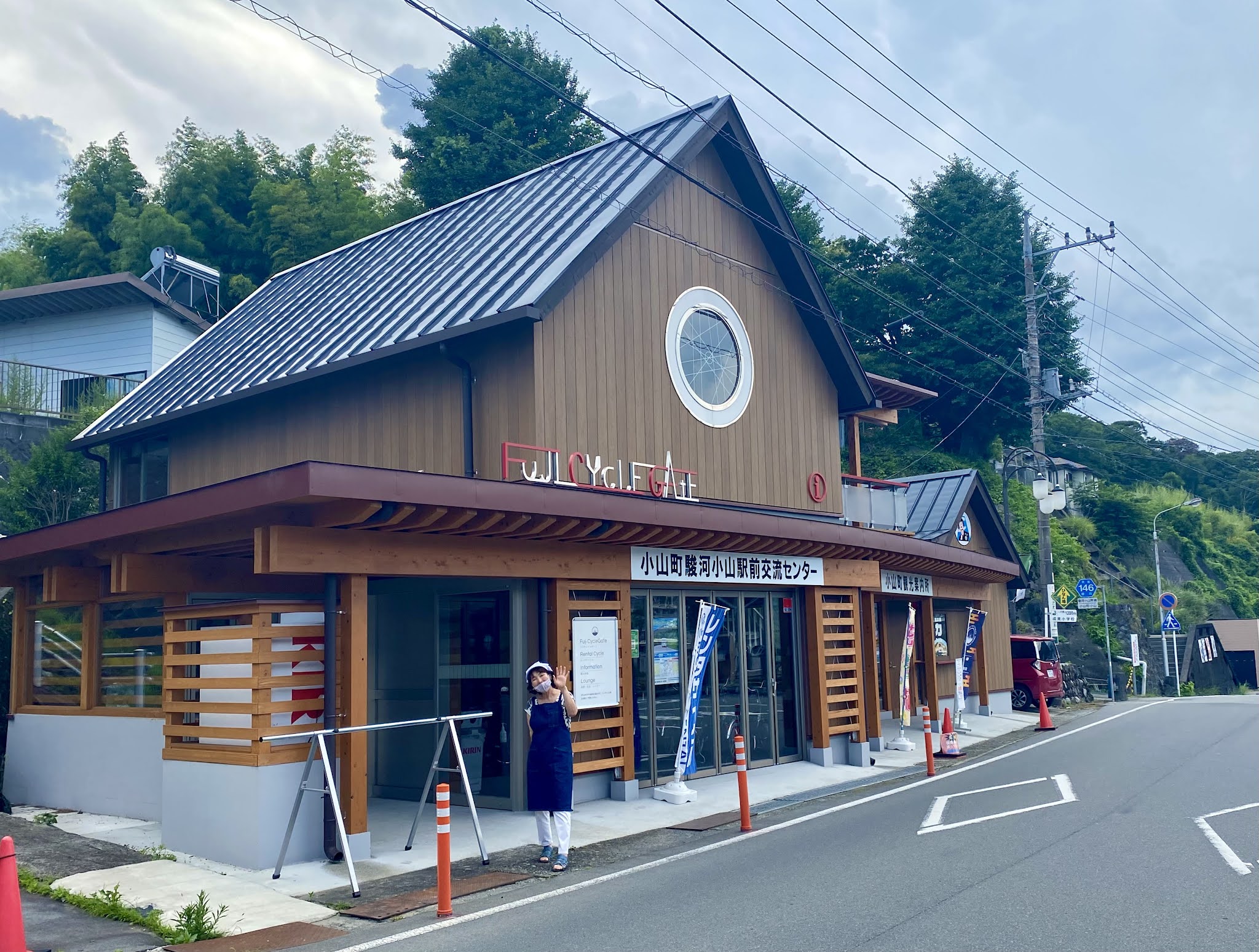
Cycling Amenities Growing in Japan ... Fuji Cyclegate at Suruga Oyama Station

Yesterday, as I did an "Olympic road racers recon ride" (they were doing recon for the race, I was doing recon to catch a glimpse of some of them) ... I was impressed by how much the selection of Doshi Michi and Mt. Fuji area as the site of the Tokyo 2020 (err 2021) road race seems to have made the region wake up and realize that they have lots and lots of people cycling there on weekends, and they ought to offer a bit of a welcome and acknowledgement.


I planned to hop the shinkansen to Odawara (634am departure/700am arrival) and go from there, ... but it was a beastly hot day yesterday, so I looked for a way to avoid slogging from Odawara up to Oyama. After I exited the shinkansen, I walked up the steps to the Odakyu Line. ... There was a 708am express (急行) leaving toward Shinjuku in a few minutes that would stop at Kaisei and Shin-Matsuda, saving me 10km of sea level riding by about 10 minutes on the train. I hopped on and got off at Shin-Matsuda ... and walked across the street to the JR station ... there was a 723am local heading in Gotemba/Numasu direction ... I had to fight through a crowd walking the other direction on the platform, but made it onto that train and got off at Suruga-oyama station (駿河小山駅) just after 740AM. The stop looked a bit closer to my destination, if lower, than the next one (Ashigara), and I have been through Ashigara several times so through I would try it.  This starting point put me at 275m elevation, ahead of the heat all morning heading toward 1130m elev, with the climb through field and forest via Oyama toward Subashiri. It also avoided the need to ride a few lower stretches on the shoulder of Route 246.

As I took my bike out of the rinko bag and put the wheels back on, a gentleman approached and introduced himself. He said he was from the local tourist association and pointed to a nice new wooden building across the street. He welcomed me and handed me a pin. He said "these are for cyclists who come here via train to ride". Indeed, the pin read "駿河小山駅輪行記念" -- Suruga Oyama Station Rinko Commemorative!!!  A badge designed just for me. Wow. I thanked him, completed the bike assembly, and headed out. As the only cyclist to exit the station that morning, I had mixed emotions. As I passed the empty building from which he had emerged, I could see it had a cycling theme and what looked like some kids bikes and mamacharis on display, as well as bike racks in front. It is the Fuji Cyclegate. Next time, I will check it out thoroughly. (There is apparently a direct train from Shinjuku to Gotemba that would stop here, for those of you not near Shinagawa).

Suruga Oyama Tourist Association Welcomes Rinko Cyclists!

Up at Yamanakako, and on Doshi Michi, of course, there are now cycling themed cafes, sculpture work, every restaurant or store has at least one cycle rack ... and they will sorely miss the crowds that they expected for the actual Olympic events this weekend. 


At Yamanakako - end of Doshimichi

The bike's too small for him, ... and the seat looks a bit painful!


As I descended upper Doshimichi, I passed a small grassy area beside the road on the left side which had at least 20 wooden cycle racks in a few lines ... places for the spectators to park their bikes as they watched the race. ...  the empty racks a sad reminder of a no-spectator event. I hope those racks will get repurposed and donated to parks, stores, and cafes nearby. 

A newly opened establishment on Doshimichi, just a km below the Michi-no-eki.
It had VERY minimal food offerings and coffees, but a large section of frozen food cases with meat for a massive BBQ party. ... I hope that they up their game a bit so it is worth a food stop.

Postscript: I went back later in the week and rode in the opposite direction up Doshimichi, over Mikuni Pass (the easy side) and down to the Odakyu Line. I stopped again at Suruga Oyama to actually check out the rinko-rider facility. They have lockers to stow a change of clothes and free showers (available 8Am to 6PM), and even sell spare tubes for road bikes in their vending machine outside ... accessible 24-7 should you need one. And if you are a non-cyclist, they also have some rental bikes, helmets, etc. 

A good jumping-off point for riding near Ashigara or Gotemba.