Showing posts with label Yokohama. Show all posts

27 April 2025

First Brevet of the 2025 Audax Year ... December 15, 2024?

For some years now, the “Audax year” has started on November 1 and finished on October 31. This I guess allows riders to meet qualification requirements (i.e. successfully ride shorter events) in time to register for grand randonées (i.e. 1000km or longer) events. Most famously, PBP is held in late August, but requires completion of 200, 300, 400, and 600km brevets by sometime in early June to perfect one’s registration.  This, and satisfying requirements for some earlier long events, can be a challenge for those of us who have jobs, families, and/or other hobbies, as well as for newly minted randonneurs.

Anyway, I did my first 200km ride of the new Audax year on Sunday, December 15, before my year-end Festive 500kms.  

Unusually for a winter 200km brevet, the ride went out the Akigawa and over Kobu Tunnel. The climb to Kobu can be ice-covered in winter,  especially on the north side of the mountain. At least the route would descend on the sunny south side where ice was unlikely.  And, of course, winter did not officially start for a few more days.

This brevet, sponsored by R-Tokyo, started at the large complex of athletic/park facilities in Todoroki, on the Kawasaki side of the Tamagawa.  I left home at 530AM and headed out Nakahara Kaido … so was around 5 minutes late to the start, still well within the 30-minute window, but arriving after all but one or two others were far ahead. 

So, I never saw the fastest riders in the event. 

Eventually, due in part to the many traffic signals on the first 15+ kms to Fuchu, I was able to catch and even pass a few groups of riders. 

Crossing the Tamagawa early in the course.

I saw more riders at the first checkpoint – a photo stop on the North Akigawa, just at the base of the climb to Tokisaka pass.  People were stripping a layer of clothing, preparing for the climb ahead.

Now came the hard part.  Sure, we had already reached 275 meters elevation and the ride up the valley was just more gradual climbing until the short (4-5kms) steeper ramp to Kobu Tunnel.  

Left turn to Kobu Tunnel

Finally on the sunny side of the hill

But the 55kms AFTER Kobu Tunnel would include pretty constant up-down sections (I counted 9 short climbs of 25-75 meters each). Then we were in a fairly vicious headwind, riding along a line of traffic, the next 15-20kms to the coast, then a bit more headwind along the coast toward the checkpoint/turn-around.  So this "middle" section of the event was by far the most difficult.

It was the section AFTER descending from Kobu Tunnel that was the hard part.

At the Shonan coastline

The final 65kms were easy, relatively. A bit of a tailwind along the coast, then rolling home via Yokohama.  The major challenge was … Sunday late-afternoon traffic.  
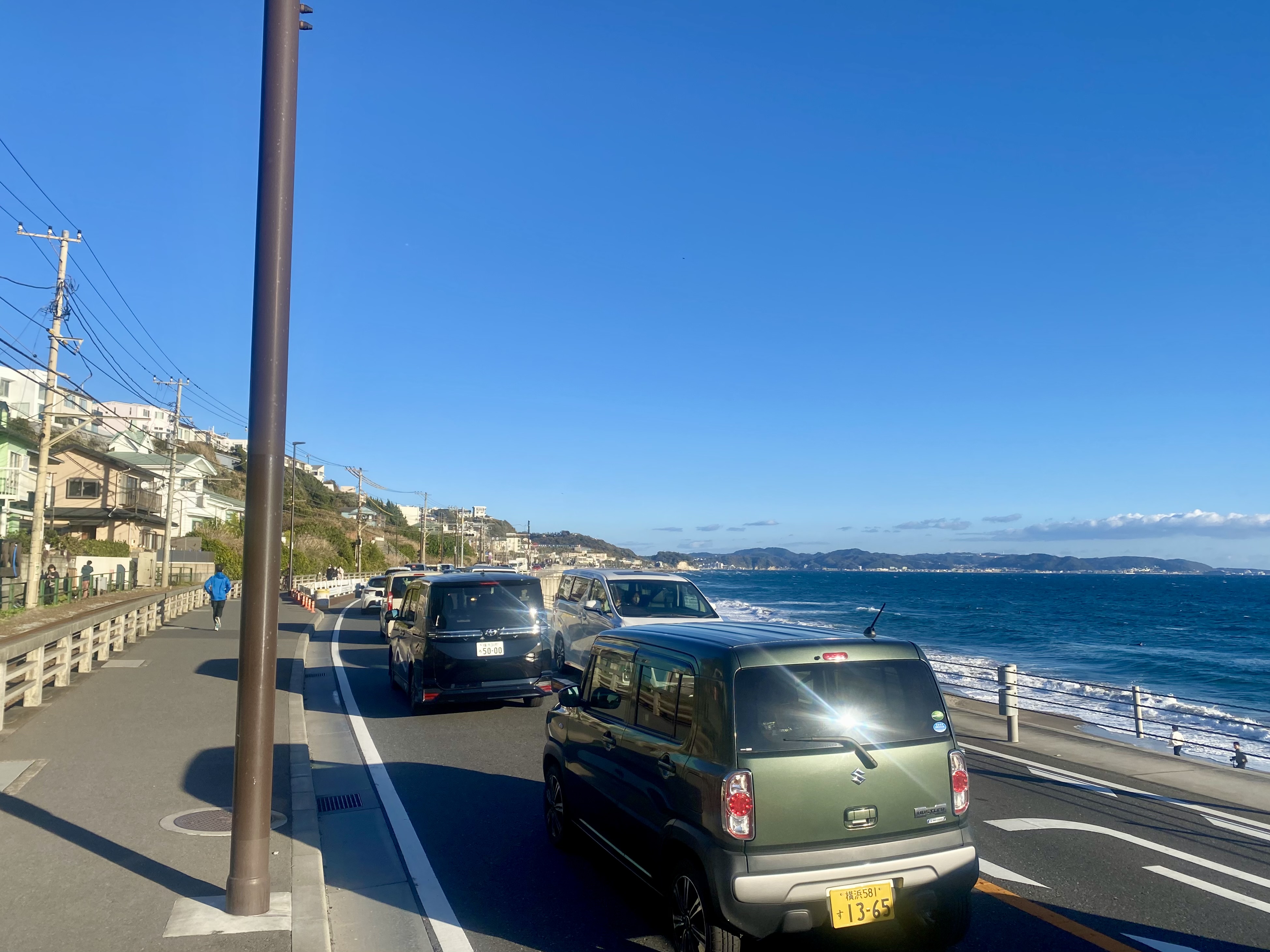
Kamakura Traffic!

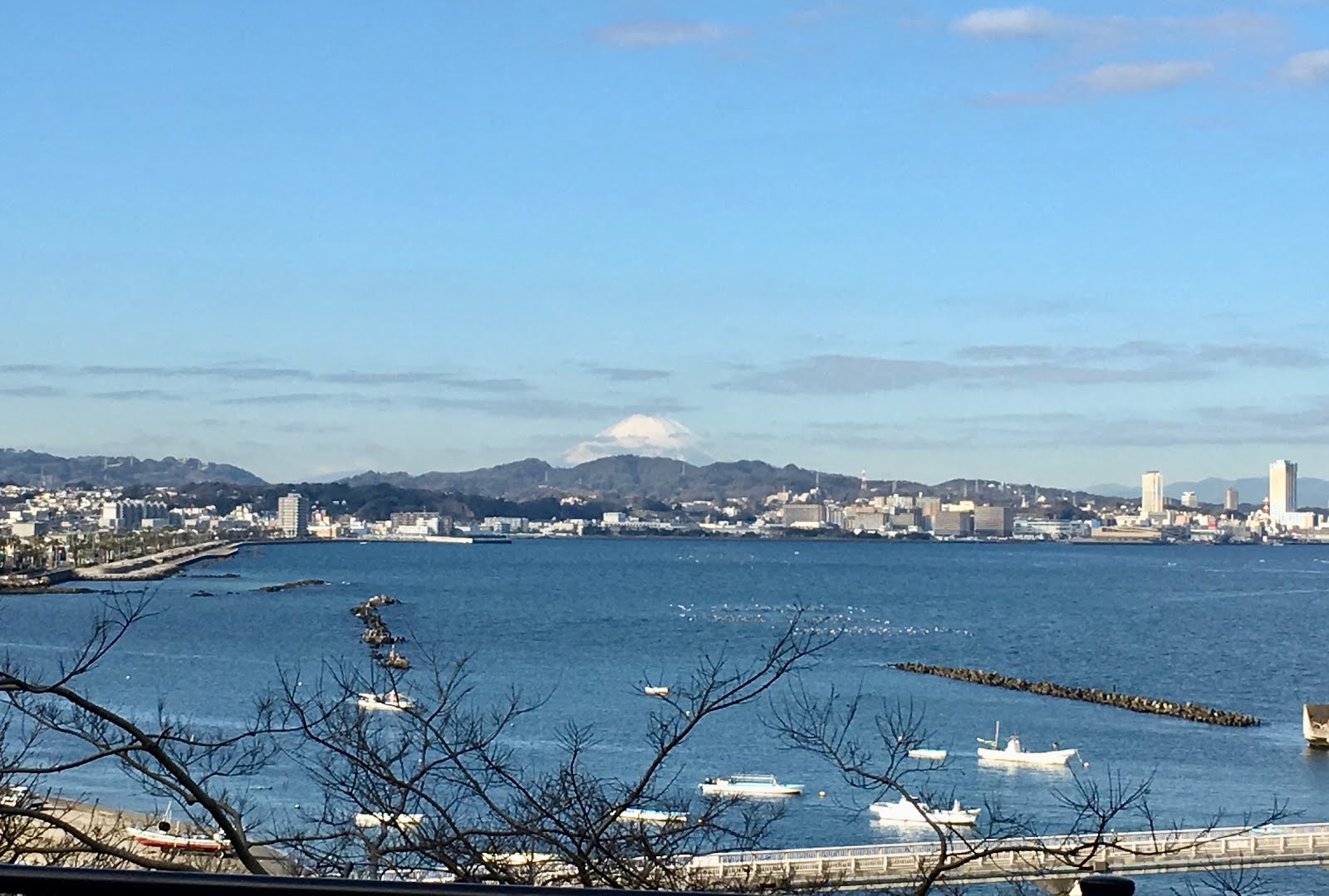
Fuji from Zushi

Slog through southern Yokohama

And our route went through Minato Mirai, where the crowds of pedestrians were just incredible, nearly spilling out into the street as we rode by. More red lights. Long ones. Finally, the very-familiar ride along Rte 1 north from Yokohama, then a left turn just over the Tsurumi River and parallel to a train line past Shin-Kawasaki to finish at a random convenience store located South of Musashi Kosugi.  

More Yokohama traffic, on Route 16.

Minato Mirai -- I tried hard NOT to get people in the photo. The area behind me had thousands of them.

Sometimes a brevet “goal” does really seem like a random store, selected just because it clears the required distance but with no other redeeming qualities.  This was such a case. 

It was cold so I headed home, glad to finish the event without difficulty, and to ride some more in the hills than the typical winter brevet course and 225kms including the ride to/from the event.

I think it was the next time I visited Audax Japan’s home page that I saw an announcement that Audax is switching back to a calendar year from 2025. So this brevet would not count toward any 2025 achievements.  In the end, I am not really riding Audax for the “medals” and my planned long event this year does not require a specific SR 2/3/4/600 series for purposes of entry, so no problem there.


05 January 2019

First Brevet of 2019

The Oregon Randonneur at Tateishi on the Miura Peninsula, looking toward Mt Fuji

Japan Audax local affiliates offer many 200km brevets in early January. They usually fill up, and this year (a PBP year) especially so, as everyone wants to get in a ride while off from work.

Last year, 2018, Jerome and I rode our first brevet on January 7 in Shizuoka, 200kms from Numazu to Fujieda and back, with a detour up Nihondaira. It was a very nice day and, despite some heavy traffic at places, a nice course.

In 2017 I did an AJ Tamagawa brevet from midnight on New Year's Eve, watched the first sunrise of the year along a beach on the Miura Peninsula, with a few other riders and thousands of visitors to the area. I was done and home before Noon on January 1.

This year, AJ Tamagawa, among others, is offering a "brevet week" of events -- it is possible to ride 200, 300, 400 and 600km events, complete the "SR" (super randonneur) series, and qualify to ride Paris-Brest-Paris, all during the first week of the year! Taiwan's audax group has a similar series, and one Japanese randonneur I know had already completed the SR series before I started my ride on Friday. Another, Ijichi-san, staff of AJ Tamagawa who is one of the core Audax riders (he rode Susan Otcenas' Seattle Intl Randonneurs' Cascade 1200 last year, as well as Maya Ide's Tohoku series over Golden Week), told me that he would do the full series this week -- but he already did the 200km on the pre-ride check (which counts under Audax rules).

But this idea of an SR series in the northern hemisphere in winter is, well, crazy. It is going overboard. It MAY work well this year, when the weather is good, but it is hard to plan a good 400km or 600km ride that will work in mid-winter, even in typically dry Kanto. Indeed, the AJ Tamagawa 600km will have probably 300 or even more (500?) traffic signals. So many stops. So much traffic ... to keep on a route near Tokyo and out of the mountains. One long boring slog. Worse, if the weather is cold. No, the first week of January is for riding during the day. A 200km is the perfect challenge.
The moon, Venus, riders, high rises, trees, and train station, all before first light.
The same view a few minutes later. Wave of riders at the ready!
Jerome missed the signup, and was unsuccessful in asking AJ Tamagawa to accept a last minute (late) entry. I think they just have too much on their plate to accommodate such requests while running a brevet week. So he rode out over Yabitsu Pass, and did meet us at the Oiso control. Mindful of the Audax rule that non-participants cannot provide any assistance to riders outside of controls, we rode the same course, but never close enough to draft. I gave him some directions ... but not vice versa. Still, with about 50 stops for traffic signals, and another control, we could chat enough.

Which bike to ride? I wanted to ride the Parlee ... but broke a cable and did not have time to replace it. The Ti Travel bike, Voyage Voyage, is disassembled for installation of a new group set. So I was happy to ride the Oregon Randonneur. I had not used it in months, so needed to lube the chain, pump the tires, and rode it the evening before to a fondue feast at Jerome's. It felt a bit sluggish. And on the ride out to dinner the rear fender was rubbing, and I got a flat tire on the way back home.

I switched out the wheels and tightened the rear fender ... and it was as good as new. Still I am not a fan of the Ultegra 6700 shifting -- far more sluggish than 6800 (or 6600, in my opinion). It turns out that the DT-Hugi hub on the rear wheel ... needs maintenance. The freehub was barely turning, as if the grease inside has gotten clogged with other material. So I I switched to other wheels. I was glad to have others to use for this ride -- the bike was a joy once I got it ready to go. (If anyone needs a spare wheel in a pinch ... I have them!).
Mt Fuji while crossing the Tamagawa on Route 1 (from the side walkway)
Anyway, I made it to the 6AM start with almost 15 minutes to spare ... only to be told that I was in the 630AM "wave". This was a bit disappointing since I knew that the traffic through yokohama would not get better as time passed, to say the least.

The course was kind of like a combination of my recent Miura ride (to the tip of Miura Peninsula), and my recent Shonan coast ride (the segment from Enoshima to Oiso where we had lunch). But this time I would take Route 1 through Yokohama and then Route 16 all the way to Yokosuka. I prefer my route from Christmas Eve, which skirts the harbor edge of Yokohama, goes through Minato Mirai and to Hakkeijima via the Sangyo-Doro. And I would prefer to avoid the coast road between Kamakura and Enoshima, where it is basically a parking lot. It is not fun to ride through a parking lot, even when the view is glorious and drivers don't pull over to the left and block your way.
On the parking lot/road between Kamakura and Enoshima.
I did not take many photos. Only one stop on the way between Yokosuka and Misaki-ko, none between Enoshima and Oiso -- both where I was taking photos last week with a far more dramatic sky.  These are from elsewhere -- Hayama area mostly.
Mt Fuji from south of Yokosuka
The Oregon Randonneur takes a different riding style than a modern carbon or titanium racing bike. It requires a kind of spinning style. It is a bit heavier, and the narrower steel tubing will flex a bit and absorb stomping. But it responds very well with a slightly lighter touch and a faster peddling cadence. And once it gets going ... it keeps going, fast.  The randonneur-style bars have comfortable, large/wide "drops". Then again, to move fast up the hills on this bike, I must get out of the saddle. It is almost like running up a hill on the peddles. Once I adjusted to this style of riding ... which took the first several hours ... the bike was fast and comfortable, and I could finish in a reasonable time, given the stop-and-go nature of this course and the relatively heavy traffic.
More from Tateishi


Sunset at Marukobashi ... almost done!
Even as I grumble about the traffic on this course, it was a great way to start my cycling year. I just need to keep it up to be ready for Tasmania next month and France in August.

Strava for the entire day is here.

01 January 2016

2015 -- Ended with an Exclamation Point!

Last sunset of 2015, from Kamakura on the Shonan Coast
2015 was for me a year of dramatic change.  So I was elated that I managed to complete the major cycling goals I set at the outset for the year, taking advantage of a nice, lengthy planned professional transition to complete both an "SR600" and Paris-Brest-Paris, while also participating in two very different, spectacular weeklong events--the Giro del Dolomiti and Cycle Oregon. According to my mileage log, I rode over 15,300 kilometers in 2015.

Despite all these highlights, this autumn I have been on the other end of the professional transition and very busy on all fronts.  I have only taken a handful of "classic" weekend rides with friends in the hills west of Tokyo.  No randonneuring.   Indeed, October and November were my two lowest mileage months since January, despite regular Wednesday 75+ km commutes to the Keio SFC campus.

For the last goal this year, I looked forward to the annual Strava/Rapha "Festive 500" -- ride 500 kms recorded by GPS and uploaded to the Strava site, and get sent a small cloth patch in the mail months later.  This trivial award is much better than other Strava challenges, which seem to offer mostly an "opportunity" to buy exclusive Strava-branded goods.

I've managed to complete the Festive 500 the last two years, but as of December 30, with only a day left, the situation looked bleak for this year.  I took a short Christmas ride on the 25th, but had other plans the 26th and 27th. On the 28th, I rode out of town in the morning and into town on a commute for an afternoon at the office and evening dinner, but only 90 kms.  Worse, I ate something that disagreed with me, and was so weak by the evening that I needed to lock my bike half way home and hop in a taxi.  On the 29th, I had planned to ride with my two sons, but one was not feeling well, so instead we substituted a much less strenuous plan than a bike ride.  On the 30th, other plans.  So with one day left on the Festive 500 calendar, I had ridden only around 220-230 kms out of 500.  270-280 kms remaining.  (There is some uncertainty because I had not realized Strava does not "count" a ride that is marked private -- which I had done for a few shorter local trips I was recording but did not think merited going into the Strava feed.)  I was considering a click on the "leave challenge" link.

Then again, what is 280 kms?  Less than Tokyo-Itoigawa.  Less than a 300 km brevet.  And riding for a Strava challenge, I could have complete freedom as to my course.  I could even change course mid-ride based on conditions -- come to a long red light?  Turn at the corner and head up the cross street, then cross it at the next signal and come back down the other side, turning again and continuing en route.  Do it all at a relaxed pace, and add 500-750 meters for what otherwise would have been sitting at a signal.

So after a look at a forecast for beautiful weather and only light winds December 31, I decided to go for it.  And did it -- leaving home shortly after 6AM.
I approach Maruko-bashi on the Tamagawa
I rode a classic winter course around the Miura Peninsula and the Shonan coastline to Odawara, and back again, and had a very nice time.

Through Minato-Mirai section of Yokohama.  No traffic around 7AM on December 31. 
At Hakkeijima on the southern tip of Yokohama.  Lost more fishing boats up ahead.
Through Yokosuka now

Near Kannonzaki Park

Agriculture on the southern tip of Miura, Chiba across the bay
Cats at the park on Jogashima -- residents, not visitors.
My first food stop was a convenience store around 115 kms, somewhere on the west side of the Miura Peninsula between Misakiguchi and Zushi.  My next food stop was around 180 kms, in Odawara.  Again, convenience store pasta for the "toshi-koshi" long noodles Japanese custom requires (okay, they really ought to be soba, but I needed the carbs!)
The outer moat of Odawara Castle

At the crossing to Enoshima
The final food stop was a convenience store again, when I was almost back to Yokosuka on the return.  I hopped the train at Motomachi/Chuka-gai station around 7PM.  Not bad for a 265km+ km ride.  Great conditions, ... almost no one driving, except for the LONG lines of cars at service stations as Japanese get a car wash and fill up the gas tank in preparation for the New Year.

I rode the Sky Blue Parlee with my Gokiso wheels -- the Parlee is a joy to ride -- and the 50mm carbon rimmed Gokisos take the minimum of effort to maintain a reasonably high speed.  For some reason, the hills of Miura looked much more gradual than I had remembered from the past.  And indeed, Strava tells me I rode "personal best" efforts on many, many of their segments over the ride.

Anyway, it was a good ride to end the year and complete the "challenge".  I am delighted to be in the same event, of a sort, as Kurt Searvogel and Steve Abraham, this year's two leading HAMR participants ... even if they were #1 and #2, while I was #6091 out of 72,349 participants.


As for 2016 ... stay tuned.  Plenty of epic rides in mind.

22 January 2012

Miura Peninsula -- For Mid-Winter Riding and Sashimi

The sky was dark and the roadway a bit damp when Jerome and I started out Saturday morning.  There was something falling out of the sky -- a few small stinging frozen water droplets of sleet or, in Japanese, mizore.

No reason to head toward the mountains today, where the roads were likely to be very treacherous, so we pointed to the South and through congested Kawasaki, Yokohama to the Miura Peninsula. 

Neither Jerome nor I would choose to ride in this area under normal conditions, but it is always worth some mid-winter trips and, we realized, it actually offers some beautiful  stretches of sea coast along the East side of the Peninsula, once you get past Yokosuka, especially if you stick to the coast as you pass Kannonzaki, East Kurihama and then proceed along Pref Rte 215 around the SE corner and to Jogashima -- the island at the tip.
Mabori Kaigan Koen (Mabori Coastal Park); strong (mostly tail) winds Saturday

My Canyon faces into a stiff breeze at Kannonzaki

Jerome's winter gear -- short sleeve jersey and mesh under layer, but thick feet, hand and head coverings, and bib tights that block the wind high up onto his chest.  His new long distance set-up - Ortlieb seat and bar bags

The daikon is hung and dried for a week before pickling. Lots of daikon around Miura.
It is getting from Tokyo to Yokosuka that is painful, as this means passing through an area inhabited by millions of people, together with their trucks and cars.  At least the weather kept some folks off the streets and indoors on Saturday.  The return up the western side of the Peninsula to Zushi/Kamakura also covers an extremely heavily traveled road -- National Rte 134 most of the way, and Pref Route 207 through Hayama.

All-in-all, about 120km of relatively easy riding, which we tried to do in the spirit of "long slow distance", without getting the heart rate too high but with a good cadence.  The reward came at Jogashima, where they serve sashimi fresh off the boat from the adjacent Misakiguchi harbor.
The Reward!  Sashimi lunch (free refills of soup and rice) at Ka-ne-a on Jogashima.


09 October 2009

Look who is doing all the work

Two Positivistas pulling at least seven Neutralicos through the rain and through the typhoon ... so who is in the bloody A-Team ?

06 October 2009

The Ducks of Endurance

Dear Mob of 2010,

This is the Mob of 2009 writing a letter to you on the evening of the Yokohama endurance race. I just would like to remind you that before you coax yourself and your friends into riding in the 2010 Yokohama endurance race you read this one. I am sorry for the shortness of the letter, this is due that every single of my bones seems brittle, my major muscle groups are still shivering in cramps and my tendons are squeaking and aching every time I try to get them moving. Yes, mob of 2009, I would like to remind you that this was not an easy race. Perhaps you forgot your experience from 2008 when you applied in 2009, but make sure to think about it when you consider of riding it again in 2010.

Yours sincerely

mob of 2009


If I would have known (or remembered) how hard this race is, I wouldn't have registered in the first place. James has kindly written about all the racing aspects and our share of suffering and there is little to add but some personal observations:
When we registered, we met Fujikawa-San and his friend from Catteni Positivo; this being the other team supported by Nagai San's Positivo shop. I met Fujikawa-San also last year at the race and we talked about the experience. These are nice guys and they also have their own blog where it seems that they are focusing more on brevet style rides.
Without wanting to appear to arrogantly I shall nevertheless remark that during the race we made it abundantly clear which is the Positivo A- and which the Positivo B-Team.

The next thing I remember was that James and me were standing in the starting field when the cheerleader performance began. I am not sure why, but endurance races in Japan do always field cheerleaders (Tsukuba, Yokohama) or at least Weider girls (Motegi) although the connection is not so clear for me.


"How was your last endurance race?"

"Great - we had a fantastic cheerleader performance"


Would probably be a perfectly normal conversation in Japan. Actually the ones which were performing in Yokohama were so bad, that even the rain stopped for a while. They also held posters with the words "Care", "Fun", "Joy" and some others up (Not sure, I think the other ones were "lung cancer" and "non-linear depreciation") to inspire us.


The the race started. I tried to get into the first or second fast group, but had to give up after the third lap and from then onwards James and me stayed with the third fastest group. The first hour is always the hardest for me and when it started to rain really, really hard I was considering to throw the towel. I couldn't see very much through my sun glasses as in the cavity between the sunglasses and the optical glasses inserts humidity was gathering, slowly obscuring any vision left. Luckily James rode in front of me and I could see his bright orange Positivo jersey, but some of the black clad ("anti-globalization dress", as David said) riders where hardly contrasting with the road surface at this point. I was very lucky that the rain stopped and I could regain some vision.


Next thing was, that I was leading the group and riding down the tight flyover from the stadium to the park. The rims were still wet and I braked too late and too hard: so suddenly my rear wheel blocked and I was fast going in direction of the barriers. But luckily I got the bike under control and could avoid a crash, but at the cost of stopping and getting out of the cleats.


"Daijobu ?" I heard from someone of the Japanese riders in our group.... "Matte!" I shouted in despair, clipped in and went in pursuit of our group. Luckily I could manage to hang on.


There were quite a few crashes, but not as manya and as hard as in Shuzenji in August. The amount of human suffering one sees at the ramp leading steeply (I guess 15%) up from the park to the stadium level is just amazing. Many riders were so exhausted that they pushed up their bikes; others took the initial swing to capitulate them up about a third and then they just stopped there and couldn't go further on their own power.


My strategy was to stay in the outer front and shift down to my 27 teeth cog on the rear. That worked pretty well and I wasn't so bad in sprinting up the ramp. But once I was up it was hard to accelerate from 20 km/hr again and than there is this ugly right curve leading into the stadium which takes the momentum out of the ride again.


This is not an easy course, unlike Hitachi Naka where you stay in the peloton all the time and go virtually straight for about 160 km. Yokohama requires constant acceleration and braking - add some attacks from the group - that takes it's toll on the body.

One of my of legs after my semi-crash was cramping and I had a hard time to ignore that. Later on I was not able to let my leg rest in the highest pedal position when manouvering a corner. Cramps only stopped when I was pedaling.

So in the end I had no reserves and although we managed to decimate our group to only four or five riders over time, I couldn't follow James when he sprinted away at the very end.

Nevertheless I was very pleased with our performance and I was sure that we had a good finish even before the results were released.


At the start to the two hour race in the afternoon I was so tired, I could have slept on my bike. I was also incredibly dirty but luckily I brought some equipment for exchange. And at least the weather was getting better and the rain stopped.


The two hour race was not as good as the morning one. In fact I was even a little bit slower than last year. All the fresh new riders were overtaking me to the left and to the right and I couldn't found a good group to draft with after I have lost contact with James.


I was so tired and so slow. I was cursing that I shouldn't do this kind of stupid races any longer. Really, I was so exhausted. Nevertheless I made it to the finish and in the end we had a splendid result.

As the Prince Figure Skate Center - the location in town where my daughter and my wife spend more time than at home - was just around a corner and I knew that there was also a 7-Eleven, we went there and had some food and drinks. Looking at the girls coming from the figure skate center and comparing them to what we have seen in the Yokohama stadium, we were wondering if we shouldn't' put a different focus in our sport activities. OK, at this poin tim time we weren't looking exactly attractive. I would say the only thing that looked more dirty that us were our bikes.

James asked if we should lock them. I thought that he made a joke, nobody at the figure skate center knows want I bike is and what it is good for.

By the way, we were noticed. My wife told me some days later that at least one ugly-duck-becomes-olympic-hero-educating-mother has noticed us and described as later as "dirty, foreign perverts handing around at the entrance to the centre". My wife wisely decided not to disclose her relationship.
"Dirty, foreign pervert"

So after getting back to the stadium and checking the final results (Complete surprise that TCCs Naomi and Alan and their teammate were also riding in the event, I haven't seen them at all)
we rode home.
I asked one a the reception if James would be eligible for a price with his 6th place finish, but I was told that only the 1st place will get something in the King of endurance category. Naturally, there can be only one king. So we have to be conten with the title of dukes, or, as Laurent remarked, ducks of endurance.


Riding home after the event was a 5 km monster brevet-like trip along long roads and high mountains. So it seemed. Which completely exhausted me. And after having a business meeting and entertaining my family with heroic stories at the local Yakitori restaurant I felt asleep, dreaming and cramping until the early morning light.


The next day I went hiking with a group of German friends. We started at Mitake station on the Ome-Ouktama line an walked up the road to the cable station. This road is well known as "The mother of all pointless rides" by James, Graham and Michael. From Mitake we took a hiking trail to Hinode mountain and then further on to Tsuru tsuru Onsen (on the road from Itsukaichi to Umenoki pass leading to Ikusabata at the Tamagawa West of Ome). Quite nice and very painful. Perhaps a new trail to be explored by Tom and his new bike?
Anyway, after a good soak in the water and some good food and beers later at the Ishikawa brewery (= Tama Jiman, Positivo approved) I was ready for my bed and didn't woke up until late on Monday morning.

My muscles are still hurting and I am not completely unthankful that the rain is stopping all biking activities for the time being. I wanted to tell our heroic deeds to the students at university but decided later that history of the Japanese zaibatsu would be equally interesting for them.