Showing posts with label Shirakawa. Show all posts

14 October 2026

600km Birthday Ride to Kitakata and Back - Fox, not Bear, Sighting

Since I did not quite complete the lovely 1300km ride over last month's "Silver Week" holiday, I wanted to ride the "back-up" 600km event for which I had registered. The back-up was a Randonneurs Tokyo ride from Kawasaki to Kitakata, a town north of Aizu Wakamatsu in the same large valley in NW Fukushima Prefecture, and back. The theme title was a Japanese version of "let's ride to Kitakata and back to eat some ramen," as Kitakata is famous for its style of ramen. Kitakata is one of the 3 most popular ramen styles in Japan, along with Sapporo and Hakata (Fukuoka) ramens. Kitakata is not a big city, so I guess not a lot of people visit there for reasons other than its ramen, and it leads Japan in ramen shops per capita.

Strava links:

Day one:  https://www.strava.com/activities/20528435703

Day two: https://www.strava.com/activities/20541510011

I did not choose this ride for the ramen, however (fortunately, as reported below). I chose it because this is the only weekend in October that I don't have a schedule conflict, and because it looked like another interesting trip into parts of Japan north of Tokyo, not dissimilar to last year's 600k, or this year's 1000k and 1300k attempts, all out of Yaita organized by Utsunomiya Audax. Also, October is prime riding season in Japan, at least in areas north and northwest of Tokyo.

The start of our 600km brevet and a 300km event, at Todoroki, Kawasaki-shi

One of the benefits of an R-Tokyo ride is the usual start location -- within 45 minutes' ride from my house in Todoroki area of Kawasaki, just across the Tamagawa at Marukobashi. This is just over 11kms from my house, less than half the distance to the Aoba Randonneurs start, and about the same distance as a Nihonbashi or Tamagawa start. Just about all the other Kanto-based groups -- Saitama, Kanagawa, Chiba, Utsunomiya, among others--require either a train or car trip to the start and from the goal, utsunomiya typically requiring arrival the night before the ride given the distance from Tokyo. This time, I did not want to use/bring a rinko bag with me -- if I don't have one on the bike, then I won't be tempted to return home by train, right?

Another benefit of R-Tokyo rides is the large number of offerings. This time, they were offering a 300km and a 600km on the day when I could start. 

I felt good in anticipation of the event. I would ride the RAMAX again -- it had worked perfectly on the 1300km attempt -- except I would swap out the Ryet saddle for an older, trusty Fizik Arione. I brought the same combination of creams I had used on the 1300km, and those, the dry weather, plus the Arione seat, meant I could make it through in comfort, at least as to my butt. The weather forecast was near perfect -- cool at night, warm in the day, but not too warm, not summer hot. And no major headwinds in the forecast, nor signficant risk of precipitation. 

The ride started at 6AM on Saturday of a 3-day weekend. It also happened to be my 64th birthday, and I figured it was my party so I could do what I wanted, and delay any other celebrations until the recovery phase. (My older sister called this my "will you still need me, will you still feed me" birthday after the Beatles' song "When I'm 64"). 

The 6AM start was great, especially after the 8AM start a few weeks ago in Utsunomiya. Why?  It meant the first day could finish up before 10PM, instead of extending to after midnight. It also meant an hour riding at the start before there was significant traffic.

Entering Tochigi, at 10:41AM. No photos up to here.

And oh boy was there significant traffic. The route north from Tokyo went through Tokorozawa, Saitama, near Kawagoe, and up into Gunma near Takebayashi and Sano, then over a modest climb and into the area around (just west of) Kanuma. The roads all the way through Gunma and into southern Tochigi were toward the awful end of the spectrum, in terms of heavy traffic and lack of shade or attractive features. At least they were fast and relatively direct. Then once we got over the hill and into the area around Kanuma, everything switched, 180 degrees. Now the roads were quiet, and much slower. There were even a few nasty little ramps on side roads in the forest. Maybe the course designer started out thinking "fast" and "who cares about the traffic!" then went out and had a delicious, filling lunch, and came back to continue the route plan thinking a "slow and scenic" route would be best. Anyway, I would hope the route planner would look at other Audax routes that go north out of Tokyo and toward this part of Gunma/Tochigi, and find a nicer option with less traffic.

The nicer country west of Kanuma, Tochigi


Approacbing Nikko ... camera lens needs cleaning!

The big surprise for me was the climb north of Kinugawa Onsen.  I had been through the area around Nikko many times, but never headed north up the river beyond this major onsen town. Or should I say formerly major onsen town. The place is known for having a number of larger hotels that catered to group travel back in the 1960s-1990s, but have shut down or become dilapidated. At least that is my strong impression. Stil, on a sunny Saturday afternoon of a 3-day weekend, the place was full of tourists and did not seem dead. 

Kinugawa.
Below is a video of the river further up on the climb.

The climb up Route 121 north of the main part of Kinugawa town was lovely. It was mostly not steep, and it was something like 35 kms from the Lawson convenience store checkpoint to the border with Fukushima Prefecture, a climb from around 400m to around 850km elevation. The climb had plenty of flat stretches, including a ~10km long section with a reservoir (Lake Ikari), but mostly was just a lovely wild valley. Eventually, we reached a "T" intersection and joined Route 400 -- the same road I had taken out of Yaita into Minami Aizu on the Utsunomiya 600 and 1000km brevets this and last year.  

Approaching the "T" intersection with the route from Nasushiobara to Minami Aizu
17:21 and light starting to fade.

My feet still flared up, swelling and painful in the heat of day-1 afternoon around 135kms. The same happened again on the second day.  I had zero issues in the mornings or at night, so I really do think my feet were swollen in the warm of the day, after some hours on the bike each day.  I wore Lake shoes that fit well (with thin wool socks that would not constrain my feet even if they swelled in the heat), and with a custom molded insole. I lowered the seat a bit relatively soon after pain appeared, I used topical Voltaren, I loosened the shoes at rest stops, and the pain was manageable ... and went away not long after sunset, only to return late-morning on day-2.  What is the solution? Is there one? Flat pedals and other shoes ... as I use on the recumbent? I will need to experiment further.

Jerome, who also joined the ride, broke the cable on his rear derailleur relatively shortly after we got to the nice territory west of Kanuma. This is the kind of thing I once carried spares for ... but I use an electronic shifting groupset and Jerome did not have a spare cable with him. Also, his bike has internal cable routing, so changing one is no longer as simple as it once was. We stopped for lunch at a "shokudo" in the countryside. We were the only customers and the food was uninspired ... but he could call and locate a bike shop ahead in Nikko. There was some up and down in the stretch before Nikko, and I actually saw Jerome walk up one hill -- a new experience. As we went through Nikko, we were further down the hill than we had been on the 1300k last month, but at one point crossed the course, and Jerome veered off to go to the bike shop, Kamiyama. I continued on to the check point at Kinugawa Onsen falls area, and then onto the long slow gradual and, at a cool dusk on an October day, lovely climb.  I got a report from Jerome that he was done at the bike shop and back on course. He was 1 hour and 20-30 minutes behind me at the checkpoint, having lost that much time with the repair, but still way ahead of the notional time deadlines. 

Once I got to the intersection with Route 400, I knew the top of the climb--and entry into Fukushima Prefecture--were not far. Once on the descent, my hard work for the day was essentially done. I had ridden 230kms from home, around 215km on the actual brevet course. I had another 85km to go before I would sleep, but it was only just ~6PM and the rest of the course was almost entirely downhill or flat, without headwind or rain. What a contrast to Day 1 of last month's Utsunomiya 1300k!

I got a dinner of convenience store pasta at Minami Aizu Tajima, and kept rolling. I arrived at the Kitakata checkpoint -- the "ramen shrine" -- around 9:40PM.  All the ramen shops on the main street were closed! I was extremely disappointed with R-Tokyo for planning a ride to eat ramen and not giving any suggestions about where we might find it. I had asked at the start and been told if every place was closed in Kitakata, we could get some in Aizu Wakamatsu at a chain place open 24 hours. ... of course, we did not pass THROUGH Aizu Wakamatsu, the course went around. And we would not even touch the outskirts until 3AM on the return. And who needs to go to Fukushima Prefecture to eat chain-shop ramen? 

The ramen shrine ... closed for the night
I stopped at a Lawson convenience store en route to the guesthouse I had booked. I got some of their special Tohoku miso ramen, figuring I could at least eat it before I slept. At least it was supposed to be regional -- Tohoku.  I also got my breakfast yogurt, eggs, banana, etc. for a few hours later and headed to the guest house. It was a converted house with 3 or 4 spacious tatami rooms, a kitchen, bath, toilet, lounge, etc. facilities. The proprietors looked to be two younger men, perhaps a couple? They appeared almost immediately when I texted a question. I guess they also run the coffee house, gallery, and performance space in the adjacent building. It was nice to see them making a go of it in Kitakata.  Everything in the house was so clean, I was very worried about making any kind of a mess. Sadly, by the time I got to the guesthouse, most of the ramen soup had spilled out of the bowl and into the plastic bag ... so I drained the bag into the sink without making a mess. Whew. And I ate the barely warm noodles. 

Guesthouse -- I left the door to our room cracked for Jerome.

Anyway, I sent Jerome instructions ... he had closed the gap a bit and was around an hour behind me in arriving at the accommodation.

I had planned to sleep until 2AM, but I was in and out of sleep repeatedly and my eyes open wide before 130AM. I gave up going back to sleep, got up, dressed, ate, and was on the bicycle and headed out. 

The organizers had announced that they had modified the route on this next stretch -- the climb up to Lake Inawashiro -- due to bear sightings on the original planned route. Even worse, every electronic sign board since entering Fukushima Prefecture warned that persons should watch out for bears and check the latest reported sightings before going out.  Of course, I had no time to figure out how to do this, and now I was riding alone toward a forested climb in the dead of night. Worse, I was not sure if my GPS had the original or the modified course, and I was not very enthusiastic about going up ANY deserted, forested climb in the dark in bear country given all of the warnings. 

I decided I would just head up a climb up to the west and try to get onto Route 294 at its beginning. If I could connect with Route 94, I would be on a road with actual vehicle traffic, but not heavy traffic at 3AM.  This conscious deviation from the course ... did not work.  I climbed almost 150m elevation, through an industrial park then a mix of fields and forest.  As I was traversing the fields ... I saw a pair of saucer eyes reflecting in my bicycle light from 100m up the road. Then as I got a bit closer, a small dog-like animal crossed the road and hopped across the field. Its hop was very distinctive -- bounding on all 4 legs as if it had springs -- as it went through the field of tall grasses.  It was ... a fox!  I had never seen a fox on Honshu before. They are secretive, nocturnal, carry a very dangerous (to humans) parasite, and are at the core of many Japanese folk tales -- foxes who disguise themselves as beautiful women or needy children, or one's aging long lost mother -- and who trick humans.  

Anyway, the fox bounded on its way, and I found my road intersection and continued the climb. I got to a road that I thought would take me to Route 94 ... and after maybe 500m it started to wind down the south side of the slope I had just climbed from the west, twisting and turning.  Eventually, I stopped and got out my google maps.  I had lost at least 2/3 the elevation I had just climbed, and was approaching the bottom of the hill not far from where I had started the climb. I called Jerome -- he was already ahead of me and about to start the proper climb. I gave up my plan, went back to the bottom, back on course, and did the actual climb.  Other than losing time and wasting energy, I was back on course, and still on track. 

Quite a few riders passed me on the climb toward Route 294. On the one hand, this was reassuring that I was indeed on the correct route. On the other hand, I really regretted not sleeping longer, and my earlier detour. The climb was long but not steep, even if it seemed steep in the pre-dawn dark. Finally, I was up the hill and onto Route 294 ... but the climb was not quite finished.  The next stretch of 25km or so along Route 294 was basically flat, but with enough up and down to remind me how tired my legs were. Then there was a climb up another 100m of elevation to a tunnel, then, finally, a 15km descent from 650m elev down to just over 300m.  We had another 12-13 kms to the checkpoint, and could just roll it in well ahead of the notional closing time. 

Glorious sunrise with fog in the valley below. Another spectacular dawn in Fukushima Prefecture!

6:25AM, down the big hill and now a much flatter road to Shirakawa ... except the upcoming climb(s). 

Except there was another climb -- nearly 100m of elevation gain over a few kms -- before the control point. I arrived exhausted.  But I knew we would just need to get over the Fukushima/Tochigi border and then it would be a gradual descent and lots of flat areas in Kanto to get home. 

I was a bit surprised that, after a small dip, we had a 10km grind climbing over 100m elevation to get to the Tochigi border.  We were riding now on Route 4 -- the "main road" of Tohoku before the expressways were built. I usually avoid Route 4 like the plague, but I had never ridden this stretch and had no idea whether it would have heavy traffic or cars and trucks whizzing by. Most other brevets use a route that takes local Tochigi highway 76 -- a delightful low-traffic climb and nice descent maybe 5 kms to the east of Route 4. How was the Route 4 alternative? It was consistent with other stretches of Route 4. Lots of traffic at high speed whizzing by. Not a lot of fun for a cyclist.  I guess it was slightly more direct than a detour to local route 76 ... but I have fond memories of a Chiba brevet where we descended Route 76 into Fukushima and down toward Shirakawa and ... stopped at a wonderful ramen shop that was open, served delicious and filling fare, welcoming a large group of cyclists in from the wet and cold. Route 4 held no such charms.

We finally exited Route 4 around 40kms from the Shirakawa checkpoint, in Otawara area. We took a nicer, more local road for over 20kms, then could "enjoy" another 5kms along Route 4. This time at least we were riding along an access road, not the main highway, so were not exposed to traffic. Here there were lots of election posters of a local LDP Diet member, Yana-sensei, the new Minister of agriculture. He has been in hot water over threats of cuts to the road repair budgets localities that don't support the LDP. After riding some of the roads that might not get repaired in the future, I must say that I am not a fan of Yana-sensei.

Jerome and I had been together since the Shirakawa checkpoint. As we came into Mouka, I started to look for the next PC. Jerome was ahead of me and rode right by it, thinking it was still 1-2kms ahead. Anyway, there were at least 10 other riders in the PC at the same time.  We stopped briefly, then went down the street to a Mosburger for a sit-down hamburger lunch.

Our bikes -- especially the water bottles -- were warm in the midday heat, as we had parked them in direct sunlight where we could watch them as we ate at the Mosburger. 

The next stretch was unremarkable. In fact, I don't remember very much about it - flat, boring, with traffic gradually building up.  

By the time we entered Ibaraki, at Chikusei NW of Tsukuba, the holiday traffic jams were in full swing. Chikusei, Shimotsuma, Ishige, Joso, Moriya, and finally across the Tonegawa to Kashiwa and then the checkpoint at Matsudo. At places it seemed we were riding past lines of sitting traffic several kms in length, all to get to one red light "chokepoint".  In Moriya, a group of kids on their bikes "raced us" for what must have been a kilometer, we on the road shoulder avoiding a line of cars, they on the sidewalk avoiding other sidewalk users.  Eventually, we veered off with a right turn. I guess they won the race ... but I wanted to holler out "just try doing that for 500 or 600kms!"  If you think the Straits of Hormuz are a chokepoint ... just check out Ibaraki's Joso Fureai Doro and local Route 47 over the Tonegawa on a holiday weekend!

A shoes-off rest at roadside, watched over by the jizo-bosatsu in the shed

This congested course ... I do not pin blame for on the organizers. It is unavoidable riding pretty much anywhere between Tsukuba and central Tokyo on this kind of weekend. The roads are just too narrow, and never caught up with the population when it exploded decades ago. The only routes that avoid congestion tend to be along river levees, and the rivers were flowing perpendicular to our direction, so of no use to us.

Anyway, it was 7PM by the time we made it to the Matsudo PC.  Jerome was still stronger than me, but he was slipping a bit in alertness and judgment ... missing a turn as he had missed the earlier checkpoint. He was doing 80-90% of the pulling when we were riding in tandem, but mostly we were just rolling it home within 50-100m of each other, often with decent separation. Frankly, at this point in the ride, it is safer to have a bit of separation.

Finally, we entered Tokyo Prefecture and the roads immediately widened.  We rode down wide avenues, with thinning traffic in the evening, through Edogawa-ku, Koto-ku, and finally, Chuo-ku. We went over Eitai-bashi, passed the former Tsukiji fish market site, then Shinbashi and down Route 15 through Minato-ku to Takanawa, all very familiar roads and the last within a few hundred meters of my home. From here, we had only 7 kms to go to the finish, a convenience store on Nakahara Kaido just inside Kanpachi. We rolled it in, arriving with almost 30 minutes to spare (a bit less by the time I got my receipt for proof of passage). 

After a short chat with other riders, we went across the street for Indian food and Jerome treated me to a kind of birthday dinner. I think I have never ridden more slowly into town on Nakahara Kaido than after that dinner, as I retraced the final 7kms to home. 

Birthday dinner

I was glad to complete a 600km brevet this year, one that had a reasonable amount of climbing even if it had long flat, boring, and congested sections at beginning and the end. And there was no rush to the end or sense of desperation around time management or punishment to the body to get to the goal on time -- just a long ride back into Tokyo. The RAMAX again worked perfectly; no flat tires or other mechanical issues; no chafing; ... only that annoying foot pain. Still, I know that I will need to up my game substantially if I am to complete 1200k randonees in coming years. The Silver Week 1125kms and this ride have shown me where I am, and where I need to get to.  

21 March 2023

400km with Chiba Audax on the Worst Day of the Year* ... on the Pelso

In order to qualify for the quadrennial Paris-Brest-Paris randonee, to be held this August, I must complete a full series of 200, 300, 400, and 600km brevets by early June. Having done the 300 and 200km events in December and January, respectively, and another 200 in February while visiting the USA, I want to clear the remaining qualifiers relatively quickly, so I have plenty of time in case I need to redo one of them.
After all, things can go wrong: things like a mechanical issue or minor stomach upset that result in a DNF. Or bigger things, like an earthquake, tsunami, and nuclear disaster that stop all train services and result in cancellation of Audax rides for at least a few weeks. Or even a pandemic lockdown that stops all Audax rides for awhile.
Over the years things HAVE gone wrong. At this point in my randonneuring career, I've seen it all, or at least most of it. So I know I should plan ahead and try to consider contingencies.
It was in that spirit that I signed up for the Chiba Audax March 18 400km "GO Shirakawa" brevet. The course started from Abiko -- same location as last year's Chiba 400km around Boso Peninsula -- but it headed in the opposite direction, north through Ibaraki and Tochigi as far as Shirakawa in southern Fukushima Prefecture, then back along an almost parallel North-South route somewhat further east, eventually, reaching the Pacific coastline at Oarai near Mito, then eventually looping back to Abiko.
The course looked relatively easy. It had no relentless climbing, and no high mountains, only one sub-500 meter elevation pass at the Tochigi/Fukushima border, and the usual ups and downs elsewhere. The final 60kms was pancake flat.
But the course looked at least less boring than a typical Kanto winter ride. Heading north from Abiko, the route was mostly in the countryside. There would be traffic lights, but they would not be endless, and there would be no 20-25km straight agricultural road in the midst of flat fields. And the entire return would be on Saturday night into Sunday morning, with light or even no traffic on some highways that I would not enjoy riding during the day. The Chiba Audax website listed the "difficulty" as 2 stars out of 5. Easy.
RidewithGPS showed 3800 meters of elevation gain on the 400km course. But a close examination of the route led me to think the actual climbing would be well under 3000 meters, probably closer to 2000. (In fact, my GPS measured just under 2000 meters when all was said and done). The climb between Nasu and Shirakawa, the one almost to 500m elevation, was very gradual, only the last few kilometers exceeding 5%. Most other climbs seemed to be less then one kilometer long, with elevation gain less than 75 meters. 
As the ride date approached, I started to think ... maybe, just maybe, I could do this event on the Pelso recumbent? I cannot climb well on the Pelso, but I can go fast on a flat course -- faster than on my other "diamond frame" bikes. And I have gone 400km on it before, once. Even if I ended up walking up the last few kilometers of that one bigger climb, and a few smaller climbs later in the course, maybe the Pelso would be as fast as another bike? At least it should be fast enough to complete within the 27 hour time limit. 
So I decided to ride the Pelso.
As the ride date got even closer, however, the weather forecast started to look ominous. By 2-3 days before the ride, the forecast was showing heavy rain throughout the relevant area of Japan on March 18. Andrei O., who was also riding and is also planning to do PBP, mentioned the forecast. 
Worse yet, it would be very cold, nearly freezing, and the winds on Saturday would be steady out of the north.  In Shirakawa, we might be riding in sleet. To sum it up, we would be riding from Abiko to Shirakawa (165kms) directly into the wind, in heavy rain, and near freezing, winter-like temperatures. I remembered a brevet in mid-March eight years ago, when Jerome and I rode with Japanese randonneurs in the wee hours through northern Ibaraki, in weather that was much colder than anticipated. I remembered a slog down the Beef Line, barely warm enough to keep going, knowing that to stop would be even worse. I warned Andrei that it might be colder than expected.
Given the weather forecast, I waffled on whether to go ahead with the Pelso. In the rain, the reclined body position offers full exposure to the elements. Rain hits my face and goes straight into my eyes -- blinding me temporarily if I do not have appropriate eyewear. Sleet would be even worse. And in the rain, my feet tend to slip off of the flat pedals that I prefer for riding the Pelso. 
In the end, I decided to stick with the Pelso. Forewarned is forearmed. I would take a real rain jacket, rain pants, new REI Goretex rain covers for my Amfib Q36.5 gloves, and other appropriate gear. I swapped out the flat pedals for SPD pedals. I would wear SPD/mountain biking shoes. I also would bring spare warm socks, gloves, winter head cover, inner layer, socks, etc., just in case needed during the trip.
Only 23 out of 90 registrants started the ride. Chiba Audax allowed people to switch entries to a 200km brevet on Sunday if they did not want to challenge the difficult conditions. A dozen did so. 

Still feeling jet-lagged and somewhat sleep-deprived from a return to Japan on Monday ...  I removed the wheels from the Pelso and fit the beast of a bicycle into my car on Friday evening. On Saturday I woke at 430AM, still not feeling well-rested, and was driving toward Abiko in the rain shortly after 5AM. I arrived, set up the bike in the rain, and proceeded to the Start area. There were about 25 people there, including the organizers. The vast majority of the 90 registrants were marked "DNS" due to the weather. What was left was a relatively hard core group. The organizer told us that this was an easy course ... except for the weather. He also announced that they would not enforce the time limit at the Oarai Kaigan control point (288kms), to offer more flexibility to complete the ride. These messages, an "easy" course, but a need for more time to clear the control over 70% of the way through the ride, seemed inconsistent to me.
And then we were off. I made it up the first short hill out of the start, my heart racing, and continued making good time over the first hour. One Japanese rider, Kimura-san, passed me with a reflective vest labeled "組長" or "boss".  I kept catching up to him at traffic lights over the next 5 kms until he finally cleared one that I missed in Tsukuba. He told me that he was only fast at the beginning. I took this as typical Japanese humility ... but in fact, now see that he finished at the back of the group. 
I needed a bathroom break so pulled off at a Family Mart where our course turned east in Tsukuba at 31.5km. I also got some food, and could see lots of riders passing me by. A few blocks after I started up again, I turned to go up a curb cut and onto a wide sidewalk ... failing to realize that the curb cut was covered in slick metal. Wham, I went down on my left side as the wheels came out from under me. Fortunately, with the Pelso recumbent, this fall was not much worse than, say, rolling off a sofa onto a floor. No injuries to me nor bike (other than a need to re-set my chain and readjust my handlebars), and so I continued.
Temporary shelter in Tsukuba
By late morning, the rain was, if anything, stronger, and the temperature, if anything, colder. And the headwind had picked up ... not as vicious as some Spring winds in northern Kanto, but steady. We crossed from Sakuragawa in Ibaraki into Mashiko in Tochigi. Mashiko is known for its style of pottery, but there were few people out and about today anywhere. This entire part of Japan was familiar to me from my days locating sites for and developing solar projects. Our team ended up with two Tochigi projects further north and west, but also spent endless hours roaming this part of the prefecture with local partners looking at sites that, for one reason or another, did not pan out. 
NW Ibaraki
By 145PM, I was at 133kms, slowing down, and really cold and wet. The rain was strong (stronger than the forecast, at least tenki.jp's forecast), the temperature was maybe 3-4 degrees celsius (38F?), and the headwind continued. I pulled into a convenience store for some lunch. There was no "eat in" space. Across the road was Otawara City's "Kurashi-no-kan" that seemed as if it might at offer some covered space ... but looked very dark and cold. I decided not to head over. Instead, I went outside the store and adjusted my recumbent, raising the seat back maybe 3-4 cms, to try and get more power on the upcoming climbs and to be a bit more stable starting and stopping. I came back inside and ordered coffee. The staff ignored my presence sipping coffee inside the store by the front window ... against the rules. In the end, it was nearly a 30 minute stop but I did not feel much better as I restarted. Still cold and wet and tired. 
As I continued on, I found that my hands were not moving well due to the cold. I could barely move my shifter using my right thumb, even applying all the weight of my arms from an odd angle. I rode for at most 30 minutes/10km before another stop, this one at a michi no eki in Iono. They were selling some cooked foods ... at a cafe window with seating only outdoors (though at least it was under a roof cover). Eating outside would not help in my current condition. The main indoor area was a vegetable market, selling local produce. I went in and asked if there was someplace warm I could just sit and warm a bit. The woman at the cash register led me to a back area where there was a table and bench, and told me to make myself at home.  It was not toasty, but at least it was a lot warmer than outside. After 15 minutes I got up to leave ... but one foot outside and I realized I needed a bit longer. I had a spare pair of winter gloves with me (forewarned!), that I had wanted to save until after the rain stopped. But I realized I would never make it up the next hill without changing into them.  The Goretex mitten covers ... would not fit, as these gloves were bulkier than my Q36.5 Amfibs.  Anyway, the stop took nearly 30 minutes in total, but at least I headed out with warmer hands and wearing dry, warm gloves. 
Miraculously, the rain started to lighten up a bit after a few minutes of riding. At this rate ... less than 1mm precipitation per hour ... I might make it with my second pair of gloves dry. The road turned up, elevation gradually climbing from 220m elev toward the pass at 460m. I was able to climb okay and make decent time now. This was the climb I had thought I might need to walk, perhaps as much as 2-3kms. In fact, I was doing okay, but I slowed to the point where, for the last 500m or so, I dismounted and walked to save energy. It was already after 4PM, but at least I was at the high point for the entire ride, had done 155kms, and would get some rest on the next section. Andrei O's photo of this stretch from a bit earlier ... as he was now far ahead, is below.

The minute I reached the descent on the northern side of the slope, into Fukushima Prefecture, the rain turned to sleet. The sleet stung as it hit my face. But it was still falling lightly, and the road was not icy. I could descend at decent speed toward the next control point (a photo at Nanko Park in Shirakawa 166km) then to the Tora Shokudo (171km) where the organizers had suggested we stop for food. 
At Nanko Park in Shirakawa
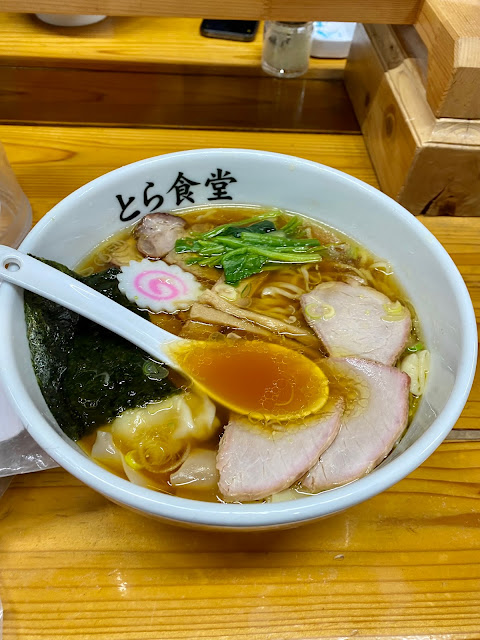
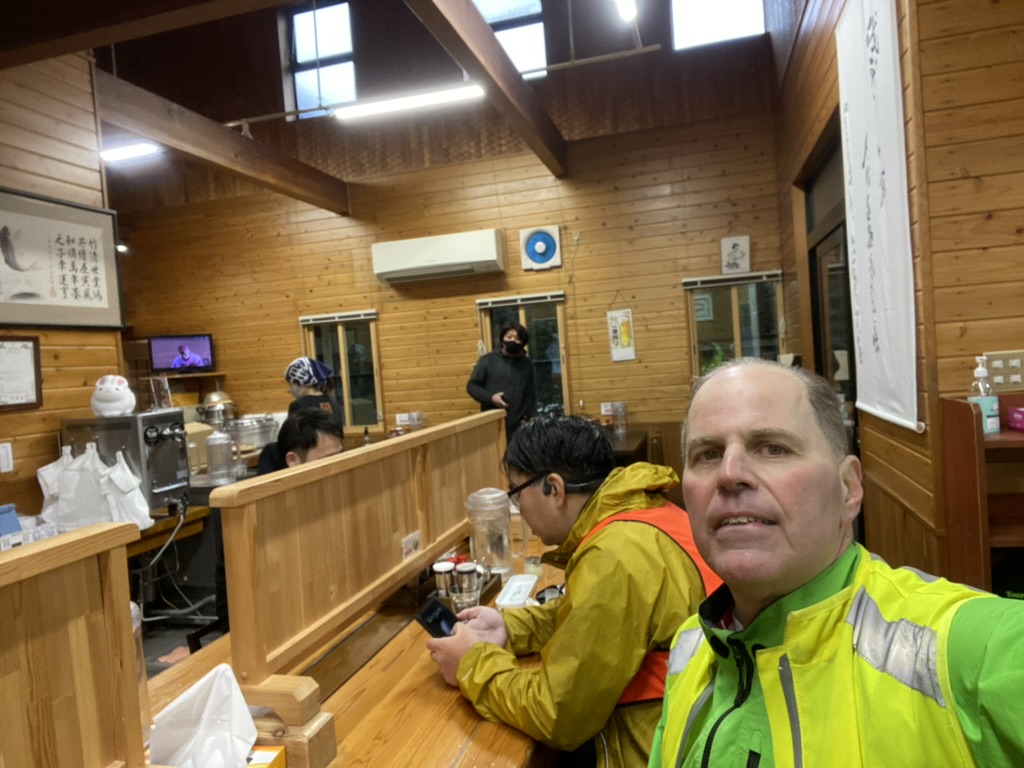
The restaurant's interior was warm, there was room for me to place my wet outer wear next to my seat in a box on the floor, and the ramen tasted better than any I have ever had. I used the toilet and changed from my soaking wet inner layer into my warm, long-sleeved turtleneck Q36.5 base layer. In the end, a 50 minute stop.  If I total the 16 min stop at 31kms, 20 mins at the first PC at 88kms, the 2x30min stops in Otawara and Iono, 7 mins at Nanko Park, the 50min stop at Tora Shokudo, and 10 mins a few minutes later to get new batteries for my rear light,  ... I must have been off the bicycle at least 163 mins during the first 175 kms. 
Best ramen I've ever tasted?!


But the rain had almost stopped, and from here (175kms in, at just after 6:00PM) the route would head east, then south, with the wind at our backs. Indeed, I actually made very good time from here most of the way to Hitachinaka, 100kms further on.  The temperature indicators by the roadside first showed 1 degree Celsius, then 2 degrees, then finally 3.  I could see stars in places now -- my gaze upward as I reclined on the recumbent. By 11PM, I had gone 265kms total. This entire stretch from Shirakawa had started at around 300m elevation, and ended close to sea level. There were a few intermediate climbs, but all of them were short. A few I walked up, if I felt at all unsteady, taking a couple minutes rest from the bike. But most I could ride up. I took one more short stop, then pressed on to the Oarai Kaigan 7-11 control point.
I got a rice w/ melted cheese and sauce "doria" at the convenience store, heated up. Here, the staff person shooed me outside when I tried to eat it just inside the front door. "no eating permitted inside!"  Well, I explained, it was so hot that I got cold waiting for it to cool down to an edible temperature. She was not buying my story, even though it was after midnight and very cold still outside. Ugh. A Chiba Audax staffer had been at the Tora Shokudo, and was here as well at Oarai. I asked if there was any place to rest up ahead ... a coin laundry, internet cafe, onsen, or similar? ... he said there was not much until Kashima, the 337km checkpoint.  Another 25-30 mins off the bike, then I pressed on. 
Finally, around km 326, on the eastern side of Lake Kitaura, there was a 7-11 that had a mini-coin-laundry in its parking lot, a small shed with 4 dryers, enclosed with a glass front door/window. You can see it here with google street view.  
My 3AM rest shed
The space was not heated, but it was protected from the wind. I put all my extra/wet gear in the dryer and set it for 24 minutes, laying down on the floor mat in front. I could feel warmth from the dryer on my hands, and slept immediately, waking to the buzz of the dryer alarm. There was another audax cyclist lying down motionless across in the parking lot in the lee of the 7-11 building. ... it looked cold out there. I added another 100 yen to run the machine another 12 minutes, and slept again until the next buzzer. The rider had moved on by the time I awoke. 
After heading a few hundred meters further and noticing my front light was not working, I stopped to fix the wire  ... and two riders passed me and zoomed up a hill, as our route left the Kitaura lakeside. Including both my rest and the repair work, by the time I was back on my way ... it had been another 50+ minute stop, but a much needed and very effective one. I walked up the hill then remounted. Finally, I made it to Kashima Jingu. The shrine looked huge, and quiet. 
At Kashima Jingu ... bicycle parking
It was now just past 4:30AM, and there were two other riders at the shrine, one of whom had asked questions about the Pelso and introduced himself to me earlier as Warabe (based on the start list, last name Shiraki-san), and was the guy who had been resting earlier by the 7-11, I believe. After the obligatory photo as proof of passage and a short rest, it was on toward the next PC ... and now riding into the wind for the last 65 kms. I reached that PC and chatted a bit with Warabe-san. There were two younger riders as well who had zoomed past as I fixed my light connection, one said he was 31 yrs old, the other 38. They looked like college kids. I headed out ahead of them but stopped when the course started to parallel the road along the Tonegawa. I wondered, ... should we ride up on the levy on the bike path (last year's Chiba 400 had taken that in the opposite direction) or stay down on the road? The two youngish riders passed me and stayed on the road. I followed, keeping to the road, eventually passed them, and did not stop again until I got about 30kms away from the PC, only 20km left to the Goal. I could see Audax riders heading down the road in the opposite direction. Apparently they were from a Nihombashi event, another 400k that started 5-6 hours later than we had (and so had had 5-6 hours less rain!). 
I pulled off to the side of the road and removed some clothing ... my rain jacket, winter cap, and helmet cover. And I switched back to the somewhat lighter weight gloves. It was at least 6-7 degrees C now and warming gradually, the sun above the horizon. Indeed, Sunday looked like a lovely day for a bike ride, even if Saturday had not been!  I could go noticeably faster without so much gear on. Less wind resistance, I guess? In any event, the finish was so close now, I could taste it. I pushed through, puzzled over which of three 7-11 stores within a kilometer of each other was the official end point, finally needed to consult my cue sheet, google maps, and confirm some kanji readings then loop back to the correct one and pick up my receipt. The two 30-something riders came in just as I entered the store.  I checked in at the finish with the organizers, headed back to my car just as Warabe-san came rolling in, packed up my bicycle, ... and napped for an hour before driving home. 
I finished in 25 hours and 33 minutes. There were 23 finishers in all, 6 after me and 16 ahead. Andrei was the first in, in 21 hours and 11 minutes. I think if I had been well-rested, in decent weather, and on a normal bike, this could have been a 21-22 hour event. Amazing that Andrei could do it that quickly despite the conditions (he had similar difficulties in the cold and wet ... and a 90 minute stop to rest and warm up). But then again, if we had had decent weather ... it would not have been an adventure. 

Postscript: I must say that the recovery from this ride, now 3 days ago, has been much tougher than other recent long rides. At the end of the ride, my butt was very sore where it had been resting on the edge of the recumbent's carbon seat. Usually I ride the Pelso laying on top of the seat, but by changing the seat to a steeper angle, I was effectively sitting on the bottom edge and applying more weight on a narrow edge there. I did not notice it until ... after 8 or 10 hours riding in that position.  With the seat elevated and SPD cleats, I could not move around on the seat but was locked in one position. The last couple times I got on the bike ... I really did not want to sit down on it again.  Also perhaps from the single position, my knees hurt just a bit during the ride, but not significantly. Spinning in a low gear helped defray the issues of a single position. But the leg stiffness following the ride was much worse than usual.  Overall, I was exhausted the next two days.  I think I started the ride tired -- both from bad jet-lag and not enough sleep on Wednesday evening, and an early Saturday start with not an early enough sleep on Friday night. Also, climbing on the recumbent I find I am quickly going "into the red zone" -- pushing the pedals at an unsustainable power output. Those repeated "red zone" efforts, trying to get a heavy bike and an overweight rider up a slope, took a toll on my cardio vascular system. I'm being careful to just rest and recover so that now, on Wednesday, I feel ready to re-engage fully. Also, I should add that this Spring the pollen levels in this part of Japan have been off the charts. The rain on Saturday of course kept them down ... but once the rain stopped, and definitely by early Sunday, they must have come back with a vengeance, and pollen levels have stayed high since. I'm on medication, but I think the impact of the pollen has probably complicated the normal recovery. 

I think next time I try to ride the Pelso 400kms or more, I will stick with my flat pedals, and will try to make sure that I am wearing shoes that will not slip in the rain, rather than going with cleats.  And in warmer weather I hope I will be able to avoid the baggy un-aero clothing, and also will be a few kgs lighter!

*Portland Oregon has an annual "worst day of the year" bicycle ride on the last Sunday of winter. This ride, on the last Saturday into the last Sunday, and in these conditions, was close enough.

Addendum:  I next rode the Pelso on April 2, for around 95kms in pleasant weather -- to get coffee with the Tokyo Cranks, view sakura along the Tamagawa, and then a few errands on the way home. It felt faster. And more comfortable. I had ridden the day before so did not push my pace, but still made decent time. I felt far better than I had on the Chiba 400kms.  With flat pedals and some running shoes, and the seat a bit lower down - not "slammed" but not elevated as I had done for the climbing, I could make decent time with less effort and more comfort.  Next, I'm going to get some new tires and do some modest maintenance, and I should have it ready for an ultra distance attempt during Golden Week.