27 September 2011

New Arrival

7:30PM Monday night, side profile
7:30PM Monday night, front
11:15PM Monday night
The frameset arrived at my home while I was at work today.  I got home, ate a quick bite, and literally could not wait to build it up ... and definitely could not wait to have it built up by the LBS.

She will never be this clean, or white, again.

26 September 2011

Autumn in Germany

It is already getting cold in Bremen. And much to my surprise, there is even the occasional scrub of Kosmos blooming on the sides of the streets.

I took the Canyon out for a fast ride on Friday evening. Very fast indeed, only 2:07 hr for the usual 70 km loop along the Wuemme to Worpswede and Fischerhude and back. My shape was "ma ma" but I could draft behind several tractors bringing in the hay and finally I was behind a scooter (small numberplate, speed limited to 40 km-hr theoretically) for almost 8 km.

On Saturday I was too busy building up the new bikes. Yes, the plural is correct as I am working on the Union Single Speed as well as on a new Kotter frame that I am going to built up for a friend of mine, currently working in Saudi-Arabia.

The steel frame was made by Kotter, a company from the South of Germany for their own racing team. The frame was chromed first and then painted with a thin layer of lilac paint, so that the chrome is shining through the paintlayer from underneath. It is hard to see the real beauty of the frame on a photo - one has to see the frame on a nice autumn day outside in the sun. This called "Chromovelato" in Italian.

I also decided to sell my Gazelle winter bike. The new blue Olmo works very well with removable mud guards and I really don/t need two winter bikes. In case you are interested:

It is a Gazelle Champion Mondial A Frame model from 1979 with serial number 3237 359. Framesize is 60 cm, made of Reynolds 530 tubing. - Sorry Hiroshi, Sorry Tom you are out. You can see the frame in the original Gazelle catalog from 1982 on Page 13 on the top. I upgraded the components, now there is a super-light Suntour Cyclone Mk. II rear derailleur attached, plus new bar tape, new wiring and and and. Should be ready to run and be misused in the winter. 320 Euro plus shipping if you like.

On Sunday I felt the first onslaught of German virus on my body and since today I am finally confined to the house. The good thing about being sick is, that it takes away the pressure of all operational issues in normal life (clean up the garden, help daughter with her homework, fight about money wisely spend on bike components with the wife, scold wife about money uselessly spend on figure skating dresses - same wife by the way). Instead one can lean back and think about the strategic things in life, provided that the headache are not to big and the nose is not running faster than the supply of tissues will last:

So, this will be one of my last post on the Positivo Espresso blog. In the last weeks I have set up a new blog in German which will be much more handy when communicating with the other cycling guys in Bremen. Once it is completely ready for launch a will let you know.

As a kind of farewell gift David and me have published some excerpts from the "Great Kanto Cycling Book" I was writing with the help of Phil and Thomas from TCC in 2009. The original idea was to publish it as a book, but nobody was interested to pick up the threads in Japan and I was too busy organiszing my new life in Germany.

So instead of leaving it in the drawer to rot, David and me decided to make the content public. Perhaps somebody else would like to add or comment on some of the pages - plaese feel free to do so.

To see the Positivo Espresso blog growing from 0 to almost 60.000 hits has been a great pleasure. However, most of these hits had been made when I was already in Germany. So I believe it is would be better to set up something similar in Germany again before hanging on too long with the original site.

While blogging on a separate site, I still feel as a member of the Positivo Espresso Original Core Team (PEOCP) and I will continue to stay in contact and ride together with all of you. Actually most likely I will ride together with Stephen on Mallorca in two weeks time.
Read all about it ... later and elsewhere.

So long and thanks for all the fish.

25 September 2011

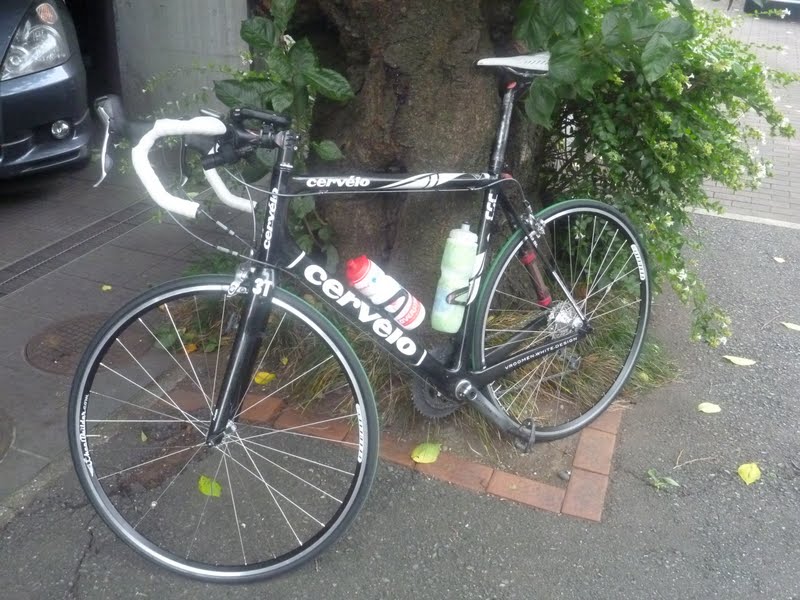
Cervelo Farewell Rides

My new Canyon frameset left Koblenz, Germany on Friday the 16th.  It made it to Narita (via Shenzhen and United Parcel Service) on Thursday the 22nd, just before this 3-day weekend.  I hope it will actually get delivered early this coming week.

_______________________________


Last weekend, on Sunday the 18th, Didier and I rode in muggy weather up Wada Pass via the Rindo approach.  On the climb, my first trip to Wada since before summer, I somehow got into my head that Wada Pass had an elevation of 600 meters, 210 meters higher than Otarumi ... but eventually as the road kept headed up, was forced to acknowledge that the top is 700 meters.  Of course, the Rindo approach we took goes another 40 meters or so higher to 740 meters elevation, before you approach the Pass descending along the spine of the ridge.

We returned via the "main" road down from the Pass - Jimba Kaido - and saw many Japanese riders suffering in the heat, struggling to turn over their cranks, or resting by the roadside having abandoned part way up the climb -- five years ago that would have been me!  And at one point, a car I had been stuck behind met 3 cars coming up the road on a narrow stretch -- instant gridlock that allowed me to pass and continue the climb without any traffic. ... No photos though.  Thanks Didier for a nice ride.
_______________________________________________

Saturday September 24.  The Cervelo enjoys a well-deserved rest in dappled shade and a cool breeze, outside a courtyard restaurant on the hillside above the South shore of Sagami-ko.


Yesterday, Saturday the 24th, I rode with Fumiki, Tim, Thomas and Travis of TCC on their O-Toge time trial.  It was nice to enjoy a true Cat 1 climb and beautiful weather in the countryside on the 2007 Cervelo R3 SL.  I suspect I can count on one hand the remaining rides on this frame, which has served me so well these past 4 years.

A question for Positivistas everywhere:  if by obscure tradition some Japanese cycling clubs insist upon burying a punctured tire tube at the end of its useful life, what does one do with an older, slightly scratched up carbon frame?  Maybe touch up the scratches with paint and hang it on a wall?    Maybe sell it on Yahoo auctions ("rare XL (61cm virtual) size not sold at Japanese retailers, only crashed a few times, rarely raced, AS IS condition")?

Maybe apply the Transalp elevation profile decals again?  Add some other custom markings with my name such as:

"Paris-Brest-Fresnay sur Sarthe, 2011 Metric Millenium",
"Schwalbe TOUR Transalp Finisher, 2009 and 2011",
"Tokyo Itoigawa Fast Run, 2008 and 2011"
"Etape Acte 2, 2011, 1390th place",

or even the undeserved

"JCRC Class C Racer"?

Does it need some personalized high points to accompany the manufacturer's small "Paris Roubaix 2006, Fabian Cancellara" decal and the Positivo decal on the seat stays, or would that just clutter up an attractive design?

Rear Disc wheel for ... less than 7000 yen?

Inspired by MOB's reminder of the TT world championships, I decided on Saturday to try a product that I got recently from wheelbuilder.com along with my new Velocity A23 rim/White Industry hub wheels.  It is an "aero jacket" cover for my HED Jet 6 rear wheel, converting the already-aerodynamic wheel into a super slick disk for TT and triathlon use.  The product is cut and drilled specifically to fit my wheel, including an inquiry as to whether I had 24 or 28 rear spokes, to make sure that the fasteners don't hit any spokes.  And the cost, only $89, or about 6700 yen.

Shipping charges would increase that substantially ... so best to order as an accessory that can fit in the same package as a wheel set.  Maybe this is something one of our favorite LBS's would want to offer in Japan?

There is an adhesive cover to place over the cutout for the valve stem -- not yet attached.

This photo showing right/cassette-facing side.


Do I ride TT's or triathlons?  No.  But someday.  ...

It took quite awhile to tighten the plastic fasteners so that the cover is firmly attached against the spokes.  And the fasteners look pretty flimsy -- I cannot imagine I can take them on and off very many times without damaging them (but a spare set costs only $7.50 ... 600 yen).  The plastic aero jacket itself looks reasonably durable and should hold its shape nicely, though it comes with a warning that it is not intended for regular training use -- save it for race day.

I rode these wheels up and down the Tamagawa on the Friday holiday afternoon.  I really noticed a difference, especially coming back down the road along the Kawasaki side.  Yes, I rode this stretch awhile back with Steve T., holding a high average speed as I gave it my all.  But this time, I was not pushing it into the "red zone", and could still hold the speed at 41-42 kph for long stretches without much wind.  Nice.


22 September 2011

UCI World Championship Copenhagen

Yesterday
Martin’s salute
Podium

Martin

Tuesday


Judith Arndt Of Germany Competes

Looking forward to the men race on Sunday.

17 September 2011

Olmo Evolution One

Well, today is my birthday. Thank you David & Ludwig for your good wishes. I took half a day off from work and my new white Olmo out on a longer ride in splendid autumn weather as a kind of birthday present to myself.

After fiddling and tweaking for weeks on the white Olmo I feel now very good with the (almost) final result. The original idea was to built up a Eighties aerodynamic craze bike (a good example is here) with "aero dynamic brakes", slim seat post, shifters on top of the down tube, internal cable routing, Recessed spoke holes on the hub and a complete Shimano 600 AX group.
Although I am now the owner of a complete 600 AX group set, I encountered some problems: First, the Olmo frame doesn't provide for shift cable routing on top of the chain stays. This used to be the standard for older frames, but this Olmo frame is just too new.

And second, the Shimano 600 AX crank set with 1'' pedal connectors isn' really a thing of great beauty. I gave up on this idea and as I had already bought Campagnolo Super Record brake levers with Olmo pantographs I thought it would be nice to buy some Campa parts for the drive train as well.
The Olmo is now equipped with a Super Record front derailleur and a Gran Sport rear derailleur as well as a Gran Sport crank set. Gears are shifted by Shimano 600EX Arabesque frame shifters, friction type which I believe are the most beautiful baroque shifters ever made.
One problem I always encounter with friction shifters is, that the threads in the braze-on adaptors are worn out so that the screws to connect the shifters to cannot be tighten hard enough. Friction shifters work with ... friction .... so the tighter they are screwed on, the more friction can be provided. If there isn't enough friction available, they tend to slip and this results in unintended gear shifting. The original M5 screws from Shimano are not long enough so that they interact only with a few convolutions. I bought some cheaper screws which do not look as fancy but do the job. But I wonder if there is any better solution?

There are a few things left to be done: I will give up on the aerodynamic idea in terms of bottle holder and buy a nice, old looking bottle holder for standard bottles. I also need to think about the cable routing for the rear derailleur again. And finally I would like to have rubber hoods for the Super Record brake levers. But as vintage spare parts they sell at 40$ a piece if at all.

The Olmo rides beautiful. It is fast and accelerates well. I had no problems to keep up with modern racing bikes on the Wümme trail. I had to get used to ride on the lower part of the handle bar only. With the track style handle bar it's almost impossible to have the hands on the upper part. It is certainly not possible to brake with the hands on the upper part. At first I had some pain in my back but now I got used to it. It is also new again to get used to clip pedals but now I can fairly quickly get in and out of the clip pedals. The braking performance isn't good at all but it is enough for standard situations.


This is a nice bike to ride distances of 50 - 100 km. More than that will be painful. I can also use It for commuting to work.

Having spend all this words of praise or my new white Olmo I need to add that I am currently working on two new bikes:

This is the basis for the first Fixie bicycle I am going to built:
And a good friend from Japan-days asked my to built up an old Cinelli bike for him. This will keep me busy during the long winter months in Bremen.

15 September 2011

Bavarian Adventure

During a business trip in late August I had the chance to visit Munich with my bike and take two days off to explore the Bavarian countryside.

I stayed at a cheap hotel (Best Western) in the vicinity of the main station in Munich. This part of the town is mainly populated by Turks and so it is no wonder that some of the restaurants, shops and hotels are named after famous figures form the Turkish history such as Johann Wolfgang von Goethe.

On the first day I took my bike on a train out to Starnberg lake which is about 30 minutes away from Munich. Bikes don't need to be packed in bags so it is rather easy and fast to start. The weather was just perfect and I started to ride along the lake. Some of the estates grouped along the shores of the lakes are just spectacular. They look like villas silent movie stars from the Twenties use to live in.

 I just rode aimlessly but fast around. After Starnberg lake I rode on to Tegern lake and then further on to the Schlier lake. In one of the villages I noted a good bicycle shop and I spend some time with the mechanic there to fix my cassette. I had tried to combine some of my Ultegra 6700 and Dura Ace 7900 cassette parts and construct the ultimate 11-28 Durultra cassette but that didn't worked out at all. So I could ride only in 8 gears with the fastest one being the 14 tooth cog on the rear.
But nevertheless it was a beautiful day and I just rode and rode without any plan or any goal. If a road looked nice or a village hat a nice and interesting name I just went there. For work I have to be so much organized and plan carefully the things ahead but in my private life I prefer a more chaotic approach from time to time. When the sun went down I took a train home to Munich main station. Everything was so easy.

I wondered if I should travel to Sonthofen the second day for a repeat of the first day of the Transalp 2011 race and conquer Oberjoch and Hahntenjoch for a second time. Actually the Hahntenjoch was the first climb in many years that forced me to walk up. But the weather didn't looked to good and since a long time I wanted to visit one of the most famous sights of Germany : the Neuschwanstein Castle.

So I took a train to Garmisch Partenkirchen, home of the famous winter sport idols Rosi Mittermaier and Christian Neureuther. That day it was cloudy and it threaten to rain. Nevertheless I started to ride in direction of the Austrian border. It was so nice to be back in the mountains and I wholeheartedly enjoyed the climb. But then it started to rain and I was forced to take a break at a bus stop in order to wait until most of the water was released from the clouds before I could continue to ride. An ugly and busy road brought me back to the German border and the town of Füssen. From there it was only a few kilometers to the castle of Neuschwanstein. The site was extremely busy with many, many tourists from all over the world. Actually from the main road up to the castle gate is a very nice climb, lasting for about 2 km and 180 m elevation difference. One has to navigate one way around the tourists which must be similar to the feeling that TdF or Giro rider have when they ride up the last stretches of the Tourmalet, the Galibier, to Alpe d'Huez or the Mortirolo.
The castle itself looks surprisingly new. Which is probably due to the fact that it is pretty new, only erected during the reign of Ludwig II in the late 19th century. Just like Tom collects new bikes and I collect old ones, the hobby of Ludwig II was to built new castles. The money for that expensive hobby was provided courtesy of Prussia or the German Empire which was paid in return for the consent of the Bavarian King to agree to the formation of the German empire under Prussian leadership. Probably people found it rather extravagant and lavish to spend that much money on a singular purpose. The same thing could have been said about the pyramids in Egypt, but history proved the investment of the king right: Today the magic castles of Ludwig II are one of the main tourist attractions of the Bavarian Federal state.

Next to Neuschwanstein castle is another castle built by Ludwig II, the Hohenschwangau castle. Not many tourists go there but It provided the opportunity for another shorter climb so I rode up to the castle gate as well.  

Clearly one can see the point up to which cycles are allowed. The most funny thing I saw was, that there is  street number sign mounted on the castle gate (Alp Street 30) which speaks for the German sense of organisation. Were letters to the king addressed like this?

Mr. Ludwig Wittelsbach
Alp Street 30
Hohenschwangau

After so much sightseeing I was eager to do a little bit more of cycling. I entered the main road in direction North and suddenly I realized that I was on this very famous road that every Japanese with some interest in Germany knows: The famous ROMANTIC KAIDO!
Please note that the name is also written in Japanese on the road sign. Wow, I heard so much about this road but I had never been there and I even had doubts that it would exist in reality. But here I was with my bike and two nice white Swiss DT rims and looked at the beautiful, romantic road and the even more beautiful, not romantic mountains.

After that I road through the countryside of Bavaria and the weather was continuously improving. There were many rolling hills and I really enjoyed this part of the trip. It was so enjoyable that I even forgot to take pictures. The villages along the road had such nice names as "Einöd", "Lauerbach" and "Sndgraben" and not such ugly names as they are common in the North of Germany: "Sauensiek", "Okel" or even "Fickmühlen". This was one of the best rides I had in the last month. As in Japan I ignored a road barrier and rode through a construction site. At one point I realized that I was riding on almost liquid asphalt that has just been poured some hours ago.

After more than 150km riding I arrived back at Starnberg lake and took a train home for the last 30 km through the Munich suburbs. I really should live in the South of Germany.

04 September 2011

Lots of Rain ... to the West; Plans for Sept 17-18

Well, despite predictions, Tokyo proper was mostly dry this weekend.  The storm dumped over 1800mm (almost 6 feet) of rain in parts of Wakayama Prefecture and Nara, between Osaka and Nagoya.  Lots of flooding, landslides and many people killed or missing.  Many other areas also received record rainfall.

Jerome and I had planned to ride today.  There was a sudden, brief downpour just as he got to my house, so we went inside for coffee.  We are thinking about a Sat/Sun ride the weekend of the 17-19, maybe going out to Nagano and trying one or more of (1) Odarumi, (2) Crystal Line, (3) the 299 "mountains of madness", (4) Akiba Kaido with some variations, (5) Norikura, (6) Utsukushigahara, or (7) Kurumazaka Toge.  If anyone is interested in riding those days (I need to be back in Tokyo no later than Sunday evening, although Monday is a holiday), and has thoughts about the route, just let us know.

The weather radar this morning showed a North-South line of hard rain at the edge of the hills west of Tokyo, so we just went to Ome, did one smaller hill in Chichibu, and returned again along the Tamagawa, hitting rain at several points near the westernmost part of our ride. This 115km was plenty for me, as I am still recovering from PBP, still a bit of numbness in my 2 outside fingers on my right hand.

The Tamagawa was completely full of muddy, fast moving water, roaring like I have never heard it. This was the only photo I took ... does not really do it justice.

Nagai-san and Nakayama-san at Positivo had restored the front end of my Cervelo, building it up with my old FSA "wing" style carbon bars and some nice white (for now) bar tape.

Also, I got yet another pair of traditional aluminum clincher wheels -- built up in the U.S. at a reasonable price and shipped to Tokyo.  These are Velocity A23 rims, 23mm instead of 19mm wide, just like the HED Ardennes or newest Zipps.  I had them built with 36 spokes in the rear, 28 in front, and White Industries hubs (which seem to have many fans).  I am hoping that they will be significantly lighter and more comfortable than my "bombproof" 36/32 spoke Mavic Open Pros with Ultegra hubs.  So far, so good.  I am trying Vittoria Open Pave 700x24 tires, and with the wider rims and Open Pave tires, I could barely feel the speed bumps on the Tamagawa path today. If all goes well, these will be my Brevet wheels.

When I picked up the bike yesterday, I did get a warning that the top tube ... is not going to last forever given the deep scratches it suffered in May.  So even though it made it through the summer and shows no sign of imminent collapse, a new frame (or bike) is definitely still on the agenda.

01 September 2011

Paris - Brest - Paris 2011 by Velonews

An incredibly well written article about this years edition of PBP 2011 published by Velonews. Too good to put only in the "shared" box on the right.

Look at the eyes of these guys and tell me how people look like after 1.200 km on the bike:


"This is my first and last Paris-Brest-Paris,” Edwards said. “My wife, who is a great endurance athlete, did it in 2007 so I had to do it also. I race Ironmans but this was something else. There was nothing which could have prepared me for this. Physically I trained hard, my equipment was perfect … but mentally this was the hardest thing I have ever done, and I have been to war.”


The Germans that attended were also naturally being associated with war:

"To know that I am not going to have to ride through another night is such a relief. I wanted to ride through without sleep but had to stop for three hours in the end. I could not keep up with the large group in front (a large group of German riders had just finished, all riding for the same team) they were riding like a military unit."
Meanwhile I am back in Munich and have two days off before I will frolick around with a larger group of students in the "Teutoburger Forrest", the site of the greatest German military victory ever. Quite some while ago, though.

Staying at Davids Bester Western Hotel in the Turkish quarter close to the main station, I used the first day to ride around some of the lakes in the Southof Munich: Starnberg Lake, Tergern Lake und Schlier Lake. The weather was just wonderful and I easily did 120 km and more than 1.000 elevation meter. Climbin felt so wonderful, I am missing that.  The later being the average tally for a month of cycling in Bremen.  I also went to a bike shop to get my gear fixed. Now I know what is wrong: I tried to built a all purpose cassette from my Dura Ace 11/25 and my Ultegra 12/29: The Durultra 11/29. Doesn't work. Hm, it would be nice to live in the South of Germany, I thought.

I am still torn if tomorrow I should take a train to Sonthofen and repeat Oberjoch and perhaps Hahntenjoch climbs of the first day of the Transalp, or.... I heard that quite close by is a pretty good copy of Cinderellas castle from Tokyo Disneyland. It was built in the 19th century by the Bavarian king Manfred II. Am I mixing things here? Perhaps I have been on the bike too long - look at my eyes.....


30 August 2011

Scene of the Crime

Over the past few days, if I've wished it once, I've wished a hundred times that I had gone back and taken a photo of the site where I went off the bike last Thursday morning in Fresnay-sur-Sarthe. 

Did I just get distracted and tired, fall asleep at the switch for a minute, or was it really a treacherous site?

Today, I thought I would try to pinpoint the spot using Google Maps and, surprise, surprise, there is actually a "street view" photo of the very site.

The obstacle that I hit felt like a "low curb" stretching out directly into the street for some unknown reason ... and it was. 

You can see it just past the pedestrian walkway, after the "Renault Agence LaLouette" storefront and before the Funeraires (grave tombs) shop on the right hand side.  There really is no warning, a sudden end to a lane (which is really a series of parking spaces -- marked only by the yellow line that was not visible at night), an odd sharp protrusion that is difficult to see even in daylight.  I really did go over it, blow out both tires, go sliding onto the lighter stone area past the crosswalk that marked the right edge of the street ... and beyond that, to come to rest at one of the set of marble gravestones.  How appropriate a resting place!

View Larger Map

Of course, fatigue and darkness had a role in this, but at least I can stop wondering if I imagined it.

29 August 2011

Bremen Challenge 2012

Der Eingang zum Überseehafen in Bremen.
Today I attended the Bremen Challenge Race in ...surprise, surprise, Bremen. For the benefit of the other participants I know I am writing this post in German. All other readers please enjoy the pics.


Bremen, oder, "Das kleine Hamburg an der Weser", wie es die Einheimischen liebevoll nennen, zeigte sich heute wieder einmal von seiner eratischen Seite. Dunkle Wolken, kurze Schauer, Sonnenschein und vor allem viel Wind. Der Wind wehte teilweise so stark, dass man beim Pinkeln in freier Wildbahn schon gut überlegen musste in welche Richtung man loslegt, um sich nicht selbst zu besudeln und beim Start als unfähiger Idiot aufzutauchen. Ausserdem war es kalt, oder in Anlehnung an Nick Nolte in "48 Stunden": "Der kälteste Winter, den ich je erlebte war der Sommer 2011 in Bremen."
Landschaftsgestaltung im Hafengebiet. Charmantes Nichts.
Ich kam, registrierte mich und bekam einen Beutel mit dem üblichen Schickschnack. Ich finde das ja unpraktisch, da ich, wie es sich gehört mit dem Rad gekommen bin und meine Familie, wie es sich gehört, zuhause geblieben ist, so dass ich keinen Platz für Schnickschnack habe. Es ist auch immer derselbe Schnickschnack. Wasserflaschen, T-Shirts und Papier. Die T-Shirts geben immerhin noch gute Lappen beim Radputzen ab, aber die Wasserflaschen nehmen nur Platz im Küchenschrank weg und schimmeln vor sich hin. Warum werden nicht einmal Sachen verteilt, von denen ich nicht bereits zwanzig im Schrank habe, wie z.B. Küchenscheren, Rasentrimmer oder 5 Zoll Diskettenlaufwerke? Egal, ich versuchte dann das T-Shirt in die Wasserflasche zu stopfen, damit ich es mitnehmen konnte aber es wollte mir nicht zur Gänze gelingen. Also kam das ganze in einen Hohlraum unter den Absperrungen, wo ich es dann am Ende des Rennens abholen konnte.


Ich drehte ein paar Runden auf dem 1,5 km Pro Kurs und sah Muckel und Campa. Vor dem Start hingen Tafeln mit Duchschnittsgeschwindigkeiten und man sollte sich nun in realistischer Selbsteinschätzung am Start aufstellen. Ich suchte vergeblich die Tafel für 36,72 km/hr (realistische Selbsteinschätzung) und stellte dann fest, das eine realistische Selbsteinschätzung durch die Massen von Radfahrern vor mir massiv behindert wurde. Also starteten Enrico und ich von irgendwo aus der unrealistischen Mitte.


Und schon ging es los und auch gleich gut ab. Ist ja immer so, die ersten 300 Meter fährt man noch normal da die Straße einfach zu voll ist, aber danach wird brutal Tempo gemacht und man muß gucken, daß man nach vorne kommt. Die lange Gerade runter wollte ich gerade an einer Gruppe vorbeizischen, als mir siedend heiß einfiel, was ich die ganze Woche einmal abends nach der Arbeit machen wollte: Mein Schaltwerk einstellen. Die beiden höchsten Gänge rasteten überhaupt nicht mehr ein. Also eigentlich fiel mir das zunächst auf und dann wieder ein. So war ich dann gezwungen (Kompaktkurbel für die Berge, nicht Bremen tauglich) irrsinnig schnell zu treten. Jeder Trainer, der hochfrequentes Treten propagiert, weil das ja so viel effektiver und gesünder ist und die Pros das machen wäre von mir begeistert gewesen. Ich bin aber ein Brutalo-Kraft-Treter, so dass meine Maximalgeschwindigkeit nun auf ca. 45 km/hr begrenzt war.


Die erste von 6 x 10km Runden lief gut. Highlight war das kaputte Strassenbahnwartehäuschen mit entgegenkommendem Krankenwagen auf der Strecke. So etwas wünscht man keinem. In der 2. Runde glaubte ich dann, ich könnte in realistischer Selbsteinschätzung alleine die Distanz zur vordereren Gruppe überbrücken. Ich biss die Zähne zusammen und hatte auch einen Mitstreiter auf einem wunderschönen roten Olmo, aber wir hätten skeptisch werden sollen als die Distanz nicht weniger wurde. Danach war ich so ausgepumpt und schwindelig vom hochfrequenten Treten, dass mich die ursprüngliche Gruppe komplett nach hinten durchreichte und ich den Anschluß verlor. Schlecht, vor allem dann das Fahren mit drei, vier anderen Loosern wie mir.
Aber am Ende der zweiten Runden kam das Team der senatorischen Behörden mit einer recht großen Gruppe und dort konnte ich mich wieder gut einreihen. Die senatorischen Behörden haben ja wegen einer absolut stressfreien beruflichen Tätigkeit viel Zeit zur Ausübungen ihrer sportlichen Hobbies und sind daher auch recht flott dabei. 


Danach wurde es geradezu langweilig. Das Tempo war nicht übermäassig schnell, also etwa 34 - 38 km/hr und es war auch keine schnellere Gruppe da, zu der ich hätte aufschliessen können. Also blieb ich, wo ich war und fuhr schön mit. Bloss nicht in den Wind fahren. Es war so langweilig, dass ich für einen Moment überlegte, ob ich nicht einmal ausprobieren sollte wie die Pros auf der Tour vom Rad aus zu pinkeln, ich verwarf diesen Plan aber wegen den völlig unkalkulierbarren Windböen. Dann fing es auch mal an zu nieseln, aber zum Glück hörte DAS auch wieder auf.


Und so ging es dann bis in die letzte Runde. Jetzt wurde das Tempo auch wieder ein wenig schneller und der allgemeine Adrenalinspiegel stieg. Taktisch fuhr ich ganz gut nach vorne. Das sollte sich auch wenige Minuten später auszahlen, denn da hörte ich links hinter mir nur einige kurze Flüche und dann die typischen Geräusche von Carbon und rasierten Unterschenkeln auf Asphalt. Das nach vorne arbeiten klappte ganz gut und in der letzten Doppelkurve war ich innen positioniert. Innen ist besser, denn nach aussen fliegt man.


Auf der Zielgraden fingen dann viele an direkt nach der Kurve bei der 250m Marke den Spurt anzuziehen. Das kann man aber nicht durchhalten, ist einfach zu lange, so dass ich mich schön an ein Hinterrad klemmte, Miss Poco stehen liess, einen orangen Stadtkurier noch abfing und mich freute heil und lebendig ins Ziel gekommen zu sein.
Die Gewinnerinnen in der Frauenwertung. Miss Poco hält die gelben Blumen. Die beiden im kleinen Schwarzen sind leider nicht mitgefahren.
Wiegtrittler nach dem Rennen.
Das Rad des Gewinners in der Jedermann Klasse. Das Pflaster ist eine hübsche Idee, hatte ich aber schon mal gesehen, wo war das nur ....?
Genau hier: "Das verwundete Klavier" von Joseph Beuys im Centre Pompidou, Paris.
Ich traf dann noch ein paar andere Bremer, wie die rote S. , Muckel und Enrico wieder, trank einen Kaffee und schaute mir die Siegerehrung an. Es gibt übrigens Weltmeister für Disziplinen die nicht unbedingt jedem bekannt sind. Weltmeister der Radkuriere kannte ich aus eigener schmerzhafter Erfahrung in Tokyo 2009, als ich nicht mitfahren durfte, da ich Bremsen an meinem Rad hatte. How uncourier-like! Aber was bitte ist denn die beliebteste Hobbysportlerin Deutschlands bitte? Oder sollte das die beleibteste Hobbysportlerin Deutschlands gewesen sein, das wäre wenigstens quantifiziertbar gewesen.

Und siehe da, Miss Poco war zweite bei den Frauen geworden. Das entspricht in etwa meiner Erfahrung in Japan, wo ich mich auch zeitlich in etwa bei den guten Frauen wiederfand. Die Siegerehrung dauerte etwas lang, mir wurde kalt und ausserdem hatte ich ja noch weitaus interesantere Dinge für den Tag geplant: Den Schimmel von den Wänden im Zimmer meines pubertierenden Sohnes zu entfernen! Eine echte Alternative zum Pro-Rennen schauen.

Nach dem Rennen, Silke und Andreas
Dieses Erfinden von neuen Sportarten geht mir ohnehin etwas auf den Keks. "Früher" gab es gutaussehende deutsche Sportler wie Liesel"Diskus" Westermann, Klaus "Speer" Wolfermann oder Dieter "Zahnpasta" Baumann die in Sportarten Siege einfuhren die es seit tausenden von Jahren gibt: Etwas in die Gegend werfen und dann schnell wegrennen. Heute gewinnen Sportler aus Löndern, die weitaus jünger sind als diese Sportarten, oder schnell auftauchen und wieder verschwinden werden (sogenannte Atlantisländer wie Süd-Mikronesien) und die deutschen Sportler gewinnen in diesen uninteressanten Randsportarten wie Biathlon, die dann auch noch in epischer Breite im TV übertragen werden. Da werden diese nun auch verdrängt, so dass wir bald im Fernsehn Übertragungen der WM im "Wassersieden auf dem Sessellift" oder "Nordic Biathlon" (Biathlon im Sommer mit Schiesstöcken) ertragen werden müssen. Gähn. 


Also ging ich erst einmal zum Speicher 108 an der HfK und trank einen Kaffee, wo ich von einer schnöseligen Kunststudentin,  die in Antizipierung ihres zukünftigen Erfolges es nicht nötig hatte mich zu  bedienen, nicht bedient wurde und fuhr dann zurück und schaute mir noch etwas die Pros an. Also, zwischen dem Jedermann Rennen und den Pro Rennen gibt es einige signifikante Unterschiede, die vielleicht nicht jedem bewusst sind. Deshalb sind sie hier noch einmal explizit und in allen Details aufgeführt:
So fahren die Pros! Unglaublich!


1. Die Pros sind dünner als die Jedermänner.
2. Die Pros sind weniger als die Jedermänner und vor allem
3. Die Pros haben weniger Zuschauer als die Jedermänner.


Ein rundum schöner Tag in der Überseestadt. Danke an Alle. Das Entwerfen von Schimmel rundete den Tag ab.
Mein Rad. Carbon. Plastik vor Plastikmüll. Sieht aber jetzt endlich mit zwei weissen Felgen bestückt richtig gut aus.
Optmimierte Lenkerposition nach Windtunneltests.

Paris to Brest to Fresnay-sur-Sarthe -- Lessons from the "Metric Millenium" Ride

As reported earlier, I did not quite make it back to Paris and so DNF'ed from Paris Brest Paris 2011, as I tried to ride over a curb in the darkness of night and then smash my handlebars into some marble stone at the roadside in the town of Fresnay-sur-Sarthe, almost 1040 km into the event.  But I did get to take in almost all of the PBP experience, and wanted to pass along a few thoughts for anyone who might want to try it with me in 2015.  I don't have time to do a proper attempt at an MOB-esque blog post, and I did not take many photos, but at least this should give some ideas.

Actually, I'm not sure many photos are necessary, if you use your imagination.  The landscape looked pretty much like this:


To this "basic template" photograph of a French field you can add (1) corn, (2) cows, (3) sheep, (4) horses or (5) various grains.  Imagine well-fed, healthy looking farm animals, constantly eating the grasses.  Also, there were some forested areas -- just expand the trees in the distance.  To the sky, you can modify the clouds, either make them much darker, lower and more ominous (most of the time), or add more blue and make the clouds small, white and puffy (for a few hours on Wednesday).  Also, you can add some huge wind power generators at a few places, the ones closest to the route after Carhaix, looming out of the mist on the outbound leg and with flashing red warning lights visible even in the near complete darkness on the return trip.

Sometimes, even often, it felt as if the landscape was more like this (riding from right side to left side of the picture):


There were some completely flat sections, but for the most part it was up or down, 1, 2 or 3%.  And there were lots and lots and lots of little 4-5% rollers that went on for less than a kilometer, and also some shorter 6-8% hills.  The section between Villaines-la-Juhel (221km) and Fougeres (310km) seemed elevated a bit -- always up on a ridge with the fields slipping away to both sides, which made it a bit scary during the intense lightning storm that I experienced there on the outbound leg -- though not as scary as the even-more-intense lightning storm later that evening between Fougeres and Tinteniac (364 km). The section between Loudeac (449 km) and Saint-Nicolas-du-Pelem (493 km) also had lots of hills and elevated sections on back country roads with poorer surfaces.  And there was one "mountain" of 350m elevation between Carhaix-Plouguer (525 km) and Brest (618 km), which felt like a long, long climb and was pretty impressive in the storms and mist on the outbound leg, less imposing or impressive in the dry dark on the return leg.

The last night I saw incredible stars -- the milky way, the big and little dipper, cassiopeia, etc. -- though I could not rest for long to enjoy them.

The locals along the route were great in many places -- with tables set up in front of their houses offering water or other drinks, or even food.  At first I thought they might be selling these items, like the restaurants I saw in some of the first control towns, but in fact they were just trying to help out.  Some kids had strips of paper they were handing out -- I did not stop, but later learned that they were handing out their name/address and wanted riders to send them postcards from foreign lands.  In some places, such a commitment was the price of water or coffee.  Some people had mattresses where riders could rest.  But there were long stretches, in the rain and at night, where there were no locals along the road.  And being in the last start group also doubtless meant fewer people along the roadside on the outbound leg.

Kojima-san, of the Japan team, who I rode with at various times.
There were lots of choices for start times -- 5PM Sunday mass start with 80 hour time limit, 6PM Sunday mass start with 90 hour time limit (though the last group from this start time did not actually cross the line until closer to 8PM, I heard, and so spent hours waiting), a 9PM-10PM "free" start with 90 hour time limit, and a 5AM Monday start with 84 hour limit (the "quatre-vingt-quatre heure" group).  I chose the 5AM Monday start on the theory that I could use another night of sleep to get over jet lag, and based on the organizer's promotional materials which suggested much less crowded experience at the control points, and noted that this group had the highest percentage of finishers in 2007.
The 84ers waiting for the 5AM Monday start.

The line grows longer -- but Monday 5AM was still the smallest of the single road bike start groups.

The point about fewer crowds in the controls for riders with my start time was definitely true.  But I am pretty sure what happened in 2007 is that there was awful weather for the earlier starters, and the weather got better before the 84 hour riders passed through.  This time, the 84 hour group had awful weather for the first 36 hours, while I talked with someone who did the 80 hour start at 5PM Sunday and who made it through the entire event (in under 70 hours) without any rain at all.  And I think I would have done better if I could have ridden Sunday night and all day Monday, then rested at Carhaix-Plouguer (525 km).  Even though I was always on track for a sub-80 hour time, I felt really pressed by the intermediate time cut-offs, which required me to get to the Brest control (618 km) in 38 hrs 51 minutes, but left 45 hrs and 9 mins for the (612 km) return trip. 
The Loudeac sleeping accommodations.

The temperature was almost perfect for cycling -- cool enough so as not to sap your energy or require massive extra liquid intake, but not so cold as to cause you to get chilled, at least when it was dry.  The rain became a big problem.  I always assume that I will just put on a light rain jacket, but that the rest of my body will get wet, and that has worked fine for me on most rides, including plenty of Brevets and this summer's Etape stage from Issoire to St. Flour.  But it is not easy to ride wet for several days.  Even with a change of bib shorts at Loudeac, my spare pair got wet within an hour or two of riding.  Even with enough chamois cream for 3 days+ of riding, I was chafing badly and needed to "ration" the application of cream on the return route so as not to run out.  And my palms were getting raw from riding with wet gloves for far too long, though I alternated among 3 pairs, two of which were soaking wet by the end of the first day.

Both ankles and my left knee started to ache within the first 200 km.  I raised my seat a little at the next control stop and that helped for awhile, but then both ankles and both knees started to ache.  I really should not have climbed Mt. Fuji one week before this event.

My palms, chafed groin and an aching lower back also gave me various minor problems along the way. ... but everything felt better by the time I had passed Tinteniac (867 km) and Fougeres (921 km) on the return trip, and I realized that yes, I could make it.  My leg muscles never let me down.

If I were to do it again (and I very well may) in 2015:
  • I would put in a lot more thought in planning the ride, thinking about where and when to sleep, setting time goals, etc.  If I could I would try to ride to Carhaix (525 km) before sleeping, so as to get a large "savings" balance and be well ahead of the clock even when starting off on the next leg.  I would think hard about how to get in and out of the controls more quickly, since these can take a lot of time to get the food, etc.
  • I would arrive on site 2 days earlier, to really resolve jet lag before the start.
  • I would choose one of the 90-hour start time, probably the "free" start from 9 to 10 PM.  Even though this would mean more crowds in the controls, and even though I should be able to ride this easily in under 80 hours (and goodness knows, it does not get easier by spending more time on the bike), I think it would be worth it to get the extra leeway in my schedule for sleep.  And I think it is probably more consistent with getting to Carhaix before sleeping -- though it would require getting a long nap the day of the start.
  • I would carry larger water bottles.  I no longer have my 1 liter bottle, and need a replacement, or to use a hydration pack.  During the longer, daylight, dry sections, I ran low or out of water, or needed to ration it.  
  • Likewise, I would bring more energy bars for my saddle bag and drop bag.  It is nice that they have "real food" in cafeterias at the controls, but the lack of convenience stores means you are otherwise stuck, especially at night.  I really could have used those bars that we brought, and did not need, on Transalp.
  • I would use a larger saddle/rear bag.  I tried to put all my heavy items in my rear bag, to keep my small pack light.  But let's face it, it would be better to ride with no pack.  And you really do want to take more gear on this ride than a shorter Brevet, even with the ability to access re-supplies via a drop bag at Loudeac (449 km and 782 km), and even with summer weather (or something that approximates it).
  • I would either get a dynamo front light (built into my hub) to avoid the need to change batteries, or just stock up on lithium AAA instead of alkaline AAA batteries, since those apparently last several times longer than alkaline batteries or Ni-Mh rechargeables and sustain their full output much longer.  I was rationing batteries and so did not have both my front lights on at times, and was limiting my headlamp to checking directions, etc.  
  • On the other hand, the small lithium polymer "brick" battery/charger I brought for use with my Garmin GPS worked very well.  I did not keep the Garmin on for the full ride, but I could use it when alone and at night with no problem, and replenished the charge twice from the "brick" and once from the wall outlet in the Tinteniac dorrmitory where I slept.
  • I would bring at least a two-week supply of chamois cream, so there is no need to ration this either.
  • I would do it with some friends instead of alone, or at least try to do some Brevets in the U.S. between now and 2015 so that if I stay with the U.S. randonneurs, I will know more of the participants from before the event.  Yes, I met a few somewhat oddball randonneur types at PBP -- people who have done PBP many times, never use a car, look as if they got a bit too much sun while on the bicycle over the years and have difficulty thinking or putting together a sentence in a conversation with a human being, ride incredibly retro equipment just to make things difficult (but who am I to call others eccentric?) -- but most of the participants were very normal, friendly types and would make good cycling buddies.
  • The vibration from the road surface was painful at a few points, including one of the last stretches that I rode.  I went with my bombproof wheels (32/36 spokes, open pro rims) and regular 700/23 Schwalbe tires.  These did fine, but I think I would try a set up with slightly fatter tires, and lower tire pressures (at least when riding these sections) if I did it again, to try to make these stretches less painful.  The Schwalbe Ultremo ZX are great, but they do not quite give the "cadillac ride" that I get from these wheels with Vittoria Open Pro CX's. (My two outside fingers on the right hand still have some numbness 4 days after the event ... not atypical for this kind of really long event).

All in all, PBP is well worth doing, and it is a part of cycling history that I wanted to join -- and I may very well want to join again.  But I think they are right to hold it only once in 4 years.