29 April 2013

Flèche #1

Japanese translation follows English.

Tea fields of Shizuoka -- at our first checkpoint.
This weekend I participated in my first ever "Flèche" (French for "arrow").  This kind of ride is a team variant in the usual Audax-sponsored Brevet or Grand Randonee and a Spring tradition since 1947, which has spread from France to other countries' Audax chapters.
Photo by Kawase-san as we climb in eastern Aichi Prefecture.
Initially I committed to join a team with several riders I know well, two of whom did the Rocky Mountain 1200 last year, and one of whom I see often on Kanto-area brevets.  But as the detailed schedule became clear during the application process, our team fell apart when 2 of 4 members dropped out due to schedule conflicts with the Kyushu rides going on this week.

In the end, I was lucky to be picked up by another team that had a spot left.  The leader, Tanaka-san, christened us "AR Chubu and Friends", or maybe "Friends of AR Chubu".  In any event, the other members -- Messrs. Tanaka, Kawase, Matsumoto and Kozakai -- are all from the Chubu area (near Nagoya) and members of AR Chubu, so I was delighted to join as their friend.  I have ridden a few very memorable AR Chubu events, my first 600km ride, and a very damp 500+ kms of a 1000km ride.  I was signed up and ready to depart for a third Chubu event on March 12, 2011.  But of course that was cancelled, due to the earthquake/tsunami/nuclear disasters of March 11, 2011 in Northeast Japan.  (If you happen to look at my blog entry about the 600km ride, please note that the rider with the sandwich protruding from his rear jersey is Tanaka-san).

There were 38 teams in all.  The Flèche essentially is a 24-hour ride that must be completed by teams of not less than 3 nor more than 5 persons.  The team must be together at the start and a few other key points (including the finish).  The team must ride at least 360 kms (223.694 miles) along their chosen route, and in order to ensure that it is really done as a 24-hour event, the team must ride at least 25 kms during the last two hours.  The organizers designate a "nice place" at which the team must submit its Brevet cards and for a post-event celebration, so teams plan a route to finish near the "nice place".  Also, the team must choose a route that follows the shortest distance between each checkpoint (presumably so as to prevent any cheating/shortcuts).  Other than that, a team may select its own course and its own start time, within a window of 24~36 hours.  This year, the Japan sponsor was Audax Kinki, and the "nice place" near the finish was Hanazono Kaikan next to Myoushinji temple in NW Kyoto City.  Below were the routes chosen by the 38 teams in this year's event.

As you may be able to see, teams headed toward Kyoto from as far east as Tokyo, as far west as Higashi Hiroshima, as far North as Jyoetsu in Niigata, and from Shikoku and Wakayama in the South.  Many did looping routes as well.

Tanaka-san (I really should call him "sensei" as it turns out he is a pediatric surgeon, but I would probably not recognize him if he were dressed in medical garb instead of spandex with a bike helmet.) planned our route from Shizuoka Station, past the Shizuoka regional airport and Fukuroi City, then north of Hamamatsu to Tengu, into the mountains and over several passes (the highest at approximately 680 meters), down from the hills into Inuyama City, then a fish-hook route along the Kisogawa around the North and West sides of Nagoya, through a long tunnel and down toward Lake Biwa, across a long bridge, then eventually with a last climb before a triumphant arrival into Kyoto.  The route was 408 kms, with plenty of flat stretches, plenty of hills, some seacoast, river valleys, parks, Japanese urban sprawl and deserted countryside.  It even passed the regular starting points used by the Shizuoka and Chubu Audax groups.  The route looked as if it had just about everything one might wish for, and this was home territory for the other members, so I had confidence that the roads would be well-chosen.
One of several lovely river valleys we climbed, I believe on Route 257/420 somewhere near the border of Shizuoka and Aichi Prefectures.
I have done less riding than usual this past 6 to 8 weeks.  Friends visiting, work, and even some international business travel (a trip to Europe and back last week), have not helped.  One week in mid-April, I drove a car further than at any time in recent memory (500+ kms on Monday alone, more driving on Wednesday and Thursday).   And I ate huge amounts on my trip last week and other recent events.  I have added 3-4 kgs of weight since last year.  The best thing about the added weight is that I can again descend much faster than others.  I just get into a tuck position and ZOOM, I go flying past.  This is especially so compared to Matsumoto-san, who cannot be over 65 kgs, and who rides a mountain bike with thick, semi-knobby tires.  The weight also helps in a stiff headwind or cross wind.  Unfortunately, just about everything else about the extra weight is bad.  I fell behind on the climbs, in particular.  I need to lose it before London-Edinburgh-London (as politely suggested by one of the riders at the post-Fleche party who will join that event).

Worse, I was jet-lagged from the European trip, with my head a bit fuzzy.  This impaired my language skills, making it harder to communicate with my Japanese team members.  Tanaka-san's Japanese was extremely precise and clear, but I could barely understand a word that Matsumoto and Kawase were saying.  Maybe my ears had yet to clear from Friday's return flight?  When I tried to ask Tanaka if we were to continue on the same road "michi-nari", the words came out a meaningless "michi-nami" instead.  Still, I figured, even with jet lag, the ride was only 400 kms.  And if I dropped off, the rest of the team could still finish with the required minimum of 3 members.

A week before the event, we got a note from Kozakai-san that his bicycle had been pretty badly smashed up in an accident and, while he was generally okay, there was no way his bicycle would be ready for the Flèche.   He was clipped by a side view mirror as a car passed him, sending him flying.  Ouch.  So it was only four of us who started out on a beautiful, sunny morning from Shizuoka Station.  Kawase-san had arranged for a "support car" driven by his friend.  Under the Audax rules, a support car cannot offer any assistance outside of the checkpoints.  On the other hand, our route had checkpoints every 40~65 kms, so we had plenty of chances to meet up along the way.  This proved extremely helpful -- especially at the end.
Messrs Kawase, Tanaka and Matsumoto of AR中部の仲間たち
We headed toward the seacoast and turned west, into the WIND.  And what a wind it was.  This was a stiff, Shizuoka west wind like I remember from January 2011 and again in early April 2011.
The "koi nobori" were flying in the wind all day!
The wind slowed our pace dramatically.  We got to the first checkpoint about 15 minutes later than planned.  We worked really, really hard, but were another 15 minutes behind at the second checkpoint, and would fall a further 30 minutes behind our plan when we stopped there for lunch.  And we rode oddly for a team -- I fell behind on the hills, went ahead on the descents (unless I applied my brakes!), and on the flats we could sometimes ride together, but often got separated -- in the wind, I would take a turn in front and sometimes look back to see that a gap had opened.  Or vice versa.

As we approached the second checkpoint, Kawase-san seemed to be suffering, and he decided that he would go ahead directly from the checkpoint so as to get a bit ahead of us, instead of joining Tanaka, Matsumoto and myself for a lunch of ramen and then risk falling behind us.  Matsumoto-san set us into a panic when he seemed to have misplaced his Brevet card -- only to find it a few minutes later.  (No Brevet card, no finish).  And we gave up on the idea of completing the entire 408 km route, remembering that we could complete a Flèche just by getting through the first 360 kms.

At the third checkpoint, around 130 kms, Kawase-san greeted us, emerging from the support car in street clothes.  He had had enough, suffering from ailments described in Japanese I could not quite understand.

Now I was no longer just an "extra" on the team, but was actually needed for the team to complete the event.  Each of the remaining 3 team members needed to finish, within the rules, in order for any of us to complete the Flèche.  We had no margin for mislaid brevet cards, forgotten checkpoint receipts, mechanical problems, stomach upset, or crashes!  At least we managed to make it through the entire event without major mechanical problems or crashes, and managed to recover in time from the forgotten receipts, stomach upset and minor mechanicals.  And Kawase-san appeared from time to time at the side of the road to cheer us on and take photos, so there should be a good photographic record of the daylight portions of the event.

By the time we left the mountainous segments and rolled into Inuyama ("dog mountain") City, Northeast of Nagoya, it was well after midnight.  After an inadequate meal and some brief "head down on table" time at Denny's, we left around 2:30AM.  From Inuyama, we finally made decent time, riding together in a line (mostly) along a bike path and/or access road next to the Kisogawa around the edge of Nagoya.  The Denny's meal got the best of me, and my stomach started to act up.  On the western edge of Nagoya, we tried to rest horizontally on benches in a park -- though I at least started to shiver in the 4AM cold, and none of us managed to sleep.  We were back on the bikes in 15 minutes or so and continued to make decent progress, into Mie Prefecture and to our checkpoint at Inabe City.

310 kms done.  2.5 hours behind schedule, but 360 kms well within reach.
Photo by Kawase-san, in Mie Prefecture early morning
The dawn brought a beautiful morning and then another climb along Route 421, past flowering trees and forests to the mouth of a tunnel.  One member noted before the climb that the tunnel mouth was just under 400 meters elevation.  This was true.  As usual, Tanaka and Matsumoto waited for me at the tunnel entrance.  I tried to lead the group through the tunnel and set a decent pace, but something was not right.  After 21 hours on the bicycle, with jet lag, riding in a tunnel, I felt disoriented.  I knew it should not be that difficult to ride at 22~24 kph through a flat tunnel.  Was my brake shoe rubbing?  Or were my tires getting flat?  No, and no.  ... so it was a relief to finally notice that the altitude indicator on my Garmin device ticking up, meter-by-meter.  Yes, indeed, we were still going up hill!  By the time we emerged at the other end of the 4 km long tunnel (Matsumoto and Tanaka first, me following well behind), we had climbed another 100 meters -- a steady 2.5% inclined plane.

We descended the hill at high speed (me first, then Tanaka and Matsumoto well behind), stopped at exactly 7AM for our 22 hour checkpoint, recording our location at the post office in Mandokoro and obtaining the signature of a local gentleman who had stopped his car to enjoy a morning cigarette.  We continued to roll down the hill until, a little after 8:30 AM, we all confirmed that we had exceeded 360 kms and pulled over for one last rest.  As we rested, we saw another Fleche team of five cyclists go zooming by, and I recognized Tominaga-san as he yelled out a greeting.  At 9AM we entered the nearest convenience store, got one last receipt as proof of passage, and headed for Omi Hachiman Station on the Tokaido Line.  There we were met by the support car with Kawase-san and Kei-san, who managed to take all of our bikes and luggage to Kyoto and the location of the post-ride party.  The 3 riders hopped the train, changed lines at Kyoto Station, walked the short distance from Hanazono Station to the banquet hall, checked in at reception with our cards and receipts, enjoyed a hot spring bath, and went upstairs to the banquet hall for the big party.

At the banquet we were regaled with stories of tailwinds for those arriving from the West, rain and cold for those who came from the North, more suffering in the headwinds for others who, like us, came from the East.  We met the visiting riders from Taiwan, and I was glad to learn that Tominaga-san and Tachikawa-san both will join London-Edinburgh-London.  I certainly closed my eyes for a few minutes during the party, and when mine were open, I noted that Tanaka-san also dozed off.  The other team at our table looked remarkably well-rested.  ...  having started and finished almost a day earlier than us and then enjoyed a good night's sleep.  An interesting idea for next year.  Maybe we should plan a midnight-to-midnight ride, then a good sleep before attending a Noon party?

We made an odd team -- a mountain biker, two "normal" experienced Japanese road cyclists who are 15 years apart in age, and an overweight foreigner who climbs slowly and descents like a rocket (or at least a rock) -- but we made it through the event in good spirits.  And even though we did not train together, we did achieve the goals of the event as promoted by the Audax Club Parisien: "building a strong spirit of camaraderie, striving during 24 hours to achieve a common challenge and finally meeting and socializing with fellow randonneurs from across your country, region or province."
The headwind starts to take its toll.
Seems like it would make a nice annual tradition.

---------------------------------------

Japanese translation kindly prepared by Tanaka-san:


今週末、私は初めてのフレッシュに参加してきました。このライドは通常のAudaxが主催するブルベから派生した、チームで行われるもので、1947年以来春の伝統となっており、フランスから諸外国の支部に広がっています。


当初私はよく知った自転車乗りたち数人のチームに加わる約束をしました。そのうちの二人は昨年のRocky Mountain 1200を走り、一人は関東地区のブルベでよくお会いする方でした。しかし申し込み期間中、詳細なスケジュールが明らかになるにつれ、今週行われる九州ブルベと日程が被るために四人中二人が抜けてわれわれのチームは崩壊してしまいました。


最終的に私はラッキーなことに欠員のある他のチームに拾われました。リーダーの田中さんは、「AR中部と友だち」またはおそらく「AR中部の友だち」と名付けました。いずれにせよ、他のメンバーの田中、川瀬、松本、小酒井さんはいずれも名古屋近郊の中部地区の人でAR中部のメンバーであり、私は彼らの友人として喜んで加えられたのです。私は少しですが非常に記憶に残るAR中部のブルベを走ったことがあります。私の最初の600kmブルベや、1000kmブルベでの失意の500kmです。私は2011年3月12日の3回目の中部ブルベにエントリーし出かけようとしていました。しかしもちろんそれは中止になりました。3月11日に起こった東北での地震/津波/原発の大惨事のためです。


全部で38チームが参加しました。フレッシュの本質は24時間ライドで、チームで走破しなければならず、3人より少なくても5人より多くてもダメです。チームはスタート地点、途中のキーポイント(ゴールを含む)で一緒でなければなりません。チームは最低360km(223.694マイル)を自ら選んだルートに沿って走らなければならず、正に24時間のイベントであることを確かにするために、チームは最後の2時間で最低25km走らなければなりません。主催者は「ナイスプレイス」を設定し、チームはそこでブルベカードを提出し、イベント後のお祝いが行われます。そこで、チームはルートのゴールを「ナイスプレイス」の近くに設定します。またチームはおのおののチェックポイント間を最短距離になるようにルートを設定しなければなりません(おそらくズルや近道を防止するためです)。それ以外にチームは自らのコースと出発時間を24〜36時間の幅をもって選びます。今年の日本の主催者はAudax近畿で、「ナイスプレイス」は京都市の北西の妙心寺(Myoushin-ji)横の花園会館でした。下に今年38チームが取ったルートをお示しします。


見て取れるように、東は東京、西は東広島、北は新潟の上越、南からは四国や和歌山から京都に向かっています。多くのチームがまた円周状のルートを取っています。


田中さん(本当は彼を「先生」と呼ぶべきかもしれません。なぜなら彼が小児科医と分かったから。しかし、彼がバイクヘルメットとスパンデックスの代わりに医者の格好をしていたら、多分彼とは分からないでしょう)は、静岡駅から、静岡空港、袋井市を越え、浜松北部から北上しTengu(?)へ、山岳地帯に入っていくつかの峠(最高で約680m)を越え、下って犬山市に入り、名古屋の北と西を回るように木曽川に沿って釣り針の様に走り、長いトンネルをくぐって琵琶湖に向かって下り、長い橋(琵琶湖大橋)をわたって最後の上りを終えて京都に入るルートを計画しました。ルートの総距離は408kmで、多くの平坦区間、ふんだんな丘区間、少しの海岸線、川沿いの谷間、公園、日本の周辺都市、田舎を含みます。静岡ブルベ・中部ブルベのいつものスタート地点も通ります。このルートは望まれるすべてを揃えたように見えました。そして他のメンバーのホームグラウンドであり、道路はよく練られていると確信していました。


この6〜8週間はいつもより自転車に乗っていませんでした。友人たちが尋ねてきたこと、仕事、海外出張(ヨーロッパから先週帰ってきました)は何の助けにもなっていません。4月の中旬の一週間、これまでの記憶にないぐらい自動車の運転をしました(月曜日は一人で500km以上、水曜日と木曜日にそれ以上)。そして先週の旅行と最近の他のイベントで大量に食事をして、去年から3〜4kg体重が増えました。体重増加で得られた最もいいこととは他の人よりより早く下れるということです。
身をかがめてバキューンと飛ぶように下りていく


。

これは特に松本さんと対照的で、彼はきっと65kgないでしょうし、太いセミブロックのマウンテンバイクに乗っていたので。体重はまた、強烈な向かい風や横風にも有利でした。不幸なことに重量過多は他のことには悪条件でした。特に上りでは私は後塵を拝し(こうじんをはいし)ました。(フレッシュ後の懇親会でLEL参加者の一人から親切にも忠告を受けたように)ロンドン-エジンバラ-ロンドンの前に減量しておく必要があります。


さらに悪いことに、ヨーロッパ出張後で時差ボケで頭が少々ボーッとしていました。そのため私の言葉の能力に支障をきたし、他の日本人とのやり取りをより難しいものとしました。田中さんの日本語は非常に確かで明瞭でしたが、松本さんと川瀬さんがしゃべっている言葉はほとんど理解できませんでした。おそらく金曜日の帰りのフライトの耳の詰まりが取れていなかったのでしょうか?田中さんに同じ道を行けばいいものか「道なりですか」と聞こうとしましたが、口から出たのは「道なみ」という訳のわからない言葉でした。それでも、たとえ時差ボケでも走行距離はたった400kmだ、と考えました。そして例え自分がリタイアしても残りのチームメンバーは必要とされる3人でフィニッシュできるだろうと考えました。


イベントの一週間前、小酒井さんから事故でバイクが大破したという連絡を受けました。体は大丈夫だが、フレッシュまでにバイクを準備する術がないとのことでした。脇を通った車のサイドミラーに当てられ飛ばされました。イテテ。そういうわけで、美しい陽気な朝に静岡駅を出発したのはわれわれのうちのたった4人となりました。川瀬さんが「サポートカー」を友人に運転を頼んで手配してくれていました。オダックスのルールではサポートカーはチェックポイント以外ではいかなる援助も出来ません。一方、われわれのルートには40〜65km毎にチェックポイントが配してありましたので、道中出会う機会は幾多(いくた)となくありました。これにはいかに助けられたか、特に最後に証明されました。

海岸に向かって出発し右折しました。風の中に。何たる風。強風で、2011年1月と再び2011年4月を彷彿とさせる静岡の西風でした。

風はわれわれのペースを劇的に落としました。われわれは最初のチェックポイントに予定より15分遅れて到着しました。本当に本当に一生懸命漕ぎましたが、2つ目のチェックポイントではもうさらに15分の遅れを取っており、 昼食をとるのにそこにとどまればさらに30分予定より遅れることになるでしょう。そして私たちはチームとしておかしな乗り方をしていました。私は上りでは後ろに下がり、下りでは(ブレーキを使わない限り)前に出ます。平坦路では時にはいっしょになって走ることが出来ましたが、しばしば風によって離されました。私が先頭になって振り返ると時として間隔が広がっていました。また、逆も然りでした。

二つ目のチェックポイントに近づきつつあるとき、川瀬さんは調子が悪そうで、田中・松本・私がラーメン屋に昼食をとりに行くのには加わらず、チェックポイントからすぐに出発して少しでも距離をかせぐ決断をしました。そうしてリスクがわれわれに迫っていました。松本さんはわれわれをパニックに陥れました。ブルべカードをなくしたようだと言うのです。ただ数分後には見つかりましたが。(ブルべカードなし=完走できず。)そして、われわれは408kmの全ルートを完走するという考えを捨てて、360kmを走りさえすればフレッシュを完走できるということを思い出しました。

約130kmの3つめのチェックポイントでは、川瀬さんがサポートカーから私服で現れ私たちを出迎えました。日本語で説明されたのでよくは分かりませんが想像はできる持病に苦しんでおり、彼はいっぱいいっぱいだったのです。私もそうでした。

今や私はもはやチームの「おまけ」ではなくなり、このイベントを成し遂げるためにチームに本当に必要とされる人になりました。ルールで、フレッシュを完走するためにはチームのメンバー3名おのおのが走りきる必要があります。ブルべカードの置き忘れ、チェックポイントでのレシートのもらい損ね、機器の問題、胃のムカムカ、事故は許されなくなったのです。川瀬さんは、あちこちで道路脇から声援を送り写真を撮ってくれました。イベントの昼間区間でのいい映像記録となるでしょう。

山区間をあとにして名古屋の北東に位置する犬山市にわれわれが転がり込んだ頃には完全に真夜中になっていました。デニーズで十分とは言えない食事と束の間の「テーブルに突っ伏した」少しの間を終え午前2時30分頃に出発しました。犬山を出てから、自転車道や木曽川沿いの道路を名古屋の縁を巻くように大体はお互い一列をなして、結局かなり急いで走りました。デニーズの食事は私を打ちのめし、私の胃袋は気持ち悪くなり始めました。名古屋の西の端にきたところで、私たちは公園のベンチで横になって休もうとしました。しかし、少なくとも私は午前4時の寒さに震えだし、誰も睡眠を取れませんでした。私たちは15分かそこらで再びバイクにまたがり前進を続け、三重県に入りいなべ市のチェックポイントにつきました。310km走って2.5時間の遅れですが、360kmは十分手の届くところにきました。

夜が明け、美しい朝となり、それから国道421号を、花咲く木々や森を縫ってトンネルの入り口までもう一上りしました。メンバーの一人が上りだす前にトンネルの入り口は丁度400mちょっと下だと言っていました。これは本当でした。いつものように田中さんと松本さんがトンネルの入り口で待っていました。私はグループを率いてトンネルを通過しペースを作ろうとしましたが、何かうまく行きませんでした。21時間自転車に乗って、時差ボケで、トンネルの走行、私は方向感覚の麻痺を感じました。平らなトンネルを22〜24km/hで行くことはそう難しいことではないはずと思いました。バイクのブレーキシューが擦っているのか?はたまたタイヤがパンクしかかっているのか?いや、いや。結局、わたしのGarminの高度計が1m-1m刻々と増えていっているのに気づいて安心しました。そうです。私たちはまだ登り続けていたのです!4kmの長いトンネルの出口から、松本さんと田中さんが先頭、私が遅れて出るまでに私たちはもう100m、2.5%一定勾配で登っていました。

私が先頭、それから田中さんと松本さんが遅れて山をすごいスピードで下りていき、丁度午前7時に22時間のチェックポイントで停止し、政所の郵便局でわれわれの場所を記載し、早朝のタバコを自動車を停めて楽しんでいた地元の男性にサインをもらいました。わたしたちは午前8時半を少し過ぎたころまで山を下り、私たちは全員360kmを越え自転車を寄せて最後の休憩を取りました。休憩中、他のフレッシュチームの5人が通り去るのが見え、叫んで声をかけてくれた冨永さんを認識しました。午前9時、私たちは近くのコンビニエンスストアに立ち寄り通過の証明となる最後のレシートを取って、東海道線の近江八幡駅に向かいました。そこでサポートカーの川瀬さんと恵(けい)さんに合流し、バイクと荷物を京都の懇親会会場へ運んでもらうようにしました。ライダー3名は電車に乗り込み、京都駅で乗り換えて花園駅から宴会会場まで少し歩き、ブルベカードとレシートを渡して受付でチェックインし、お風呂を楽しんだ後、盛大なパーティーが行われた上の階の宴会場へ行きました。

宴会では、西からのチームは追い風、北からのチームは雨と寒さ、より向かい風で苦しんだのはわれわれのように東からのチームだったと言う話しで盛り上がりました。台湾からのライダーに会い、冨永さんと立川さんがLELに出られることを知ってうれしくなりました。私は確かにパーティー中に数分間目を閉じていましたが、私が目を開けたとき田中さんも眠っていることに気づきました。私たちのテーブルの他のチームは明らかによく休んでいました。スタートとゴールが私たちのほぼ一日前で夜はぐっすり眠れたのです。来年に向けて面白い考えです。恐らくわれわれは真夜中から真夜中の走行を計画すべきです。そして真っ昼間のパーティ参加の前にしっかり寝ておくというのはどうでしょう?

私たちは変わったチームでした。マウンテンバイク乗り、二人の「普通の」経験のある15才歳の離れた日本人ロード乗り、そして体重過多の上りは遅いが下りはロケット(もしくは少なくとも岩)のように下る外人からなるチームです。しかし私たちはすばらしい精神でこのイベントを乗り越えました。そしてたとえわれわれがトレインを組めなかったにせよ、Audax Club Parisienが以下のように発起した通りわれわれはこのイベントにゴールしたのです: 「強い友情の精神を築き、共通の目的を達するために24時間がんばり抜き、最後に国・地域中からの仲間のランドヌールたちとおち会って交流する」

Tanaka-san's blog report on the event can be found here.

06 April 2013

Yamabushi/Shomaru ... Half-Fast?

Jerome has been very busy at work, and my work also has spilled into a number of weekends so it was for the first time in many weeks that we headed out together for a ride.  A major rain storm was forecast to start mid/late Saturday afternoon and go into Sunday, so we departed from recent tradition and rode on Saturday.

As we approached the Tamagawa, passing by the massive Tamagawa Rise condominiums south of Futako Tamagawa Station, we saw Ira Stevens and two women, Jan and Fumi, ready to start a ride.  I know Ira from the pool at Kinuta Park, where we met last year when I was training there and swerved into the wrong side of a lane, running directly into him and inspiring some mild invective.  He lives nearby and leads some of the "Half Fast Cycling" rides.  We were joined by two more riders (Chris and Barbara) up the river, and continued with them at a relaxed half-fast pace until they crossed the river to head out the Asagawa toward Hachioji area.
After a farewell photo, Jerome and I picked up the pace, a tailwind helping speed us toward Oume.  We were behind schedule a bit and the weather was threatening, so we bypassed Oume Station/Aurore Bakery and headed straight onto Nariki Kaido from Higashi Oume Station.  The area looked spectacular, with some sakura left and many other flowering trees and plants, the babbling brook at the base of the Tokyo Hill Climb course, and dry pavement, still.


We made better time than expected, and were up to the top of Yamabushi Pass, through the dip and up the short climb to Shomaru Pass.

We stopped at the Pass at "Okumura Chaya" for lunch.  We were the only customers in the place, and so were able to persuade the nice ladies there to step outside for a photo.  The older of the two said "obaasan de moushiwake nai, mo sugu 80 sai", roughly translates as "I apologize for being an old lady, I am nearly 80."  No apologies needed ... but the Japanese language lends itself to these sorts of statements.  Whenever you do not know what to say, best to apologize.

This view, of course, looks out to the East toward Saitama and northern Tokyo.  And that haze in the distance is ... not dust from China, but a line of rain clouds. Of course, it is the same view as once observed by the Showa Emperor and Empress Michiko, on an inspection tour of the realm.
We made it back down the hill and half way through Naguri before the line of showers hit.  Fortunately, the drenching rain lasted only 15-20 minutes, and had ceased when we emerged from the tunnel at Ozawa Pass and headed down the hill to Nariki.  The pavement was dry when we got back to Higashi Oume, but the real storm hit later on, and we slogged the last 80-90 minutes back in the wet.  The main storm brought a warm, humid rain, like the rainy season storms that come from the South in May, so we were not cold.  But the rain kicked up a lot of grime from the road, which seemed to end up all over me.

It was great to return to Chichibu and Yamabushi/Shomaru after far too long an absence, to get in a 150 km ride despite the rain, and to meet some of the Half Fast folks.

31 March 2013

March Showers Bring April Flowers

If last weekend's ride was full of positive surprises, this week was the opposite.  Saturday morning  looked like perfect riding weather as I left home -- cloudy, cool and with a tiny hint of precipitation in the air -- just enough to keep one cool, but definitely dry pavement.

It was, however, one of those days when the weather gets worse near the hills west of town.  As I headed west out along the rolling hills of One-kansen-doro, it got damper and damper, the pavement wet.  I wore arm warmers, a decent cap, and even (very thin) full finger gloves.  I slipped on my rain shell, ... but was still chilled and with damp feet by the time I made it out near Machida Kaido west of Aihara.

The roads were very slippery.  Perhaps it is the pollen dust, cherry blossoms or maybe just oil slicks after a few dry days.  In any event, my rear tire was well worn and lacked any tread, even on the sides, and the rear wheel seemed to slip as I braked.  Extreme care was required near any metal surfaces.

I made the short climb up to Shiroyama reservoir/dam area, my rear tire slipping on the steeper parts of the ascent, forcing me to spin lightly, remain in the saddle, and pick a line on parts of the road that looked as if they were the most free of moss, sakura blossoms and other slimy organic material in order to avoid falling.  At the top it looked like this:


My original plan of "riding the rindos" did not seem workable, so I turned around and headed for home.  It was only a 83 km trip, but together with another 25 km round trip into Tokyo for an early evening event, pushed me well over 1000 kms for the month of March, and over 3000 so far for 2013.

24 March 2013

Sunday Ride: Happiness is ...

Happiness is ...

... setting out on a morning when the weather forecast is "cloudy" with an increasing chance of rain, and enjoying perfect riding weather, with blue sky in the afternoon.

... heading up Tomin no Mori and Kazahari Pass for the first time after my 50th birthday, having not gotten in decent rides the last few weekends and eaten a huge piece of cheesecake at lunch yesterday, without pushing the pace, and still getting within five minutes of my personal best.

... enjoying piping hot "oyako donburi" at Yakyu-tei cafeteria at the far end of Okutama-ko.

... Yamanashi Route 18 over Tsuru Pass back to Uenohara, with the Steve T. side route around Tawa Pass.

... hopping a train back from Hachioji thereby avoiding the sakura crowds.

It was a great day for a ride, and I was happy to get in one of the Positivo Expresso classic routes.  There were almost no motorcycles on Kazahari and surprisingly few cyclists.  Route 18 over Tsuru was deserted as usual.  The first ride I have done with over 2000 meters climbing in many months.  I would like to put together a string of these in coming weeks.


Sakura out the window on Saturday evening.
Sunday's steed - the Ti Travel Bike, with dynamo hub/light, 32/36 spoke wheels, 2 x 1-liter bottles of water, underseat bag and fastback DLX fenders ... which on this bike work fine with 700x23mm tires but rub with 700x25mm.

11 March 2013

Not Weather for Riding

On Saturday the pollen was incredible in Tokyo.  On Sunday the wind kicked up and raised dust clouds throughout Kanto.  I rode to and from Tokyo station for a Sunday morning trip out of town ... but had no desire to go further in these conditions.  Some photos from the train in S. Tochigi/Saitama area are below.


03 March 2013

Sunday ride and stop by local bike shop (Cherubim)

Jerome and I took a morning ride today, heading out past Takao over Otarumi and to the area around Lake Tsukui, then back.
Early March -- almost Spring.  The brown looking trees toward the left on the hillside are fir trees heavy with pollen.  The pollen level is VERY high this year, so thick you can taste it.
Jerome had a slow leak in his front tire tube -- he can be seen in the distance where he stopped to pump up the tube.

On our way back into town, we stopped by a local bike shop and Jerome borrowed a tire floor pump.

It just happened to be the Cherubim store in Machida.  Of course, Cherubim is home to the most decorated framebuilder in the world in recent years, Konno-san.  So the bikes on display are all custom, and spectacular.  I think I will need to order a randonneur frame here while I am living in Japan.

I think I saw this one at Cyclemode 4 or 5 years ago.

Classic Cherubim road frame and colors

NAHBS award winner

Old school


Standing on the shoulders of giants

Detail -- NAHBS award winner

wooden rims, retro design, nice high flange hubs

All decked out in chome and leather bags
Ouch

25 February 2013

The iPad presented us with flash problems, thus a bit of a late post....

PE Europe had an impromptu celebration of Stephen's birthday in Dublin on 27th December 2012 en route to the far west of Europe to scout out routes for the Positivo Craic summer tour 2014ish.

No bikes this time, but Sweet Molly Malone's wheelbarrow has two wheels...

We found the perfect map for the job:


Beautiful quiet roads, empty sandy beaches, torrential rain, gales what else could you want?
Errrr, sunshine?


23 February 2013

Updated Fender review -- Curana C Lite alloy, Axiom Fastback DLX Reflex, SKS Raceblade Long, Procraft Rainbow Race 35, SKS Xtra-Dry

Fenders are for shopping bikes, commuters, and old geezers on touring bicycles with full panniers and unpadded leather saddles.  At least that was what I thought for many years, as an aspiring road cyclist zooming in and out of Tokyo with the Positivo Espresso train.

Yes, I would use a "clip on" seat post fender for riding in the rain.  But mostly, I would just avoid riding in the rain, or get a bit wet.

Then I started doing longer Audax rides.  The rides are scheduled long in advance, and go through several days, different geographies, and you will not finish many (any?) if you just skip the ones where rain is a possibility.  Thinking back over the past 3 years, I have gotten wet on EVERY Audax event I have done that is 1000 kms or more.  2010 Chubu 1000, 2011 PBP, 2012 Tohoku 1700, 2012 Cascade 1200, 2012 Rocky Mountain 1200.

Now I seem to get rain even on mid-length brevets.  We had rain during much of the night on the October 2012 Kanagawa 600, and again at night for the last 6-8 hours of the January 2013 Kinki Audax 400.

Cyclist culture varies by geography with regard to fenders.  Lots of riders in Japan complete audax events fenderless, even if rain is forecast.  The same in Europe, where lots of the PBP riders did not have fenders or true "randonneuring" set ups, and were on typical road racing bikes with 700x23mm tires.

But try to ride a Seattle International Randonneur (SIR) event in the rain without fenders and you will be treated just slightly better than a leper.  I started Cascade 1200 in June 2012 with just my seat post clip-on blade fender, and was soon firmly told to move to the rear of the pace line (in a voice that included a bit of thinly disguised contempt--a tone rare during Audax events and more suited to racers).

Apparently a rear fender with mudflap is intended primarily to prevent water from splashing the rider behind you, and is considered an essential part of cycling etiquette in those rainy parts.  Indeed, a blade, or larger rear seatbag, will protect my backside reasonably well, but does nothing for the person trying to draft behind me.  And as sage Sheldon Brown noted, fenders protect your bike from the road grit that can get inside your headset and, to some extent, reduce the amount of grime on your derailleur and brakes.
Seat post clip-on blade fenders on my aluminum and titanium bikes - just keep the spray off my back
So when I was in Vancouver BC last July, before RM 1200, I paid some attention to the wall full of fenders in each bike shop that I wandered through.  Again, fenders seemed to be essential equipment in a city where it rains all winter.

--------------------------------------------------------

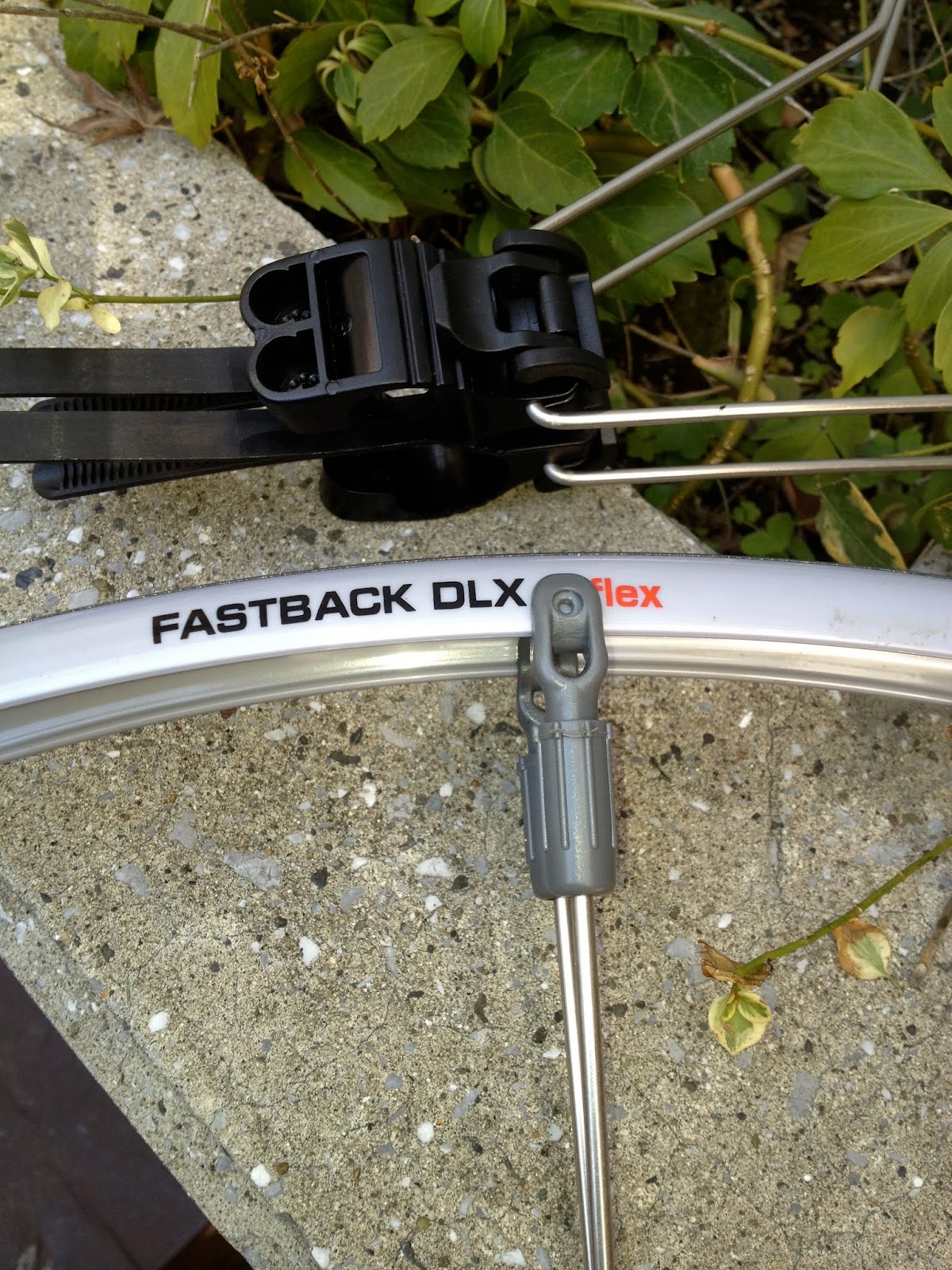
Axiom Fastback DLX Reflex.  I picked up a pair of clip-on plastic fenders that are designed to fit on a road bike that does not have fender attachment eyelets or significant extra brake/fork clearance.


These clip-on fenders, the "Axiom Fastback DLX Reflex", have mudflaps and a very nice reflective stripe.  Unfortunately, they do not attach well to my Reynolds Ouzo Pro fork.  And without eyelets and bolts to attach the fender directly to the bicycle frame, I could not manage to install them on a road frame in a way that is stable or did not rub against my tires, even when I used a 700x23 tire.  They were worthless for me.  Then again, they were not expensive, and I thought I might even cannibalize the mudflaps and some portion of the reflective striping.  BUT SEE BELOW -- I got these to work with a different fork and they are just fine ...

--------------------------------------------------------

Procraft Rainbow Race 35.  Also in 2012, I ordered a cheap (18.50 Euro) pair of Procraft Rainbow Race 35 black plastic fenders that  require eyelets and use traditional hardware.  These I planned to use on the steel Yamabushi, with its cyclocross clearances and ample braze-ons and eyelets.

I only tried to install them in January, after putting the disk brake on the Yamabushi.  The disk brake completely blocked the path of the metal rod you can see in the photo, which extends from the eyelet near the front hub/axel and attaches at two places on the front fender.  With a metal rod on each side of each fender, there are 4 rods attaching in 8 places in all.  And they are way too wide and thick for my other bikes, even the Ti Travel Bike with its relatively generous brake clearances.

So they will sit in the garage, unusable and unused, for the time being.

--------------------------------------------------------

Curana C Lite Alloy.  In late February, I rode the Yamabushi home from work, and stopped at the Potavel shop near the corner of Komazawa Dori and Kyu-Yamate Dori.  They had what looked like a very nice, light weight aluminum fender.  Better yet, the fender was noticeably stiffer than the plastic Procraft, and so required only a single rod for each of front and rear.  The rod attaches to the eyelets on both sides of the hub.  And since I had the bike with me at the shop, I could confirm that the disk brake would not interfere with the fender rod, nor the rod with the brake.  I bought the set and did the installation as soon as I returned home.

Front fender -- single rod wraps around the wheel and does not block the disk brake.
These Curana CLite alloy fenders are really great.  They look nice (to me), fit well, are stiff, easy to install and very light weight (apparently they are made from two thin aluminum layers, with plastic in between -- achieving much greater stiffness and weighing 30% less than plastic).  Yes, they did cost a bit more, around 5500 yen ($60).  But that is not so much considering that I wasted money at least the Fastback clip ons.  Highly recommended.


These fenders won an award at Eurobike 2008 ... so I am a bit late to the party!

They are now tested over many commutes and a few rides outside the city, and work as advertised.

My experience with the Procraft Rainbow 35 (useless for now) and the Curana C Lite Alloy (a great purchase) speaks to the importance of not buying a product online unless and until you really understand how it works with your bicycle.

--------------------------------------------------------

Rear Clip-on Blade -- SKS Xtra Dry 3.  If you do want a rear clip-on blade fender, I swear by the SKS Xtra Dry 3.  It is designed for wide mountain bike tires, so still does the job even if knocked a bit off center.  The clip-on mechanism is very easy to use and adjust.  And it is light weight, fits easily in luggage, etc., etc.  Perfect for use on a road bike during a rainy one day event.


---------------------------------------------------

Update.  The Axiom Fastback DLX Reflex fenders work!

Fender clearance
I got a cheap Tifosi replacement fork for my Ti Travel bike, which has grommets for fenders, more room around the tire area and narrower blades.

I was going to put on the plastic traditional fenders, ... but need to tweak one piece of connecting hardware, so tried the Axiom Fastbacks.
They do fit, both front and rear, and seem reasonably secure.  And the mud flaps protect riders to the rear, unlike some other clip-on fenders.

No rubbing, with 700x23 tires on fairly wide rims (Velocity A23 or HED Belgian).  And now I can report that they also work with 700x25 tires (Conti Four Season Gran Prix 700x25), and over lengthy rides in the rain (14 hours of rain on the May 2013 Kanagawa Audax 400km Okitsu Classic).

The "quick release" feature is great.  I was planning on installing traditional fenders on the Ti travel bike ... but I very much like the QR feature -- the ability to remove them in a few seconds and just leave the hardware on my fork and seat stays -- I will stick with these for the time being.

Two minor issues.  First, the plastic latch that secures the right side of the rear fender broke.  Still, the fender stayed secure even without any latch over a 2-day ride.  And I was able to use superglue and a minor reinforcing piece to revive the latch, at least for the time-being.  Two months later, the plastic latch for the front left attachment also snapped off as I tried to assemble my bike after a train journey and put the fender on at the beginning of ride.  Again, these latches seem unnecessary ... but if they break, then why have them at all?

Second, the rear fender ends at the brake/seat stay, and so in heavier rain/standing water on the road there is definitely some spray off the wheel onto the seat tube and back of my legs.  Still, it is good to get 90% of the protection of a full fender with something that can come on and off in a minute or two.  Perfect for the travel bike.

Third, the fender attachments form large, ugly attachments on the fork and the seat stays.  These are semi-permanent features, even when the fenders are removed during travel or a ride on an entirely dry day.  I am not so worried about the aerodynamics, but these large plastic clumps defeat at least one of the reasons for a removable-style fender.


--------------------------------------------------------
Update.  SKS Raceblade Long plastic removable fenders!  After a bit of browsing on Amazon, I realized that there is one removable fender that fits road bikes, is reasonably priced and seems to get near universally positive reviews.  Also, even though the product is manufacturer-rated for 18-23mm tires, online comments suggested that it works just fine with 700x25mm tires as well.  I purchased a set a few weeks ago from Wiggle (after carefully studying the attachments to confirm that they ought to fit my Ti Travel bike).  They arrived at the end of June and are now installed.

The "semi-permanent" attachments are smaller and less visible than on the Axiom Fastbacks.  The main attachments are small metal pieces that fit onto the front/rear quick release skewers.  By using the QR skewers, instead of some user-selected location on the fork and seat stays, the location is certain every time the fenders are taken on or off.  This allows use of a fixed length fender stay that wraps around the fender.  The fit is perfect for a 700x25mm tire (or 23mm or 20mm).  No need to tweak it.  No worries about the fender adjustment getting re-set after the bike leans against a wall and something gets knocked out of kilter. 
The other semi-permanent attachments attach to the brake.  One sticks out toward the rear, clipping to the main fender body.  A second sticks out to the front, allowing a 150mm attachment extending around the wheel in front of the fork (front) or seat stay (rear).  Significantly better coverage than the Axiom Fastback, without the need to fit a fender through a narrow area under a road bicycle brake.  Plus, as with the Axiom, the product includes mudflaps for extended coverage.  No backwash for a rider following in a paceline.  
On the other hand, there is still slightly less than full rear fender coverage along the seat tube, and no front or rear coverage under the brake itself.  
One of the semi-permanent attachments looks like this:
Although it take a bit of work to get these installed in the first instance, once they are on, the fender just slides on, and comes off with a small push on a tab.  
Here is the 150mm attachment to the rear fender, with the plastic tab visible:
Assuming no problems experienced over the next few weeks, I will use the SKS Raceblade Long fenders instead of the Axiom Fastbacks for London Edinburgh London.
"Final" LEL setup, including SKS Raceblade Long fenders?