 |
| Sunset on the Kujukurihama Beach Line, trading pulls |
 |
| Sunrise in Futtsu, on the start of the Chiba Route 93 climb to Mother Bokujo |
 |
| Taking in the view at the top of the climb, Tokyo Bay below in the distance |
Another Audax Adventure!
This weekend, Jerome and I joined an AJ Chiba 400km brevet. The event started at Noon on Saturday from Lake Teguma in Abiko City. Abiko has decent train links to Tokyo -- either the Ueno Tokyo Line (from Shinagawa near my house) or a continuation of the Chiyoda Line subway beyond its Ayase terminus. The Noon start was because, as the organizers explained, a 400km brevet cannot be completed by a typical audax rider without stretching into two days, so why not split it up, starting and ending when public transit is running, and allowing a rest somewhere in the middle? The organizers suggested riding for 10 hours, resting for as much as 7, and riding again for 10, to complete just at the 27 hour time limit. After three formal control points, at 48, 98, and 192 kms, there were a series of "passage confirmation" checkpoints that did not have a formal time cutoff. This meant riders were free to rest after 192 kms, check into a hotel even, then power on to the finish without worrying about falling a bit behind schedule.
We did take advantage of the ability to go to and from the ride by train, rather than car (or bike).
We did not reserve a hotel or make a plan for a long rest mid-ride. After all, we are training for the Cascade 1400 at end of June. And Cascade's first two days are 340km and 320km. If we need an overnight rest after 200 or 250kms, we will be toast.
As we arrived at Abiko Station, there were a few other riders with rinko bags, and also a few assembling bikes down by the station entrance. Jerome sighed with relief -- his last Chiba brevet was cancelled at the last minute due to "snow" that never stuck to the ground on the actual ride route. Then there was our Mitsumine ride -- a Saitama brevet that had been cancelled due to anti-Covid measures. In fact, there was a decent sized crowd when we got to the start point along the north side of Lake Teguma. We would start in four "waves", ten minutes apart, at 12:00, 12:10, 12:20, and 12:30. We were both in the last wave.
 |
| Jerome rides the 400km after a night out with friends?! |
 |
| The bike are ready to go. Are the riders? |
This crowd was a big contrast to the 6 persons who showed up for the Nishi Izu 200km ride (Matsuzaki Route) two weeks ago. The weather forecast might have had something to do with it. High around 70F (~22-23C), lows around 50F (~14-15C) along most of the route, though it turned out a wee bit colder on the pre-dawn descending sections of southern Boso Hanto. And dry. Ideal.
The only problem was likely to be the wind. Especially on Saturday afternoon/evening we would "enjoy" a stiff wind from the South or SSW. This meant cross winds on the 98 kms to the second PC at Choshi (most of it VERY exposed riding along the north side of the Tonegawa), then 150 kms of headwinds all the way along the eastern coast of Chiba.
For better ... or worse, the wind was not as predicted. We did start with a cross-wind, at times vicious and as if threatening to swoop one off the bicycle. Fortunately, we were on solid, dry asphalt with grippy wheels and heavily loaded bikes (most of the heavy load being us, the riders). So we remained upright. The greater threat was the pedestrian traffic as we rode along the pathway. I forgot to switch on my GPS ride recorder until we cleared the initial few kilometers, but we could not go very fast given the obstacles.
Within 10kms of the start, the crowd dissipated, and the wind shifted, more to the SW. And we started to ride a bit more in an East-North-East direction. Effectively the crosswind was now tailwind. We zoomed forward with a big assist! What a glorious surprise. We were cruising along at 35-40kph or faster without much effort. Jerome seemed to want to go closer to 45kph, and went ahead. I was happy settling in at a slightly slower speed. I warned him to be careful not to get a receipt at the checkpoint from before its official opening time. (Yes, Audax has not only a minimum average speed -- 15kph including stops, overnights, etc. -- but a maximum all-inclusive average speed of 30kph.) If you get a receipt from the convenience store at the control point that shows you arrived too quickly ... you are disqualified. So you just take your bathroom break, eat your snack, and then get your proof of passage. This is never a concern for me ... beyond the first control, in a tailwind.
 |
| Our start path ... quickly we would share with runners and strollers. |
 |
| On the levy/embankment. |
 |
| Nanohana (rapeseed?) everywhere this weekend! |
 |
| Nanohana, embankment, Jerome, Tonegawa ... for a long way. |
 |
| Waiting patiently for a red light after PC1 |
 |
| Wind going to left, riders struggling to go to right. |
 |
| A bit of a "death march" - straight into the wind here. |
 |
| Finally, we get to the harbor at Choshi! |
Jerome waited a bit for me as the course left the Tonegawa embankment for a convenience store nearby that served as the control. Indeed, the control opening time for 12:30 riders was 13:55. My receipt showed 13:56.
Jerome needed a pit stop in the mens room (which had a line of riders waiting) and finally emerged from the store with his snacks and drink as I was already itching to head on. I knew he was riding faster than me so asked if I could head out first, or at least told him I wanted to do so, as he would catch me in any event. The glorious wind continued to push riders ahead ... for another 5kms or so. Then it switched toward the SE. From here, the course gradually bent toward the SE as well. And so almost in an instant the tailwind became a headwind. There was not any intermediate crosswind this time. Just a headwind. And we were exposed as we rode on the river levy ... wide open space for miles in front and at our side, nothing to block or shield us.
As I fought into the headwind, I saw a lone rider moving fast along the road that paralleled the levy on its north side. It was Jerome ... taking a minor deviation from the course and getting a major advantage in terms of some, any protection from the wind. He passed me quickly and was far ahead by the time we crossed over to the South side of the river on a narrow bridge atop flood gates on Chiba Route 260.
From here, we had one more slog of a few kilometers on an embankment, then finally headed to a parallel road that was back from the river and passed by houses, trees, temples, shops, all of which helped to slow the wind. I caught Jerome just before the second control point, where he had pulled off the road for a bit, I guess for a phone call or maybe just to wait. Anyway, it turned out that the second control was within a kilometer down the road. This time we did not need to worry about arriving too early. When we arrived at 16:05, the control had been "open" for over an hour. But we still were making very good time for these conditions. 98 kms in only 3 hrs and 35 minutes, including a decent rest and a long headwind slog. The checkpoint would not "close" until 19:50, so 2 hrs 45 minutes of time savings.
We refueled and spent a few minutes resting before heading out. This time as we sat down to eat, I suggested to Jerome we head out 8 minutes later for a 15 minute total stop. It is easy for rest stops to drag on, and I wanted to keep our excellent momentum.
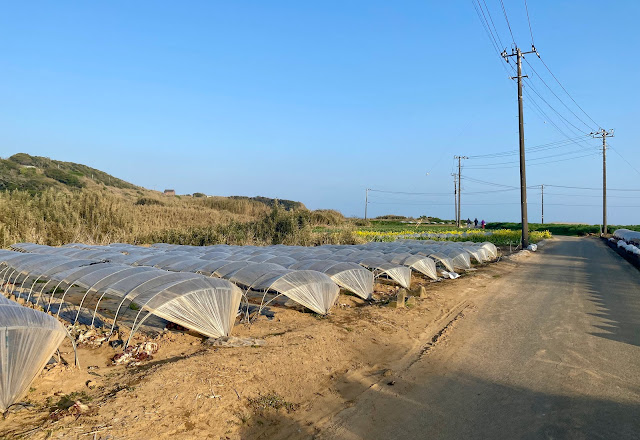
So we did head out together ... as the road curved left and up a gradual slope, into the wind. I quickly lost Jerome's wheel. After 6 or 7kms, at Misakicho, the route left the main road and, for another 7kms, followed side roads, first around the back of a shopping center, through a park, then some dusty fields, but eventually passing through some lovely little valleys up from the nearby ocean. After one lovely stretch, the road turned right and headed into and straight up a very steep hillside. The paving was in a brick-like pattern with each square including elevated concrete and an almost serrated top -- for maximum grip by the farm equipment and other vehicles going up and down? I had never seen this pattern before, but it had to be a 15-20% gradient, I thought. I got off my bike and walked up the short slope.
 |
| On the lovely side road/detour between Choshi and Asahi |
 |
| 100 meters from the last photo, more nanohana |
After rejoining Chiba Route 30, the route headed down the gentle arch of the Chiba coastline and its 99ri beach (kujukuri-hama). It is a very long beach. But it is not 99ri long. That would be
388kms. In fact, it is
only 60kms long. It must have been named by a real estate developer. Maybe the Trump Organization was planning a casino hotel here and wanted it to be the 99 ri beach? The biggest casino hotel on the longest beach! Or maybe it was the Happy Science folks. We passed
Happy Science University near the southern end of the beach. Certainly there is plenty of vacant land around here, so it is the kind of place that real estate developers, or new religions who want a university campus, might like. The coast is an attractive feature, even if the transport links are not great for, say, a corporate facility, or a new residential development. (Just ask the developer of Lakeside Hills in Togane, where my company made a solar park out of unused land. They went through reorganization proceedings twice, once after the "bubble" burst in the 1990s, and again after the 2008 global financial crisis. And they had land available for several solar parks still in 2012-13.)
For much of the route down 99ri beach, we were passing brevet riders headed in the other direction. Apparently this was a Randonneurs Tokyo 400km event. Indeed, I remembered considering which one to try, and chose the Chiba one because the R-Tokyo course involved getting TO and FROM Chiba by bicycle, always a slog, more urban areas in the west of the prefecture, and it missed out on the southern Boso Peninsula, the loveliest part of our ride. Today, however, they had at least the compensation of a tailwind.
I last rode part of part of 99ri beach in November 2021, on the Pelso recumbent, also into a headwind. But then I was 250kms into a brevet, pretty exhausted, and took a nap under a gazebo at one point. Now I made great time, averaging nearly 26kph (including the occasional red light) for a 20km stretch. And the wind had weakened a bit, plus this road had SOME protection in the form of buildings and trees rather than direct exposure to the ocean. I passed a bunch of small groups of riders early on. Then one rider passed me. He was going at a good clip, but I realized it would be easy for me to draft off of him. I did so for probably 5-10 minutes and recovered a lot before pulling alongside and announcing "my turn"! I pulled at least another 5 minutes, then motioned him to come through. He did so, and we traded pulls for the next hour. I was out of liquid the last 30 minutes, and finally explained to him that I needed a vending machine stop. We thanked each other for the collaboration, and I pulled off at the next Coca-Cola machine, where I loaded my bottle with water, and took a rest to consume an Aquarius "sports drink" -- basically sugar water.
Jerome messaged me to ask if I was okay. I gave my location ... and it seems he was just up the road. He said he would continue to a convenience store for a stop, and so I followed and arrived a few minutes after him, only 4 kms from the vending machine stop. We spent around 10 minutes here for a brief snack, and decided we would head on to a Gusto "family restaurant" 20kms or so ahead for a sit-down dinner stop.
About 2/3 of the way to our dinner plan/Gusto, we passed the entrance to an onsen resort that I had thought MIGHT make a good rest area. It was way too early for our "primary" rest of the ride, but there WAS an Italian restaurant just at the entrance, which advertised pizza cooked in a "stone oven". It was open ... and sounded like just what we needed. We spent just over a hour there. Jerome ordered a small "course" with appetizer, pizza, dessert and tea. I did the same, except coffee. The pizza was disappointing. Both our pies were identical -- straight out of the box from the freezer, we thought. Yes, it was pizza, and the volume was plenty, but the taste left a lot to be desired. The crust DID taste as if it had been defrosted. A bit soggy, almost. Jerome had the good sense to stop when he had finished half his. I ate my whole pie. After all, there was some time to digest, and we would start up gradually. That was my mistake.
After dinner, I would expect to take it easy for another 30 minutes or so until I could digest fully. But this time, my stomach never settled. Whenever I pushed a bit too much, I felt a twinge of stomach discomfort -- bloating, gas, even, was it, a wee bit of nausea. Well, I figured, it will fade with time. Jerome pulled now, and I followed. We got to the next checkpoint, PC3, at 192kms, around 9 hrs and 15 minutes into the ride., around 21:45. That was an excellent pace, considering the dinner stop, the headwinds (weaker now, but still there) and now my tender stomach. PC3 did not "close" until 1:18AM. We had plenty of time now if we wanted a longer stop.
But where would we stop? It was not cold for the coastline in Springtime, probably 15 degrees C. But a breezy 15 degrees C is not really ideal weather for sleeping on a bench in a park for more than a few minutes. I had not found any onsen (hot spring) that allowed short-term visitors this late at night, other than the one way back where we ate dinner. The family restaurants on this coastline all seemed to close at 22:30, having abandoned 24 hour service long ago (indeed, even some share of the convenience stores in rural areas have abandoned 24 hour service as the population ages). Jerome suggested we try a coin laundry, if we could find one open late at night. There were several in Kamogawa about 30 kms further on, including one that was open until 1AM and not far from our course.
We were going slower now, but got to our destination before 1130PM. My stomach was okay ... unless i tried to push it. Plenty of time for a nap. There was no one inside, but several washer/dryers were running, and I noticed that there were guys sitting in two cars in the parking lot, each engrossed in his smartphone. Typical scene. We rinsed some items -- caps, socks, etc. and tossed them into a dryer, feeding all my 100 yen coins in the slot, then lay down on the chairs across the front of the shop. There were two other chairs at a table in case anyone else needed to sit down, but that seemed unlikely.
 |
| Our hotel for the night. |
 |
| Either the chairs are too small, or the rider is too big. |
One of my shoulders and arms was off the edge of the tiny chair and hung in mid air. I could rest, but I could not sleep. I guess I was not tired enough, or the precarious perch was keeping my mind alert. At least I can see that my heart rate declined gradually over the first 30 minutes of this rest, and stayed at an actual resting level the second half.
We rejoined the course and kept heading Southwest. The wind had quieted enough so that we could now hear the ocean in places. The route left the main highway and went through some towns, up some hills or along the harbor. There was one place where the organizers had cautioned that the main road (via a tunnel) constituted an illegal short cut. They clearly wrote in the briefing materials that anyone they saw taking this tunnel would be disqualified. ... I had warned Jerome about this, and we could easily follow a rider about 100m ahead of us where we were supposed to turn off the main road and head up a hill and over a small pass instead. A few kms ahead the route crossed the main road and continued around an outcrop along the sea, waves crashing below. But as we waited to cross the highway ... a brevet rider came out of the tunnel. I said "you can't do that, the tunnel is off the course and prohibited!" He looked disappointed, at having been noticed, or having made a mistake. Anyway, he could easily go back through the tunnel (or along the course) and repeat the section properly ... or just wait until we left then continue on. We did not wait to find out.
I was doing okay, except whenever I pushed a bit, my stomach acted up. Clearly the stomach juices had been shaken up, and they had not settled down even with the passage of time and an hour or more of rest flat on my back. I snacked conservatively -- an onigiri, a hard boiled egg, but was careful to avoid anything that might add to the upset.
After one last checkpoint around 239 kms, we finally turned off the coastline and headed across the narrow southern part of Boso Peninsula for Tateyama. I could not stay with Jerome on the short climb of this section. We had another "passage checkpoint" in Tateyama, then started another section with two climbs up, down, up, and down, peaking just over 200 meters. Again, despite a toilet stop at the checkpoint, I could not stay with Jerome on the long gradual uphill approach to the first climb, as my stomach started to feel queasy. Eventually, I pulled off the road for a rest. I was not sick enough to vomit, but not healthy enough to ride with full power. And now it was almost seven hours and 100km since we finished dinner. I stuck my finger down my throat ... and a big dry heave. I repeated a few times, still nothing but air (or stomach gases) coming up. I sipped some water ... and I felt 100% better. The pizza must have been fully digested by now. I wished I had tried this tactic an hour or two earlier.
Immediately I felt better, and stronger. I messaged Jerome at the beginning of the second climb ... much shorter and steeper than the first, to the same elevation. Jerome responded that he was almost at the top. I had no problems on this one, passing one tired rider who was walking up the entire way ... I could see his light far below as I crested. On the next descent I could see a bit of light in the sky and stopped to snap a photo, then pushed on to the passage checkpoint at another 7-11, in Futtsu.


After a decent rest (15 minutes, including eating a convenient store "doria" rice dish), we headed toward the event's longest climb, 6 kms to "Mother Bokujo" then another couple to the top of the Kanozan. The last 3 kms to the bokujo were steep, and it was with a sense of accomplishment that we took in the view. There was still almost no traffic before 7AM on a Sunday morning, and I could hear birdsong on the entire climb and even more so descending the north side. There were sakura on the hills and in the forest that were still with blossom. And the day was warm. It was a lovely start to the new day.
 |
| Sakura on the descent of the north side of Kanozan. |
We enjoyed the ride through towns and countryside, eventually passing the park-like industrial center (a true "industrial park") of Kimitsu's Academia Park. At the start of one climb, after we turned onto a small road through some fields, we lay down to rest on a concrete turnout. It was warm, a cool breeze, lovely flowering plants and a nice view. Ten minutes here ... were as refreshing at least as an hour in the coin laundry!
The next PC, around 332kms, had a good group of riders and some shade around the side of the 7-11 where we could sit on the pavement. I recognized Kurosawa-san (his brevet vest has his name, and his jersey also is from the Kurosawa Cycle Shop). I guess he is in the cycling business. Anyway, he is a regular at these events. He was riding with a group that included one woman randonneur (also referred to as a "randonneuse"). I had passed them on the embankment to the Tonegawa Saturday after about 5-10kms of nasty headwinds, and she had remarked at my "power" riding into the wind. She repeated the remark at the PC. I noted that I had also passed them on the down hill at Academia Park. Yes, she and Kurosawa-san said they remembered. I pointed out that I am now at (back at) a weight which allows me to pass many riders downhill, and to maintain firm grounding into headwinds. ... but not ideal for cycling generally and especially for climbs -- an attempt at self-deprecating humor. Another younger woman with spectacular waist-length hair and mechanic's coveralls had stopped in a slightly beat-up old Mazda roadster (Miata?) at the checkpoint. She was obviously friends with that group and joined their conversation. It became clear that she and the woman who had spoken to me were a couple. Jerome suggested they should trade places for the rest of the brevet. Many riders who seemed to know them admired the Mazda, one of the more beat-up cars I have seen in Japan recently. I guess they are Chiba audax regulars.
Things started to go downhill a bit after that checkpoint. First, the course veered into urban Chiba. Sodegaura-shi, Ichihara-shi, Chiba-shi. Then it remained mostly urban until the 370km checkpoint, with only the occasional opportunity to ride in an agricultural area between two towns. The worst stretch was a road parallel to the Keiyō Road expressway. Not only was there lots of traffic, but we were stuck behind 3 riders who, at each red light, were waiting behind all the cars ahead of them rather than sliding up along the curb to the front ... where you can SEE cars coming from the side, the cars waiting can SEE YOU, and you can BE READY for the light to change. We missed light after light ... they were not anticipating lights, or gunning it through on yellow. And as with many lighter Japanese riders, they would accelerate very quickly for a few seconds ... then stop their acceleration at a top speed that was 2-3kph slower than we wanted to go. Traffic was heavy now, and it was actually getting a bit hot, the morning sun high, no shade, and no tailwind as we headed north -- near zero compensation for yesterday's headwind.
Eventually Jerome and I cut ahead and made it through a traffic light that the others missed. We passed some other groups of riders until eventually one younger guy "attacked" us on a short climb. He went zooming ahead. I could only think ... why didn't he finish hours ago if he can ride that fast? Then we caught him at the next red light, sitting behind the line of cars rather than sneaking to the front. We turned a corner and headed up a hill, and he attacked again, zooming ahead. We caught him again at the next light. Also, he was riding in a long sleeve jersey and what seemed full cold weather tights. By this time, Jerome and I were in summer weight gear. I think we actually made it to the next and last passage checkpoint ahead of him. I wanted to tell him "you know, in the US and Europe, cyclists go to the front at traffic lights. It is MUCH safer if you can be out front where you can see the cross traffic, and where all drivers can see you. And you don't get drivers turning in front of you and cutting your front wheel out from under you." But I figured I should just respect Japanese tradition.
Indeed, the drivers in Sodegaura and Ichihara are among the most ill-tempered I have come across in Japan (a view I formed from a minor shouting match I had with one who cut me off on Meguro Dori in Tokyo more than a decade ago). I guess if I lived in car-dependent Sodegaura and needed to pass through Ichihara and Chiba congestion, I would be impatient also. One driver revved his (or her) engine ominously behind Jerome and me as we rode, angry that our presence dared to make it difficult for them to pass given a steady line of ongoing traffic, even though our speed was pretty close to that of the cars. ... eventually, the car did pass, with a squeal of wheels and a roar of the engine (well, a yelp at least ... not a big car nor a big engine). ... but we caught up within a few hundred meters at the next red light. In other circumstances we would have challenged them ... but we were tired, and there was another brevet rider present, so we just waited behind for the light to change. Sometimes prudence is the better part of valor.
Anyway, my main complaint was not the traffic, but "hot foot", a symptom that can have many causes but is not uncommon with endurance cyclists. I have had this issue from time to time over the years while cycling long distances (never otherwise). One or both feet get too much pressure on the sole of the foot over a longer ride, leading to stinging pain. Usually it has been solved with a cleat adjustment and a better insole and perhaps a slightly roomier shoe. Mid-ride, I can ameliorate it with a short rest, curling my toes, "spinning" rather than grinding the gears, or even doing one-leg cycling exercises for a few minutes. But I got a new pair of shoes this year, and nothing I do has yet to solve the issue -- though slamming the cleats back, flexing the feet in my shoes, etc. did keep it from appearing for over 200kms this weekend. Next brevet, I will try my old shoes and see if they are better, as I remember them.
Another minor challenge was my eTap front derailleur. A couple times I backpedaled at a red light to get ready to clip in ... when the chain was not securely on rear gear, and the chain came off to the inside. After resetting the chain, I realized that the position of the front derailleur must have shifted a bit as the derailleur cage no longer pushed far enough outside to shift the chain onto the large chainring. The derailleur seemed to have moved enough in its clamp from the chain coming off to cause this. It happened 3 times over the 400kms. Each time I could just tug on the derailleur cage a bit and it again worked perfectly. I need to check this and make sure the derailleur clamp position is really secure so it does not move. In general, I love the SRAM eTap shifting, and this should be an easy fix with the bike up on a stand.
The last 30kms included much more rural scenery, and many of the dells (gullies?) I recall from trips East<->West through the same part of the prefecture. I took no photos -- my total focus now was on getting to the goal. We pushed on, Jerome still pulling me much of the time, now focused on getting back to Tokyo and voting in Sunday's French presidential election, which required that he get home, shower, change, and be at the Embassy in town by late afternoon.
We made it to the finish just 24 hours after our start, checked in, went to Abiko Station, packed our bikes, and got the Ueno Tokyo Line.
Jerome voted (and drank with compatriots to celebrate the occasion). I got home, took a cool bath, and slept extremely deeply from just after 4PM until midnight, then again from 2AM until after 6AM, so 12+ hours in total. Today my body feels extremely relaxed. I am a bit drowsy still, a bit stiff in the leg muscles, but all the stress and tension are gone.
All in all, it was a good course and a successful brevet. But for the headwinds, it would have been considered an easy event. And we are now well on the way to qualifying for Cascade 1400 and, more importantly, attaining the kind of physical conditioning that will allow us to compete a 5 day, 1400km event.
Our route:

Time Management. We finished with nearly 3 hours to spare, so time management did not seem much of an issue. But this pace is not quite what we need to accomplish for Cascade 1400 where the first three days are 340, 320, and 301 kms in length. Looking at the stops along this weekend's ride, I can see some easy ways that would have improved our time.
-- The 140/144.5/157 km stops were too close together. The first two were okay for me to reconnect with Jerome, but we should have gone onward as soon as I showed up at the convenience store at 144.5 and grabbed an onigiri. (-5 or 10 mins). Maybe I should have asked him to get one for me so I would not even need to enter the store? We also should have avoided the "course" menu and kept the dinner 15 minutes shorter. (-15 mins).
-- The 239/250 PCs are very close together. Many riders stopped at the 239km PC, but just got proof of passage and continued on at 250km. If I had not still had stomach issues, that would have been a good approach. (-10 mins)
-- We spent too long in the last two controls, at 330/370kms. Of course, we were tired and we enjoyed chatting with some of the riders at the 330km control. But we would have been less tired if we had spent 10-15 minutes less at each control and kept forward motion in a relaxed manner. (-25 or 30 mins)
So if we had been more focused on time management -- if we had needed to focus on time management -- I think we could have shaved nearly an hour off the rests, and probably shaved at least 40-45 minutes off our elapsed time with no more intense effort.
That is a good lesson for next week's very challenging 300km ride.

So all I need to do to be ready for Cascade1400 is:
-- continue to improve my cycling condition, especially work on recovery for multi-day efforts and lose some weight for faster climbing.
-- be careful to eat in smaller portions and only easily digestible foods during rides. Eat less at stops. Order a sandwich, eat half, and finish it 60-90 minutes later by the side of the road in a beautiful place.
-- fix the "hot foot" issues -- go back to my old shoes if I cannot with these.
-- better time management during the ride to ensure plenty of sleep in the overnight controls.
-- build-up and dial-in the titanium travel bike with its new components ... to be revealed soon!


