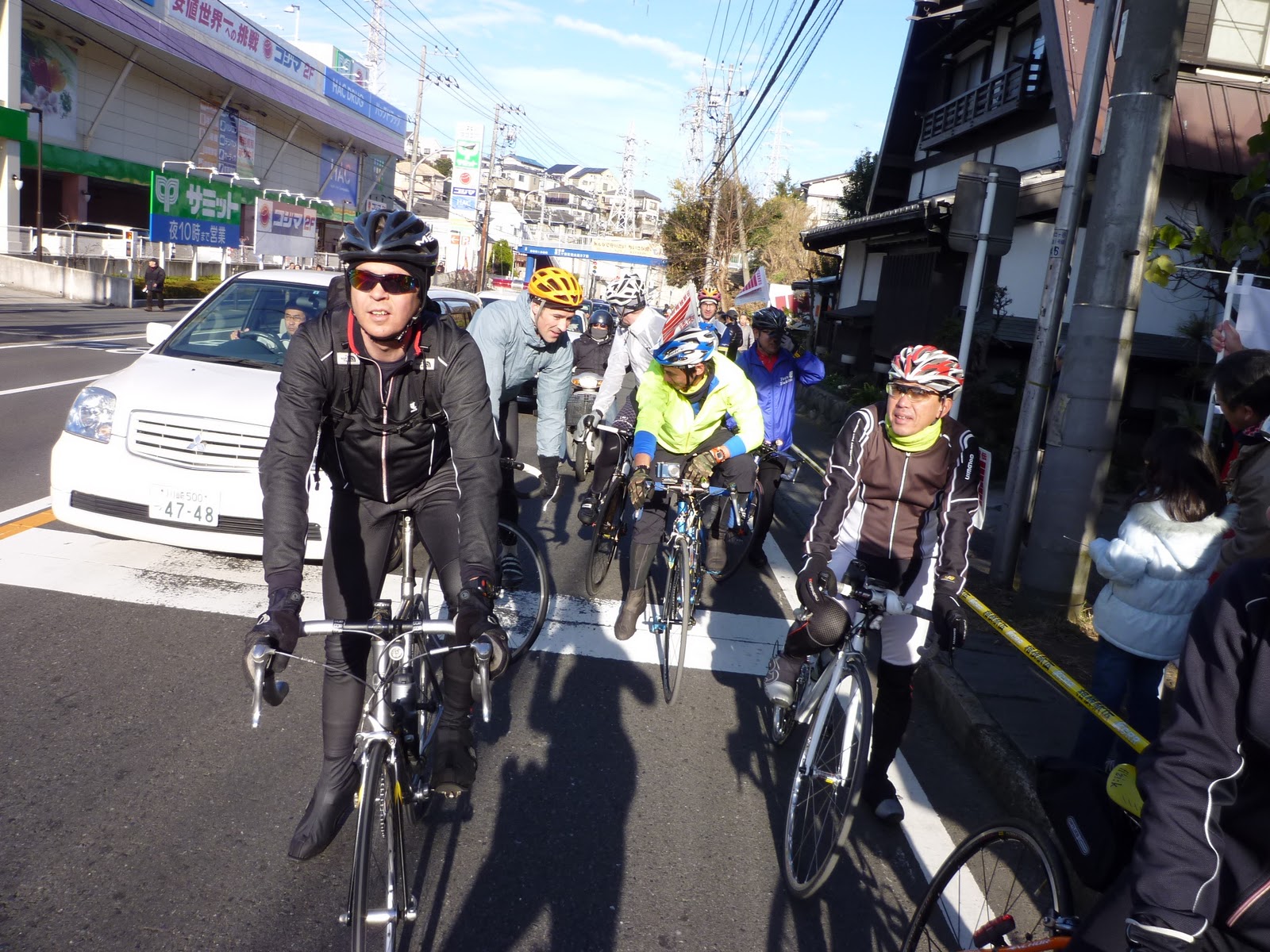
It is now three months since I last touched my bikes. As I reported previously (http://positivo-espresso.blogspot.com/2011/10/three-years.html) strong back pain has changed my life in an unexpected way. Here is the full story of what has happened and what I have done about it.
The morning after an exceptionally hard ride in mid August (http://connect.garmin.com/activity/106388342 and http://vlaamsewielrenner.blogspot.com/2011/08/manfred-von-rindomeisteradded-two-new.html), I woke up with a slight but persistent pain in my lower back. I thought I must have slept particularly deep after such an exhausting ride, and my muscles must have relaxed so much that a disk had slipped a bit. This happened to me on occasions many years ago, and the pain always disappeared after some days or weeks.
Alas, this was not the case this time. Worse, I noticed that on subsequent rides my usual back pain while riding got worse, requiring me to take more frequent breaks to relax my back. A longer ride in Austria (http://connect.garmin.com/activity/113853004) was particularly painful and I remember being happy that I was back in the hotel after what was a mere 160km and not even 2,000m of climbing - laughable by my standards. The much harder aluminium bike I ride in Germany and Austria was not kind on my back, even on well paved roads.
I managed to complete four more really tough rides back in Japan, despite the pain. My last ride on 1 October was a rather easy one, except for the fact that I did Jinba-san partly by bike, partly pushing my bike, to the utter surprise of all hikers.
At some point during the first week of October, the back pain increased significantly, and it became worse every day. It was so bad that I knew immediately something was really wrong and I had to get an MRI done. I went to the closest orthopaedic clinic with an MRI, and after a short negotiation I was indeed able to get the MRI done right away.
The doctor glanced at the images on his screen for a few seconds, mumbled hernia and said this was to be expected with age and would happen more and more often.

The MRI image indeed showed some protrusion of two disks, similar to what I had ten years ago. Only back then the pain had developed more slowly over time, and was of a more bearable nature.
He prescribed me a few days worth of Mohrus (ketoprofen) tape and handed me a few leaflets explaining how to do exercises to strengthen my back muscles once I'm better. In the meantime, he wanted me to come back every few days for "rehabilitation" exercises, i.e. electric treatment, massage etc.
Tape and electric treatment helped a bit, but not for long. The following week the pain kept increasing to unbearable levels. Always the left side of the back and right down to the left knee. The pain became so strong I could no longer walk properly.
I went back to the doctor, several times. I got his favorite NSAID pain killer (Loxonin = loxoprofen), more tape, more electric treatments. He refused to give me PPIs to protect my stomach as he claimed the insurance claims bureau would reject reimbursement and would even blacklist him for all his claims (a totally absurd claim, but one that is made frequently by Japanese orthopaedists who stopped learning anything new about their field 20 or more years ago). I had to take my own omeprazole pills which I had bought in the US over the counter, just in case.
Overall, he showed little sympathy with me for my pain, belittling it as normal. When I asked for an epidural injection, he claimed I was not in the right condition for such a treatment. Another absurd claim, which only proved he was both clueless and wanted to avoid doing anything that would take more than 30 seconds of his time or refer me to another doctor and thus lose me as a source of income.
On another day of intense pain that kept me away from sitting down and mustering enough concentration for work, I had enough and went to another orthopaedist close to my office. He was a lot more understanding and willing to take the time to discuss treatment options and prescribe a couple of different pain killers for me to try out, each in sufficient quantity so I did not have to come back just 2-3 days later. I had no difficulty getting a PPI (lanzoprazole) prescribed either. He also offered to do an epidural injection, though ideally only a few days later at his own practice (he was working only one afternoon at the clinic I had chosen).
I tried out Lyrica but it made me feel so bad that I had to stop taking it after just two doses. I was back on a combination of two ketoprofen or loxoprofen patches per day, combined with Celecox (celecoxib) and lanzoprazole. Eventually, I managed to convince him to write his very first script for Nexium, the most effective PPI which had launched only a few weeks earlier in Japan (many years after the rest of the world).
In the meantime, I had contacted an uncle of mine in Germany who himself is a hospital-based orthopaedist specialising on the lower back (what luck!). He had already advised me ten years ago on my first bout of hernia. I sent him the MRI and X-ray images which I had bought of the clinic and eventually managed to speak to him by phone. He had uploaded the images into their hospital system and was impressed by their quality.
He quite categorically denied that I had hernia. Some protrusion was normal for one third of people of my age and my type of pain did not fit the pain caused by a disk pushing onto the spinal nerve. (And indeed, it was very different from what I had experienced ten years ago.)

 Instead, he suggested that one or two disks may have ruptured. Not only did my pain symptoms point to discogenic pain, but the images also showed so-called high-intensity zones (HIZs) at the edge of two of the disks, and these are normally an indication of rupture.
Normally, disks do not contain nerves, so a rapture should not be felt. In my case, nerves may have grown into the disk(s) - perhaps because of the frequent and prolonged pressure to which they were subjected when I was riding road bikes?
 Next he started pushing contrast media into the disk. If this disk was the cause of my pains, building up pressure inside the disk this way should produce the same pain I normally experience. Alas it did not. Only when 1.5ml was injected did I feel some pain - but not the same pain I normally have.
Needle out and a new needle into the next disk. He deliberately did not tell me in which sequence he was doing the disks as to avoid biasing my perceptions. However, I had already guessed he would have started with the lower of the two and now noticed that the next penetration was higher up. He had to admit defeat :)

The left-hand image shows a HIZ at the left side of disk L4/5. This would fit the fact that I have strong pain on the left side of my back, going down into my leg, but not beyond the knee.
The second image here shows a HIZ at the back-side of the L3/4 disk. This led at least me to hypothesise that this was the disk that ruptured already in August.
My uncle suggested I should get three epidural injections, sequenced a few days apart. This might both help me to alleviate the strong pain, and also serve as a further diagnostic tool.
I had these done at the second doctor. In case of hernia, injecting a combination of a local anaesthetic (10ml 5% Xylocaine = lidocaine) and a cortisone = steroid (3.3ml dexamethasone) works wonders. The anaesthetic takes away the pain right away, and the steroid takes away the inflammation which may then give pain relief for many weeks or even months.
In my case, initially nothing happened other the skin around my bottom becoming slightly numb. The pain persisted unabated. A few hours later the steroid started working, on my entire body. The back pain went down to much more bearable levels, but I also experienced the typical side effects of too much adrenaline, just like after a very long bike ride: headache, dryness, racing heart etc.
The doctor was puzzled by this, but to me it was already clear that these injections could not have a better effect, as the epidural channel was not connected to the real source of the pain: a raptured disk.
I went back for the second and third injections because they provided still some relief and my uncle had suggested to be persistent. By the third injection, however, I felt rather tense about these injections as they were somewhat painful without the use of a local anaesthetic and dangerous without proper anti-sceptic cleaning of my lower back (an infection in the spine would be disastrous). This probably caused the doctor to pass the needle into my bone rather than the epidural channel and I continued to feel the pain from this mistake for many weeks.
By this time, I had agreed with my uncle what the next steps should be. He said I should get discography done to confirm the hypothesis about the disk raptures and confirm which of the two disks was the real problem.
Discography is nicely described in this short video: http://www.spine-health.com/video/discography-video-non-surgical-back-pain-diagnostic-procedure. This intervention helps to identify which disc, if any, is causing the pain, and why.
If these interventions then confirmed the hypothesis, I should undergo intradiscal electrothermal annuloplasty = IDET, described nicely here: http://www.spine-health.com/video/idet-interactive-video. By literally boiling the painful disc, nerves that have grown into the disc are meant to be destroyed and proteins of the disc are meant to be changed which in turn should lead to some kind of regeneration of the disc. Nobody seems to know how this actually works - but in about half of the cases it is effective.
I asked the Japanese doctor what about doing discography. He reluctantly admitted that was a possibility, but said it would require me going to a hospital and they would then likely want to put me under the knife which he thought was the wrong answer.
Rather than taking more chances and arguing my way through Japanese medicine, I decided it was much easier to put myself into the good care of my uncle - or rather his boss, the medical director of a hospital division specializing in "conservative and operative spinal therapy", as my uncle didn't want to take responsibility for treating relatives and friends.
After some back and forth on the dates and me having to cancel some professional commitments, I flew to Germany in mid November. My uncle and aunt took good care of me and until the actual hospitalization, I stayed two nights with them.
I spent the first morning getting checked up and signed into the hospital, and prepaying for the interventions to come. I received a lot of attention and everybody was exceedingly nice to me - quite a difference from visiting a hospital in Japan where everything works like in a factory (for better and worse). The afternoon I was free to do some sightseeing in this beautiful town of Germany which I had never properly visited before.
The next morning my uncle drove me into the hospital for a 6:30am start. The medical director came by for a quick check-in. This was the first time for me to meet him - up to then my uncle and other younger doctors had done all the preparations. Shortly after 7:00am I was being rolled into the operating room.
It took at least half an hour to get the room prepared (so much again for German efficiency!) - plenty of time for me lying on the operating table to chat with the nurses about my past life as a paramedic. I was nervous - pulse at 80, blood pressure at 140, despite the early hour. Still nothing as nervous as at the start of a cycling race when my pulse was typically at 100! I remembered to ask for a protective cover for my lower parts. Lots of x-rays would be taken during the intervention to help guide the needles being inserted into my disks.
The medical director started injecting a local anaesthetic into my right side of my lower back. Soon after he pushed the pretty thick needle through my skin. Actually, it isn't even a needle - there is no sharp tip, so it took some force to push it through my skin. From then on, he went subsequently deeper through many layers of tissue (8cm in total) to finally reach the first disk. The deeper he got, the more I would feel the advancing needle. Penetrating the disk took some force and was associated with quite some pain - itself an indication that the disk was not without issues.
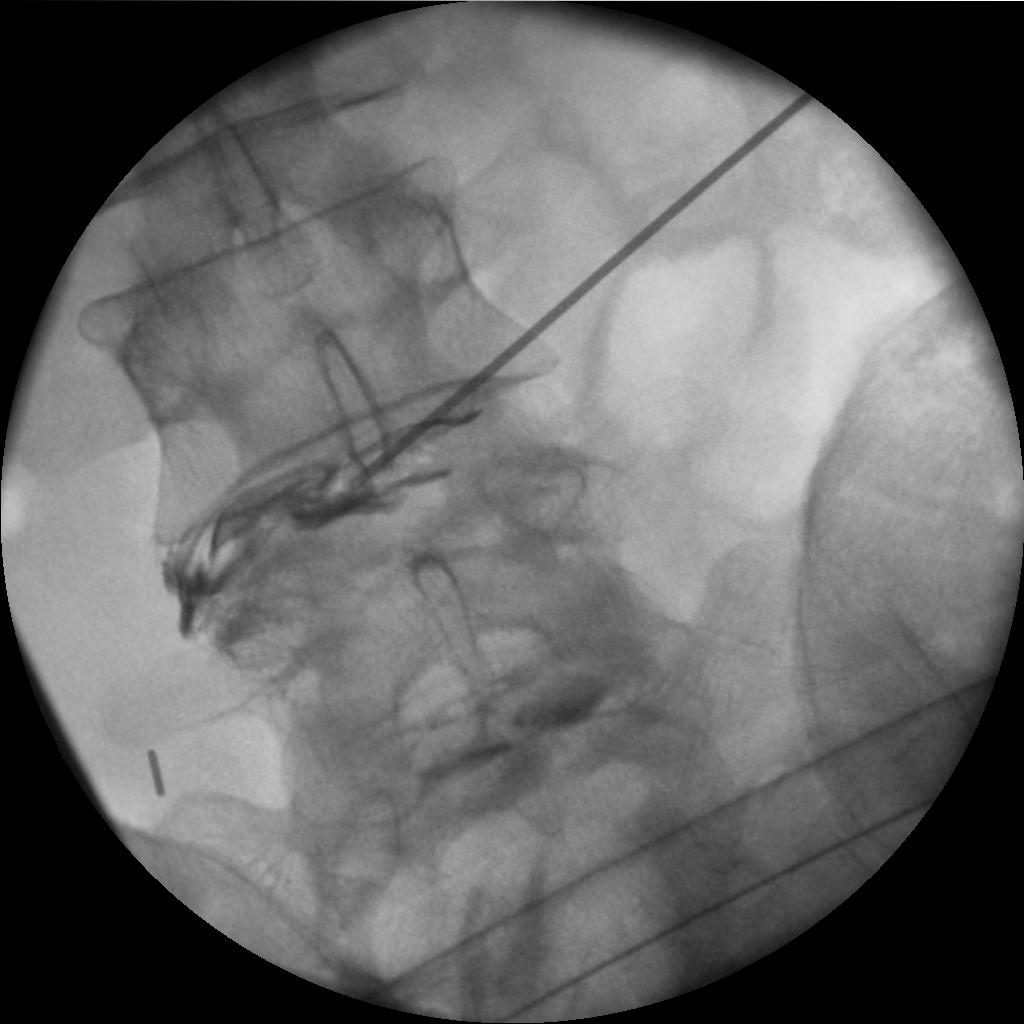 Next he started pushing contrast media into the disk. If this disk was the cause of my pains, building up pressure inside the disk this way should produce the same pain I normally experience. Alas it did not. Only when 1.5ml was injected did I feel some pain - but not the same pain I normally have.
Needle out and a new needle into the next disk. He deliberately did not tell me in which sequence he was doing the disks as to avoid biasing my perceptions. However, I had already guessed he would have started with the lower of the two and now noticed that the next penetration was higher up. He had to admit defeat :)
Same procedure again, only this time it was harder to reach the disk and also to penetrate it. Not a great
feeling having someone basically poke a knife twice into your back!
Now only 0.7ml of contrast media already produced a lot of pain - though not really the same pain going into my leg that I normally experience. This led him to conclude that proceeding to the next intervention (IDET) was not indicated. He counselled that IDET was an irriversible procedure and he would recommend it only if discography had produced clearer results.
That was in some sense still a disappointment, because I had hoped for some kind of intervention that would finally stop this immense pain!
As with the previous disk, he completed the procedure by injecting a bit of a local anaesthetic into the disk, which would give me amazing relief from all the back pain for the next 16 hours or so (and thus also helped to reconfirm the source of my trouble).
I spent one night in the hospital recovering from the intervention which had swollen my back quite a bit - but took only half a day to disappear again.
The next morning, before leaving the hospital to spend the weekend with my parents, he gave me an epidural injection. Unlike in Japan, this one was masterly placed into the epidural channel just between my bad disks, local anaesthetic and proper disinfection included, done by the medical director without any assistance.
Alas, the effect was no different from the injections in Japan: no immediate relief, and only modest relief from the cortisone over the weekend.
The medical director and my uncle got together over the weekend to discuss my case. For some reason, the medical director hadn't remembered that all my pain was on the left side. When he realised it, all the pieces fell into place. The above X-ray images of the discography show that while the contrast media stayed inside the L3/4 disk, it escaped to the left from L4/5, indicating a completely ruptured disk. Moreover, as a result of the leak, it was not possible to build up the pressure needed to produce my normal back pain, so this explained the initially negative finding.
When I called my uncle Monday morning, he said I should come quickly for an IDET intervention, and not another epidural injection as initially planned.

I was in my hospital bed at 11am, awaiting to be pushed into the OP momentarily, but it eventually took another three hours and a short visit from the medical director before I was really there.
Similar setup as last time - only that I forgot to ask for the X-ray projection until it was too late!
Once again, the needle was inserted into my back and into my L4/5 disk. The first attempt to place the thermal catheder failed as it landed it the wrong place inside the disk (see the first image on the left). Pushing it in and pulling it out was no fun - a very peculiar pain inside my disk which I have never experienced before and hope to never experience again.
 In the second attempt, the catheder reached the left-side of the disk. Now temperature was put onto the catheder, in steps up to 85 degrees. The disk became increasingly painful. I agreed to endure for as long as was necessary to achieve a good outcome. When it was over and I looked up, the timer showed 6:53 minutes.
The heat-related pain did not disappear after the catheder was gone, though injecting another round of local anaesthetic at least killed the normal back pain for the next 16 hours. During that time, the heat pain started subsiding, though not disappearing completely. That took another few weeks.
In the first few days after the intervention, I felt remarkably good, except for short bouts of minor heat pain in the disk. However, almost as

soon as I was back in Japan, did the back pain become stronger again. What a disappointment!
Fortunately it is not at the level it was before the intervention, which was truly unbearable. But it is not at a level at which I can be happy, and I am still dependent on taking NSAIDs every day because without them the pain swells back to bad levels.
The prospect of no more improvement makes me wonder what my future will look like: drug dependent until the rest of my life? Not a good prospect, considering the long-term side effects NSAIDs have (chance of earlier death), not even considering the prospect of never getting back onto a bike.
My uncle still thinks I may improve in a few months' time. And in the worst case? Well, he hasn't seen old people with discogenic pain - i.e. maybe I'm finally pain free in 20 years or so...
After six weeks of mandatory rest from exercise, I have started a careful programme of back exercises and walking/hiking. Let's see what this will bring - at a minimum some positive feelings!
* * *
Some final thoughts. Why did this happen to me? Did I overdo the cycling? No doctor wants to confirm, the logic being that many people cycle at least as hard as I did and they don't have their disks rupture, and most people with ruptured disks are not cyclists. Personally I still think that all the strains on my back while riding up to 13 hours a day leaning my body forward must have at least contributed to the problem. The back pain while riding was a warning sign, but as it always disappeared as soon as I got off the bike, I did not take it seriously - it was merely a big annoyance.
Was it perhaps the position on my bikes which was wrong? This is another possibility, as I preferred to sit relatively high and lean forward as much as possible, to gain leverage in my legs and be aerodynamic. To do what I did this felt perfect - except for the back pain. I did experiment with a somewhat lower saddle height, but this did not reduce the pain while riding, and when too low went into my knees. So I am not sure my fitting was poor. If I ever get into the position of riding again, I will of course have a proper bike fit done, just to be safe.