11 August 2013

The Spanish Job

After a long week of cycling during LEL, what better way to recover than ... more cycling, in Spain, at the Positivo Espresso Sierra Nevada (Alpujarra) summer training camp.

Time does not yet permit a full report, including the "queen stage" of our successful ascent of the Pico de Veleta, ... but for now a few pictures I hope will help to quench our viewers' thirsts.
We traveled in a black, white and grey VW Golf convoy, in honor of the 2003 remake of "The Italian Job".
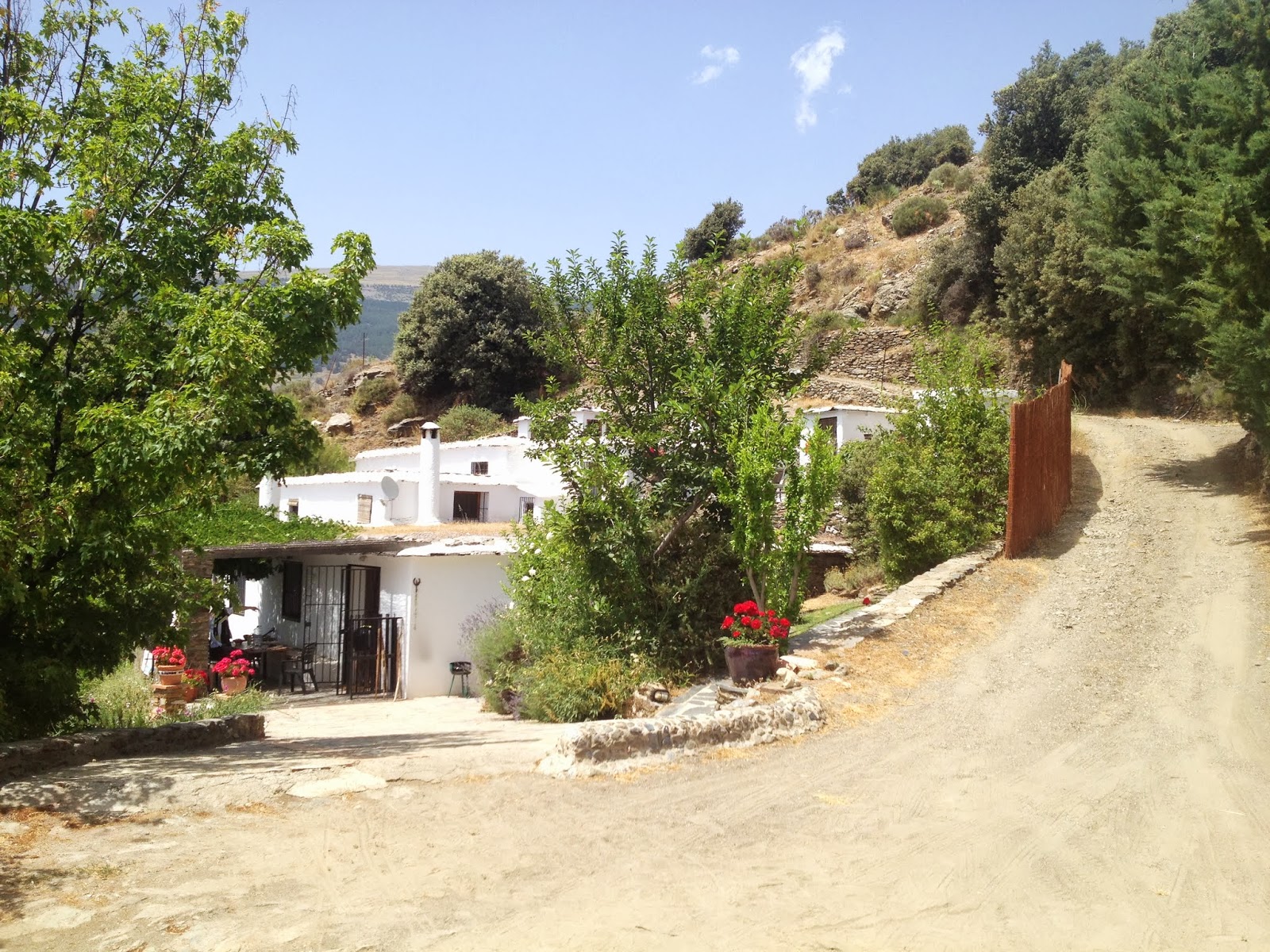
Our base camp, strategically located above Capileira at 1700 meters elevation for altitude adjustment,
approximately 2 kms from the end of the paved roads.
Looking up at Bubion (right front) and Capileira (left rear)
Trevelez, the home of the Spanish ham (jamon), through which all rides seemed to pass.
Inside J. Jimenez, direct seller of Jamones, in Trevelez

Juliane "the gazelle" Prechtl, at the intersection beyond Trevelez through which almost all rides passed.

Another perspective on "the intersection".  Note the very low traffic volumes.

Positivistas David, Stephen and MOB in Valor mid-ride

Another view of the middle/upper villages of Trevelez, approximate elevation 1500 meters 
MOB poses behind the "Bimbo truck"

07 August 2013

London-Edinburgh-London ("LEL") 2013

Last week I rode LEL.  I arrived in London on Thursday late afternoon -- just enough time for clearing the worst of jet lag -- and stayed in Lambeth (close-in SW London) with Positivistas David and Juliane.  It helped to be with friends on Friday and Saturday, since it prevented me from sleeping all day, ensuring that I got at least some decent sleep each night.
My Ti Travel bike, Voyage Voyage, rests among David and Juliane's vintage parts collection
Near David and Juliane's home in London -- a sign on the Council-owned housing block


As seems usual for these long randonees, I finished near the back of the pack, but at least with plenty of reserve strength left "in the tank" and hours to spare before the cutoff time.

It was a really great, memorable experience, as one of these rides should be.  How does this ride compare to Paris-Brest-Paris 2011, or the 2012 Cascade 1200 or Rocky Mountain 1200?  
The Prologue departs central London, just after 6AM on Sunday July 28
LEL is longer.  Indeed, including the prologue, and the ride back into London on Friday morning, and a few minor detours, I traveled nearly 1500 kilometers in 5 days.  300 kms (190 miles) per day.  So it is as if I rode Tokyo-Itoigawa, slept 4 hours, then repeated it again ... 5 times in total.

While LEL is longer than PBP, Cascade or Rocky Mountain 1200s, it is not necessarily harder than these.  That depends on weather -- heat, rain and wind -- and this year we cannot complain overall, even if we did suffer from headwinds in the afternoon on Day 2 and again on much of Day 4 and 5, and we did get rain at times on Days 3 and 4.  
The English countryside, mid-day on Day 1,  north of London
Two factors make LEL a bit easier.  First, the time cut offs at controls seem very generous, making it possible to rest earlier and longer than would otherwise be the case.  Second, while there is plenty of up and down, and a few real climbs, there are no long "all category" efforts, and long stretches are entirely flat.
In the Fenlands, a flat stretch on Day 1 -- nice while the tailwind lasted
Same location, looking to the South
My ride plan was to finish Day 1 early.  I arrived at Market Rasen a little after 7PM, ate, slept for 4+ hours, then started Day 2 in the wee hours of the morning.  I had only ridden the prologue plus 248 kms of the real event, but had been up since 430AM, so a real rest seemed in order.  When I awoke at 1:00 AM, a gymasium that had been nearly empty was now full of sleeping riders.  As I left the control, a few very tired riders were still arriving.  I used a similar strategy on subsequent days, though my arrivals were later at the end of Days 3 and 4.  This plan allowed me to avoid crowds at the controls, by and large, and to ride relatively fresh each morning, starting at a time of day when there is zero traffic and putting in significant mileage before breakfast.
North Yorkshire on Day 2 -- the Howardian Hills
Same
North Yorkshire lavender
North Yorkshire -- on the return leg
Castle Howard, North Yorkshire, as the rain starts on Day 4
Support/volunteers.  The LEL organization and volunteers were incredible.  It takes a huge effort just to feed 1000 riders across many controls over 115 hours, and Audax UK came through.  This event was larger than any UK predecessor, and I was well-fed, had a place to sleep, and got some help with directions, bike repairs, etc. as and when I needed it. 
Barnard Castle (the ruins, not the town that bears their name)
There were a few controls on the return legs where I was greeted by the same person serving food as on the outbound leg.  At Barnard Castle (or was it Thirsk?), one elderly woman volunteer looked as if she had been working non-stop the 2 days since my earlier visit.  She used her left hand to support her right arm, near collapse, as she ladled food onto my plate.  Dedication.  And so mutual respect was shown by the riders and the volunteers.  I hope that we riders expressed sufficiently the gratitude we felt toward these volunteers, to make the experience worthwhile for them.
On Yad Moss, Day 2.  At 600 meters elevation, this pass is the highpoint for the entire ride ...

More Yad Moss
Crowds/fans.  There were none, with a few, very limited exceptions.  This is one area where PBP is and will remain impossible to match.

Riders.  The Brits and Scots were great hosts.  They were happy to offer advice.  Often as I sat down at a table in a Control, or rode with others, I was greeted with a proud “I live nearby here …”  and some interesting comments about the upcoming roads, sights and topography.

The French, Germans, Danes, Poles, and others (Taiwanese, Spanish, and on and on) were in evidence, recognizable by their jerseys and often riding in groups.  The U.S. and Canadian members were lower key (except maybe Liz, the sole Canadian woman entrant, who wore her Canada colors proudly).

I rode part of the time with friends, most of the time alone or with people I did not (yet) know.  Theo, from BC, had told me he would be at LEL.  We started the prologue together but were quickly separated.  I found him again 18 hours later, at the top of the first climb on Day 2 a few kms out of the Market Rasen control, lent him a tool needed to fix his light bracket, then we rode together 80+ kms to Pocklington.  We rode together again on the afternoon/evening of Day 4.  

Likewise, I rode the prologue and part of the initial stage with Inagaki-san, friend and Vice Chair of Japan Audax.  I saw him again at various points, and he also led the group that rode in the rainy dark evening of Day 4 from Pocklington back to Market Rasen, over the Humber Bridge in the dark and wind.  
Inagaki-san at Saturday's registration, hair flowing
I met Istvan (aka Steve) at times, a Hungarian who said he has lived in Stuttgart for 30 years. I passed and kept well ahead of him on the early morning of Day 4 as I climbed Yad Moss.  On Day 5 we rode together and shared the hard slogging into a headwind from Market Rasen to St. Ives, making easy work of a stage that caused many to suffer.  

I also rode for part of Day 3 in Scotland, and the last 2 stretches on Day 5, with Stephen, a Brit who lived in Japan in the late 1990s, when he worked for Nokia and Japan was a hotbed of innovation for the mobile internet.  I relied some on his knowledge of local geography, and helped make sure he did not fall asleep as he flagged near the end of the course.

As for the Japanese participants, Inagaki-san was his usual irrepressible self.  When he tired on the evening of Day 4, he started yelling “gamba, gamba, gamba” at the top of his lungs, taking aback some nearby riders but successfully giving himself the strength to continue.  There was one other Japanese rider I recall at the finish profusely thanking (in English) others who had helped him make it through.  Otherwise, each Japanese rider seemed mostly to keep to himself.  They did not ride together, even when several of them were very close by on Day 5 and might have done so.  I did not see them ride with other non-Japanese either.  Perhaps it was the ever-present language barrier? At least there were no serious accidents, and I suspect that all or nearly all were able to finish the event.

Scenery.  The scenery was always pretty and sometimes spectacular.  It seemed more varied than PBP, taking in numerous different regions, instead of Brittany.  Particularly memorable were the Howardian Hills and nearby areas in York, the Penines (including Yad Moss) in NW England, and Scotland.  But Essex and other areas closer to London also were beautiful.

Roads.  The road surfaces varied, but at least traffic was light in most places, and drivers were courteous.  England and Scotland are criss-crossed with a huge number of local roads and lanes, which is a major advantage in planning an event like this, as compared with the Rocky Mountain 1200 in BC, where there is often no choice except to ride a major road together with trucks, buses and cars.  Indeed, the network of roads and lanes seem to make Britain a kind of potential cycling paradise ... when the weather cooperates.

All in all, congratulations are in order for Audax UK.
Audley ("oddly"?) End, a great house now open to the public, near dusk on the last day of LEL
See also: my report of the 3rd day of LEL, spent in Scotland.

For further reading, see Susan Otcenas' (Oregon-based randonneuse) LEL ride report which offers a more chronological narrative of the event.

03 August 2013

A Traveler's Guide: Scotland in 19 hours (LEL)

Late Thursday night I completed the 2013 version of London-Edinburgh-London, together with 800 others.  Actually some completed the ride over a day earlier, a few later on Friday morning, and several hundred of the 1000 starters not at all.

Audax UK did a fantastic job in providing controls that featured hot food, a flat place to sleep (with blanket), mostly warm showers, toilets with functioning plumbing, bike mechanical assistance, etc. for 1000 riders stretched across many hundreds of miles over a 5-day period.
Sorting the drop bags at the start -- color coding avoids misplaced bags!
The ride offered far too much to relate in a single blogpost, so let me introduce the event by featuring the middle (3rd) day.

I started riding after 2AM Tuesday from Brampton, in NW England near the Scottish border, and returned to the same location, having completed a 300km loop mostly through hills, before 10PM the same evening.

It was the hardest day of LEL; except perhaps for the others.

For the prospective visitor to Scotland, I highly recommend this bicycle loop as an efficient way to see a lot of the country.  It is best to prepare ahead with maps and a route plan, since the locals speak a different language than the English a few miles to the South.  Scottish can be very difficult to understand, if one must stop to ask directions.

We rode from Brampton to Moffat, via Lockerbie, the town made world famous by the Libyan bombing of a PanAm 747 many years ago.

From Moffat, our course took the scenic route (Route A701) and we ascended the "Devil's Beeftub". What is a "beef tub" and why might it have a demonic connection?  I did not know. Other place names were equally (or more) obtuse ... and seemed as if they must have far more distant origins. This visit, like any good 19-hour visit to a new country, inspired me to want to go back and learn more, to find out why anyone would call a location the Devil's Beef Tub?

I am told that the view from the top of this climb is spectacular.  Unfortunately, we climbed in fog and mist, which had yet to burn off.  We were not about to wait at the top for something as unreliable as the local weather.  At least we could enjoy the spectacular wildflowers along the road, and the nearby sheep.  And in the end, the fog lifted as soon as we had descended into the valley to the North.
Descending from the Devil's Beeftub toward Edinburgh

More of the countryside SW of Edinburgh
As we descended through the beautiful valley to the North, on one of the worst road surfaces of the entire 1500 kms, we passed Tweedhopefoot, then a sign identifying the "Source of the River Tweed" (and, I speculate, also the indirect source of the fabric known as Tweed, and of NYC 19th century politician William Magear Tweed a/k/a "Boss Tweed", and other tweeds).  A few miles further on we passed through Tweedsmuir.

Then it was on toward Edinburgh.  (To avoid embarrassment, please remember that it is pronounced "Edinborough" with an "o" instead of a "g" at the end.  It is a big enough city in these parts of the world so one really is expected to know this, even as a visitor!)

What can I say about Edinburgh?  Not much.  As we approached, we went up and down, and up and down, and way down, then up, before arriving at the Control, located just south of the city at Gracemount High School. I am told it is a great, historic city.  Any visitor should allow at least a few days to scratch its surface, instead of only an hour or two.  I would love to return, as soon as possible.  
My best view of Edinburgh, from a hillside well to its South
But for the road cyclist, it is not recommended.  First, there is "big city traffic":  lots of people in a hurry to get somewhere in their motor vehicles.  Second, there are hills.  Too many hills, too steep for road cycling, if the intention is to get from point A to point B without getting completely exhausted and bathed in sweat.  And third, it can rain at any time, almost at the drop of a hat.  And it did, the heavens opening up just after I left the Control, even on what had been a glorious day a few moments earlier.

From Edinburgh we headed toward the south, this time on real back roads, with low traffic volumes, and spectacular views.  We slogged from sea level back up to above 500 meters elevation, all of the climb on an exposed hillside, riding into a stiff headwind.  The headwind continued for the rest of the day.  The rain came and went.  The scenery was incredible, more wildflowers and always sheep, sheep, more sheep.
Looking back down the hill

Looking up the hill ... and into the wind
In England I saw foxes, various game birds (pheasants, etc.), bunny rabbits, sheep, cows, horses (large, race, pony, etc.) dogs, cats, frogs, snakes, etc.  In Scotland, sheep.  And more sheep.  A few cows, yes, but mostly sheep.  In England, the sheep seemed very relaxed, at peace with themselves and the world.  In Scotland, the sheep were eating frantically, with a devotion I have rarely seen in any living being engaged in any activity.  Perhaps they were the Devil's sheep?  They were bigger than English sheep, and all appeared to have been recently shorn.  They ate as if every piece of grass were the last on earth.

Unfortunately, while the sheep made an impression on me, they did not make it into my photos in any significant numbers, so you will need take me at my word, or go visit yourself!

After two long climbs into the wind, a long hard slog up a valley into the wind, and two more descents on rough roads, we finally made it to the Control at the little hamlet of Traquair.  This was the most jolly Control of the entire 5 days.  Perhaps it was the recognition that we were "over the hump" and headed home, and had just cleared one of the tougher stretches?  

Or maybe it had something to do with the little portions of Glenlivet 12-year-old Scotch whiskey offered to each rider?  The Glenlivet, made with water from the River Tweed, of course, was delicious.  Highly recommended as a souvenir of a visit to Scotland (but a bit heavy for the road cyclist to carry, so best to pick it up at the airport, in duty free).
The "valley of death" -- it looks pretty, but straight into a stiff headwind with 850kms and many hills behind already 
There were plenty more hills after Traquair, another mini-Control at Eskdalesmuir, then a lonely climb in the rain and a nice gradual descent along a river (with plenty of "rolling" hills along the way), before re-crossing the border and riding a mostly-flat stretch in the gathering dark from Longtown to Brampton, via the A7 and A5071. 

Back at Brampton, there was enough time for a few hours of sleep before the start of the 4th day.

P.S.  I should note that my one-day tour of Scotland's hills covered only the "lowlands".  The Scottish "highlands" are further to the North and, even hillier.  Audax UK is planning a Scotland Highlands, Glens and Western Isles 1300 km event for summer 2014, for anyone who wants to see more of this spectacular country.  (Warning:  That is a very hilly event, so best not tried with a fixie.)

UPDATE 1:  After the end of my trip, upon returning to Japan, my crack team of research assistants discovered, following exhaustive research using the latest in tools ("Google" and "Wikipedia"), that the Glenlivet distillery is located far to the North, in the Scottish Highlands, and is nowhere near the River Tweed.  So either I was hallucinating, or I fear that someone at the Traquair control was having a bit of fun with us outlanders when they said that the scotch whiskey came from the River Tweed.

UPDATE 2:  In case the style of this post is not immediately recognizable, please see the bestselling book "Dave Barry Does Japan" for a master humorist's attempt to write about a country he does not know at all, based upon the most superficial of impressions formed during a short visit.  See also MOB's classic 2008 post with its description of Japanese pachinko sprawl, the True Tokyo-Itoigawa Monogatari.

22 July 2013

English (and Scottish) Weather - Changeable

Getting ready for London-Edinburgh-London (July 28 to August 2), I have completed my training and did not take a long ride over the weekend.

Or rather, it is too late for training to do any good.  Any more than normal exertion (and any less than normal sleep) over the next six days will just make it more difficult to complete the event.

So I have entered the phase when all preparation is focused on equipment, route planning (where to sleep, how much distance is realistic how fast?), figuring out what to put in the two "drop bags" that riders are allowed, and trying to put work on an even keel so that I can be out of touch during the event without problems.

Part of this involves checking the weather forecasts.  My friends in London told me that "the weather is the weather here, never reliable".  That seems pretty much the case in other parts of the world as well from every time I have ridden more than 600km in a single tour or event -- at least some rain, and some shine.  Indeed, the longer range BBC forecasts for each of the first few days of the ride now look something like this in Brampton (NW England) and Edinburgh:

What does that mean?  Some rain showers (2 drops apparently meaning "heavy showers"), some sun, some clouds, with the high temperature somewhere between 14 and 21 degrees C -- all on the same day.  And the same forecast (with 1 drop instead of two, signifying lighter showers, and somewhat warmer highs) for almost every location of the ride, every day of the event.

At least it is not likely to be as hot and humid as Tokyo, nor as cold as Rainy Pass in Washington State last year during the Cascade 1200.


15 July 2013

Bastille Day Ride

We got an early start -- almost as early as planned (630AM), and made it out of the central Tokyo heat island before the temperature exceeded 30 degrees C.  Then after some riding in the Akigawa, Itsukaichi and Jerome Hill areas, including roads not previously taken ... we ended up near the Positivo Espresso Oume/Ikusabatake training facility.  
Hidden roads near Oume
The training facility was closed, so after buying food at the local PE-approved super market, Jerome and I went down by the river, where families with kids were picnicking, relaxing and watching rafters and kayakers come through, at the end of their upper-Tamagawa runs.  
At the picnic area, Ikusabatake.
The kids, mostly under the age of 10, all seemed to be enjoying the water, while parents mostly watched from the edge.  Jerome and I, of course, went and joined the kids, spending a very nice 20-30 minutes cooling down.  My first experience swimming in the Tamagawa, if memory serves.

This break was just enough of a cool down so that we decided to climb over the Tsuru Tsuru onsen hill -- 400+ meters of elevation gain, in addition to the short steep climb just to get back to Yoshino Kaido. 

The climb was steep, the weather now getting very hot and the air thick, but we did our best.  In fact, I think on the upper portion, as we neared the pass, a hiker must have surreptitiously recorded us and posted it to Youtube.  

I can only think that watching us must have been what inspired Chris Froome to attack with such gusto near the top of Mont Ventoux, as he obviously mimicked our super-high-cadence climbing attacks.

We descended the other side safely and were back in Tokyo a few minutes after 3PM, having ridden back in 34-35 degree C, sticky, miserable weather.
Cut hillside above Tsuru Tsuru Onsen.


10 July 2013

Riedberg -- P.E. Bremen Chapter goes to the Alps

Well, the Tour de France have left the Pyrenees and it will be awhile yet before the peleton gets to Mt. Ventoux and then the Alps ... and how long can one remain interested in watching a group of brightly colored cyclists schooling like fish down roads with aerial shots of hay fields cut so that they form the shape of two wheels and a bicycle frame, or the like?  Yes, it is pretty, but it eventually gets old.

So for relief it is very nice to get a report from Positivo Espresso founder MOB on his cycling in the German/Austrian border regions.

He has even written in English ... and despite several years back in Germany his English is still easier to read for me than German translated to English via the "Google Translator" function in Chrome.


06 July 2013

Wheel Nos. 00011 and 00012 - Carbon Clincher 25mm wide rims from China


It has been several years since I rode my Reynolds Stratus Cross carbon tubular wheels.  I decided that for those of us who ride without a team support van and spare bikes/wheels at the ready, the benefits of tubulars (low weight, better "road feel") do not outweigh the costs (glue/tape, carrying spare tires, replacing the $75+ tire instead of the $7.50 tube, etc.).  

But the hubs on my Reynolds wheels are still as smooth as the day I bought them, and no reason not to repurpose them.  So I ordered a pair of carbon clincher rims (25mm wide, basalt braking surface) from China ($360 for the pair, including shipping), and some Sapim CX-Ray spokes from a German online retailer ... and today built up a set of carbon clincher wheels.  They look great and should be very fast and comfortable, given the 25mm width and beautiful deep carbon rims.
Wheel 00011. Front.  20 spokes.

Wheel 00012.   Rear.  24 spokes.

Happened to have a set of Vredestein 700x25 Fortezza TriComp tires waiting for these.  Perfect.
Of course, carbon clinchers have their own, very well-known weaknesses.  They melt apart when overheated from braking on long, steep, technical descents.  Fortunately, we do not have any such terrain around where I live (hah! just kidding).  

So these will probably be my time trial, triathlon and/or flat terrain wheels.  Or perhaps I will end up giving them to someone who weighs much, much less than I do and so is not a target for extreme brake-related heat on a descent. ...  And I will use Shimano cork-style brake pads, rather than Swisstop Yellow, given the warnings here about a link between heat generation and these pads.

Saddle cut in two

Jerome can be somewhat hard on his equipment -- not just wheels.  I noticed a line across his saddle this morning, as we returned from a short ride in the hot, hot, humid weather.  Upon further inspection, the saddle seems to have been split completely into two pieces - fore and aft - with only the top cover and rails holding the pieces together.

How did it get this way?

Fortunately, I had a Charge Spoon saddle purchased last year from Wiggle but not yet tried, so Jerome will now be the test-rider.

04 July 2013

Wheel No. 00010 (and 00014) For Jerome

Jerome has had a run of trouble with rear wheels.  He favors wheels from a certain French famous brand we shall refer to as "M".   He had M wheels on his old Peugeot bicycle, on his newer Look bicycle (ca 2010 ... replacement for the one that was stolen).

In any event, the lower end M wheels on his Look bike started to have serious problems last year as he essentially rode them into the ground.  Repeated adjustments and new spokes did not solve the problems, so it was time for something else.

He started to use the old (mid range) M wheels from his Peugeot, but the cassette/free wheel has some play in it and needs a replacement part, ... which are no longer available given the age of the product.

So I told him I would build him a wheel, and meanwhile sold him (steeply discounted) my R P "made in Oregon" wheels, which I got for Transalp 2011 climbing.  I thought they would be okay for him, since he is 10+kgs lighter than me.  ... but he broke spokes, 3 over the first few months.

So for the SR600, I offered to swap the R P wheels for my older 2004 M Ksyrium SSC SL wheels -- which have been completely rebuilt once by our expert local shop, new rim, etc., etc., and have not gotten much use lately as they have been on my son's bike.  ... but he broke spokes again during the SR400, on Utsukushigahara and again on Route 141 near Kiyosato.

So, at last, the SOLUTION.  I finally built wheel No. 00010.  32 spokes 3-cross, DT competition drive side, DT revolution non-drive side.  Basic hub (Shimano 105 - 5700).  Light rim (DT Swiss RR415).  Strong, reasonably light, and let us hope it can stand up to even Jerome's big ring torque-heavy climbing style.
Sadly, the wheel has no French components.  At least I put back on the Michelin tire ...
---------------------------
UPDATE:  August 2013.  I have now completed the companion front wheel, No. 00014.  It also has an RR415 rim, but an SP Dynamo SV-8 hub and 32 3-cross DT Revolution spokes.  He has been using the heavier Shimano dynamo hub and DT Competition-spoked wheel for the past almost 2 years.  If the RR415 rims are sturdy enough for Jerome, then he should be zooming up the hills on future brevets.

01 July 2013

SR425? Flash Report

Your correspondent is too busy for a full trip report ... but in the meantime, Jerome and I each DNF'ed on the SR600.  But "DNF" has a negative connotation, and this was in fact a very nice, very epic ride.  Just that neither of us had allowed enough time for sleep in the day or two before the ride, I had not planned for an early enough start to actually get home at a decent hour Sunday evening, and Jerome suffered another rear wheel failure ... with my interim repair only getting him part of the way home.
Venus Line!
The Fuji SR600 is an incredible course, and we will try it again, with better preparation, and ride it to completion.
At Shibu Pass -- highest point on a National Highway in Japan
In the meantime, I got to ride some incredible climbs for the first time -- most notably from Kusatsu to Mt. Shirane and the 2172 meter elev. Shibu Pass on Saturday, then on Sunday morning the climb from Ueda up to Utsukushigahara (1940 meters elev.) and along the Venus Line.  Spectacular.  
Near Utsukushigahara
And in addition to deer at night on the climb to Yamabushi Pass in Chichibu, I saw one of these ungainly beats in the wild on Saturday afternoon:
Kamo Shika (from Google Images ... no time for a photo ato 50kph+ on a descent)

27 June 2013

SR600 Fuji this weekend!

This weekend, Jerome and I will attempt the Fuji SR600.  What is an SR600?  It is a course of 600 kilometers and at least 10,000 meters of climbing.  To qualify for "credit" as a randonneur, one must complete it in 50 hours (10 hours longer than a "normal" 600km Brevet, to accommodate the extra climbing).  In this case, since there is EVEN MORE than 10,000 meters, the time limit is 52 hours.

The course looks spectacular

The climbing is daunting, with 2 passes of more than 2100 meters elevation, and a whole bunch just a little bit lower. 
At least the weather seems reasonably cooperative -- not too cold on the high passes, not outrageously hot in the low valleys, and no segment that is showing (24+ hours before the start) a greater than 30 or 40% chance of rain ... after two or three very wet weeks!

23 June 2013

Positivo Espresso Classic Hot Ride

Tokyo heat and humidity, hammering up the river with Jerome at 35-38kph.  Today's weather brought back memories of so many similar rides with good friends over the past 9 years.

Hot and humid, but not so hot as to be completely oppressive.  And with a cool breeze on the upper stretches of the climbs and, of course, a reasonably stiff headwind on the homeward leg.  Hot enough so I lost several kgs of weight during the ride, despite consuming 3.5 liters of liquids (plus a bowl of cold udon with salty broth, and at least 3-4 cups of mugicha).

Jerome and I headed out on a half-day ride.  We planned to go to Takao, over Otarumi Pass, then back over Wada Pass (the "Ura Wada" climb).  It rained a lot last week, and so we thought it best to avoid climbs that would be damp.  Both these seemed likely to be dry enough to avoid slipping on a bed of leaves, moss or still-wet pavement..

Of course, once over Otarumi, we decided to add a third hill and headed off to Bijotani (valley of the beautiful ladies).
On the flat area at the top of Bijotani ...
Sadly, there was a sign at the Bijotani Onsen to the effect that the Onsen has CLOSED for good.  The "bijo" have all moved to the city or gotten old and feeble.  We saw no cyclists on the Bijotani climb, but did pass one man descending motor scooter, chatted at the top with an 80+ year old hiker climbing Mt. Jimba, and then saw a group of about 10 men on mountain bikes as we descended the South side of the pass.  The men on mountain bikes were in their 40s or 50s. I hesitate to call them "mountain bikers" since they were all spinning ridiculously low gears on a relatively shallow part of the climb, but they were traveling in groups of 2~3 and looked as if they were having fun.
Steep drop off alongside the road at top of Bijotani
Ura Wada was relatively quiet, though we did see Alan and Naomi W. of TCC whiz by on the descent as we climbed the lower stretches.  On the descent, I got a heat puncture from sitting on my brakes ... and the wheel rim was too hot to touch as I tried to change the tire.
Fujino's local yuzu cider - lots of sugar
I rode Brunhilda Li, my German-designed, China-built Canyon carbon frame bike, with my HED Jet 6 wheels.  Brunhilda is a great frame, and the wheels are fast -- noticeably easier to hold a speed over 35 kph, and noticeably easier into the headwind.

22 June 2013

Ready for LEL -- Voyage, Voyage

I still have more training to do -- the Fuji SR600 coming up --  but my bike ("Voyage") is ready for London Edinburgh London.

I've selected the wheels, lighting and storage options (though I may go with a larger rear bag ultimately).  The major tweaks from recent rides are below, as of June 22.  Updates further below are as of July 7.


(1) I have added some new carbon bottle holders (via Aliexpress) and will take advantage of the ability to attach a third bottle holder under the downtube.  As you can see, I have a tool canister in the third bottle holder.  This will free up space in the rear and handlebar bags for other, lighter weight gear.

UPDATE:  Though I will use the third bottle holder, I am a bit disappointed by its small capacity.  Its main purpose will be for storing a few heavier items, since the Rixen Kaul klick-fix seatpost attachment is rated for a maximum of 2 kgs.  I will probably use the slightly larger Rixen Kaul bag (photo below) rather than the Voyager Mini-Flex (photo above).

(2) I will go with my trusty SV-8 dynamo hub, Velocity A23 rim, 32 Sapim CX-Ray spokes, and Supernova E3 Pro light.  For the rear wheel I will use the A23 rim I built with a Chris King classic hub and 32 spokes (drive side DT Swiss Competition, non-drive side Revolution0.

When I mounted the Supernova at my front brake attachment last month, I found that when I would turn the mounting bracket hit the shifting cable's barrel adjusters, which are at the base of the headtube.  This limited my turning angle to around 25-30 degrees -- a potential issue at slow speed.  It also would knock the light and brake off-center, and I feared that with time repeated impact against the cables would sever the inner shifter cables.  So I am mounting the light off a handlebar mount, with an extension high enough to avoid obstruction from the Ortlieb handlebar bag.  I considered the "axle mount", but I like this better -- at least I will try it for the SR600, to confirm it is stable.

UPDATE:  Using the light attachment pictured above, the light kept slipping forward/pointing down toward the ground, and was only really stable after being secured with a plastic tie looped from the light back around the handlebar stem.  I have since found another brake-base mount attachment that does not interfere with the barrel adjusters and, with some metal-bending, I managed to attach it to the Supernova light.  This seems to be a better solution for me than the SR600 attachments or the axle.  I should make a better attachment, or have one made, by someone with some scrap metal and a good drill.

(3) I also hooked up the Lightcharge USB charger again for some help in re-charging batteries (*limited to dry, daylight hours), to help keep the Garmin Edge 800 going over 4~5 days of LEL.  It has the benefit of being cheap, easy to install, and it should not compromise my lighting even if it happens to get waterlogged somewhere in Scotland.

UPDATE:  I tried to use the Lightcharge USB charger on my iphone ... and the amount of the charge over a 45+ minute plus descent with constant speed between 30 and 50kph was only around 6% of the phone's capacity.  I think "The Plug" does slightly better, but installation would be difficult.  I will go with battery chargers for Garmin and iphone, one more time.

(4) I plan to use the Axiom Fastback DLX reflex fenders -- clip on and off for easy packing.

UPDATE:  I will now use the SLS Raceblade Long removable fenders.  Easier clip on and off, better coverage, and slightly more stable.  See the updated fender review.

(5) new bartape, with gel pads underneath.  This and 700x25 (or 700x24) tires at sub-100psi, with 23mm wide rim traditional 3x spoked wheels should prevent hand pain, even if the road surfaces are poor.

UPDATE:  On the SR600, the bar tape/gel worked very nicely.  Also my shoes worked well -- no hot foot or pain whatsoever.  I will go with my favorite 700x24 Vittoria Open Pave CG tires.  My Conti 700x25s will be spares, one on the bike and one or two in my drop bag(s).

(6) a SRAM Rival "wi-fli" long cage rear derailleur and 11-32 rear cassette (to give me easy climbing gears with 53-39 front chainrings -- essentially the same low gear ratio as with 11-28 and 50-34 compact crankset gearing).

UPDATE:  LEL set up pictured below.


15 June 2013

More Keirin -- International Riders

Nice documentary about Shane Perkins and other international riders who are invited to participate in Japanese keirin races, embedded over at MOB's Cyclyng blog.

The Return of Womens' Keirin

Apparently in the past year or two, women's keirin has returned to the betting tracks of Japan.

I learned this when I happened to catch a rebroadcast segment on J Sports cable TV last week.  The event is called "Girl's Keirin" in Japan by the marketing folks (and J Sports), though this would be considered offensive in the U.S., and in interviews the athletes themselves use the term jyoshi keirin -- 女子競輪 -- which really means womens' keirin.

It seems that the bikes used are international standard track bikes -- carbon frames allowed -- and the rules are more consistent with international track bike racing, so the intention is to nurture women riders who can compete at international events, not just to add to the domestic keirin/gambling circuit.

In any event, I missed the earlier inevitable TV segment about the model or "campaign girl" turned keirin rider, and instead caught the much more inspirational one about Miyoko Takamatsu, the 51-year old mom and ex-amateur triathlete who in 2011 decided to go to Keirin School and make her professional sports debut at age 50.  50 ... is the new 40!  or maybe 50 is the new 35!  To a 50-year old cyclist, this is as much of an inspiration as Yuichiro Miura summiting Mt. Everest at age 80, or Jamie Moyer (born one month after me in 1962) still suiting up and pitching in the major leagues in his late forties -- and managing to pitch a major league shut-out game in each of 4 different decades.


Japan may be an aging society, but it is a very healthy and active one.

14 June 2013

Brevets on Gravel?

Jerome and I would love to plan some Brevet courses some years in the future, when we each have fewer job and family commitments. ...

So after seeing this NY Times story, and reading on the Seattle Randonneurs' list about this San Francisco based series of gravel long distance rides, I think I need to consult with Tom, Manfred and others about potential Brevet courses on real backroads in Japan.

13 June 2013

Who needs an Ebike ...

When you can have ... a jet bike.


And more detail is available here.