22 March 2016

400km Utsunomiya Brevet

On Saturday I rode the 400km Utsunomiya event.  Well, it actually started at 2AM Saturday and I finished well after midnight, so I guess I should say "on Saturday and Sunday".
An early scenic checkpoint
The start and finish were at the forest park west of Utsunomiya where the Japan Cup and other cycling races are held.  The park is on the edge of hills that climb to the west and become mountains.  But we would head Southeast, meaning that we did most of our descending (climbing) within a few kilometers of the start (finish).
Briefing at the start - Lots of route changes to explain, especially one area where the path along the Tonegawa was closed for construction and a detour ended by a dark walk through a field.  Ide-san (staff) gave me his "koma-zu" style cue sheet since I had brought only an earlier version.
Otherwise, we stuck to a relatively flat course.  Easy, right?  Well, it would have been, except for wind and rain.  Actually, mostly rain.
The scenic Ushiku Checkpoint.  Next time I ride a course like this, I think I will try to play "count the convenience stores".
The outbound leg was via Tsukuba, Tsuchiura, Kashima and to the tip of Chiba at Choshi.  The return was via the Tonegawa.  Something like 150 kms on or near the banks of the Tonegawa.  I was warned by many of the participants that the headwinds coming UP the Tonegawa could be vicious, and would get stiffer in the afternoon and early evening when we would pass.

In fact, the wind was not bad. We had an impossibly stiff headwind only for a few minutes crossing the river from N. to S. in Choshi, the entire weight of a western Pacific gale coming at us. On the return I faced stiff headwinds for less than an hour.  No doubt I enjoyed (though did not notice) tailwinds on many other stretches.  I noticed some other cross- head- and swirling-winds, but they were not sustained and not nearly as bad as what we come across on some rides in these regions.
Choshi checkpoint views.  I got a nice harbor views a few steps away ... but really did not want to spend any more unnecessary time in the rain to go back and get the photo after I had my warm food!

Starting the return trip up the Tonegawa - looking back at floodgates in the distance on a bridge.
What was bad?  The rain.  It started raining off and on just as I got home to pack on Friday evening.  Other than some brief respites, it rained straight through from the 2AM start until about 2PM, after I was already on the return from Choshi.
Another rider in another checkpoint convenience store.
The Renovo -- a smooth ride.  I was very happy to have the fenders this trip!  And the dynamo lighting!
No equipment issues the entire trip ... fenders keep the grit to a minimum even riding in rain for many hours.
Not time now for a detailed equipment rundown ... later.
The rain was very tough -- riding in standing water.  The roads were generally nice and lightly traveled until we passed Tsukuba and Ushiku, where we had our second checkpoint at a Lawson. Through Tsuchiura, Kasumigaura, and Kashima and beyond, it was pouring rain and we were riding on heavily traveled roads, lines of traffic, zooming trucks.  Ugh.
Finally dry!
The return leg, however, was great.  Much of the return was on bike paths with NO traffic.  The Tonegawa had some stretches of beauty.  There were cows grazing on the banks, trimming the grass along the levy.  There was even a water skiier.  The rain ended around 2PM and we even got a little sun for sunset!
Sunset near Toride.
I had planned to do this ride after a nice nap on Friday evening.  Unfortunately, I got behind schedule and other plans intervened (a dinner with colleagues and a guest who I wanted to meet but who would leave town on Saturday).  After a couple hours of riding, I started taking cat naps -- stop, drink coffee, nap 10-15 minutes, then continue.  I did this at least 6 times over the entire event.  It worked until the last 50 kms, when my pace slowed to a crawl.  I had hours of spare time before the cut-off, and somehow could not push hard.  I finally stopped at a 7-11 where the midnight shift clerks seemed very excited to see a gaijin rider.  They said I was the 3rd or 4th rider to come by, and asked a million questions.  They got out a folding table and wheeled out 2 desk chairs so I could rest INSIDE, in an aisle of the store, while I ate some pasta and drank MORE coffee.  Another rider, Ohno-san, joined. Then another.  We had a very subdued party in the aisle between the magazine rack and the cosmetic/toiletry section -- the first time I felt like more than a customer at a 7-11 convenience store in Japan, as they clearly departed from the rulebook.  Somehow it seemed the perfect last stop for a ride that had featured nothing but convenience store food for 24 hours!

Thanks to Utsunomiya Audax for a course that was mostly nice, and in nicer weather would have been mostly easy.  The course was not the most interesting, but at least the heavy traffic was limited to the Ibaraki stretches around Lake Kasumigaura.  So if I compare  this route with the Nihonbashi 300 I rode in early 2015, which took those same heavily traveled routes around Lake Kasumigaura in the other direction from Choshi, I would estimate that this time we had 100km out of 400km that was somewhat unpleasant, whereas on the Nihonbashi 300 maybe 175kms out of 300kms was so.  This ride I would do again; the other, never.  And if I were to design a course to/from Choshi, I would definitely use the Tonegawa path in one direction, and Kujukuri-hama and rural Chiba in the other.

In any event, after a few hours on a bike path in the dry weather on the return, the rain was only a distant memory!

Update:  The 392 kms during a 24-hour period I captured on my GPS unit put me at #118 out of over 180,000 participants in Strava.com's "March Gran Fondo" ride challenge.  Not bad ... though still less than one-half the 24-hour distance recorded by the #1 rider.


Didier and his Hong Kong Bike

This bike looks just perfect for zipping around the busy streets of Hong Kong without getting killed by a speeding taxicab.  Maintenance is minimal, and hardly takes any storage space ... unless, that is, you live in Flatland.


16 March 2016

For the Cyclist Who has Everything?

Yes, I already have a nice Ti frame, Steel, Aluminum ... and now a beautiful carbon Parlee Altum R, and Renovo hardwood.  No need for anything else, right.  Maybe a recumbent someday?  Or maybe ...

http://bastion-cycles.com/gallery.html
What about this:  a report via Bikerumor at NAHBS of a Titanium and carbon blended, 3D-printed frame designed to the customer's specs
Is this the shape of things to come in cycling ... and other industries?
The Bastion Cycles site even has an FAQ page

Somehow they missed one question on the tip of my tongue ... how much will it cost????
I guess if I need to ask ...


UPDATE:  In reading Jeremy Rifkin's "The Zero Marginal Cost Society", I am told that 3D printing should be a much cheaper method of production than traditional manufacturing, using materials in a much more efficient manner and making use of open source software.  Nice in theory, and maybe 10 or 20 years down the road.
FWIW, an article that appears online in Bike Rumor and 3ders.org (a 3d printers online site?) indicates that the Bastion frames are "quoted as starting from A$7000").   


12 March 2016

Spin up the river

Today I took a quick afternoon spin up the Tamagawa.  I wanted to get some exercise in limited time, but did not really want to do repeats, so I did the Yomiuriland hill, the first hill of Onekan, then the "hospital hill" and came back.  The pollen seems better than last weekend -- two decent rainstorms in the intervening week have washed some of it away.

Just under 50kms, and around 375 meters of climbing, in around 2 hours.

Two items of note.

First, there is a new Starbucks under construction in Inagi, not far from the start of Onekansen Doro.  So next winter, training rides to Onekan and Wakabadai may potentially involve coffee at BOTH ends of Onekan?!

Second, Jerome is now out of the country and will not be back for awhile. The traffic police have taken this as an opportunity to pull their teams off of the streets and brush up on their skills.  So for the rest of us, a bit of smooth sailing.

Maybe I will try the same course again tomorrow?

06 March 2016

Saturday Full Paul Jason

On Saturday I rode the "Paul Jason Memorial course" -- over Wada Pass, then the golf course hills of Uenohara, then over the climb to Kobu Tunnel, and back in via the Akigawa and Tamagawa.  145 kms and around 1500 meters of elevation gain.

We had some major delays on the outbound leg.  The planned 730AM start had been shifted to 8AM, then 820AM, at Jerome's request.  Then another delay. Didier's rear brake cable was stuck when he and Jerome arrived at my place.  We replaced the cable with a spare from my supply.  850AM by the time we got on the road. Then, as we headed toward Hachioji, Didier's left pedal started to wobble.  After tightening it once, it loosened again.  Finally it came entirely detached from the crankarm and he "one legged" it the last 5 kms or so into Hachioji.  I joined with one leg drills, and Jerome offered Didier regular pushes on his back or shoulder.

In Hachioji we stopped at the "You Can!" bike shop.  I have seen You Can jerseys in Japan as long as I can remember, but had never been to the shop.  In fact, it turns out, there are now 8 shops, 3 in the Kanto area and others far away.  The shop did not open until 11AM on Sunday, but someone was inside at 10:20AM and kindly took a look.  The problem was not in the pedal, but in the left crank arm. So Didier ended up with a new crankset, BB and chain.
Open from 11 ... but emergency service at 1020AM!
While we waited, we walked a few blocks to a Doutor Coffee shop for "morning set" including coffee.  Jerome and Didier, with anti-pollen masks and sun glasses, looked like bank robbers trying not to be caught on video.  They jokingly told the clerk at Doutor "this is a stick up.  Turn over the money!"  Fortunately, he got the joke.
Your coffee or your life!
The You Can repairs done quickly, professionally and at a reasonable price.  We met Kamiya-san, the founder of the small chain of shops.  I showed him my Parlee and Gokiso wheels (and Dipell bartape). We headed onward.  It was nearly Noon and we were not even to Takao.  As we entered the mountains, the pollen was so thick I could taste it on my teeth.

On the rindo climb.  Some leaves and branches under the rubber.
I made it up the forest road approach to Wada Toge in good time, Jerome and Didier following.  As I waited for them at the top, 3 young women cyclists came up the front/main road, each gasping for breath as she crested this very, very tough climb.  One offered to take a photo of me with my bike.  So when we later wanted a traditional Positivo Espresso pose of 3 riders with bikes, we asked her to take that picture.


She and her friends seemed to get the joke, and so I offered to snap their photo in a similar pose.

A new tradition is born.

The descent down Wada - Ura was great.  I REALLY like descending on the Parlee (Altum R).  It is I think the nicest bike I have ever ridden for a descent with corners and varied grades.  Nimble. Smooth.  Goes just where I point it.  Grounded.

After a quick convenience store lunch, we had more and more climbing.  Then after the descent from Kobu Tunnel, Didier and I said goodbye to Jerome as he headed for Tomin no Mori.  Didier and I headed home, arriving not too long after dark.

All in all, not the longest of training rides, nor even the most climbing, but no slouch either, and nice to enjoy the forced interlude in Hachioji and the "wait at the top" rest at Wada.

My only complaint about the day was the pollen.  For some reason, this year my loratidine seems to have failed me, and today I am a sniffling wreck. No doubt I will recover quickly, and be back in the saddle again on future weekends.

04 March 2016

Why Cycling Works in Tokyo

This nice explanation by Byron Kidd of "Tokyo by Bike" of how 14% of daily trips in Tokyo are made by bicycle, despite almost no bike paths or bike lanes.  Hat tip to Rob Williams on the Tokyo International Cyclists FB page.

The Gaman Spirit: Why Cycling Works in Tokyo from STREETFILMS on Vimeo.


17 February 2016

Cruzbike -- A better recumbent bicycle design?

With "normal" road and touring bicycles, design is a matter of minor refinements.  Different sizes, thicknesses and shapes of tubing, a slightly more or less compact triangle or maybe some "aero" features.  There is very little in the way of radical departures in design. The basic frame geometries were established long ago. UCI rules enforce orthodoxy, as do the laws of physics and human anatomy, which intersect well with the longstanding main+rear triangle design, and a relatively narrow range of front fork "trail" and other measurements.  Deviate too far and you will be punished with an unrideable monstrosity.

In contrast, recumbent bicycles still leave a huge amount of room for experimentation. First, the UCI rulebook is thrown out the door. And the different seating positions allow different approaches to the human/bike interaction and to accommodation of human anatomy. We see everything imaginable -- from fully faired "velomobiles" to trikes with the rider lying on his/her back inches above the ground, to almost "normal" looking seated riders, to large aluminum boom-based bikes like the popular Bacchetta (Italian for "stick" or "rod"), and mix-and-match versions of these and other concepts. Recumbents are interesting to look at and figure out just how (and how well) they work -- with their long chains and tensioners.  I enjoyed riding nearby many recumbents at PBP -- passing and being passed by the same riders many times on the rolling hills outbound from Paris the first evening as light faded.  I would pass on the climb, a recumbent would pass back on the descent.  Repeat.  Repeat.  and ... repeat.

I once had a Trek R200 recumbent, purchased at a deep discount on a close-out sale when I lived in the U.S.  It had a "double rear derailleur" drivetrain, a rear suspension, and small wheels.  It was the only recumbent model Trek ever made, and it is the only Trek bike I ever bought. I gave the R200 to a friend when I moved to Japan -- the heavy, unwieldly frame was not something to add to our moving baggage, and I had no idea where I would store it in Tokyo. Besides, it was SLOW climbing hills.  I could almost feel the blood rushing to my head as I desperately, slowly, spun up the road near our house with my toes pointed into the air.
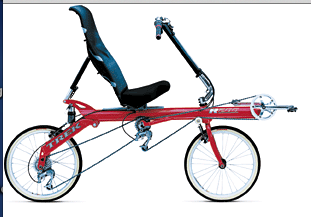
Trek R200
In Japan, I have never considered a recumbent.  A bicycle that does not climb well is poorly suited for a country where all the good rides involve mountains! Nor is a design that is bulky, hard to store and that cannot easily fit in a "rinko" bag or onto a train well-suited to Japan.  Even the lightest recumbent is around 12 kgs -- probably 50% heavier than a typical road bike.

But last summer at PBP, one of the U.S. riders staying at my hotel had a recumbent, a Cruzbike Silvio.  It struck my eye immediately.  Most recumbents have long, long chains stretching from the pedals in front all the way to the rear wheel, a tensioner/guide somewhere in the middle of the chain. Like this:
A Bacchetta -- long wheelbase and very, very long chain.

The Cruzbike is a bit different.

-It has front wheel drive!
-The chain length is about the same as a "normal" upright road bike.
-The bottom bracket and front pedals and cranks are on a rotating steerer stem connected to the handlebars and fork.  They are also connected to the wheel by front "chain stays" -- a kind of "front triangle."

The Silvio, which has some "suspension" to soften the ride in the rear, looks like this:
I was told that this demo bike, used at a recent show in Seattle, is available for $4000 at Rose City Recumbents.
Normal retail for the Silvio/standard build is something like $4400
A frameset is available for $2600 direct from the manufacturer.  .
There are other models besides the Silvio, and the fastest is now the Vendetta, which features a more horizontal rider position and no suspension.

In order for the front wheel to steer the bike, and also drive the bike, the bottom bracket and pedals are not attached to an immovable boom, but rather to a set of stays with the handlebar that turns along with the front wheel.

When I first examined it at PBP, the bike looked odd.  Especially the need to adjust pedaling leg lengths as one turns.  But the rider I met said it is easy to adjust to the moving BB and that his Cruzbike climbs well.  The manufacturer website notes that Cruzbike holds RAAM and other records for speed and is the only recumbent that "climbs like a road bike".  The climbing capability comes from the ability (and need) to use one's upper body while climbing, to push the bars opposite of the leg that is applying power -- very similar to when "dancing", out of the saddle, on a normal road bike.

Rose City Recumbents were kind enough to let me test ride the Silvio.  They warned, however, that it is not easy at first to ride a Cruzbike.  Almost impossible until you "get the hang of it".

They were right!  I struggled for about 15 minutes, but the best I could manage was 3 or 4 pedal strokes before I would veer off to one side and need to put a foot down to stop from falling.  Often I would only get in a single stroke.  They told me that I should sit upright and push with my legs to get up some speed before sliding into the seat and trying to pedal. Eventually I settled on downhill starts, on a ~2% incline nearby the shop.  This allowed me to practice balancing on the bike at various speeds WITHOUT trying to pedal.

After a break for a scheduled telephone call, I tried again.  With the downhill starts, I at last managed to pedal smoothly while remaining upright.  I could make it down a street of 2 blocks, turn a corner, then climb a steepish hill into a cul de sac.  After putting a foot down, I could head down the hill, around the corner and back up the first street.  After a few more trips, I could sense when the bicycle was going fast enough so that I could steer by leaning, and when it was slow enough so that I needed to "use my feet" as I was told.

So after a total of 30 minutes on the bike, I could at least get the sense that, yes, I could ride this without difficulty if I worked at it.  And I could see Jonathan, of R.C. Recumbents, ride another Silvio in tight circles and even with his hands off the bars.  Jonathan said it took about a week until it felt as easy to balance on the Cruzbike as on a normal bike.  He said kids can do it right away ... especially those whose muscles remember riding a "big wheel" tricycle.  Regular cyclists need to "unlearn" their usual tricks before they can ride it successfully.

As for the overall feel, climbing was, indeed, a different sense than I remember from the Trek R200. Eventually, I think it might climb as fast on it as a road bike.  I immediately felt that I was putting MORE pressure on my knees pushing the pedals and driving my back into the seat cushion than I normally would spinning a road bike.  I would need to be careful not to use too big a gear on this bike. And I was definitely using different muscle groups than I normally do when riding.

A Cruzbike might prove to be a good way to ride long distances in more comfort than with a normal bike.  No worries about pressure on hands or butt/groin.  And it might be a great way to get through a truly "yuge" (as "the Donald" might say) cycling year without physical problems -- indeed, I have read that Kurt Searvogel used a recumbent on some days of his HAMR effort last year, to vary the punishment his body took in riding 75,000 miles in a year.

Maybe it is the way to the next level of craziness in cycling ...

08 February 2016

To Atami ... and its slopes, and back on a sunny winter day


Miyagase-ko

More Miyagase-ko
Aikawa/Hanbara area after dusting of snow.
Sunday I rode my first brevet of 2016, a 200 kilometer trip from Inagi-shi to Atami and back sponsored by the Aoba (Yokohama) Velo Randonneurs group.  Aoba rides often start along the Tamagawa, within 10-15 kms of my home.  This one was a bit farther away, 17-18 kms, with start and finish at Omaru Park just at the base of the "hospital hill", making the day's ride 235-240kms total.

The Aoba volunteer "staff" for this ride included Tominaga-san and Minoda-san, two of the most intense commuting and randonneuring cyclists in this part of Tokyo.  Tominaga-san, whose 50+km daily roundtrip commute takes him down Komazawa Dori, and Minoda-san, who I sometimes see if I happen to be riding along the Tamagawa during commuting hours -- heading downriver on the Kawasaki side in the morning, back up on the Tokyo side in the evening.  Both much faster than me. Both signed up for the Saitama Audax 2400km "Japan end-to-end" ride scheduled for Golden Week. There were lots of friends and acquaintances among the riders on this event as well.  Aoba seems to attract a lot of regular, seasoned participants.  Lots of Audax Saitama PBP jerseys and 2015 Audax Japan vests produced for PBP (I wore mine).
Aoba staff at the finish ... still light after 5PM now!

Aoba staff at the "secret" control point on the descent south of Miyagase-cko
I left home a few minutes before 5AM, arrived at the Start just as the briefing was about to begin, and due to a quick restroom detour ended up near the back of the slower of "bike check" line and one of the last out on the road.
Start briefing 530AM
The first 30 kms traffic lights were a problem -- I was stopped at more than the usual number of lights heading out Onekan, and seemed to hit just about all of them going through Machida/Sagamihara area over to Aikawa.

The other problem was ice.  Just a few minutes after the start, crossing a bridge OVER Onekan, there was already an accident, a cyclist who has fallen, police van on site already with lights flashing, awaiting ambulance.  He apparently broke some bones (collarbone? arm?) but will recover.  We were ice-free until the area around Hanbara and Miyagase-ko, where again the road became a bit treacherous at points.  Yoshida-san (who I recently discovered is an executive at the Japanese subsidiary of a Netherlands-based company that acts as secretariat for a Tohoku rebuilding charity effort I have been involved with since 2011, and whose office I have been visiting regularly for the past 4 years) slipped on a patch of ice as we approached Miyagase, but at least did not break any bones and completed the ride.  He said this was his third brevet of 2017, already!

I made it through the icy patches without a problem.  I was riding the Renovo -- a rideable work of art -- with 700x28 Conti tires inflated to around 70 psi (4.8 bars) and so had much, much better grip on the roads than most of the cyclists I saw with their 700x23 or 700x25 tires at 90-110 psi (6.0-7.5 bars).

The Renovo was a joy to ride as always.  The combination of its wood frame and slightly larger tires really does seem to dampen the bumps and road chatter, so I feel less tired and jarred -- a noticeable difference on the last stretches of a long ride like this.

My clothes also worked perfectly, in weather ranging between 0 and 8~9 degrees Celsius.  I wore my Q36.5 "hybrid Q" tights and jersey/jacket.  While lighter weight than most winter gear, I find it perfect in this temperature range, with a long-sleeve inner layer and, during morning and evening hours, a light goretex rain shell.  The key for me is to keep head, hands and feet warm, then get by with as thin, light and breathable gear as possible over my trunk and legs, to reduce condensation and stay warm not only when I ride but when I stop to rest.  It worked perfectly on Sunday.

The highlights of the trip for me were (1) Miyagase-ko after a light overnight snowfall -- the photos tell the story, and (2) taking Route 740, the "old road", between Manazuru and Odawara.

Route 740 was a revelation for me, a way to get off of the horribly congested coastal Route 135 for about 10 kms of the trip between Odawara and Atami.  Of course, I assumed that if it is an "old road" and goes high through the hills of Izu, it must be impossibly hilly, right?  Actually, none of Route 740 was steep, and I think the total climbing was no more nor less than on the coastal route with its ups and downs.  With this road, I will consider cycling to Atami (or Manazuru/Yugawara) in a whole new light.
Mikan orchards line Route 740 looking out across the bay toward Oiso and Hiratsuka
The crowded coast road visible at the bottom of the hill
The event's route planner (the aforementioned Minoda-san) seemed to want to avoid a "flat winter brevet" and wanted us to go up and down some hills for training.  So the route included around 2200 meters of real elevation gain.  Most of this was to good purpose and took us through nice territory.  But after we arrived at Atami and took a circuit of the harbor area, there was one last nasty, steep climb up through the town and it seemed like half the way to Atami Pass (actually just under 200 meters of elevation gain), to the turn-around convenience store.  This was pure punishment, climbing on a narrow shoulder past a line of cars at over a 10% grade ... with little to no view for reward.  Still, it did manage to make the 200 km event seem, well, not so easy.
A rider wobbles into the turnaround check point, having just made it up the hill

Entrance to the Atami "plum garden" -- trees blossoming already in early February!
The Sagamigawa, on the way back into town
I made it back to the goal in just under 11 hours.  Not a fast time by any means but a very nice ride on a course that had its challenges.

Team Metabolic Racing (as in Japanese "metabo" or "metabolic syndrome"--Perhaps I could join?

Sunday's route.


08 January 2016

Long bike

01 January 2016

2015 -- Ended with an Exclamation Point!

Last sunset of 2015, from Kamakura on the Shonan Coast
2015 was for me a year of dramatic change.  So I was elated that I managed to complete the major cycling goals I set at the outset for the year, taking advantage of a nice, lengthy planned professional transition to complete both an "SR600" and Paris-Brest-Paris, while also participating in two very different, spectacular weeklong events--the Giro del Dolomiti and Cycle Oregon. According to my mileage log, I rode over 15,300 kilometers in 2015.

Despite all these highlights, this autumn I have been on the other end of the professional transition and very busy on all fronts.  I have only taken a handful of "classic" weekend rides with friends in the hills west of Tokyo.  No randonneuring.   Indeed, October and November were my two lowest mileage months since January, despite regular Wednesday 75+ km commutes to the Keio SFC campus.

For the last goal this year, I looked forward to the annual Strava/Rapha "Festive 500" -- ride 500 kms recorded by GPS and uploaded to the Strava site, and get sent a small cloth patch in the mail months later.  This trivial award is much better than other Strava challenges, which seem to offer mostly an "opportunity" to buy exclusive Strava-branded goods.

I've managed to complete the Festive 500 the last two years, but as of December 30, with only a day left, the situation looked bleak for this year.  I took a short Christmas ride on the 25th, but had other plans the 26th and 27th. On the 28th, I rode out of town in the morning and into town on a commute for an afternoon at the office and evening dinner, but only 90 kms.  Worse, I ate something that disagreed with me, and was so weak by the evening that I needed to lock my bike half way home and hop in a taxi.  On the 29th, I had planned to ride with my two sons, but one was not feeling well, so instead we substituted a much less strenuous plan than a bike ride.  On the 30th, other plans.  So with one day left on the Festive 500 calendar, I had ridden only around 220-230 kms out of 500.  270-280 kms remaining.  (There is some uncertainty because I had not realized Strava does not "count" a ride that is marked private -- which I had done for a few shorter local trips I was recording but did not think merited going into the Strava feed.)  I was considering a click on the "leave challenge" link.

Then again, what is 280 kms?  Less than Tokyo-Itoigawa.  Less than a 300 km brevet.  And riding for a Strava challenge, I could have complete freedom as to my course.  I could even change course mid-ride based on conditions -- come to a long red light?  Turn at the corner and head up the cross street, then cross it at the next signal and come back down the other side, turning again and continuing en route.  Do it all at a relaxed pace, and add 500-750 meters for what otherwise would have been sitting at a signal.

So after a look at a forecast for beautiful weather and only light winds December 31, I decided to go for it.  And did it -- leaving home shortly after 6AM.
I approach Maruko-bashi on the Tamagawa
I rode a classic winter course around the Miura Peninsula and the Shonan coastline to Odawara, and back again, and had a very nice time.

Through Minato-Mirai section of Yokohama.  No traffic around 7AM on December 31. 
At Hakkeijima on the southern tip of Yokohama.  Lost more fishing boats up ahead.
Through Yokosuka now

Near Kannonzaki Park

Agriculture on the southern tip of Miura, Chiba across the bay
Cats at the park on Jogashima -- residents, not visitors.
My first food stop was a convenience store around 115 kms, somewhere on the west side of the Miura Peninsula between Misakiguchi and Zushi.  My next food stop was around 180 kms, in Odawara.  Again, convenience store pasta for the "toshi-koshi" long noodles Japanese custom requires (okay, they really ought to be soba, but I needed the carbs!)
The outer moat of Odawara Castle

At the crossing to Enoshima
The final food stop was a convenience store again, when I was almost back to Yokosuka on the return.  I hopped the train at Motomachi/Chuka-gai station around 7PM.  Not bad for a 265km+ km ride.  Great conditions, ... almost no one driving, except for the LONG lines of cars at service stations as Japanese get a car wash and fill up the gas tank in preparation for the New Year.

I rode the Sky Blue Parlee with my Gokiso wheels -- the Parlee is a joy to ride -- and the 50mm carbon rimmed Gokisos take the minimum of effort to maintain a reasonably high speed.  For some reason, the hills of Miura looked much more gradual than I had remembered from the past.  And indeed, Strava tells me I rode "personal best" efforts on many, many of their segments over the ride.

Anyway, it was a good ride to end the year and complete the "challenge".  I am delighted to be in the same event, of a sort, as Kurt Searvogel and Steve Abraham, this year's two leading HAMR participants ... even if they were #1 and #2, while I was #6091 out of 72,349 participants.


As for 2016 ... stay tuned.  Plenty of epic rides in mind.