21 March 2023

400km with Chiba Audax on the Worst Day of the Year* ... on the Pelso

In order to qualify for the quadrennial Paris-Brest-Paris randonee, to be held this August, I must complete a full series of 200, 300, 400, and 600km brevets by early June. Having done the 300 and 200km events in December and January, respectively, and another 200 in February while visiting the USA, I want to clear the remaining qualifiers relatively quickly, so I have plenty of time in case I need to redo one of them.
After all, things can go wrong: things like a mechanical issue or minor stomach upset that result in a DNF. Or bigger things, like an earthquake, tsunami, and nuclear disaster that stop all train services and result in cancellation of Audax rides for at least a few weeks. Or even a pandemic lockdown that stops all Audax rides for awhile.
Over the years things HAVE gone wrong. At this point in my randonneuring career, I've seen it all, or at least most of it. So I know I should plan ahead and try to consider contingencies.
It was in that spirit that I signed up for the Chiba Audax March 18 400km "GO Shirakawa" brevet. The course started from Abiko -- same location as last year's Chiba 400km around Boso Peninsula -- but it headed in the opposite direction, north through Ibaraki and Tochigi as far as Shirakawa in southern Fukushima Prefecture, then back along an almost parallel North-South route somewhat further east, eventually, reaching the Pacific coastline at Oarai near Mito, then eventually looping back to Abiko.
The course looked relatively easy. It had no relentless climbing, and no high mountains, only one sub-500 meter elevation pass at the Tochigi/Fukushima border, and the usual ups and downs elsewhere. The final 60kms was pancake flat.
But the course looked at least less boring than a typical Kanto winter ride. Heading north from Abiko, the route was mostly in the countryside. There would be traffic lights, but they would not be endless, and there would be no 20-25km straight agricultural road in the midst of flat fields. And the entire return would be on Saturday night into Sunday morning, with light or even no traffic on some highways that I would not enjoy riding during the day. The Chiba Audax website listed the "difficulty" as 2 stars out of 5. Easy.
RidewithGPS showed 3800 meters of elevation gain on the 400km course. But a close examination of the route led me to think the actual climbing would be well under 3000 meters, probably closer to 2000. (In fact, my GPS measured just under 2000 meters when all was said and done). The climb between Nasu and Shirakawa, the one almost to 500m elevation, was very gradual, only the last few kilometers exceeding 5%. Most other climbs seemed to be less then one kilometer long, with elevation gain less than 75 meters. 
As the ride date approached, I started to think ... maybe, just maybe, I could do this event on the Pelso recumbent? I cannot climb well on the Pelso, but I can go fast on a flat course -- faster than on my other "diamond frame" bikes. And I have gone 400km on it before, once. Even if I ended up walking up the last few kilometers of that one bigger climb, and a few smaller climbs later in the course, maybe the Pelso would be as fast as another bike? At least it should be fast enough to complete within the 27 hour time limit. 
So I decided to ride the Pelso.
As the ride date got even closer, however, the weather forecast started to look ominous. By 2-3 days before the ride, the forecast was showing heavy rain throughout the relevant area of Japan on March 18. Andrei O., who was also riding and is also planning to do PBP, mentioned the forecast. 
Worse yet, it would be very cold, nearly freezing, and the winds on Saturday would be steady out of the north.  In Shirakawa, we might be riding in sleet. To sum it up, we would be riding from Abiko to Shirakawa (165kms) directly into the wind, in heavy rain, and near freezing, winter-like temperatures. I remembered a brevet in mid-March eight years ago, when Jerome and I rode with Japanese randonneurs in the wee hours through northern Ibaraki, in weather that was much colder than anticipated. I remembered a slog down the Beef Line, barely warm enough to keep going, knowing that to stop would be even worse. I warned Andrei that it might be colder than expected.
Given the weather forecast, I waffled on whether to go ahead with the Pelso. In the rain, the reclined body position offers full exposure to the elements. Rain hits my face and goes straight into my eyes -- blinding me temporarily if I do not have appropriate eyewear. Sleet would be even worse. And in the rain, my feet tend to slip off of the flat pedals that I prefer for riding the Pelso. 
In the end, I decided to stick with the Pelso. Forewarned is forearmed. I would take a real rain jacket, rain pants, new REI Goretex rain covers for my Amfib Q36.5 gloves, and other appropriate gear. I swapped out the flat pedals for SPD pedals. I would wear SPD/mountain biking shoes. I also would bring spare warm socks, gloves, winter head cover, inner layer, socks, etc., just in case needed during the trip.
Only 23 out of 90 registrants started the ride. Chiba Audax allowed people to switch entries to a 200km brevet on Sunday if they did not want to challenge the difficult conditions. A dozen did so. 

Still feeling jet-lagged and somewhat sleep-deprived from a return to Japan on Monday ...  I removed the wheels from the Pelso and fit the beast of a bicycle into my car on Friday evening. On Saturday I woke at 430AM, still not feeling well-rested, and was driving toward Abiko in the rain shortly after 5AM. I arrived, set up the bike in the rain, and proceeded to the Start area. There were about 25 people there, including the organizers. The vast majority of the 90 registrants were marked "DNS" due to the weather. What was left was a relatively hard core group. The organizer told us that this was an easy course ... except for the weather. He also announced that they would not enforce the time limit at the Oarai Kaigan control point (288kms), to offer more flexibility to complete the ride. These messages, an "easy" course, but a need for more time to clear the control over 70% of the way through the ride, seemed inconsistent to me.
And then we were off. I made it up the first short hill out of the start, my heart racing, and continued making good time over the first hour. One Japanese rider, Kimura-san, passed me with a reflective vest labeled "組長" or "boss".  I kept catching up to him at traffic lights over the next 5 kms until he finally cleared one that I missed in Tsukuba. He told me that he was only fast at the beginning. I took this as typical Japanese humility ... but in fact, now see that he finished at the back of the group. 
I needed a bathroom break so pulled off at a Family Mart where our course turned east in Tsukuba at 31.5km. I also got some food, and could see lots of riders passing me by. A few blocks after I started up again, I turned to go up a curb cut and onto a wide sidewalk ... failing to realize that the curb cut was covered in slick metal. Wham, I went down on my left side as the wheels came out from under me. Fortunately, with the Pelso recumbent, this fall was not much worse than, say, rolling off a sofa onto a floor. No injuries to me nor bike (other than a need to re-set my chain and readjust my handlebars), and so I continued.
Temporary shelter in Tsukuba
By late morning, the rain was, if anything, stronger, and the temperature, if anything, colder. And the headwind had picked up ... not as vicious as some Spring winds in northern Kanto, but steady. We crossed from Sakuragawa in Ibaraki into Mashiko in Tochigi. Mashiko is known for its style of pottery, but there were few people out and about today anywhere. This entire part of Japan was familiar to me from my days locating sites for and developing solar projects. Our team ended up with two Tochigi projects further north and west, but also spent endless hours roaming this part of the prefecture with local partners looking at sites that, for one reason or another, did not pan out. 
NW Ibaraki
By 145PM, I was at 133kms, slowing down, and really cold and wet. The rain was strong (stronger than the forecast, at least tenki.jp's forecast), the temperature was maybe 3-4 degrees celsius (38F?), and the headwind continued. I pulled into a convenience store for some lunch. There was no "eat in" space. Across the road was Otawara City's "Kurashi-no-kan" that seemed as if it might at offer some covered space ... but looked very dark and cold. I decided not to head over. Instead, I went outside the store and adjusted my recumbent, raising the seat back maybe 3-4 cms, to try and get more power on the upcoming climbs and to be a bit more stable starting and stopping. I came back inside and ordered coffee. The staff ignored my presence sipping coffee inside the store by the front window ... against the rules. In the end, it was nearly a 30 minute stop but I did not feel much better as I restarted. Still cold and wet and tired. 
As I continued on, I found that my hands were not moving well due to the cold. I could barely move my shifter using my right thumb, even applying all the weight of my arms from an odd angle. I rode for at most 30 minutes/10km before another stop, this one at a michi no eki in Iono. They were selling some cooked foods ... at a cafe window with seating only outdoors (though at least it was under a roof cover). Eating outside would not help in my current condition. The main indoor area was a vegetable market, selling local produce. I went in and asked if there was someplace warm I could just sit and warm a bit. The woman at the cash register led me to a back area where there was a table and bench, and told me to make myself at home.  It was not toasty, but at least it was a lot warmer than outside. After 15 minutes I got up to leave ... but one foot outside and I realized I needed a bit longer. I had a spare pair of winter gloves with me (forewarned!), that I had wanted to save until after the rain stopped. But I realized I would never make it up the next hill without changing into them.  The Goretex mitten covers ... would not fit, as these gloves were bulkier than my Q36.5 Amfibs.  Anyway, the stop took nearly 30 minutes in total, but at least I headed out with warmer hands and wearing dry, warm gloves. 
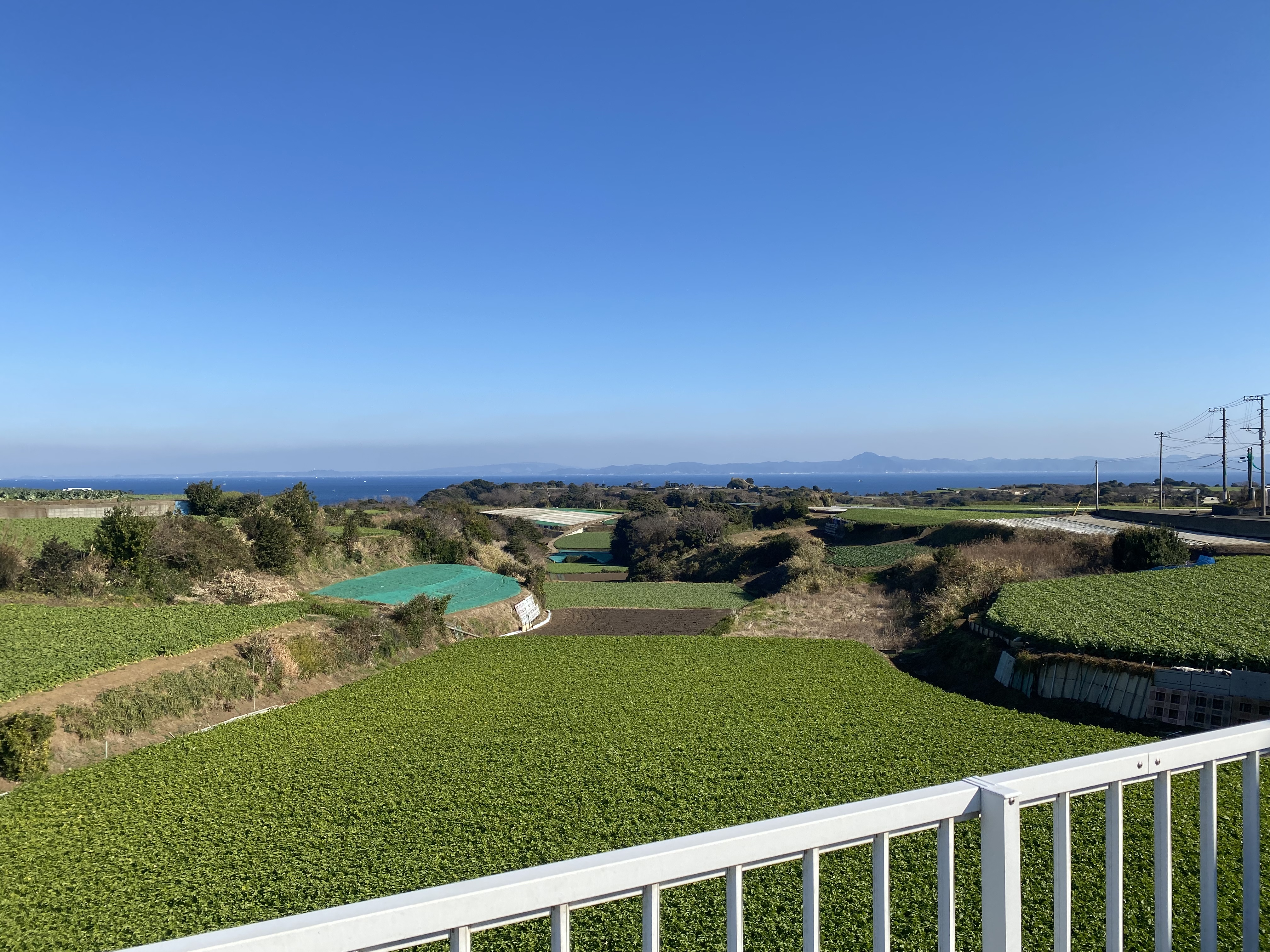
Miraculously, the rain started to lighten up a bit after a few minutes of riding. At this rate ... less than 1mm precipitation per hour ... I might make it with my second pair of gloves dry. The road turned up, elevation gradually climbing from 220m elev toward the pass at 460m. I was able to climb okay and make decent time now. This was the climb I had thought I might need to walk, perhaps as much as 2-3kms. In fact, I was doing okay, but I slowed to the point where, for the last 500m or so, I dismounted and walked to save energy. It was already after 4PM, but at least I was at the high point for the entire ride, had done 155kms, and would get some rest on the next section. Andrei O's photo of this stretch from a bit earlier ... as he was now far ahead, is below.

The minute I reached the descent on the northern side of the slope, into Fukushima Prefecture, the rain turned to sleet. The sleet stung as it hit my face. But it was still falling lightly, and the road was not icy. I could descend at decent speed toward the next control point (a photo at Nanko Park in Shirakawa 166km) then to the Tora Shokudo (171km) where the organizers had suggested we stop for food. 
At Nanko Park in Shirakawa
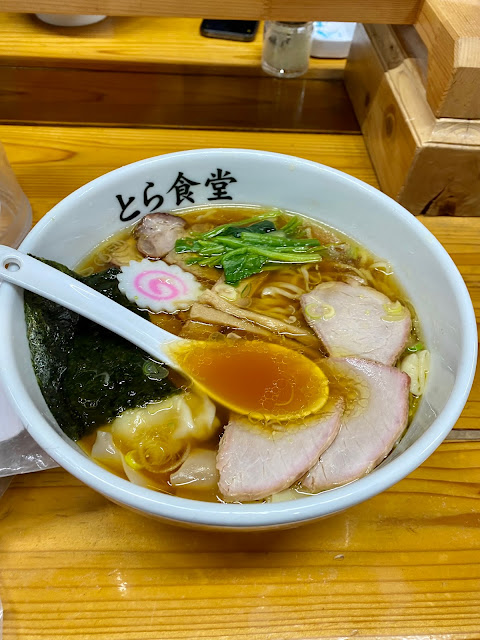
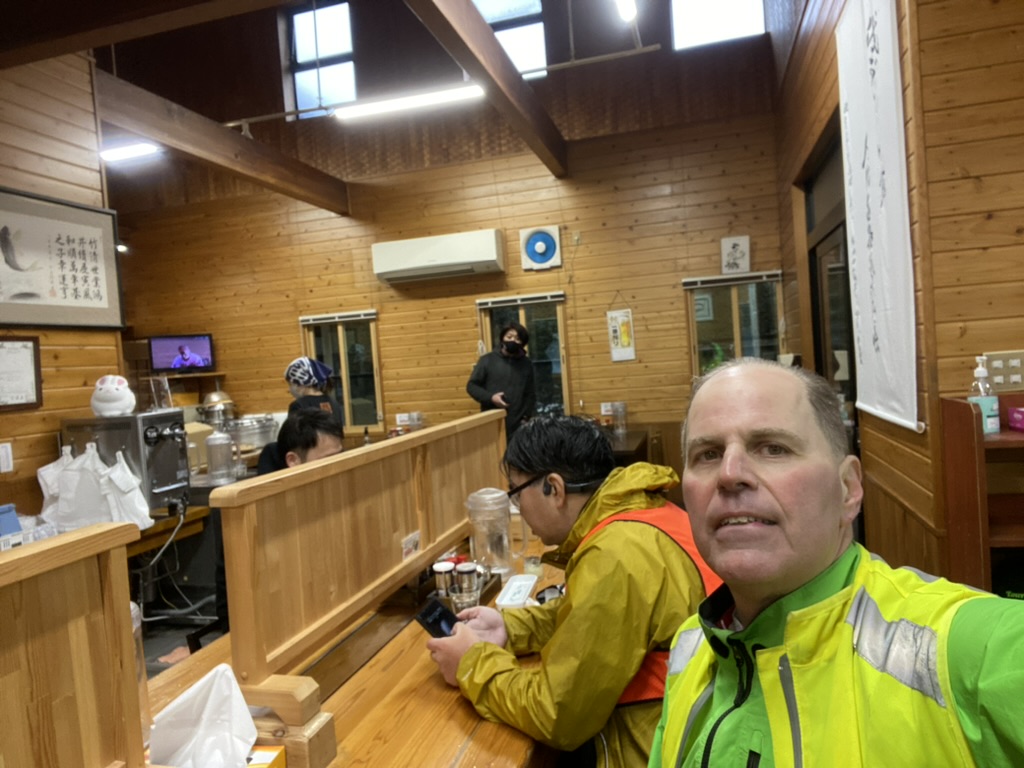
The restaurant's interior was warm, there was room for me to place my wet outer wear next to my seat in a box on the floor, and the ramen tasted better than any I have ever had. I used the toilet and changed from my soaking wet inner layer into my warm, long-sleeved turtleneck Q36.5 base layer. In the end, a 50 minute stop.  If I total the 16 min stop at 31kms, 20 mins at the first PC at 88kms, the 2x30min stops in Otawara and Iono, 7 mins at Nanko Park, the 50min stop at Tora Shokudo, and 10 mins a few minutes later to get new batteries for my rear light,  ... I must have been off the bicycle at least 163 mins during the first 175 kms. 
Best ramen I've ever tasted?!


But the rain had almost stopped, and from here (175kms in, at just after 6:00PM) the route would head east, then south, with the wind at our backs. Indeed, I actually made very good time from here most of the way to Hitachinaka, 100kms further on.  The temperature indicators by the roadside first showed 1 degree Celsius, then 2 degrees, then finally 3.  I could see stars in places now -- my gaze upward as I reclined on the recumbent. By 11PM, I had gone 265kms total. This entire stretch from Shirakawa had started at around 300m elevation, and ended close to sea level. There were a few intermediate climbs, but all of them were short. A few I walked up, if I felt at all unsteady, taking a couple minutes rest from the bike. But most I could ride up. I took one more short stop, then pressed on to the Oarai Kaigan 7-11 control point.
I got a rice w/ melted cheese and sauce "doria" at the convenience store, heated up. Here, the staff person shooed me outside when I tried to eat it just inside the front door. "no eating permitted inside!"  Well, I explained, it was so hot that I got cold waiting for it to cool down to an edible temperature. She was not buying my story, even though it was after midnight and very cold still outside. Ugh. A Chiba Audax staffer had been at the Tora Shokudo, and was here as well at Oarai. I asked if there was any place to rest up ahead ... a coin laundry, internet cafe, onsen, or similar? ... he said there was not much until Kashima, the 337km checkpoint.  Another 25-30 mins off the bike, then I pressed on. 
Finally, around km 326, on the eastern side of Lake Kitaura, there was a 7-11 that had a mini-coin-laundry in its parking lot, a small shed with 4 dryers, enclosed with a glass front door/window. You can see it here with google street view.  
My 3AM rest shed
The space was not heated, but it was protected from the wind. I put all my extra/wet gear in the dryer and set it for 24 minutes, laying down on the floor mat in front. I could feel warmth from the dryer on my hands, and slept immediately, waking to the buzz of the dryer alarm. There was another audax cyclist lying down motionless across in the parking lot in the lee of the 7-11 building. ... it looked cold out there. I added another 100 yen to run the machine another 12 minutes, and slept again until the next buzzer. The rider had moved on by the time I awoke. 
After heading a few hundred meters further and noticing my front light was not working, I stopped to fix the wire  ... and two riders passed me and zoomed up a hill, as our route left the Kitaura lakeside. Including both my rest and the repair work, by the time I was back on my way ... it had been another 50+ minute stop, but a much needed and very effective one. I walked up the hill then remounted. Finally, I made it to Kashima Jingu. The shrine looked huge, and quiet. 
At Kashima Jingu ... bicycle parking
It was now just past 4:30AM, and there were two other riders at the shrine, one of whom had asked questions about the Pelso and introduced himself to me earlier as Warabe (based on the start list, last name Shiraki-san), and was the guy who had been resting earlier by the 7-11, I believe. After the obligatory photo as proof of passage and a short rest, it was on toward the next PC ... and now riding into the wind for the last 65 kms. I reached that PC and chatted a bit with Warabe-san. There were two younger riders as well who had zoomed past as I fixed my light connection, one said he was 31 yrs old, the other 38. They looked like college kids. I headed out ahead of them but stopped when the course started to parallel the road along the Tonegawa. I wondered, ... should we ride up on the levy on the bike path (last year's Chiba 400 had taken that in the opposite direction) or stay down on the road? The two youngish riders passed me and stayed on the road. I followed, keeping to the road, eventually passed them, and did not stop again until I got about 30kms away from the PC, only 20km left to the Goal. I could see Audax riders heading down the road in the opposite direction. Apparently they were from a Nihombashi event, another 400k that started 5-6 hours later than we had (and so had had 5-6 hours less rain!). 
I pulled off to the side of the road and removed some clothing ... my rain jacket, winter cap, and helmet cover. And I switched back to the somewhat lighter weight gloves. It was at least 6-7 degrees C now and warming gradually, the sun above the horizon. Indeed, Sunday looked like a lovely day for a bike ride, even if Saturday had not been!  I could go noticeably faster without so much gear on. Less wind resistance, I guess? In any event, the finish was so close now, I could taste it. I pushed through, puzzled over which of three 7-11 stores within a kilometer of each other was the official end point, finally needed to consult my cue sheet, google maps, and confirm some kanji readings then loop back to the correct one and pick up my receipt. The two 30-something riders came in just as I entered the store.  I checked in at the finish with the organizers, headed back to my car just as Warabe-san came rolling in, packed up my bicycle, ... and napped for an hour before driving home. 
I finished in 25 hours and 33 minutes. There were 23 finishers in all, 6 after me and 16 ahead. Andrei was the first in, in 21 hours and 11 minutes. I think if I had been well-rested, in decent weather, and on a normal bike, this could have been a 21-22 hour event. Amazing that Andrei could do it that quickly despite the conditions (he had similar difficulties in the cold and wet ... and a 90 minute stop to rest and warm up). But then again, if we had had decent weather ... it would not have been an adventure. 

Postscript: I must say that the recovery from this ride, now 3 days ago, has been much tougher than other recent long rides. At the end of the ride, my butt was very sore where it had been resting on the edge of the recumbent's carbon seat. Usually I ride the Pelso laying on top of the seat, but by changing the seat to a steeper angle, I was effectively sitting on the bottom edge and applying more weight on a narrow edge there. I did not notice it until ... after 8 or 10 hours riding in that position.  With the seat elevated and SPD cleats, I could not move around on the seat but was locked in one position. The last couple times I got on the bike ... I really did not want to sit down on it again.  Also perhaps from the single position, my knees hurt just a bit during the ride, but not significantly. Spinning in a low gear helped defray the issues of a single position. But the leg stiffness following the ride was much worse than usual.  Overall, I was exhausted the next two days.  I think I started the ride tired -- both from bad jet-lag and not enough sleep on Wednesday evening, and an early Saturday start with not an early enough sleep on Friday night. Also, climbing on the recumbent I find I am quickly going "into the red zone" -- pushing the pedals at an unsustainable power output. Those repeated "red zone" efforts, trying to get a heavy bike and an overweight rider up a slope, took a toll on my cardio vascular system. I'm being careful to just rest and recover so that now, on Wednesday, I feel ready to re-engage fully. Also, I should add that this Spring the pollen levels in this part of Japan have been off the charts. The rain on Saturday of course kept them down ... but once the rain stopped, and definitely by early Sunday, they must have come back with a vengeance, and pollen levels have stayed high since. I'm on medication, but I think the impact of the pollen has probably complicated the normal recovery. 

I think next time I try to ride the Pelso 400kms or more, I will stick with my flat pedals, and will try to make sure that I am wearing shoes that will not slip in the rain, rather than going with cleats.  And in warmer weather I hope I will be able to avoid the baggy un-aero clothing, and also will be a few kgs lighter!

*Portland Oregon has an annual "worst day of the year" bicycle ride on the last Sunday of winter. This ride, on the last Saturday into the last Sunday, and in these conditions, was close enough.

Addendum:  I next rode the Pelso on April 2, for around 95kms in pleasant weather -- to get coffee with the Tokyo Cranks, view sakura along the Tamagawa, and then a few errands on the way home. It felt faster. And more comfortable. I had ridden the day before so did not push my pace, but still made decent time. I felt far better than I had on the Chiba 400kms.  With flat pedals and some running shoes, and the seat a bit lower down - not "slammed" but not elevated as I had done for the climbing, I could make decent time with less effort and more comfort.  Next, I'm going to get some new tires and do some modest maintenance, and I should have it ready for an ultra distance attempt during Golden Week. 

07 March 2023

Size Does Matter

I used the same mini-pump for at least the past 15 years. That pump still works, even if it needs to be tightened at times. But it is getting old, and it sometimes slips off the valve, especially if the valve does not protrude far enough from a deep rim.

Road Drive vs Pocket Drive

So I wanted to get a mini pump that I could screw on securely to the tube/tire valve, a design that others (including Jerome) use. So last year I ordered a Lezyne "Pocket Drive" pump that had good reviews. It is tiny and fits easily in a back pocket of a jersey. But it is too small. With a 700x28 or 700x30 tire, the tire is still lower than I would like after several hundred pump strokes. Each stroke just does not push through much air.  It might work for a 700x23 tire ... but no one rides those anymore. Also, I noticed that when I tighten the flexible hose to the Pocket Drive before affixing to the valve ... the threads are at an angle. It still works, but it shows careless workmanship, something I did not expect from a premium brand like Lezyne.

Off-of-true threads on the Pocket Drive

When I happened by a bike store last week, I saw some other Lezyne mini pumps. One, the Road Drive, comes in several different sizes. There was one that is just enough bigger than the Pocket Drive to ... actually pump up a tire in 150-200 pumpstrokes. And the workmanship is what I would expect from Lezyne.  And it is still plenty small for carrying on rides. Problem solved. I hope this one lasts another 15 years!

The Road Drive is far more functional for my purposes.


200km Winter Brevet with the Seattle Randonneurs

I arrived in Seattle on Thursday February 9, just in time for a Saturday 200km brevet with the Seattle randonneurs. The ride started and finished in Redmond, east of Seattle. We headed NNE though rolling hills and exurbs, eventually into rural/pickup truck country. 


There were lots of riders I recognized from ... Japan, Tasmania, and previous Seattle rides. The ride organizer, Mitch Ishihara, has ridden in Japan as well as that menorable 2016 600k gravel grinder. Also Hugh Kimball, who pulled me in a vicious headwind on the gravel grinder. Stalwart Vinnie was there. And Rick Blacker, who I think I last saw in Tasmania (he can be seen in photos below giving the finger to the camera lens). ... and many others. 

On the opening 50km, I settled into riding at the rear of a reasonably fast group, just behind Narayan K., whose hand signals and warnings about upcoming obstacles were exemplary. Narayan said he ran the Camp Mazama (last overnight) control at last year's Cascade 1400 ... which I had hoped to join.  .


Cannot ask for better weather in winter -- dry, and even some blue sky.


Lake Roesinger

Riders study a warning sign for the answer to our quiz

Anyway, the outbound course had quite a few hills, nothing long, and steep for only mercifully short bits.  There was an "out and back" section between 50 and 62km, on a near traffic-less road that ended at a small dam below a lake. On the "out" route I could see the first group of riders, who ended up completing the event in 7~8 hours.  The climbing seemed to taper off soon after a quiz control at Lake Roesinger just past 80kms. 

I stopped for a quick six inch Subway meatball sandwich in Granite Falls, nearly 100km in. 


The northernmost point of the course, at Bryant, was around 120kms, ... meaning that the 80km return leg must be much more direct/shorter. It also involved less climbing than the outbound. Indeed, for much of the return we followed the Centennial Trail, a rails-to-trails route that meant no more than a grade of a few percent max, even as it climbed from sea level to over 100m elevation, then back down. We did another similar but steeper climb over an elevated section, on roads, between 170-185kms, and finished with flat path along the Sammamish River on the last decent stretch into Redmond. 

This was an easy 200km, especially with the second half easier than the the first. I finished in 9 hrs and 16 minutes, an hour or more faster than my typical "winter 200k" time in Japan. I think much of the difference can be attributed to ... lack of as many traffic signals!


The ride finished at Post Doc Brewing in Redmond, where pizza and beer were available, and well-earned.


20 January 2023

200km early January brevet

January 8 was the Sunday of a long weekend, followed by a holiday Monday (coming of age day). Jerome and I picked this day for an R-Tokyo 200km ride, one of our PBP qualifiers. The route was pretty typical for an early January 200km event … the classic/standard R-Tokyo start at Todoroki arena area in Kawasaki, standard route out of Tokyo (Nakahara Kaido then Chogo Kaido, then eventually heading south to hit the coast at Oiso), a ride along the coast road, Miura Peninsula, etc. The weather was good … dry and not much wind, not so cold after the first few hours. 

We met at Kanpachi and Nakahara Kaido around 540AM and made it to the start on time. Jerome struggled with the online Google form check-in system a bit in the cold and dark, so I headed out first. I managed to keep ahead until the first PC at around 68 kms. From there we rode together on the second leg to the tip of Miura. On the third leg home, he was waiting for me to catch up from time to time, but at least I was not far back.


There was traffic. There was a lot of traffic, especially for the middle of a long weekend. 
And this route requires patience with red lights. Lots of red lights. 

An upload of this photo was the proof of start.

First Fuji views were obstructed and show the smog.

Finally some car-less stretches heading south toward the coastline.

Sky Blue Parlee in foreground, junkyard in back.

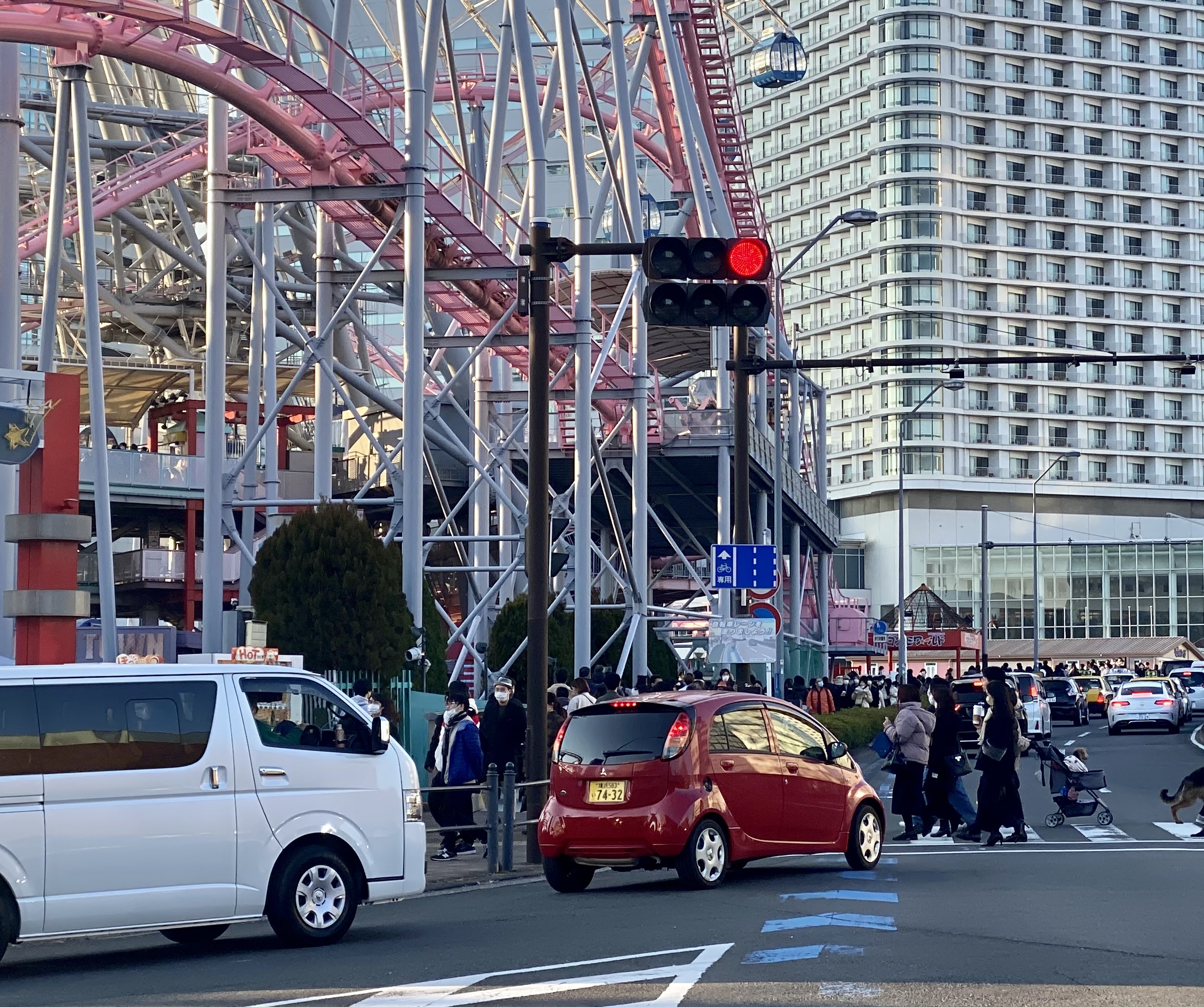
We stopped for lunch in Misakiguchi at the tip of the Miura Peninsula. After lunch, we rode past an incredible line of cars sitting, waiting to get into the town. 5kms long? There were more lines at each bottleneck up to Zushi, where our route turned east. Yokohama, again, was mobbed with people, both cars and pedestrians around Minato Mirai.

Fuji barely visible in the haze and light clouds.


A quick snack in the sun.

Minato Mirai on the return
(from here photos loaded out of order)

Almost done.

Classic view near southern tip of Miura

Minato Mirai crowds.

Wish we had ridden through more country like this ... or at least up and down the eastern side of the peninsula instead of slogging through traffic on the western side.

Misaki harbor, now searching for a lunch spot. We found a restaurant - Chiritontei - that was just fine!

Again, too much haze.

We finished in around 10 hrs 40 mins. If we had not had such a relaxed, sit down lunch, we would have been closer to 10 hrs. If we had not needed to wade through the traffic, then under 10 hrs. Not fast, but not so slow either.  I rode 227kms for the day, including to/from the start.

Another PBP qualifier out of the way, in the bag, checked off the list, crossed off, wrapped up, completed, and DONE! I've done my 200 and 300, and my 400 and 600 remain. Let's see, that means I am either half way (2 out of 4), or one third of the way (500 out of 1500km) depending on the way you think about it. 

The rest of January I will focus on swimming and also try to ride the Pelso recumbent regularly to regain my "recumbent legs". I'll get back on the road bike in February and beyond!

11 December 2022

300km in the Land of a Thousand Convenience Stores

Moon rises over Ibaraki

On Saturday, December 10, I joined the Saitama Audax 300km "Attack Nakagawa" brevet.

I need to do a full SR series (200/300/400/600km official brevets) to qualify for Paris-Brest-Paris (PBP) next summer. I signed up for this event during my US trip last month, but was actually planning to skip it and instead do a 300km Randonneur Tokyo event in January, as it turned out that I had a bonenkai scheduled for yesterday.

 ... But the Randonneur Tokyo event filled up within an hour or two of registration opening and I missed my chance to sign up. Also, the weather forecast for Saturday looked ideal for an early winter ride. And I really felt the need for a decent endurance ride after several months of travel and abstinence from long-distance cycling. Strava tells me that my conditioning has dropped dramatically due to lack of activity over the past six weeks. My body does not dispute that. I've gained weight and lost muscle. So I went ahead with the ride, skipping the bonenkai.

Worked hard to boost fitness in September / early October ... all lost.


Like many Saitama Audax events, it started from Toyomizu Bridge at the Iruma River, where it is easy to park a car for a day or two, and the organizers can set up shop under the bridge to sign-in riders and manage the "goal" without need for a tent or fear of rain. The route headed generally north and east, to Nakagawa (那珂川) in NE Tochigi Prefecture, then back again.

No trolls under the bridge at Toyomizubashi in Iruma.

The forecast suggested weather would be in between roughly 3 and 14 degrees celsius during the ride. It would be coldest at the start and again toward the finish after dark. But there were no mountain passes and would be no frost nor ice.  I made do with a short sleeve jersey and bib shorts, Craft windblock inner layer, arm and leg warmers, double socks (thin inner and wool outer), and my Q36.5 Amfib gloves. I brought a second pair of gloves for the warmer part of the day (which, in a pinch, I could slide on top of the Amfibs if I needed more warmth in the coldest hour -- I did not). And I packed a lightweight helmet-lining balaclava, shoe covers, and a thin/light rain shell just in case. I find the arm and leg warmers are unbeatable for this type of conditions ... winter bib shorts or a long-sleeved fleece lined jersey will feel great the first hour of cold, but will have you dripping sweat as you ride in the mid-day sun. 

The route to "Attack Nakagawa"

I was very pleased with the rest of the weather forecast. No worries about precipitation. And no strong winds. I can remember struggling on plenty of previous brevets north of Tokyo in vicious headwinds ... at their worst in Spring.

I have really been enjoying the RAMAX, with the wide hookless rim wheels from GS Astuto and my Schwalbe Pro One 700x32 tubeless tires, and was eager to ride it to see how fast it was on this type of course. 

RAMAX rests at PC1

Anyway, I was at the start in time for the 630AM briefing and to head out a few minutes before 7AM. Within a few hundred meters of departure, I was following two other riders who were going at a relaxed pace. Within a kilometer, someone zoomed by, riding in a massive gear. I did not try to follow. But we caught him soon at a red light. This ride had lots of red lights. I think the organizers tried to avoid lights where they could ... but it is hopeless. There were more red lights on this route than convenience stores. By the time we got to this red light, we had passed at least two Seven Elevens and one Family Mart that I recall, and doubtless others. And this was our third red light. All in just over a kilometer.

When we left the red light, I passed the relaxed riders and stayed with Mr. Massive Gear.  I got a nice pull for awhile, and within another kilometer or two we caught (and were joined by) another rider, probably my age or a few years older, riding a Trek Domane. Both these riders were going hard enough that I could not really pull much, but was just along for the ride. I managed to hang with them, occasionally dropping back but catching up at a red light. We were joined by two other riders. Eventually the Trek rider dropped back, and the two others started to lead ... until they missed a left turn. I was riding 4th of 4 and yelled (and stopped) as soon as we passed the turn.   It took them another 50+ meters to stop. Meanwhile, the rider on the Trek Domane had made the turn, ... and I was back and around the corner. 

So the ordering of our group was reversed, strongest riders at the back, probably one traffic signal behind. Eventually I caught the Trek rider, and we were passed by Mr. Massive Gear. They went ahead, and the two buddies who had missed the turn caught me.  I would see the Trek Domane rider again at some PCs ... but not Mr Massive Gear, who presumably finished well ahead. I slotted in behind the two who had missed the earlier turn. We stopped at another red light, where the course turned left. I made a lame joke about making sure to catch the turns. At one point I asked how far it was to PC1. I remembered there was only a single PC while traveling in each direction, plus the turn-around, but not the location.  Somehow I thought it was a 72kms in. ... they told me it was at 89kms. I would need another quick convenience store break to make it there.

Typical rest stop view ... dining in front of a Seven Eleven

So I took a quick bathroom break and bought a snack at ... a Seven Eleven, then found myself back on the road in a train of around 5 riders. One had "Sugiura" on the back of his reflective vest. Actually nice to have a name prominently placed like that. Anyway, two of the riders dropped off, more joined, and I was able to hang with them for another long stretch. 

The point of recounting all this detail is to convey that I could ride with others, mostly drafting and occasionally pulling, all the way to PC1 at 89kms. The PC was a "quiz point" about the statute/memorial at a park entrance, but many riders had gathered and were resting across the road ... at a Seven Eleven. I pushed on to 120kms, where I stopped, at a Seven Eleven, for a first lunch break, of convenience store spaghetti napolitano. The sauce was orange, very close to the color of my jersey. I could not help but think that the stain might not be visible if I spilled sauce on the jersey as I ate, sitting on the ground outside the store.

PC1 - the tent is not for Audax. Most riders rested across the way at a Seven Eleven.

PC1 quiz involved this object

Up to now, I had not taken out my camera once as we rode. The scenery ... typical Japanese sprawl, just did not seem to offer any photo that I have not already taken before, many times. The red lights were a nuisance, but offered a chance to rest at regular intervals. But I did notice the truck exhaust in places. I could see that a layer of smog hung over the northern Kanto plains, and I began to regret the lack of much wind. There were plenty of trucks on Saturday morning, and I could notice the diesel exhaust in places. I felt as if I could taste the particulate and feel a bit of grit forming on my teeth even. Later in the afternoon, I felt a bit of a sore throad, I am pretty sure from the same pollution. And as dusk appeared, I could see a bit of dust and particles in the beam of my headlight. Overall, not great air quality on the first leg of the ride, or going over the same segment late afternoon. 

The environment seemed to improve markedly after we entered Tochigi and swung to the East of Utsunomiya through Moka, Haga, and Nasukarasuyama. The area felt less like suburban sprawl and more like nice countryside.  There was even a hilly section.  And the air quality felt better -- the wind had picked up a bit, though it was still not strong, and was usually not directly ahead or behind us.


Crossing the Nakagawa just south of Nakagawa

At the turn around PC, I rested but did not eat much. An onigiri and yogurt drink. I headed out and ... felt good. In fact, I felt great. My body had adjusted to the riding position, my digestion was working well, and fatigue had not set in. I was with some other riders on the hilly section, but pushed ahead after most of the climing was done.  I tried to alternate between riding on the bar hoods and in the drops. The more aero position of the drops would boost my speed noticeably. And the RAMAX has a somewhat higher front end than a racing bike, so even when I am in the drops, the position is not that aggressive, and I can hold it for some time without stressing my back. 

Scenery at the turn around PC

We were on plenty of roads that had rough surfaces, especially along the outer edge where we needed to ride. I really appreciated riding 700x32 tires with around 60-65psi air pressure. This gear selection limited the wear and tear on my body. I found that my hands would stay comfortable on the bumpier sections in 3 out of the 4 hand positions that I used regularly. So I would avoid the 4th position on rougher roads. 

At 200 kms I stopped for omu-rice (omelet rice) dish at a Family Mart. I could eat inside, sitting at the Famima Cafe. I had ridden the first 200km at 9hrs and 31 mins (including rests). That is fast for me, for a brevet. On a normal Japan Audax course, usually I will do a 200km brevet in 10-11 hours. The super-hilly Nishi Izu brevet in March took me 12 hours. My fastest 200km brevet was 8hrs and 20 mins (officially 8hrs 40mins as I arrived late to the start) ... That was also a winter event in flat northern Kanto, back in 2014.

Omu-rice

After 200km, I still felt ... really good. Nothing hurt, no serious fatigue, and I could modulate my speed well by changing positions. I rode with a few other riders ... but mostly I rode past others. 

I continued to make good time to another stop, at the 251 kms PC, a Seven Eleven. I got a lasagna with meat sauce dish. Here I also could sit inside at a counter with chairs. It was now well after dark. The temperature had dropped, and the cold air felt ... really good. Bracing. It kept me alert. My only adjustments had been to pull up my arm warmers so that my arms were full covered, and to switch back from my thin midday gloves to my much warmer Amfib ones.

Lasagna with meat sauce

As I continued, I caught a rider and drafted for awhile ... until I passed him and gradually pulled away. Once I was in the drops, my speed would creep up and ... he could not hold on. Eventually, a rider did pass me, on a Cannondale, and I jumped on behind him. We were relatively evenly matched and took turns pulling. .... until he pulled off to rest at the bottom of an incline to a bridge over a river, motioning me to continue on.  The last 15 kms to the finish, I was entirely alone, everyone either well ahead or behind me. I finally started to feel some fatigue and my pace slowed, but I knew I just had to keep rolling. I rolled in to the goal at 9:57PM, for a time of 14 hrs and 57 mins. 

At the goal.

Epic? Not really. But a good ride.

Actually, my fastest previous Audax 300km was back in 2014, at 14 hrs and 59mins. It was another flat winter route, with even more traffic signals and heavier traffic, as I recall. This one was better. And I was very pleased to complete within 15 hours, despite plenty of rest stops.

At the goal, I checked in, chatted with Sugata-san, the organizer (if I have his name right), then Tak Kawano emerged from the shadows, already changed out of cycling gear. He had done the 6AM start, I learned. (they don't post entry lists anymore, so I did not know he was doing the event).

The cold hit me within a few minutes after I stopped exercising. In the end, I put on the balaclava, and sat near a kerosene stove, but was shivering nonetheless. So I heated up the inside of my car, planning to rest for a bit and warm up before heading home. After ten minutes, I was a bit warmer, and still alert and wide awake, so I made the one hour drive home, took a hot bath, and enjoyed a deep, post-brevet sleep.