03 January 2011

January 2 Ekiden Ride Report

After lunch at the Hakone Touge Michi No Eki -- nearly all the hard work done for today
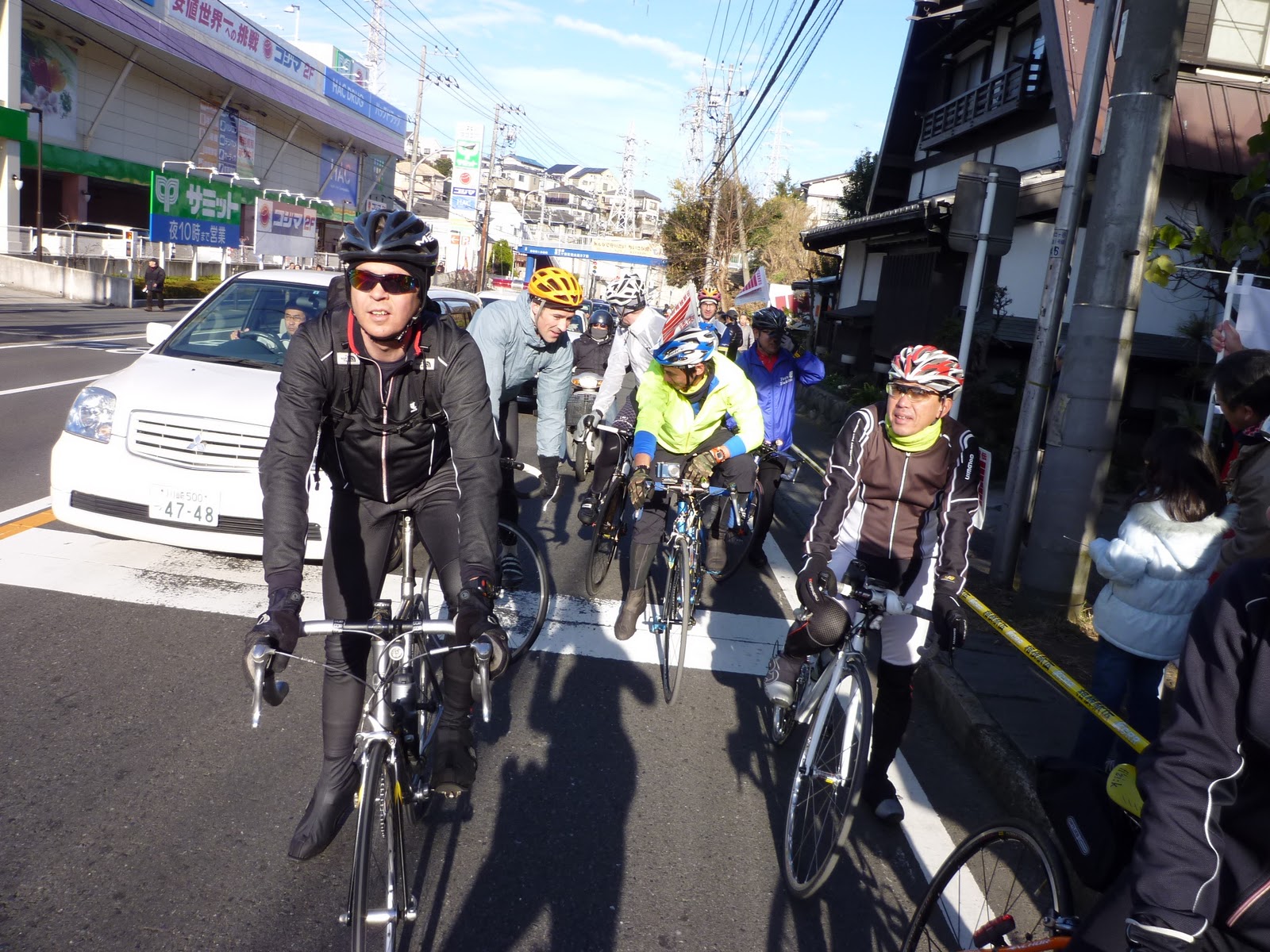
The Positivo Espresso/TCC Ekiden Ride went off without a hitch yesterday, as no one got lost, and nearly all the riders reached the top of the climb and the finish along Ashi-no-ko 30 minutes ahead of the runners -- enjoying a welcome from cheering crowds (even cheerleaders), marching bands and everyone making noise to try and stay warm.  We were blessed with glorious, clear weather, dry roads and not-too-strong winds (that were at our backs on much of the ride along the Sagami Bay).

We received plenty of encouragement on the climb, with "gambatte" calls from some pairs of attractive, younger women (waiting for their real heroes) -- inspiring us to even greater than our usual efforts -- and the occasional "Fai-toh!" (fight!) from an oddly dressed Japanese guy.  The muscle-suited cyclist who had dismounted near the top of the climb took the prize.

The group suffered a serious schism in cycling doctrine at the Hakone Pass Michi No Eki.

One group, led by Ludwig, insisted that it would show disrespect to MOB Kraehe if we were to take Route 20 toward Atami Toge (MOB's "favorite road in Japan") in his absence.  They argued that Route 20 must never be ridden by P.E. in his absence, and opted to explore Route 75, the "Tsubaki Line".  Another group, referred to by some as "the renegades" (and by Ludwig as "the re-negates"), led by Dave and Dave, argued that we must ride Route 20, out of respect for MOB -- that he would have "wanted it that way" and would not want to deny us the pleasure of this spectacular stretch along the spine of the mountains of Izu, just because he is stuck in North Germany working on an antique road bike in the dark of winter.  No one thought it was worth calling MOB at 5AM local time to figure it out. Just about the only thing that anyone could agree upon was that the descent into Atami from Route 20 was "a b****", could cause excessive wear on brake pads, and was to be avoided if practical.

So we split into two.  Ludwig's group went back down the bumper-to-bumper, extremely tedious (their words, not mine) road the short way back to Ashi-no-ko, then onto the Tsubaki-Line.  They report that Tsubaki Line was worth this minor inconvenience, is a GREAT cycling road, and some of the photos bear this out.  The TCC reports and links can all be found here.

I joined the renegades, who I had been riding with most of the way since I was slow getting my gloves on and cleat covers off while leaving the Family Mart at Fujisawa, missed a red light and did not see the lead group again until Odawara.  The four of us headed up to the pass, then cruised down Route 20 -- spectacular views as always.  After the traditional brief stop at the entrance to the Izu Skyline, we headed West down Route 11.  This was a really, really, really nice descent -- lots of curves, not too steep, emerging from forest to see a spectacular vista to the West or a valley to our side, and only a couple of cars coming up the hill for the first 5 km or so.  We realized that anyone going from Atami to Numazu takes the OTHER Route 11, which skips Atami Touge, goes through a tunnel and only rejoins our deserted road near the bottom of the hill.  Hard to imagine that any other route could have equaled this one!

Then we enjoyed our own short slog through traffic jams on the flat area, up to Mishima Station, where we acquired the necessary provisions (beer, unagi-flavored "Pretz") to enjoy a quick shinkansen trip back to Tokyo.  My Garmin data/map is here.  Some photos, mostly from Ludwig, a few from me (click on them to see in full size):

The start -- Otemachi/Marunouchi Area of Tokyo early

Too many traffic lights early on.

The Fujisawa Stop -- where I fumbled my cleats and gloves and lost the lead group.
Lots and lots of Japanese cyclists this year ... mostly slower than us, and apparently a huge group that rides slowly AFTER the runners.  I got the pleasure of driving several to complete exhaustion who tried to hang with me on the flat.
Beautiful weather, as usual!

The road turns gradually up.

Andy W, Travis, James M and Mike (photo by Ludwig), waiting for the rest of us at the finish.
Mysterious broadcast-related equipment at the Michi no Eki.  Might have something to do with all those live TV shots from trucks and motorcycles during the Ekiden.
Dave & Dave at lunch -- are those potato chips?

Mr. Rindo and others who did not grab one of the chairs at the table, and so whose legs were maybe a bit numb by the end of lunch.  I thank you for your sacrifice.

Andy and Shane (a/k/a "new Dave").

A motley crew.

The view from our lunch spot.

The traditional stop at Atami Touge.  "We have conquered Izu!  Already 1/20 of the way down the peninsula."

Looking back from Atami Touge.

On the climb of the Tsubaki Line.

I think they went up there -- ahead.

Yes, definitely climbed another hill for a better view, and proof that James M. (a/k/a "MacGyver") topped 1000 meters.

The usual heavy traffic on East Izu roads ...

01 January 2011

Bullhorns -- Flash On, Flash Off


My commuter.  The mirror, front brake, light, bell and "fiber flare" and second rear light are aesthetic compromises, as are the strips of reflective tape that show in the flash photo, but otherwise it is a pure thing of beauty, bullhorns and all!

And I guess the horns are angled up, slightly.

31 December 2010

Project Galibier - Status Update

Snow, New Year Holiday Season and the family out for figure skating training in Düsseldorf. The perfect time to work on Project Galibier.

In the meantime some more parts have arrived. To built-up an old bike is a tricky thing and I paid the price. Some of the parts I have ordered will not fit on the frame, others fit but don't work properly. Sometimes I am a loss what to do, but doing a lot research on the web, asking friends for opinion and sleeping it over helps a lot. One needs a lot of patience.

The upper part is my tribute to Euro-cyclism: New,old stock Shimano AX brake levers with white gums and white handle bar tape. I shall never touch this bike without gloves or dirty hands.

To adjust the brakes is a real nightmare and it brings me back to the time, 35 year ago, when I tried that with my first bike. Technology has come a long way and today it is so easy o adjust, say, a pair of Shimano Ultegra 6700 brakes. But Golden Arrow? One hand hold the calipers in place, another one pulls the wire and the third hand tightens the bolt. The third hand? Yes, that's the problem.

But the result so far looks good. I don't know why, but I always wanted to own a bike with a bullhorn handlebar. It seems so logical for my style of riding. I almost never use the lower part of a drop handle, all the weight, so needlessly attached. And of course, I like the design, it looks so much more sportif. Vintage fans will kill me most likely for that, but never mind.
Here we can see thee historically correct setup (except for the wheels). Shimano Golden Arrow front derailleur paired with a Golden Arrow crank set and chain rings. Beautiful - also with the label "12 vitesse". The bottom bracket which you cannot see is from Shimano as well, but brand new. After I assembled everything I found out that the chainline is not correct. The smaller chain ring is too much on the inside so that the front derailleur position does not match. I will need to de-assemble everything again and buy a new bottom bracket with a longer axle. Paid.
Again beautiful and historically correct. Golden Arrows shifters (although on later Shimano 600 sockets) and Golden Arrow front brake. A nightmare to adjust. Brakes poorly, compared to today's standards. Still not sure about the correct wire routing. But it looks perfect and nice with the chrome fork and the Peugeot pantograph on the crown.

The Gravity Zero wheels look nice but I am still working on the pair of Maillard 700 hubs. I gave up to remove the cassette and asked the bike shop to do that for me. Then I will order spokes and new rims for clincher tires. Old tubular tires are just to messy.


I couldn't resist to buy this brand new Charge Spoon saddle. Design-wise it fits perfect and apart from the chain, tires, the spokes and the rims it will be the only new part on the bike. It is also cheap but then it is only artificial leather. Please also note how the seat stem is fixed in the frame: This is a quilted stem and the nut for adjustment is located just below the saddle.

All of this takes a lot of time. I was working in the garage yesterday night and when I looked at the watch it was already past midnight. But it's fun and I hope that spring arrives soon and the bike will be ready.

30 December 2010

The Missing Expedition - Updated Photos

Zen. Bike leaning against rock in garden on the shores of Lake Suwa, Nagano Prefecture.

After a delicious and filling dinner at Jerome's house, some preparations and about 4 hours of sleep, Jerome and Yutaka appeared as scheduled at 3:15AM outside my house, as they went ahead with Jerome's crazy plan to ride to Kansai on the 30th and 31st to see the sun rise for the New Year from Mr. Rokko above Kobe. I had agreed to ride out with them today and see them well on their way.

And Yutaka seems to know how to take care of himself in these kind of cycling adventures -- he is one of the Kinki Audax organizers in Kobe, rides around 20,000 km in a typical year, and has done 1000km+ ride events in Canada, the U.S. and Germany within the past year or two. (he mentioned something about a Canada event which involved three 1000 km rides in succession, with a day or two off in between, and also the Cascade 1200 in Washington State).

The only problem with the plan, what made it crazy, was Jerome's insistence on taking the "interior route" through the Kiso Valley via Nagano Prefecture -- a region recommended more for ice skating and downhill skiing in winter than for cycling. And after a fairly dry and warmer than usual early season, normal seasonal conditions had appeared in recent days and weeks.

In any event, the temperature gauge on the hill west of Takao read -1 degree C before 5AM, and as we had passed Uenohara and headed toward Sarubashi and Otsuki, another gauge read -3 degrees C. Our water bottles started to freeze, and it became impossible to get any liquid from them. We pulled in to the 24 hour family restaurant "Gusto" just at the far end of Otsuki, 80 kilometers into the ride, and enjoyed the breakfast special, with an extra order of pancakes and many refills of hot soup and coffee.

Thawing the water bottles as we wait for our breakfast.
Yutaka and David -- guess who is faster going uphill?

The climb toward Sasago tunnel was welcome after we remounted our bikes. I pounded my pedals in a bigger gear than usual, the work generating heat and warming my extremities. The tunnel was warm and almost empty -- only a few cars and trucks passing us each way during the 3.9 kilometers. Then the long gradual descent toward Kofu, blanketed in a layer of thick smoke from wood burning fires -- reminded me of the view of Los Angeles on a summer day, except the smog was greyish white and lacked any brown tinge and, of course, this was no time for shorts and flip flops. We pulled off Rte 20 and headed North into Kofu, seeking a less unpleasant, alternative route through town, eventually (after a quick stop for me to tighten a spoke on my Fulcrum "2 way" tubeless wheels) passing around Kofu Station and heading out to Nirasaki on Route 6 (Yama no te Dori), to rejoin National Route 20.
+1 degree in Nirasaki!

We stopped at a Lawson just a few hundred meters from the Nirasaki checkpoint location for Tokyo-Itoigawa. The store had a counter and chairs INSIDE, where customers could eat their food and drink their drink -- Now after 11AM, and as warm as it would get, the temperature gauge outside the window showed +1 degree C. A Positivo number and the only one we would see!
Then we continued up the long gradual climb toward Fujimi at the Nagano border. At the top, the few flakes of snow flurries picked up, and mixed with some drops of rain. The air was clammy and damp, and getting even more so.

Jerome, after lagging behind on the climb to Sasago and again when he ran out of fuel just before Nirasaki, was getting stronger as usual, and he and Yutaka waited for me at the top. Yutaka always patient with us ... when he no doubt could have zoomed ahead at any point.

On the climb to Fujimi, looking back down the hill toward the South.

The weather ahead looked pretty bleak and there were at least a few centimeters of snow continually along the side of the road -- narrowing the "rideable" surface and making it more difficult for cars and trucks to pass us as we stayed on the dry pavement. I decided to ride as far as Kami-Suwa (190 km+ for the day) and hop the train home for a 5:15 arrival, a hot bath and then dinner with family. I gave Jerome my photocopied map pages -- a lot more detailed than what he had printed from the Internet -- said my goodbyes, and took one last photo of the expedition.


As I took the Azusa limited express train back, looking up at the first of the many lines of mountains that separate Chino from the Kiso valley further west, I could not but wonder whether they would make it, or disappear into the white void and end up on a list of missing explorers and adventurers -- Amelia Earhardt, John Franklin, Jean-Baptiste Charcot -- or whether they might, like the great Norwegian Amundsen, reach their destination, or at least like Ernest Shackleton, eventually make it back to civilization, to try again another day.
The weather closes in on Chino. Not really riding weather in the mountains toward the West.
UPDATE 12/30 10PM: A telephone call this evening reports that the expedition struggled up over the little hill North of Suwa -- as snow was sticking at the higher elevation, descended to Shiojiri, and made the turn onto Rte 19/Nakasendo and headed into the Kiso Valley. They made it about 275 km for the day, through the one longer tunnel, into the valley and to Kiso Village. By then dark was coming and the road was too icy and treacherous even for them. They have found shelter and sustenance for the night and will assess the situation in the morning -- whether conditions permit them to press on, or whether they will use their last remaining lifeline -- the conveyance known as the "Chuo-sen", which can magically extract them out of the Southern end of the valley and to the land known as "Aichi", from which it should be possible to continue by bicycle. Unfortunately, the weather forecasts suggest that even if they can get out of the mountains, more snow may await them.

Ice and gunk stuck on Yutaka's rear brake.
Nothing a little hot water won't cure.


Is this Jerome's host mom in Gifu?
UPDATE 12/31 11:30 PM: An email "where are you" inquiry gets a response, after midnight, of "stuck in Ritto" -- a city in Shiga Prefecture on the SE side of Lake Biwa, near Kusatsu and entering Kansai. The NHK TV midnight broadcast welcoming the New Year shows the monks ringing a huge bell at a temple in Kyoto. There is snow on the ground and on the temple roof. Other live broadcasts show ... more snow in Western Japan, Northern Japan, huge snow being dumped along the Japan Sea, even in Kyushu (Saga). Just about the only place without any hint of snow on this last day of the year seems to be the Pacific Coast within a few hundred kilometers of Tokyo each direction.
Suzuka Pass -- 11:45PM New Year's Eve

UPDATE 1/1 8:00 AM: After waking and going back to sleep early, I am awakened a second time just before 8AM to the ringing of my cellphone -- a New Year's greeting from both Jerome and Yutaka. They are in Yamashina, in Kyoto (if I heard correctly), and are taking the train, having abandoned due to the icy roads. They were stuck in lengthy traffic jams because of the weather, unable to go around the cars as usual b/c of snow and ice on the shoulder.

I will get the full report when Jerome is back in Tokyo -- he is driving back with his family after celebrating the New Year with his wife's parents (and no doubt some time with cyclist friends) in Kobe.

The plan may have been crazy, but the riders demonstrated sanity, at the margin. And you don't get the memories of a lifetime from an easy spin on a warm day.

28 December 2010

PEE (positivo espresso europe) winter report


The damp, grey days of winter are upon us so its time to dust down the winter bikes - scrape down mine really, cracking off the crust of mud from the last outing. However, PEE's other member didn't have a winter bike, so it was time to get busy with some banging and screwing.
Take one very pretty titanium frame (not unknown to another PE member), a pair of new SKS mudguards, a drill, a saw, a hammer and a sketchy knowledge of engineering. And you get this... British engineering at its best (thats right - the same engineering that gave you Rolls Royce aero engines....)


not enough clearance on the front forks. So some sawing, drilling
and three brackets reclaimed from an IKEA cupboard...

at at the back - more sawing and drilling, just one IKEA bracket and some cable ties
Not very pretty, but effective.


and here is the PEE clubhouse bike park. Two winter bikes, one fixie, one mountain bike (found in the garden - now repaired after MOB broke it!), Juliane's BD1 and her trusty Kalkhoff (made from scaffolding poles). The summer bikes have gone south for the winter.
...and at the back you can just see the wheel that MOB broke.


Happy Holidays to Positivistos everywhere. See you on the road in 2011.

26 December 2010

They Call Him Mr. Rindo

Mr. Rindo stops for a quick refuel during the wind-assisted return trip.

Merry Christmas!  (And Happy Hanukkah too.)

Christmas morning in Tokyo ... cold (around 0 C, or 32 F degrees) but dry, a "green" and not a "white" Christmas, like on the other side of the island of Honshu.  Not a national holiday here, just a normal Saturday with most people rushing to complete their year-end business before everything shuts down for 4-5 days around the New Year, plenty of trucks on the main roads.  So with some family activities planned for late afternoon and evening, and mid-day Sunday, there was no reason not to get up early and squeeze in a ride.  Ludwig was also of a similar mind.

I don't ride often with Tom S. or Manfred/Ludwig, since they usually go at a pace that is just enough faster than me to prove uncomfortable after the first 30-60 minutes.  But they each have cyclocross bikes for winter, with heavier frames and thicker tires, and now that I've gotten a bit faster, I can usually keep up on the flats.  It helps if, as in this case, they have ridden within the past day or two (Ludwig on Thursday) and so do not have completely fresh legs, and it also helps if I well-rested, also the case yesterday.  So the ride went fine.  Of course, Ludwig waited for me at the top of the steeper hills ... but he did not wait as long as he once might have needed to.

(NOTE:  For anyone to whom the following place names are unfamiliar, please see the Garmin Connect link/map at the bottom of the post.)

We met at 7:25AM at the end of the gravel stretch of Tama Cycling path, about a kilometer north of the Odakyu Line bridge over the Tamagawa.  We planned to do the Kobu Tunnel -- repeating my ride of last week -- but then, instead of returning over Wada (the "Ura Wada" climb), to try a "reverse Bijo Tani" -- a trip over the forest road (Rindo) that departs just down the valley from the base of Ura Wada, and climbs from around 200 meters elevation to above 650 meters elevation, then back down to meet Rte 20 on the back side of Otarumi; then the shorter, much gentler climb over Otarumi and down to Takao before the last leg home .. with a 2PM target and 3PM hard deadline for me.  The amount of climbing was boosted slightly by taking a different route -- Akigawa Kaido -- to Itsukaichi.  Some of this road, out of Hachioji, was a bit narrow and heavily traveled, but it gradually cleared up and the last 5-10 km were very nice, as it climbs a gradual slope then crests at a tunnel entrance.  It passes through the wide and little used tunnel and descends into Itsukaichi, and is a nice change from the usual trip up the Tamagawa and out the main road to Itsukaichi.

The sunlight helped to keep the cold tolerable most of the way to Itsukaichi.  But as soon as we started into the Akigawa valley and hit long, uninterrupted stretches of dark shadow, still just after 9:00AM, it got fricken' (or is that "fracken" or maybe "effing"?) cold.  I wished I had a face mask, even though I was working hard and climbing gradually.  Eventually, the steeper climb up to Kobu Tunnel seemed to do the trick, and the warm sun on the Uenohara side felt glorious.

Ludwig followed me down the descent from Kobu Tunnel and was just behind me at the bottom, but I did not hear him screaming for me to take a left turn onto a small road about 100-200 meters AFTER the turn off for the golf course hills, and I continued along Rte 33.  After climbing up most of the next gradual hill, I looked back.  No Ludwig.  The last time I was certain I had seen him was about 1 km before the bottom of the descent.  Had he flatted?  Crashed?  He had said he slipped on a descent riding his cyclocross Red Bull on Thursday, and had the scratches on his cycling wear to show for it, and he noted that the "Bull" does not handle as well on turns as his Canyon.  I turned around, went to the bottom and started back up the lower part of the climb to Kobu.  My phone rang just about as I got to the last place I was sure I had seen him.  .... He was already well on the way to Uenohara proper, on the other road, and we agreed to meet at a Daily Yamazaki on Rte 33 on the way into town.  Next time I will try his alternate route -- an older, quiet road just across the river from Rte 33 -- almost no traffic, and less up and down, probably, than Rte 33, which climbs well above the other road, then descends and drops down to cross the river, and climbs briefly into the town.
At the Daily Yamazaki on Rte 33 in Uenohara -- the rare convenience store that combines a decent selection, and comes complete with a nice wooden bench, and a view of Mt. Fuji!
A turn at the signal just after the Daily Yamazaki led us away from Rte 20 and over a nasty, short and steep little hill, past the Uenohara Junior High School, then over toward the base of Ura Wada.  We miss a turn and end up taking a footbridge and cutting through a field to get to a driveway to Rte 522.

The climb to Bijo Tani from Rte 522 side is varied, with some traffic on the lower stretches -- mini postal delivery vans, onsen food/supply deliveries, a short steeper stretch at the bottom followed by some gradual, almost flat (in comparison) sections.  Eventually, you pass the last onsen and farms, and get to a stretch where the road turns directly into and up the hill.  The pavement changes from the usual smooth dark asphalt to a coarse surface of cement with embedded rocks in a lighter shade.  I've seen this road surface before -- on parts of one of the nasty, steep roads from Agano (Rte 299) up onto the Green Line and Takayama temple in Chichibu, and on the steeper parts of the climb to Nenogongen.  This is the road surface used when cars would otherwise slip and slide downhill, or maybe when asphalt would droop and slide down out of the mold before it hardened.  I associate this concrete with grades well above 10%, and this was no exception, as we gained 70 meters elevation in about a 500 meter stretch.  Ludwig waited for me at the top.  We dismounted at the gate and continued onto the closed Rindo.
At the top of he nasty little hill in Uenohara, before the climb toward Bijo Tani.

Near the top of the climb to Bijo Tani -- nice vistas to the West.

It seems like only yesterday that Knotty was asking "What's a Rindo?"  (林道 Definition: a "forest road" -- in contrast to a National or Prefectural road; sometimes behind a chain or gate to keep out unofficial traffic, totally ineffective at keeping out cyclists.  Often, as in this case, reasonably well-maintained and paved the entire way).  I'm convinced that Ludwig deserves another crown.  In 2009 he was "D" class champion, this year I declare him "Mr. Rindo 2010."

These forest routes expand the ride alternatives in our area dramatically.  They have no (or very little) traffic, offer great views, and nice training opportunities (especially steep climbs).  But just looking at a map does not really tell you whether you will find a beautiful, deserted, paved road, or a gravel road covered in rocks from a landslide.  This requires some patience and experimentation.  For a few of Mr. Rindo's posts, see here, or here, or here.

The descent down the other side to Koshu Kaido (Rte 20) is deserted, behind the gate much of the way, but lacks any of the gradual flatter stretches -- relatively steep the entire way.  Only try this if you have plenty of brake pad left.  Road construction has been completed on the steepest stretches since I rode this with MOB back in 2008, so there was only a little debris to avoid on the descent.

Compared to last weekend, almost an hour shorter "elapsed time", but 13 km more/24 minutes more on the bike -- so 1:20 less resting time, and an additional 300+ meters of climbing.  And a much zippier climb the 2.8 km up to Kobu tunnel. -- the only section where I got a directly comparable split time.

22 December 2010

Minus Fourteen

That was the temperature in Bremen when I checked the weather forecast before I left for work. 


Nevertheless I opted for Bad Boy to take me to the university where I arrived much later than usual because I had to ride slow and carefully over large patches of exposed ice on the road. That is still much better than being left stranded at Frankfurt or Heathrow airport. Winter salt is now much in demand but also useless at this temperatures to unfreeze the ice.


My Assos early winter gloves are also now useless: Being designed for down to six degrees plus, their protective value doesn't last for the 15 minutes ride to work.


Surprisingly enough the German postal system is still working and another batches of parts for the Galibier project arrived on Sunday and today.


I cheaply bought a set of wheels, consisting of Maillard 700 high flange hubs and Mavic rims with glued-on old tubeless tires. I am not a big fan of tubeless tires, to cumbersome in event of a puncture on the road, so I completely de-assembled the front and rear wheel. Then I de-assembled the front wheel bearings. There were only eight balls instead of nine on one side of the bearing so I will need to look for an replacement. Nevertheless I greased the bearing and started to polish the chrome of the which now looks pretty good. Supported by a red rubber bear.


I will buy some spokes and a new rim and try to built my first wheel. Well at least I will give it a try and complete it as far as I can but most likely the truing needs  to be done by a pro from a bike shop.


The same for the rear hub. The spokes on the side of the cogs couldn't be removed so I cut them with a cable cutter. Then I went to the local bike shop and asked them to remove the cassette, which is old-style, screwed on cassette with integrated freewheel. They gave me a big laugh and told me that it is impossible to remove the cassette without the complete wheel: Opposed to modern cassettes, where only the last and smallest cog is screwed on to hold all other cogs in place and where you need to counter the against the stripping tool with a chain whip on any other cog, here need to unscrew the complete cassette with the freewheel that is screwed as one piece on the hub. So you need to counter with the lever of the rims. So it could very well be that this hub will never be usable any more at is neither possible to put new spokes in nor to remove the cassette. I should have read the Sheldon Brown advise before starting where all of this is described in detail. So let's see if I perhaps cannot find another way.


By the way, this thing is pretty heavy, perhaps more than a set of lightweight wheels.


I also have now a almost new Shimano 600 Arabesque front derailleur. Design-wise that was my first choice for the Galibier and I am happy that I could buy one rather cheaply. I still need to de-assemble, grease and polish this baby. These derailleurs are still working friction-based and not indexed so it depends on the rider to adjust it properly while riding. It can be used with index shifters nevertheless, so I will have a wide range of options. I will probably end-up with a strange mix of components, so the re-sale value of the bike will be rather low as real connoisseurs will not be interested. But I would like to use the components I think will look best, regardless of epoch-correct assembly.


During assembly I found out that I am really a poor mechanic. For me, perhaps because of my academic-theoretical background, if a problem is intellectually solved, I am not much interested in the implementation. I guess my marriage may serve as a prime example. I am getting really impatient when the bloody handle bar can be fiddled around the bloody handle. Or the rust cannot be polished away on the hub. So perhaps by doing this kind of mechanical work I can learn to become slightly more modest, patient and thereby by also nicer to my wife.
The question is, will she be nice to me, when in due time even more nice bike that bought will arrive on our door steps. Ah, the temptations are so big in Germany and the winter is so long. So I better start working patiently on this beautiful piece of Shimano 600EX Arabesque rear derailleur. Again, this one was produced between 1978 and 1984, as the FD. The cage is open, so it is possible to remove the chain from the derailleur without opening the chain. I am not sure what this is good for, but I like this small, useless engineering details.


The Galibier, however will need some more time. I will keep posting pictures 
of it's progress.