Showing posts with label David. Show all posts

11 December 2025

Wheel No. 00033 - a DT Swiss / Shutter Precision collaboration Dynamo Hub!

Late in 2024, DT Swiss came out with a dynamo hub based upon Shutter Precision's dynamo technology coupled with DT Swiss hub design/tech.  What a great development, I thought when I learned of it ... some months later. I love my DT Swiss hubs, and I love my SP dynamo lighting setup. DT Swiss sells these as complete wheels or hub-only for amateur builders such as myself, as well as for pros. 

I purchased one of the disk hubs from a German online retailer for 132 Euro.  It cost less than the similar SP PL-7. And it gets great reviews.  Plus it looks as if it should be easier to service than the original SP design. Very nice.

It took awhile to get around to building the wheel, but I finally built up a front gravel bike wheel with the hub in October, and fine-tuned and used the hub in November while up at Yatsugatake.

What can I say? The hub was very easy to build up. It takes straight pull spokes, which I have not used much for wheelbuilding (but will try to use in the future when possible, given how easy it was to thread them and how common they have become over the past 10-15 years). I paired the hub with Sapim CX Ray spokes -- my "go-to" -- and a no-brand-equity ("OTVTO Official Store") rim from AliExpress that is 45mm deep, measures as 28mm internal and 36+mm external, and looks perfect.

The hub works like a charm! And it is an efficient setup, with the extra drag negligible when the light is off (under 1 watt even at high speed) and barely noticeable (up to ~6 watts) with the light on.


Since I built it up on a very wide gravel-ready rim, it will go on the RAMAX, which already has a Busch Mueller IQ-XS light. So I should be ready for adventures both off- and on-road in 2026!


Over time, I seem to find that my hubs are gravitating toward DT Swiss ... while my hub dynamos are all via SP, so this is a perfect "love child". Come to think of it, my "go to" light is now the Busch Mueller IQ-XS, which is on several of my bikes. And 3 of my 4 non-recumbent bikes that are fully rideable these days ...  are via Tim Smith at GS Astuto (the Ti Travel Bike, the RAMAX, and the Mugikusa Pass ICAN FL-1 frame climbing bike).  Maybe I am converging on the best products over time? Or at least I am converging on the products that best fit my riding style(s) and budget.

Next on my list -- a set of 650B wheels with large gravel tires for the RAMAX.  I tried some Panaracer Gravel King 1X-R 700x40mm tires and I felt the bike handled differently and was not nearly as "right" with the resulting larger wheel circumference. The tires themselves are excellent, but the geometry felt off and was not easy to adjust to.  Maybe 650B wheels would solve that.  Ideally I will try out a set somewhere before going to the trouble to build a set, but they should work well, though I am not sure if they will allow me to go larger than a 40mm width.

13 June 2025

A Beautiful 600km ride ... Streams, Forests, Mountains, Fields, Biggest Dog Ever, Sea of Japan, Pacific Ocean ... and some Nuclear Waste along the way

Heading toward Aizu


After a 300km+ attempt at the Aoba 600, plus a lovely Amariyama ride (1600m gain) and some shorter spins, it was time for my next 600km brevet. I hoped the recent efforts had my legs ready. Only one way to find out.

This was an Utsunomiya Audax event, starting and finishing in Tochigi (Yaita/Otawara). I used to ride their events often—signups didn’t fill up in 30 seconds like Saitama or Kanagawa. But since more Tokyo-area clubs popped up around 2015–2020, the appeal faded. The logistics were also a hassle: a long drive or awkward train + rinko combo, plus one time I had to pull off the expressway and nap in a parking area before driving home safely, as I was starting to close my eyes behind the wheel. 

I hadn’t ridden with them since a gorgeous  2018 400km ride  (east to Mito/Oarai, west past Maebashi) and a rain-soaked Choshi 400km in 2016. But this year offered a reason: my wife had discovered that the onsen water at a certain inn in Nasu Shiobara did wonders for her health. The inn has little else to recommend it but the onsen is special—if I did this ride, she got three nights there, and I got my ride and a recovery soak. A win-win.

The route looked terrific. No Tokyo sprawl, a double Honshu crossing, and a chance to peer toward Fukushima Dai-Ichi. The organizers warned of 8000m of climbing, but RidewithGPS said 7100m—and my watch logged 6600m. Still a proper challenge.

Only 14 riders started at 2AM Saturday. Among them was my friend Andrei O. We hadn’t coordinated, but I was glad to see him. He crashed the Japanese Odyssey podium last year and did PBP hours faster than I ever could. We go back to Fuji Hill Climb days and were together when I broke my collarbone descending a Gunma mountain in 2020. I didn’t expect to keep pace—just say hi.

My ride long after dinner with Andrei?

I recognized a few others: Nagayama-san from the Iwaki 400km, some Chiba regulars. I introduced myself to one named Tsutsui-san, and to Sawamura-san, the only woman on the ride. At the start, Tanami-san (organizer) and Fujita-san (staff, maybe riding?) gathered us around for a briefing.

Participants unload their bikes from cars in the distance.

Fujita-san is the rider with the explosion of hair.

They did not do the bike checks until 2AM sharp. I was chomping at the bit (figuratively), as usual, and got out onto the course a few minutes later. 


I was very happy with my pace on the first 50km of the event, which took me up the foothills then Shiobara keikoku in no traffic to over 800m elevation, the high point of the entire ride. A number of riders passed me, but I felt I was in the thick of the group, and was ahead of the clock.  After the top of the second hill, we would basically descend or ride on the flat for 75kms. 


These signs are everywhere in Fukushima prefecture. 
Are there actually flights from the airport? It seems far from anywhere!


Making good time heading north to the west side of Aizu Wakamatsu.

I reached the 162km control at 9:41AM, more than 3 hours ahead of the closing time. At this second control, a strong-looking guy in his 30s or early 40s was wrestling with a speed sensor, muttering "sai-aku" (最悪 - "the worst") over and over. Apparently, tunnel GPS glitches made him overshoot the first control by 7km. I told him things could be a lot worse—we had no rain, no cold, no headwind, and no traffic. If this was the worst, he needed a broader imagination.

As I went to discard my trash, I saw him casually smoking a cigarette. Only in Japan have I seen brevet riders lighting up mid-ride. Somehow, he still finished hours ahead of me.


Mr. "Sai-aku" and Fujita-san as we seek shade next to the PC convenience store.

It got hot in the inland valleys—one roadside gauge flashed 31°C. After Aga, in the small town of Mikawa, I missed a turn off the national road onto a local one. I doubled back, scrambled down some steps, and rejoined the course. Under the overpass I’d just ridden, I sat on a bench to snack—only to meet a man walking the biggest dog I’ve ever seen. Calm and stately, the dog was part Great Dane, part Irish Wolfhound. He enjoyed the attention, but really wanted my egg salad sandwich. I apologized—no backup food and a long way to the next store. They forgave me. Next time, I’ll bring a spare sandwich for him.


My feet started to ache incredibly in my shoes, so I stopped beside the road and removed my second pair of thin cycling socks.  That seemed to do the trick ... until the heat of the next afternoon.  It got cooler once near the Sea of Japan, with a wind from the sea toward the land. I moved forward deliberately and at Murakami, 239kms, I was 3 hours 20 minutes ahead of the time limit.  I ate and rested there, almost an hour. I never again managed to get 3 hours ahead of the time limit.

Sea of Japan

Dragon in front of tourist info center at Senami Onsen


The next stretch to Yonezawa included a slow climb to 350m on Route 113. Too much traffic, too many trucks, too many tunnels. Eventually I pulled off and lay beside a nearly dry gorge, cooling off a bit before continuing.

Passing into Yamagata ... did not end the climb.

I rested here.

At kilometer 304, we finally began descending into Yonezawa—though it turned out flatter than expected. I blew past the control, looking for a Family Mart, but it was a Lawson. A kilometer later, I pulled out my cue sheet, turned back, and found the right spot. A rider had even yelled to warn me as I passed. Sure enough, he was still there when I returned.

I’d ridden 332km, been out for 18.5 hours (20 including pre-start ride), and was still 3 hours ahead of the control close. I flopped onto the concrete outside the store and took a 45-minute rest.

The next segment would include a climb over mountains and then down to Fukushima-shi.  The latter part of this segment I rode on the Fukushima SR600 in 2022. At least tonight we would NOT take Prefecture Route 232 through the woods to Toge Eki, but instead would use National Route 13.  The climb from Yonezawa was just under 400m elevation gain. It was not so steep, and if fresh it would have been easy. I was not fresh, at all.  So I was relieved to get to the tunnel at the top. I rode 2.5 km or more through a deserted, flat tunnel, then a quick descent about 100m vertical on the other side ... until a second flat tunnel of 2.5 kms, then a fast descent all the way to the edge of Fukushima-shi. 

I am headed over (or through) that mountain to Fukushima-shi

Our route crept along the hills to Iizaka Onsen Station. Jerome and I had stopped here last year when it was a control point on a Golden Week 1000km event. It was deserted this time, at midnight. I took a shorter rest and headed on, stocking up on food to snack on in the hills ahead. 

Basho was here (Basho was everywhere)

I reached the overnight control at 1:40AM—two hours and 20 minutes before closing. After a quick bite with Tanami-san and another staffer, I grabbed a bed in a four-bed room. Two beds were occupied, one vacated, and one—mine—fresh. A light eas on and the room was hot, but I was asleep in seconds, before 2am, and suddenly wide awake at 3:40. Downstairs, Andrei was getting ready to leave. Soon, Sawamura-san and another rider showed up—they’d already done 60km and 600m of climbing since midnight, as they had rested at Yonezawa. Machines.

I rolled out around 4AM, just as the control was set to close. Only 215km left. Easy, right? Well... I started strong. Andrei had vanished. I passed one rider, while Sawamura-san and the other sleepers were still behind. The route wound up and down before a 300m climb to a highland. New tunnels cut through the hills instead of roller coastering over them. The roads were pristine—Japan’s “throw-money-at-it” model results in great infrastructure, and they threw money here after the nuclear accident. If only tunnels cured population decline.

After the highland, a long descent led to the coast. I passed signs warning this was a “difficult-to-return” zone—帰還困難区域 being officialese for “wasn’t safe, still isn’t.” Side roads were blocked with steel pipes. Patrol cars cruised slowly. No humans out and about—just a troop of 60–80 monkeys darting across the road. The wildlife seemed fine. Maybe radiation’s long-term health effects are less brutal than living near human society. Or maybe they just haven’t read the research.

Later, I passed piles of irradiated soil, stacked in black bags along the roadside. Many more waited in nearby “temporary” storage sites. The contrast was stark: silence, sunlight, and all that dark plastic entropy.


Those cranes on the horizon are at Fukushima Dai-Ichi

In Namie, near the coast, the town showed signs of re-occupation: new roads, fresh buildings, and vast open spaces. I stopped at a 7-Eleven—the cleanest convenience store toilet I’ve seen this year, and I’ve seen plenty. It was so immaculate I found myself brushing and wiping the toilet surfaces before I left. The staff—maybe a father and two teenage daughters—still had a COVID-era plastic sheet at the register. Polite, professional. No trash bins outside, and just one tiny receptacle inside for store-bought wrappers. I left them a glowing Google Maps review. Most reviewers whined about the lack of garbage cans, but really—if your neighborhood was surrounded by radioactive cleanup zones, would you want to take strangers’ trash?


The route headed south along the ocean, then veered inland past the destroyed nuclear facilities. Signs for “screening areas” and “difficult-to-return zones” were everywhere. Then the climbing began again—from sea level up to the highland at 500m. I was crawling. At one rest stop above a stream, I saw two older men fly fishing. One flicked his wrist and snagged a fish with delicate precision. We were 20km SW from the reactors, but here, life looked normal.


In Kawauchi, I stopped at a combined restaurant/convenience store that I also had rested at during the final afternoon of the Fukushima SR600.  It had been hot then. It was hotter now. I climbed more to the crest of a pass at 650m elevation, and breathed a sigh of relief.  It was 200m of descent and 13 kms until the Ono control point. Ono was at 507kms -- 95 kms to the goal!  It was just past noon, so 6 hours to go, well, 5 hrs and 40 minutes by the time I left the control.  Another rider was at the control and said many had just left before I rolled in. I was within striking distance of the main group and still had time to make the 40 hour limit. 

The next section was a climb up 100m, then down 300m -- generally a descent.  Except even the descent included lots of nasty little up sections. They had not gotten any new tunnels here. The little climbs crushed my soul in the afternoon heat. My feet started to hurt.  I took rests.  On one, I lay down on a small spur that went up a hill. Along came another rider!  He told me that I could still make it, and encouraged me. I swapped into thick wool socks—oddly, it helped, even if my shoes were now tighter than ever. I think from now I will always carry a variety of socks on these really long rides!

We rolled together at 20–25kph through farmland. The hardest bit was when we turned south into a stiff headwind across open fields. Then came a gradual climb toward the Fukushima–Tochigi border.

I asked the other rider’s name. “Fujita,” he said—one of the staffers I’d met in the dark 36 hours earlier. Back then, his wild, mad-scientist hair was unmistakable. Now, and yesterday at PC2, it was hidden under a cap. So I hadn’t recognized him. We kept each other company through the final stretches.

Once we got onto the real climb to the Tochigi border, I recognized the road from several brevets in recent years.   I climbed stronger than I had the past 12-14 hours and got to the top well ahead of Fujita-san.  I had 90 minutes left to go under 30 kms, and that started with a 10+km descent at high speed, another few kms with a very modest downhill, then a long trip across largely rural Otawara-shi.  We took it easy the last 10km and still arrived with 10 minutes to spare.  Half the riders finished in over 38 hours. The fastest time was 33:59. Second fastest was 35:51. So even if I was the slowest (I was, again, just like Iwaki) the difference was not very much.

I thanked Fujita-san profusely. If he had not come along, would I have given up?  No. But would I have made it on time? I just don't know. I lacked confidence during a crucial segment between 530 kms and 570 kms. And riding with him was a great comfort.  It was not until I was on the familiar climb to the Tochigi border that I smelled victory and got another spurt of energy.

After the "goal" we rode another 7 kms to the "reception" at bicycle shop Fleche in Yaita, near the start. My wife kindly picked me up and drove us back to the onsen inn.  627kms in total on the bicycle so I appreciated the ride. 

I'm done with the full 200/300/400/600 series for 2025!  I guess I still am a randonneur. 

First Half of VCR Aoba 600km -- Am I Still a Randonneur?

On the climb to Torii Toge ... after the rain stopped.

Having cleared Audax rides of 200, 200, 300, and 400kms this year -- the last on a second try -- I had only a 600km ride left to complete the basic "super randonneur" series for 2025. I have done the series most years since 2010, absent injury or pandemic, and it is often an official pre-requisite for joining 1000km, 1200km or longer events. Even if it is not a pre-requisite, it makes no sense for me to try such a longer event unless I can clear the series first.

I signed up for two 600km rides, not knowing whether I would be able to join or complete either. 

The first was a May 17-18 VCR (Velo Club Randonneurs) Aoba event, out from Inagi-shi through NW Tokyo and Saitama, then via Yamabushi Pass and Chichibu into Gunma, eventually over Torii Pass into Nagano, and more hills in Nagano, Yamanashi, Shizuoka, and back to the start. The profile was daunting. I figured it would be a very difficult challenge, probably more than I could manage within the time limit in my current condition, but I would try it anyway as I liked the course, especially the opportunity to ride through Naganohara, Tsumagoi, and over Torii Pass, plus the next climbs between Ueda and Matsumoto over the broad, high shoulder of the mountains that stretch south into Yatsugatake.

The course looked very difficult -- not any one part, but the sum of the parts. The 600km showed 8800 meters of elevation gain on RidewithGPS. And unlike some courses, from what I could see the major passes did not have tunnels at the top that cut the actual elevation gain to less than what was showing on RidewithGPS. Any 600km event with over 10,000 meters elevation is in a special category of "SR600" and given a 60 hour instead of a 40 hour time limit.  A typical 600km in Japan might have 6000 meters of climbing.  This was was in between, but shading toward an SR600, without any extra time allowed. I remembered doing a similarly tough course more than a decade ago, but this one looked even tougher, and I have not gotten faster in the past 10 years -- the opposite.

Anyway, the course looked very nice to ride, so I figured I would at least try to do the first half, and see if I could somehow manage. I would ride my new "Mugikusa Pass" lightweight climbing bike, and use a battery light instead of a dynamo -- everything to shave off a few grams of weight and save a few watts of power.  I knew that once I got to Fujimi, close to the Nagano/Yamanashi border ... I would have 100km of downhill/flat riding to Kofu then along the Fujikawa to the coast, then after a few bumps,  a second long flat stretch, then after an 850m climb to Hakone Pass, downhill and then relatively flat to the finish.  So I figured, if I could just get to Fujimi in decent shape, I could press onward. I booked a business hotel in Shiojiri, leaving the climb up Shiojiri Toge, between Shiojiri and Okaya, and the very gradual climb up to Fujimi Toge, for after some sleep, however short it would prove. I have done these climbs when exhausted and lacking sleep, and it just is not very efficient and takes forever!

Staff (left/rear), riders (right)

The start was at 6AM at Inagi, around 27km from my house. There were no good options.  I could go out the night before and stay in a business hotel, losing any chance of early sleep.  Or I could get to Shinagawa Station extremely early, rinko my bike, take the first train to Kawasaki (I think), then transfer to the Nanbu Line to Minami Tama, reassemble the bike, and ride a few minutes to the start. Or I could just ride from home and get in 27kms before the actual 600kms. I chose the last option.

As the ride approached, the weather forecast looked difficult, as if there would be rain the first day.  And the forecast did not improve.  When I woke up the rain had already started, so I rode in rain more than an hour to the start. At least the rain was not cold, nor hot. The temperature, around 16-17 celsius, was good for riding.

When I got to the start at Omaru Park ... there were 4 staff, including Minoda-san who I've ridden with, or more accurately behind, on many events, and only 5 riders. The sign-in sheet was full of "DNS" markings. More than 2/3 of riders who had been foolish enough to try this one had opted out. No women joined.

Five riders and one pre-ride by a staff member. 14 DNS/no shows.

They let us go a few minutes early, and I was second to depart, behind a faster rider. Despite him being faster, I kept catching him a traffic lights over the initial 15-20kms.  Finally, I got stuck waiting at a gated train crossing for what seemed like 5 minutes, and he was gone ahead for good.  

At the holy shrine water stop.
Yamabushi Pass

Leaving Chichibu City

Another rider soon passed me, and the other two did also as I rested at the "holy shrine" water stop just before ascending Yamabushi Pass. I played "leap frog" with all but the first rider through Chichibu and even onto the climb out of Takasaki around the west side of Mt. Haruna, passing them when they took a rest stop and vice versa.

Michi no eki on the Haruna climb to Osawa Toge

There were two climbs around Mt. Haruna. The first was long and grinding, and still wet, always wet, peaking at Osawa Toge. Then there was a downhill, and a second climb that ended at the mouth of a tunnel. We descended through the tunnel and popped out the bottom along the Agatsuma River, just above the Yamba Dam and near our checkpoint, Kawarayu Onsen station.

Big station, no customers

The Yamba Dam is one of Japan's most controversial infrastructure projects. Its reservoir fills the valley and destroyed a great deal of natural environment. Local opposition slowed the project for many decades, even as preparatory work went forward. After the DPJ took control of the government in 2009, the project was stopped mid-way. When the LDP regained power in late 2012, it restarted. Now it is done. 


The reservoir west of Yamba Dam

I must say that this entire area looks far nicer now that the dam is done. They have ploughed in infrastructure and money to make it a success.  A few minutes after the PC, I saw a bus ... drive straight into the reservoir, making a big splash but floating.  I laughed -- this was a classic tourist "hippo" (kaba) bus, the kind of gimmick a bureaucrat might come up with to attract visitors. It was too far away to know for sure, but I did not see any passengers. Likewise, Kawarayu Onsen's main facility looked pretty deserted. Perhaps not surprising, given the earlier rain.

Anyway, as I emerged from the tunnel and headed for the control point, another rider was just heading out of the control. I was at least close to 2 of the 4 other riders, I was sure. And somewhere while passing the tunnel, the rain had stopped, completely. The road was already dry along the Agatsuma River. Only 10 and a half hours from home, and 185kms of cycling in the rain, and it had finally stopped.  Within 30 minutes, I even saw some blue sky. 


Climbing gradually to Tsumagoi, with a few bumps

The ride through Naganohara then climbing up through Tsumagoi and all the way to Torii Toge (elev. 1400m) was the literal and figurative high point of this ride. It was the longest climb, and Tsumagoi looked lovely, less beaten down than when I was here in 2020. Again, lots of road construction then underway is now complete. And I guess there has been some spillover investment as Karuizawa has boomed. Still, the climb is not easy, and there are some steep parts that were difficult with over 200kms and 3000m elevation gain into my legs. The sun had set by the time I got to the top and crossed the Gunma/Nagano border.  


Sunset at Torii Pass - Gunma/Nagano Border

The descent into Sanadamachi and then Ueda was very familiar from when I stayed in that area for a month in 2020, an escape from the city and the summer heat when everything was shut down. I had done the Torii Pass climb/descent probably 10 times back then. But it had been almost five years since, and it was dark now, and I was now quite tired. Also, I had an unfamiliar front light.  I wanted to keep the light on a low/intermediate setting, so it would last through as much of the night as I needed.

If that climb through Tsumagoi had been the highlight of the ride, then riding Route 18 west of Ueda was the opposite. It was a slog. I stopped for some ramen at "Ramen Daigaku" along route 18 near Sakaki. I apologized that I could only eat half of the serving, telling them it was not the taste but rather my stomach and the fact that I was in the middle of a long ride. 

We had dropped from 1400 to 400 m elevation by now.  I crossed the Chikumagawa and continued to the next climb ... a relatively steep one from 400 to 800 m. I needed two short rests to make it to the top. It was getting late, 10PM by the time I started the descent. Very dark and quiet, except the lights in a tunnel along the top. The next stretch, through hilly Nagano countryside over to Akashina, looked very familiar. I am pretty sure I did this stretch on my very first 600k ride, in 2010, but I did not save that on  Strava or RidewithGPS.

Anyway, by the time I got to Akashina and turned left heading south up the valley toward Matsumoto and Shiojiri, it was well after 11PM, and there was a brisk headwind. 


It was warm, almost hot. I finally got to the hotel at Shiojiri, after 1AM, checked in, took a bath, and ... set my alarm so I could sleep for 4 hours and then get breakfast before leaving, far behind the schedule I would need to stay on track. I needed the sleep. The front desk clerk warned me that visiting school kids would fill the breakfast room early ... so I ended up sleeping later and just grabbing breakfast before it shut at 9AM.

At Shiojiri Pass crossing into Okaya

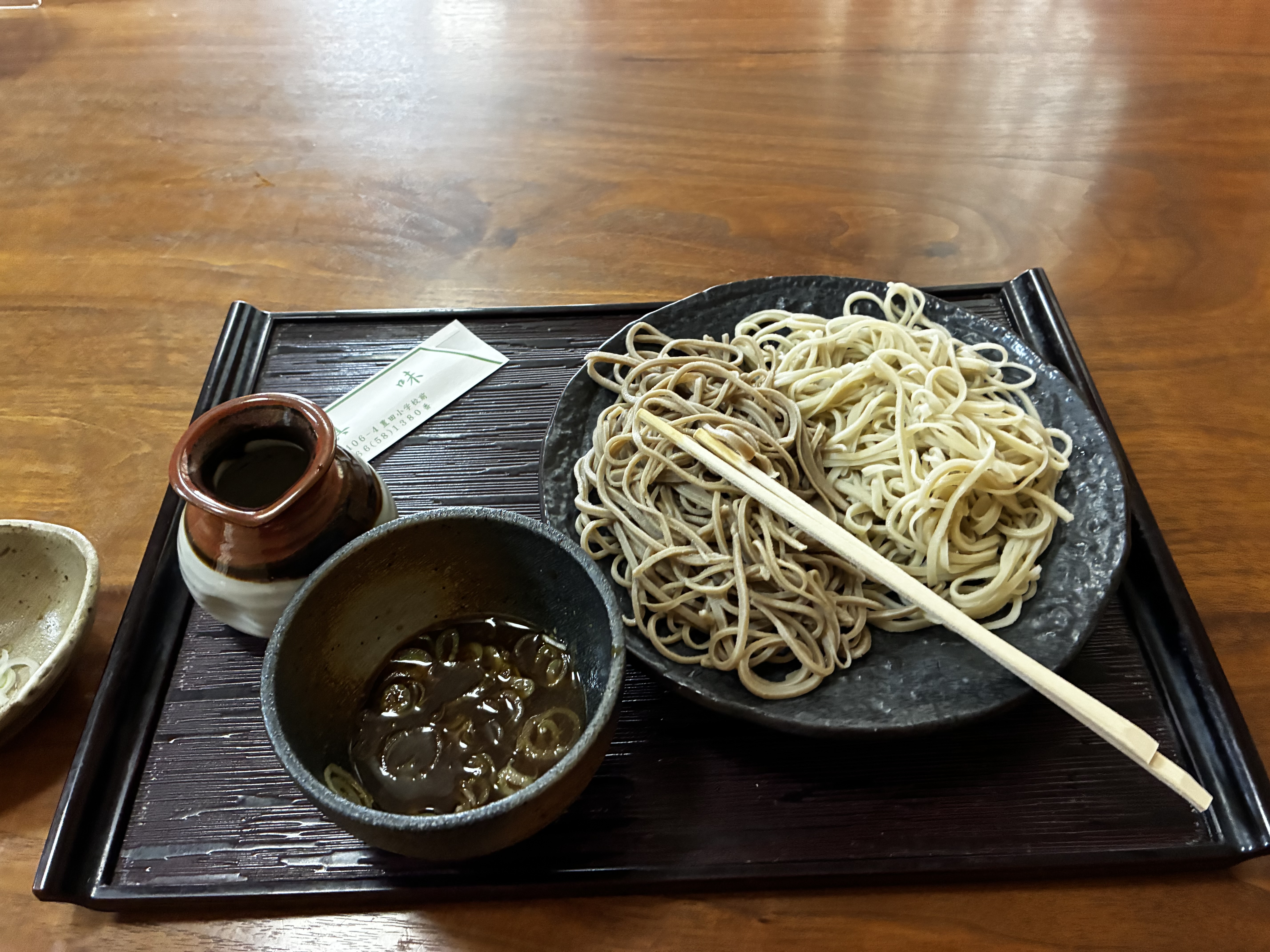
I rode over Shiojiri Pass ... It was hot and there was plenty of direct sunlight. Somehow I felt no faster than if I had continued the night before. I stopped for some soba in Chino.  ... and went to the train. 


It was hot, I was cooked, I did not feel like riding more, even up the gradual hill to Kobuchisawa. I needed to get back to Tokyo and did so, via train. The Chino train station was not convenient ... I ended up climbing a short nasty slope, then racing to try to catch, but just missing an express. Not recommended.

I had abandoned rather than riding on. Surely a real randonneur would have kept going ... at least over Fujimi Toge and downhill to Kofu, or to the Shizuoka Coast. And with this, I had DNF'ed a second brevet in 2025. 

But in truth I was fine with my ride. I had ridden 316km before checking in at my lodging, with 4200m of elevation gain, in just over 20 hours, half of that in the rain. My hands and thighs were chafed from the rain, but I had done much better in the warm rain this time than in the cold rain on February 1. I had seen a bit of new territory and plenty that I had not visited recently. And I had gotten over the climbs, even if somewhat slowly. So I look at the ride as great training rather than as a failure.