Showing posts with label bike gear. Show all posts

14 January 2024

Trying Out Some Shorter Saddles, Saddles with Cut-Outs, and Cheaper 3-D printed Saddles

I have yet to write up my PBP adventure of 2023. I DNFed after Loudeac and before Brest, just under 500kms.  The main problem was with my left wrist -- a lingering injury that turned out to be a scaphoid fracture but had not shown up on an earlier x-ray.  

A secondary problem was chafing/saddle sores that made it painful at times to ride — made much worse by my inability to ride out of the saddle due to the wrist injury, and a very hot afternoon on the stretch before Loudeac. I had the same issue in 2019, much later in the ride, with the same saddle on the same bicycle. That is a Fizik Arione model that is just slightly wider (and interferes just slightly more with my leg motion) than the classic, original Arione.  And the saddle cover is slippery/smooth on top, bit a bit grippy on the sides where the legs should slide smoothly. Also, the narrow front part of the saddle is a bit wider and protrudes more than on the "Classic" version.

The wider Arione w/ grippy sides and the more-bulbous front. 209 grams.
Worked fine on many rides ... but problematic on the longest randonees.

As mentioned years ago, the classic Arione (the "good" Arione) has been my long-time go-to saddle. I rode 205kms yesterday on one and it fit me absolutely fine.

The Classic Arione. 225 grams and worth it.

But I have my doubts whether the Classic Arione can continue to be my go-to. 

--First, Arione model types have proliferated, and most of them do not work at all well for me. The "classic" Arione is not easy to find these days. Sure, I only need one every other year or so, but at this point I cannot find one in stock anywhere.

--Second the Arione is said by Fizik to be appropriate for the most flexible "snake"-like cyclists. I am toward the other end of the flexibility spectrum.  

--Third, saddle styles have changed a lot in the past decade. The Arione is a long (30cm) and flat saddle. That has the benefit of allowing the rider to shift forward and back, relieving pressure and getting some variation over a long ride. But it also means that the rider is not "dialed in" to a "proper" position. Now, shorter saddles that put the rider in such a position have proliferated and seem favored by bike-fitters and many riders.  These nearly all have a "cut out" or "channel" in the middle to avoid numbness or pressure on the most sensitive parts of the anatomy. If your butt gets sore ... you get out of the saddle briefly instead of shifting back and forth. And the shorter saddle makes it easier to lean forward into an aerodynamic/racing position without putting pressure on your sensitive parts.

I ordered two of the shorter saddles during my injury-forced time off the bike. 

The first is a Fizik "Argo Tempo Kium R3". It is 265mm long, 150mm wide, and has a large cut-out. It is designed for endurance rides and has a bit more padding than Fizik's racing models. It is stated as 229 grams, but mine weighs 243. The cover is very smooth, almost slippery. This contrasts with the more grippy "suede" feel of the middle strip of the Classic Arione.  How do I like it?  It is OK. There is nothing particularly uncomfortable when used on the shorter rides I have taken, but I find the edges around the large cut out to be quite sharp in shape, so I feel a bit as if I am sitting on two sharp ridges, not a saddle. The padding at the rear is wasted when the edges of the cut-out are so sharp. That, the slippery feel, and the weight, all mean it will not be my go-to saddle.

Fizik Argo Tempo Kium R1

The second is the [Shimano] Pro Steath Curved [performance] saddle. It is 142mm wide, 248mm long, weighs 203 grams, and ... is now on the Ti Travel Bike. The Ti Travel bike has been in storage recently and may not be ridden for the next month or two. I liked the feel when I sat on this saddle, and I think the dimensions will work better for me that the wider Fizik Argo. Also, the edge of the cut-out has a smoother transition and feels more comfortable. But just because I have a good feeling about it does not mean nearly as much as actual testing on long rides. Stay tuned. 
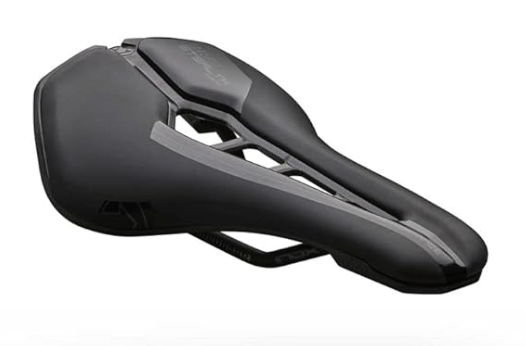
Pro Stealth Curved Performance

If shorter saddles are a trend across model line-ups, a recent trend in high-end saddles is 3-D printed versionsSelle Italia advertises 6 models, priced at Euro 340-450.  Specialized ones also cost in this range.

Fizik has 6 models in its "Adaptive" line, starting from Euro 250. As Fizik explains it, "Adaptive padding is created through a process known as Digital Light Synthesis. DLS uses digital ultraviolet light projection, oxygen permeable optics, and programmable liquid resins to essentially “print” saddle padding that is comfortable, supportive, and incredibly resilient—resistant to both UV exposure and prolonged, repeated use."

These saddles have a kind of mesh padding, like this:

I think the main advantage of this design is probably to get a greater degree of more effective and appropriately distributed padding than a traditional saddle ... at a lower weight. It is for weight weenies, and priced like a higher tech, weight-weenie product. But I just cannot see paying 2 or 2.5 times the price just to shave 50-60 grams off my saddle weight and get padding that may or may not be noticeably different than my trusty Classic Arione.

But ... I was curious. Then I saw that this style of saddle is now being offered on Aliexpress from no-name manufacturers in China. I bought one for around $70 from a brand called Bucklos. It comes with carbon rails and a carbon shell, while the padding area is made from TPU (thermoplastic polyurethanes -- a kind of sturdy but elastic rubbery plastic) ... and weighs in at 153 grams, light as a feather. It is around 143mm wide and 240mm long -- the shortest of my new short saddles. My first ride, of around 50kms ... I did not even notice the saddle. That is about the best thing one could say in reviewing a saddle. 

On the longest ride I have taken with it so far (around 120kms, including 2000m of climbing), I finally "noticed" it after around 100kms, and even wished it (or my bib shorts' chamois) might have had a wee bit more padding. But that is to be expected after months without any long rides. And on that ride, after my next food/bathroom stop, I again forgot about the saddle.
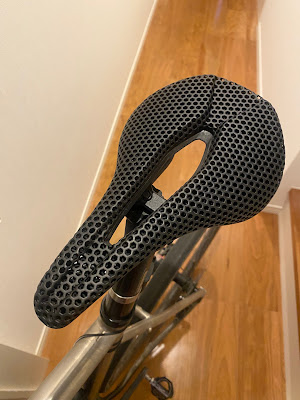
"Bucklos" 3D printed saddle from Ali Express.

The Bucklos does not have the same harsh edge to the cut-out as the Fizik Argo Tempo. And the surface grips my bib shorts just enough so that I don't slide around ... but does not seem to cause any chafing where my legs are moving. I've had this saddle on the RAMAX now since the Festive 500, for maybe 700 kms of riding, and I like it a lot. I'll try it on some longer rides eventually.  

Is the "TPU" material for the padding comparable to what Fizik and Selle Italia are using on their high-end models?  Well, it seems that the major brands work with Carbon 3D.com for their printed saddles. Here is a photo of a Fizik saddle, the padding for which seems made of EPU 41. As is stated, EPU 41 "is comparable to commercial TPUs with a Shore A hardness of 70."

In fact, I like this saddle so much that ... the last time I was on Aliexpress I ordered a second, very similar one (from "Ryet") for around $40 on sale. That one weighs in at 151 grams.

Ryet 3D printed saddle. Carbon shell and rails, 151 grams.

I'll update this post once I have more experience riding these.

UPDATE (April 2024): One problem with the Bucklos model … it is not comfortable for in town riding without a chamois pad. The holes/pattern seems to chafe a bit.

I have now used the Ryet over the past month. It is comfortable for me, as light and even cheaper than the Bucklos, and noticeably softer padding than the Bucklos, and less grippy or likely to chafe when riding in regular pants. It is staying on the bike for my next really long ride.


Seat and Spring flowers

Oh, and the one other saddle I really want (and plan) to try, is the Infinity Bike Seat. It's the official bike seat of RAAM. The seat is basically all cut-out. It places the rider in a set position, no saddle sores because ... not much saddle except around the edges, and you are propped forward so you can use aero bars on a long solo ride. I have a line on a "loaner" I could test, since this is an expensive investment.


03 June 2023

Helmets -- An Update, and [Shimano] Lazer

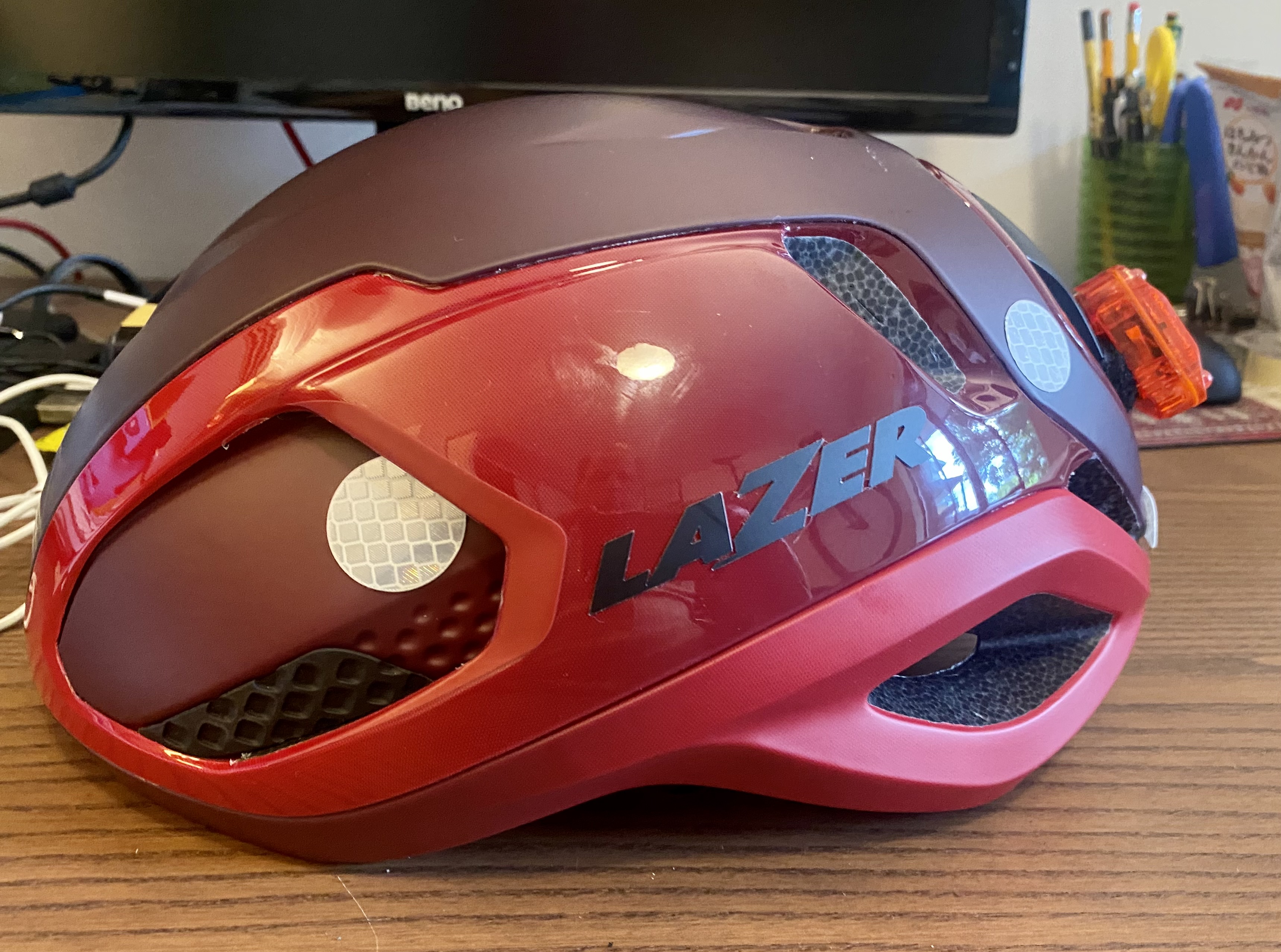
New helmet - Lazer Vento Kinetocore

Last September I wrote a brief review of my helmets when I discarded my ancient Giro Atmos and got a basic Bontrager Specter "wavecell".  I have thought about it some more in the meantime. I think my perception of helmets varies significantly with the season/temperature and length of ride.

First -- one helmet that had been in storage and was not included in last year's review. It is a Bollé model I got some years ago. It is just a little too wide to fit snuggly on my head unless I am wearing a cap of some type underneath. It does, however, have some interesting features. First, you can latch on covers that block the vents on top of the helmet (there are still a couple small vents on the side). This makes the helmet a lot warmer in winter and also presumably improve the aerodynamics considerably.  I used the Bollé this winter on the February Seattle Randonneurs' 200km brevet and some other rides, and I must say it is ideally suited to winter riding. The helmet also came with a removable thick felt lining that covers head and has generous ear flaps ... too warm in Tokyo for all but the coldest days of mid-winter. I still have that liner somewhere but have not been tempted to use it in years. If the Bollé were just a little bit narrower, I might use it in warmer weather without the vents covered ...  Anyway, it probably has another few years of winter use in it before it needs to be discarded.  (The US CPSC recommends replacing helmets after 5-10 years, even if not damaged, as the foam filling deteriorates over time).

Vent covers on!

Vent covers off!

Side view

Vent covers

Second -- last Fall I gave a relatively mixed/lukewarm review of the Giant Pursuit MIPS helmet. I have used it on a few rides recently and have adjusted it so that it fits a bit better and feels balanced on my head. It is still a bit heavy and bulkier than some, and it is still a very dirty white color.

Finally -- For PBP and other future rides, I finally bought a first-tier aero road helmet, the Lazer Vento Kineticore. "Kineticore" is Lazer's name for their crumple zone crash-protection tech, which gets 5 stars out of 5 from the Virginia Tech helmet crash testers. Lazer is a 100+ year old name in cycling helmets and was acquired by Shimano in 2017 or so. On the Worldcycle Japan domestic online site, it is listed as "Shimano Lazer" or, actually, シマノレーザー. Elsewhere it is just "Lazer".

The Vento

Rear left view. The corrugated surface above the light is actually a band to tighten/loosen the internal part that wraps around your head and holds it snug. Very easy to adjust while wearing. AND does not protrude from the back like many of the wheel systems that would interfere with a ponytail or riding on the recumbent with the headrest.

Side view with reflective stickers 

The Kinetocore crumple zones.

The helmet looks distinguished, I think. It fits perfectly, is very easy to adjust with an external adjustment mechanism on the back, and is easy to attach a rear LED light. There is even a decent place to stash glasses. And it is relatively light, as well as being designed for aerodynamics ... with decent airflow. I added some reflective stickers given the darkish cover, and affixed a rear light.  I compared it with a number of other similar designs ... and it was 10-20% less expensive and available within Japan, but by no means cheap at around $180 equivalent.

Wout van Aert (aka WvA)!

Jonas Vingegaard [correction - Marianne Vos] ... showing too much mouth.
Christophe La Porte (winner stages 1 & 3, GC leader, Critérium du Dauphiné)

Team Jumbo Visma uses the Lazer helmets which ... seems odd, given that they are not a Shimano team (they use Cervelo bikes and [Cervelo affiliated] Reserve wheels, with SRAM groupsets). Then again, Lazer is a Benelux company that downplays any Shimano connection; and Jumbo Visma is the #1 Benelux team. As the sponsors want to hear fans and consumers say, if it is good enough for [Wout/ Jonas/ Primoz/ Rohan/ Christophe ... ] then it is good enough for me.

Then again, Wout van Aert usually rides a Red Bull sponsored helmet ... he was using a different Lazer model until, at Tour de Suisse, he appeared with a Vento that has the Red Bull logo and color scheme. 

WvA in his Red Bull Vento

For a seriously hilly stage in warmer weather ... some of them opt for maximum ventilation rather than aerodynamics. I did not see Primoz Roglic using the Vento at last month's Giro. But they all seem to have the Vento at the Dauphiné ... and won 4 out of 8 stages, 3 wearing the Vento. Vingegaard used one on Stage 5, but had on a different Lazer helmet with full ventilation/less aero at the end of stage 7 -- a stage under 150kms in length but with over 4000 meters elevation gain. (Team FDJ also uses Lazer helmets.)

I hope that, with this new purchase, I will not be buying any helmets for the next couple years at least. I'll still use the Bontrager for my rides in town, and the Bollé for some rides in winter. The Giant Pursuit perhaps can see service as a backup, or for a TT-like effort.

24 April 2023

A Better Rinko Bag!

Rinko'ed bike waiting as I purchase a shinkansen ticket.

In Japan, cyclists need a "rinko bukuro" or rinko bag in order to take their bicycles on trains. The basic idea is to take your wheels off, clip them to your frame, put it in a lightweight nylon bag, and attach a shoulder strap. This way you won't get grease or other grime on other passengers, the train, or yourself, as you carry the bike. It works for all but the most crowded rush hour trains, especially if you choose a car at either end of the train. It works on the shinkansen, where you stow your bike behind the last row of seats in a car (or, in a pinch, in the area between cars). Now the shinkansen has reservations for seats that have extra space behind them at the rear of some cars for "extra large luggage", but in most cases, even on the shinkansen, you can still just take a bike in rinko with you, no extra reservations, no extra fees. Rinko bags generally roll up into a stuff sack that fits in a bottle cage, so you can ride with your bag on your bike. 

Although some old school types like a rinko-specific bike with fenders that split in two, etc., and you can study a 30 minute youtube video by the "rinko master" who will show you the right way to do every step of securing your bike in a rinko bag for maximum safety, stability, etc. ... most regular cyclists favor a minimalist approach.  But I want to just clip my wheels to my frame, pull up the bag, attach the shoulder strap, and run for the train. I can be careful not to bash my exposed rear derailleur, and nothing else is particularly vulnerable.  Some people opt for rinko designs that even leave the rear wheel attached. These result in very bulky packages, in my view, especially if you ride a large frame as I do, so I avoid these. I trade some grease and grime from taking the rear wheel off and on, in exchange for more easily stowing my bike on the train without bothering other passengers or getting requests/lectures from the train staff.  

Ostrich is the leading Japanese rinko bag maker. I have used their bags for many years. Giant, Tioga, and others make the "leave the rear wheel on" type. But for all of these, there is a dilemma for a long distance cyclist.

I would like to have a rinko bag with me in case I need it mid-ride. If I DNF and need to take the train home, wouldn't it be nice to have the rinko bag with me? But I need my bottle cages for hydration, and I don't want to carry a rinko filling up significant space and adding weight to a rear or front bag. Once, I tried the SR600 Nihon Alps and was blocked at Gero by a massive rain storm that washed out roads (okay, I was ready to abandon anyway). I ended up riding to Nagoya, buying a rinko bag that was too small to really fit my bike, and going home with a protruding bike. I had left my rinko hidden near Kobuchizawa to pick up at the end of the ride ... oh well. 

Now ... a solution!  One of the Japanese randonneurs who did Cascade 1400 last year (and goes by PEKO-chan) is selling a better rinko bag. It is much lighter weight ... but still very strong ... material.  An "extra large" size is available. Instead of needing to carry in a bottle cage, it easily slips into a rear jersey pocket. And it feels feather light. At 3000-3500 yen, these rinko bags cost far less than the "leading" brand.  All in all, a better product.  

They are available for sale direct on PEKO-chan's website, here.  But don't expect her to be accepting orders during Golden Week. Rumor has it she will be off on a long ride.

Left - my Ostrich rinko bag, right - my "otesei" rinko bag

With this product there is no excuse not to carry a rinko bag on a long ride ... or even on a shorter one if I think I might want/need to hop a train home.

I used 2 of PEKO-chan's bags for my 160cm long (plus protrusions) recumbent frame

April 2025 Update:  I have been using PEKO-chan's rinko bags regularly especially as I now have a country house for weekend/summer use -- when I can manage to get out of the city -- and often go via bike/train/bike to get there or back.  After maybe 30-40 times using it, I finally poked enough holes in the extra large green one so that I started using one of her other models I had gotten as well -- it carries the bicycle upside down, seat downward. I find it less likely to bang up a derailleur when that most sensitive mechanical part is not on the ground. Also, I find it a bit faster to get the bike into and out of the bag with that design. (The purple one shown above I got for my wife ... who has yet to take full advantage of it). 

Anyway, I am still a big believer in these bags, even more so, after a couple more years experience with them. 
"Upside down" style bag, with a stiff wind against the wheeles, at Kofu Station.

07 March 2023

Size Does Matter

I used the same mini-pump for at least the past 15 years. That pump still works, even if it needs to be tightened at times. But it is getting old, and it sometimes slips off the valve, especially if the valve does not protrude far enough from a deep rim.

Road Drive vs Pocket Drive

So I wanted to get a mini pump that I could screw on securely to the tube/tire valve, a design that others (including Jerome) use. So last year I ordered a Lezyne "Pocket Drive" pump that had good reviews. It is tiny and fits easily in a back pocket of a jersey. But it is too small. With a 700x28 or 700x30 tire, the tire is still lower than I would like after several hundred pump strokes. Each stroke just does not push through much air.  It might work for a 700x23 tire ... but no one rides those anymore. Also, I noticed that when I tighten the flexible hose to the Pocket Drive before affixing to the valve ... the threads are at an angle. It still works, but it shows careless workmanship, something I did not expect from a premium brand like Lezyne.

Off-of-true threads on the Pocket Drive

When I happened by a bike store last week, I saw some other Lezyne mini pumps. One, the Road Drive, comes in several different sizes. There was one that is just enough bigger than the Pocket Drive to ... actually pump up a tire in 150-200 pumpstrokes. And the workmanship is what I would expect from Lezyne.  And it is still plenty small for carrying on rides. Problem solved. I hope this one lasts another 15 years!

The Road Drive is far more functional for my purposes.


29 April 2022

Time for a New Deuter Race Rucksack!

Back in the waning years of the first decade of the first century of this millennium, a long long time ago, I got a Deuter Race rucksack for use while cycling.

The Deuter Race is relatively small for a pack at 12 liters capacity, but large enough to carry anything I could need on a long single-day ride or, together with my Rixen Kaul rear under-seat bag or Ortlieb (or Guu Watanabe) front bag, on a 2-day brevet. The Deuter Race has an "Air Stripes" system of two meshed foam vertical sections that hold the pack slightly off my back and allow air circulation. This makes a huge difference in terms of me not overheating and not getting the pack covered with sweat. It also has an attached rain cover (hidden in a zippered compartment), and it is designed to accommodate a 2-liter hydration bladder and hose--great for a multi-day ride where some sections require me to carry more water than can fit in my two on-frame water bottles. There is a main compartment, two small zippered small pockets, one of which is on the top and designed for wallet, keys, brevet card, etc., and 2 open mesh external pockets.
The rucksack has proven durable. And despite trying a number of others before and after it, I have never found anything that works as well -- in terms of "fit" on my back, secure/snug but not constricting feeling while I ride (and shoulder straps long enough to work with my long torso and "barrel chest" figure, room for enough (but not too much) gear, adaptability for rain, etc. I put reflective tape on the rucksack so that I could wear it OVER a reflective vest on a brevet. Heck, on our last 600km ride, I pinned a small Audax reflective triangle (signifying "slow moving vehicle") on the back so I did not need to worry about whether my vest was inside or outside the rucksack. And, of course, I could ship the rucksack home with my rain gear and other unneeded items mid-ride without difficulty.  Professional reviewers agree.
But I did manage to damage (slightly -- still usable) one of the plastic clasps on the waist strap as I got it ready for shipping. And the rucksack is pretty severely discolored from the grease and grime of many years. When the rucksack arrived the next morning by Yamato Takkyubin, my wife suggested that maybe it was time to replace it. In fact, she was so enthusiastic about getting rid of the discolored, aging rucksack she offered to give me a new rucksack as a gift. How could I refuse?!
Old and New

The "Air Stripes" are a winning design feature.

What to get as a replacement? Another Deuter Race, of course! There have been some updates in the intervening years -- the shape seems slightly more rectangular, the straps and clasps are slightly different, and the wallet/key compartment seems noticeably larger and has much wider zippered top access (resolving one of the only flaws I can think of from the original design). Will this be the last cycling rucksack I ever need? Possibly. This time I may work a bit more at cleaning it regularly (yearly?) to keep its color. And maybe an attached reflective triangle will mean I don't need to cover it with reflective tape?