Showing posts with label Saitama. Show all posts

12 March 2024

Another brevet on the Brevet -- riding in cross and headwinds, and then searching for the rear derailleur limit screws


On Saturday I joined the AR Nihonbashi 300km "around the world" brevet. Why "around the world"? Because the checkpoints were evidence of foreign culture and/or foreign enclaves in Japan -- a Dutch windmill, Thai temple, Sri Lankan temple, Brazilian grocery store, and a Mosque ... not to mention a Japanese shrine thrown in just to remind us of the host culture.

Winter brevets limit choices for the organizers. And early March can be decidedly wintry in Japan. This brevet would not have happened if it had been a day earlier, when there was snowfall in much of north Kanto, though sun and above freezing temperatures ensured it was all gone a day later. A ride in the mountains at night, on a 300km or 400km course, can be problematic. So courses tend to stick to the plain. Indeed, on the January Chiba brevet that I joined, one key goal was to get over the highest point before the "thunder snow" hit.

The difficulty with flat courses in Japan near Tokyo is that they tend to go through densely populated areas with plenty of traffic. And Saturday traffic tends to be worse than Sunday, with many more trucks out on the road. A 300km brevet usually must be held on Saturday, unless on a 3-day holiday weekend, since the finish reception for 7AM starters, for example, remains open until past 3AM the following morning. That does not work for riders or volunteers who have Monday to Friday jobs. So a winter flat brevet means a brevet with heavy traffic. Indeed, I did a winter AR Nihonbashi brevet back in 2015, and the congested traffic of that event was enough to keep me away from similar events for quite awhile. The only other option is a night-time Saturday start. That is actually my favorite if I can show up well-rested, as we are assured near zero traffic on the outbound leg and far fewer trucks on the return during the day Sunday.

On the other hand, a flat course is what I want--what I need--for the recumbent. I have done 2 previous 400 km brevets on the Pelso recumbent, plus the 1667 km ride across Honshu last Spring. But the Pelso has been gathering dust in recent months. Signing up for yesterday's event was strong motivation for me to get the bike out and put it into riding condition -- fine tune the 12-speed SRAM Eagle GX drivetrain I had got and installed last year, go back to the J-bars (I did not really like the steering tiller I experimented with briefly), and otherwise get it ready to use regularly. I managed 5 rides, each of 40-60kms, on the Pelso in the past few weeks.  Was that enough preparation to use it on a 300km brevet? I was about to find out!

The other reason I selected this brevet was its start and finish near my home. Well, the start was at Odaiba, which, as the crow flies, cannot be more than 3kms from home. Even going across the Rainbow Bridge, it is more like 5kms.  And the finish in Shinbashi/Shiodome is even closer. 

Of course, the Pelso is not easily rinko-able, so a train to the start was out of the question. And with a 630AM start it is not allowed even to walk a bike across the Rainbow Bridge (pedestrian access is from 9AM in summer, 10AM in winter). So I rode via Kachidoki/Toyosu, 11.5 kms to the start, just as far as, say, an AR Tamagawa or Randonneur Tokyo event starting near the Tamagawa. Oh well, not such a great advantage to join a Nihonbashi event when it starts in Odaiba!


Jerome also signed up for the event. I knew he would not like the flat winter course and heavy traffic, but was glad that he would do it -- some extra motivation for me to show up even if the weather was bad, to finish if the chips were down. But he registered for a 6AM start, 30 minutes before me. I got to the start location after he had left and never caught up ... but at least could communicate via text during the ride.

The forecast was for typical early March weather. A low of just around freezing and high of around 11-12 degrees C (50-55 F). But the weather forecast on Friday night warned of a "winter style" weather pattern, with stiff winds from the NW.  An online forecast showed that the winds would be strongest during the day from maybe 9AM until 4PM then gradually die down. Looking at the route, I realized the strong wind would almost exactly coincide with the time we would be riding ... to the NW. So a nasty headwind stretch of 120kms or more! The forecast proved remarkably accurate.

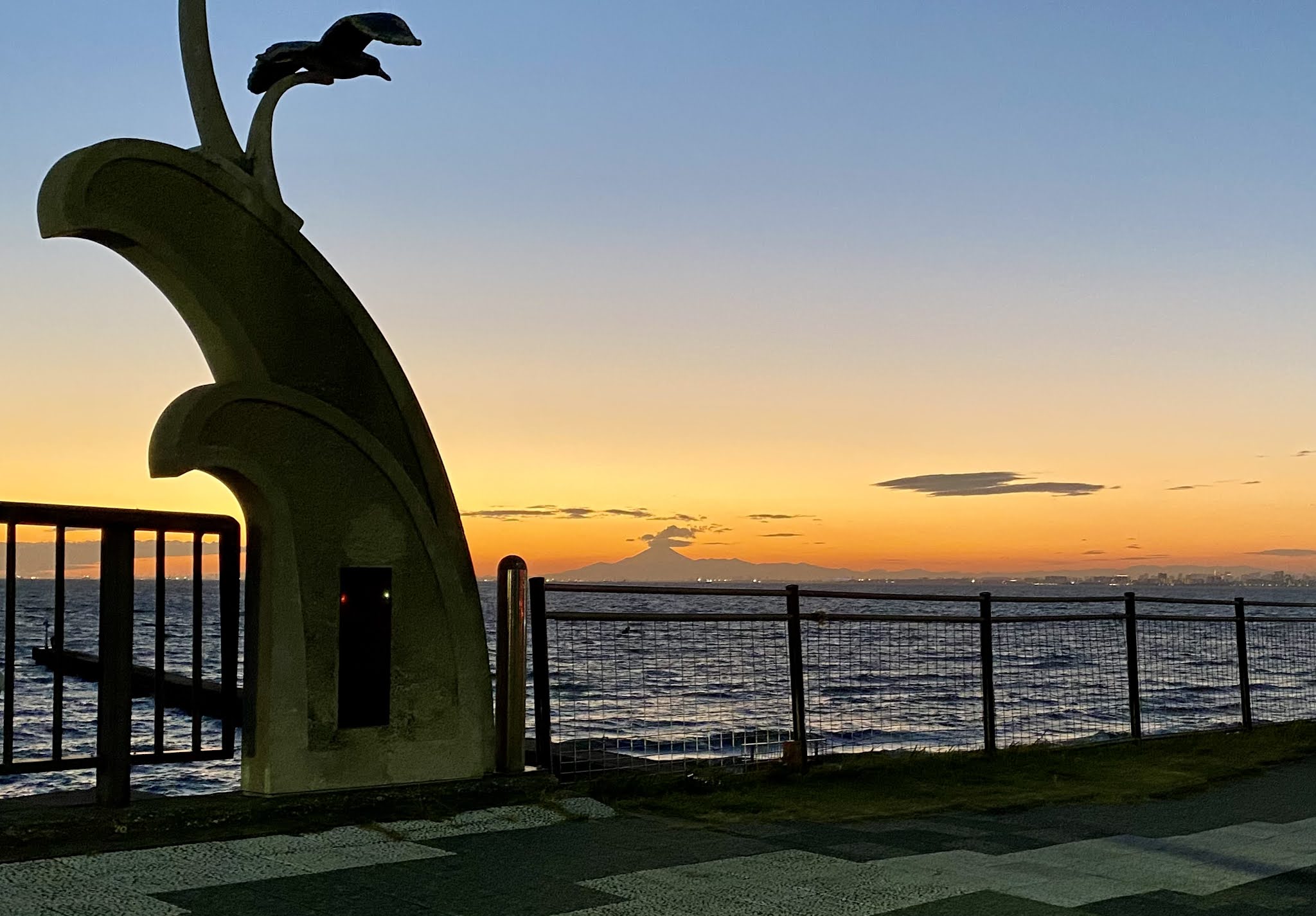
I left home by 540AM and was at the start area, next to a smaller replica Statue-of-Liberty in Odaiba, by 6:10. The ride to the start was lovely -- dawn rides often are near the waterfront.

After the bike check and lots of other riders admiring the Pelso (the only recumbent there, as is usually the case for events in Japan), one of the organizers said that the 630AM riders could start. No one else looked as if they wanted to lead, so I headed out. I managed to get around a corner, through a couple traffic lights, and onto the main road north past the Tokyo Big Sight convention center, and was sure any of those who started right after me must have been held up by one or more red lights.  I did not see any other participants until 23kms into the ride.

Onto the course, alone.

But I did have plenty of company. After 7AM on Saturday morning, the city was coming to life in this industrial/harbor-adjacent area. There were lots of trucks.

The route turned toward the East at around 20kms in. For the next two hours or so, I would be riding almost directly into the glare of the morning sun. This makes a huge difference riding a recumben, face upward. At night, I could see the constellation of Orion above me as I rode ... but in the morning, it was the brutal glare of the sun.


The route turns East here.

As the route crossed the Arakawa, there was a steep ramp up to the bridge with no shoulder. I was waiting at a light with numerous trucks and did not like the idea of riding next to them up that ramp. So I went down a side road and walked my bike up the levee to the pedestrian/bike crossing on the North side of the bridge. This was fine, except I lost time, and even more time at the far end of the bridge, where cyclists and pedestrians needed to descend a looping, slow pathway. As I reached the bottom and returned to the main road, ... a group of at least 5-6 riders, a healthy share of the 630AM starters, had passed me.

I caught them at the next traffic light and trailed them for around 10kms ... until I noticed that my front tire was noticably soft. A slow leak, or open valve that got bumped from time to time? I pulled over at the next opportunity and pumped up the tire. Perhaps it would hold?  By now, we had left Tokyo Prefecture behind and were passing through Ichikawa and Narashino, Chiba. Here we were on smaller roads -- one lane in each direction, and the traffic had become heavy -- long lines of cars waiting for red lights, in some places without room to pass and pull up to the front of the line even.  This was shaping up to be a long brevet. 

Heavy traffic ... in many places without this much shoulder nor any sidewalk, and wide trucks,
 so impossible even to pass by the cars on the left.

The tire was soft again. I pulled off at a 7-11 parking lot, flipped the Pelso over, removed the front wheel, and changed the tube. The first tube I tried to insert was around 10cm too long. Very poor quality control. The second tube worked, at least, but it seemed like the change had taken 3-4 times as long as it should have. My knees were starting to hurt -- riding the Pelso does put a lot of presure on them, something I never experience with a normal upright bike -- and I had some pain in my left rib cage going back to a minor accident on the Pelso on March 1, that I think I stressed it somehow when I did some manual labor around home on Thursday, or perhaps even when slept on it Friday night. My rib injury was causing more trouble today than it had in the past week, so I was moving slowly off the bike. On the bike, reclined on the Pelso, it was not a serious problem.

New tube inserted, I was back on the road and into the congestion. This continued most of the way to PC1. Finally, we had left the city behind and were in the countryside. The PC was at a park that included a lovely, functioning windmill.

At PC1

By now, there was what felt like a gale force wind from the NNW.  We were still heading ENE, so it was a cross wind. About 500 meters beyond the PC, my Wahoo beeped at me that I was off course. I had followed 3 other riders who were continuing ahead, when the course turned left. I hollered and the nearest 2 riders (a couple), turned around. The furthest of the 3 continued along, at least for the time being. I looped around 270 degrees and then entered the side road, which went up a steep hill, 9, then 10, then 11 and 12 degrees.  I got off and walked, the couple passed me. Anyway, it was a short steep bit so I was back on the bike in under a minute. 

Wind coming at us across a lake, just past PC1

Finally, some low traffic stretches ... but the crosswind gusts were deadly.

The next part of the trip involved less traffic and even some quiet country roads, but vicious winds mostly from our left side. At points, I felt pushed across the road, even though I leaned over to the left side of the Pelso seat. It was like riding a sailboat port tacking close to the wind ... except a bicycle lacks a keel. The vicious wind continued.  I saw a couple riders headed the other direction. ... They DNFed and were headed back to town or a train station. I took some ibuprofen for my ribs and knees, which seemed to do the trick.

A few times I needed to get off the bike, the wind was so strong.  Eventually, far into the 30km stretch between the windmill PC and PC2 (at a Thai temple), the couple who had passed me on the hill ... came heading back down the road. DNF, they said. They made a good choice, I think.

At PC2, Wat Pakna, near Narita

After the second PC, we turned to the WNW. Our route would be pretty much straight into the wind from here (82kms) to the third PC at Oizumi (198kms). It was slow going, especially the first couple hours. I was creeping along at between 15-18kph, but was still passing more riders than passed me. At least the lower position of the recumbent makes it a good choice on a flat course into headwinds.

Somewhere early in this stretch, before Tsukuba, we went through an area with some short ups and downs and I downshifted, taking advantage of the wide gearing on my 1x12 drivetrain. The chain ... rode up over the innermost gear and jammed in between spokes and cassette. It jammed hard. 

Unjamming my chain. ... first of many times.

I spent at least 20 minutes trying to get it unjammed, finally succeeding after removing the wheel (a huge pain with the Pelso!) and a lot of elbow grease. My hands got sliced a bit on the teeth of the cassette. Bloody. Why did the chain slip inside when it had not had any problem since I had tweaked the "b limit" adjustment screw a week earlier to solve some other shifting issues?  This 1x12 setup is new and really only had gotten use on the rides over the 2 weeks before the event, but all had been dialed in and going smoothly the past week. Smooth shifting into all gears. Why did it need to develop a problem now, on this slight upslope in Ibaraki near Inashiki?

I looked for any upper/lower limit adjustment screws, on the top, bottom and rear of the rear derailleur. There did not appear to be any -- nothing visible even with the bike upside down and wheel off.  Odd. Maybe the Eagle GX did not have them? Oh well, I thought, I will just need to be careful as I shift to the lower gears.

It did not work. I think over the rest of the ride I counted 7 times where the chain jammed. Sometimes I could quickly pull it out and reset it. Other times it took 15+ minutes and I needed to remove the rear wheel.  I tried to avoid the innermost gear of the cassette ... but somehow the chain jumped over and into the spokes even when I thought that I still had at least one cog left. I tried to ease the chain up a gear as gently as possible ... which usually worked ... but sometimes did not. This killed a LOT of time and set me way back over the final 200kms.

At least the tires held after the first tube change. ... except, except, the tire had not fully sat onto the rim, in some places still not all the way expanded to the "hooked" intersection with the bead, and so there was a perceptible "bump" as the front tire turned. I never fixed this (which would have required much higher tire inflation, then deflation back to a good level). I was on rough enough roads so it did not really make a big difference, but it was a minor annoyance for 250kms. 

After passing through Ushiku, the route took us SW of Tsukuba along a 4-lane road that had some trees and other landscaping. There were still plenty of trucks, and lots of "otaku" engineer types driving "car-guy" models of cars. (Audis, BMWs, the new Prius PHEV, etc.) on weekend outings -- maybe a quick trip to the pachinko parlor, or the golf driving range.  But at least with 2 lanes in each direction there was plenty of room for them to pass. Tsukuba has a different feel to it, because it was developed as a kind of science and technology city. Lots of research institutes and corporate R&D facilities, I think, as well as the pre-existing "inaka" (countryside) stuff.

PC3 Sri Lankan temple

Combini pasta stop just before PC3. Already almost 3PM -- behind pace!
Does my recumbent rear bag carry as much magic as Doraemon's bag?
Well, today it was missing a few things.

We had a nice stretch on some local roads, and a couple long stretches on national route 354, in traffic. I stopped a few times, and chatted with other riders.  By now, I was mostly in the vicinity of riders who had started at 7:30AM, an hour after me. I had made slow going of it, and I think most riders slower than me had given up already.  At every PC I was at or just slightly behind the time limit ... but the organizer was not enforcing intermediate time limits, as the PCs were designated "tsu-ka check" (just need proof of passage -- the photos -- not proof of time).  I figured I would catch up on the return into Tokyo, once there was no more headwind.

I texted with Jerome from time to time. Over the first stretch he had gone WAY faster than me. ... but then on the headwind he noted it was "tough going", even for him. He was still perhaps 80-90 minutes ahead of me, though he had started only 30 ahead. But the gap had stopped increasing. 

As I took my Wahoo off the bike at a convenience store to recharge it a bit while I stopped, one of the ziptips broke through the base that held the unit on. After a few more kms, the material I had used to bind it tightly to the handlebars (a rubbery base -- but might as well have been a cut piece of an old inner tube) fell off somewhere, leaving the Wahoo rattling around and slipping off. I held it in my hand for awhile, then eventually used some electrical tape to secure it. I had forgotten to bring my stash of zipties. 


Crossing the Watarase-gawa west of Koga, Mt Fuji in the distance. 545PM!

As the sun went down, I passed from Ibaraki into Gunma Prefecture. My dynamo light was pointed too far down so I tried to adjust it ... and it came loose in my hand. I had not secured it properly to its base -- amazing that it had not fallen off over the past couple weeks, and today's first 150km+.  I also had forgotten to bring the correct size of Torx star-shaped allen key wrench to fit it into the base. So I just used my back-up light for awhile. 

Eventually I made a pitstop for a hamburger at a McDonalds, a few kms before the Oizumi PC. I had a message from Jerome that he had stopped not long before at a burger place AT the PC -- a Brazilian supermercado. The headwind had died down to a fraction of its former self after sundown ... just before we turned, finally, in a different direction. 

The supermercado PC

I realized that my backup light would probably run out before I reached the finish. I could have recharged it if that happened, but it would have taken too long for me to have any hope of meeting the cut off. And the beam was not nearly as good as on my "Supernova" dynamo light, properly aimed.  So I used the rest of my electrical tape and managed to secure the dynamo light. It pointed slightly to the right, into the middle of the road (and oncoming traffic), but was low enough so as not to bother the drivers and it held to the finish.

Electrical tape -- one essential I remembered to bring along.

The missing torx wrench, Sunday morning at home.

After passing SW through Fukaya, Saitama, the road eventually turned south and the SSE through Ogose, Moroyama, and Hidaka. This is a very familar route. I remembered it has having more up and down than it did. The recumbent was just fine to climb on going over these "rollers" ... except when the chain slipped off and jammed into the spokes again. 

I was at my wit's end, crouched beside the bike in the dark and cold, trying to get the chain back on, when another rider (730AM starter) came by. He pulled off to ask if I was okay, and I expressed my frustration. Another 10-15 minutes wasted, by now several hours in total. Why wasn't there an upper and lower limit screw on this derailleur? He took a look and shrugged his shoulders. By now I had started to cough occasionally, and the cough seemed to be originating in the area of my ribs/lungs that had been bothering me earlier. That was not a good sign, but at least the coughs were seldom, not frequent.

Anyway, the chain dug out and reset, I made it up the hill, through Moroyama -- a very familiar location -- and took the turn off to go to Hidaka Jinja, another PC. I don't think I had ever taken this short detour, but it the shrine was very impressive and worth the deviation. I'll stop by again sometime when it is actually open.

At Hidaka Shrine

It was now 1140PM. I was 30 minutes behind schedule to make the 2:30AM cutoff at the finish.  One more chain-caught-in-spoke incident on the climb out of Iruma. I sent Jerome a text telling him about the cough, that I would not make the cutoff, and could meet him somewhere between the goal/finish and our respective homes for a bite to eat if someplace was open. But I did push on. 

The climb out of Iruma was much shorter than I expected ... the route turned left to the SE rather than going South over the ridges to the tea-fields of Sayama/Oume. I was expecting several more hills but instead we traveled on a long, long stretch of mostly flat to 1% downhill. I was making up some time, actually a fair bit of time and moving at a good clip. I passed several riders. With no more headwind and no more traffic, only the red lights held me back.  I tried my best to time them, and to use the ones that I hit for a short rest, a sip of water, a check of the route and time.

I got a message from Jerome that he finished just before 1AM.  A few minutes later I sent a note that I would "go for it". I was within 30kms, and still had 80 minutes left. 

Then I hit red light after red light.  On Oume Kaido, I rolled up to a red light watching the cross-light turn yellow, then red, and started through just as it turned green.  I had not noticed a police car on the far side of the 6 lane road. He barked at me with his loudspeaker and I gestured up at the green light as I accelerated on.  The car did not turn or follow. But the lights got more frequent as I got into town, around the Ogikubo area, then down Kan-nana.  I was riding near other brevet riders now, though none whom I recognized, and no 630AM starters I am pretty sure.  At red lights I pulled to the front and said "excuse me, I'm a 630AM starter, I'm out of time and need to hurry."  At a red light were we turned onto Inokashira Dori, I just inched around the corner and continued on -- a technical violation but a harmless one at 2:10AM. I snapped my last PC photo, the mosque at Yoyogi Uehara, at 2:11AM. There was a note from Jerome that he felt ill to his stomach and was heading home. 

The Mosque at Yoyogi Uehara, 2:11AM

Now I was on familiar roads ... taking a route I have often ridden from Uehara through Omotesando and to Nishi Azabu. In fact, I had ridden it on the Pelso within the past few weeks.  But I could not do anything about the red lights -- at Yamate Dori, then before Yoyogi Park, then at Meiji Dori, and again at Aoyama Dori. Each light killed a minute or two that I did not have. And in the city there was still cross-traffic, even in the wee hours taxis racing back and fro.

I got to Nishi Azabu Crossing at 2:28AM. 300kms into the brevet course, but still 3.7 kms from the goal in Shiodome, and no more time.

So I rode home, picked up some food at a convenience store, bought milk for my morning coffee, left a voice message for the organizers announcing my DNF, ate, bathed and slept. 

The next day, in the morning light after sleeping in, without the panic of trying to reset a chain ... I searched online and found the youtube video on how to set the limit screws for a SRAM 12 speed Eagle GX derailleur.  I got out my Torx star allen wrenches and reset the front dynamo light properly and securely.  And I will reset the Wahoo base securely.

Wahoo secured with tape after the base broke.

No limit screw visible from the bottom (nor from the top)

Two small limit screws, tucked way in underneath. Argghh!!!

I think that with a bit more thoughtful and careful bike preparation, I would have completed this event within the time limit.  And the Pelso actually handled the short rolling hills of this course better than I remember from last year's events. It is still not a good bike for longer or >10% climbs, and not great for riding in heavy traffic with narrow tolerances. But it is great for looking at the stars, and it is easy on the back, neck, arms/wrists, and butt. If I rode it a bit more and actually trained on it, it should be faster than a regular bike on a course like this, especially with the nasty headwind stretch. I worry a bit about it putting too much stress on my knees, but I think I can manage that by spinning a higher cadence/lower gear and moving my position.

I did not get "credit" for homogulating a 300km event, but I did ride 313km in difficult conditions. So not a bad training outing. And a good learning experience with the Pelso.

11 December 2022

300km in the Land of a Thousand Convenience Stores

Moon rises over Ibaraki

On Saturday, December 10, I joined the Saitama Audax 300km "Attack Nakagawa" brevet.

I need to do a full SR series (200/300/400/600km official brevets) to qualify for Paris-Brest-Paris (PBP) next summer. I signed up for this event during my US trip last month, but was actually planning to skip it and instead do a 300km Randonneur Tokyo event in January, as it turned out that I had a bonenkai scheduled for yesterday.

 ... But the Randonneur Tokyo event filled up within an hour or two of registration opening and I missed my chance to sign up. Also, the weather forecast for Saturday looked ideal for an early winter ride. And I really felt the need for a decent endurance ride after several months of travel and abstinence from long-distance cycling. Strava tells me that my conditioning has dropped dramatically due to lack of activity over the past six weeks. My body does not dispute that. I've gained weight and lost muscle. So I went ahead with the ride, skipping the bonenkai.

Worked hard to boost fitness in September / early October ... all lost.


Like many Saitama Audax events, it started from Toyomizu Bridge at the Iruma River, where it is easy to park a car for a day or two, and the organizers can set up shop under the bridge to sign-in riders and manage the "goal" without need for a tent or fear of rain. The route headed generally north and east, to Nakagawa (那珂川) in NE Tochigi Prefecture, then back again.

No trolls under the bridge at Toyomizubashi in Iruma.

The forecast suggested weather would be in between roughly 3 and 14 degrees celsius during the ride. It would be coldest at the start and again toward the finish after dark. But there were no mountain passes and would be no frost nor ice.  I made do with a short sleeve jersey and bib shorts, Craft windblock inner layer, arm and leg warmers, double socks (thin inner and wool outer), and my Q36.5 Amfib gloves. I brought a second pair of gloves for the warmer part of the day (which, in a pinch, I could slide on top of the Amfibs if I needed more warmth in the coldest hour -- I did not). And I packed a lightweight helmet-lining balaclava, shoe covers, and a thin/light rain shell just in case. I find the arm and leg warmers are unbeatable for this type of conditions ... winter bib shorts or a long-sleeved fleece lined jersey will feel great the first hour of cold, but will have you dripping sweat as you ride in the mid-day sun. 

The route to "Attack Nakagawa"

I was very pleased with the rest of the weather forecast. No worries about precipitation. And no strong winds. I can remember struggling on plenty of previous brevets north of Tokyo in vicious headwinds ... at their worst in Spring.

I have really been enjoying the RAMAX, with the wide hookless rim wheels from GS Astuto and my Schwalbe Pro One 700x32 tubeless tires, and was eager to ride it to see how fast it was on this type of course. 

RAMAX rests at PC1

Anyway, I was at the start in time for the 630AM briefing and to head out a few minutes before 7AM. Within a few hundred meters of departure, I was following two other riders who were going at a relaxed pace. Within a kilometer, someone zoomed by, riding in a massive gear. I did not try to follow. But we caught him soon at a red light. This ride had lots of red lights. I think the organizers tried to avoid lights where they could ... but it is hopeless. There were more red lights on this route than convenience stores. By the time we got to this red light, we had passed at least two Seven Elevens and one Family Mart that I recall, and doubtless others. And this was our third red light. All in just over a kilometer.

When we left the red light, I passed the relaxed riders and stayed with Mr. Massive Gear.  I got a nice pull for awhile, and within another kilometer or two we caught (and were joined by) another rider, probably my age or a few years older, riding a Trek Domane. Both these riders were going hard enough that I could not really pull much, but was just along for the ride. I managed to hang with them, occasionally dropping back but catching up at a red light. We were joined by two other riders. Eventually the Trek rider dropped back, and the two others started to lead ... until they missed a left turn. I was riding 4th of 4 and yelled (and stopped) as soon as we passed the turn.   It took them another 50+ meters to stop. Meanwhile, the rider on the Trek Domane had made the turn, ... and I was back and around the corner. 

So the ordering of our group was reversed, strongest riders at the back, probably one traffic signal behind. Eventually I caught the Trek rider, and we were passed by Mr. Massive Gear. They went ahead, and the two buddies who had missed the turn caught me.  I would see the Trek Domane rider again at some PCs ... but not Mr Massive Gear, who presumably finished well ahead. I slotted in behind the two who had missed the earlier turn. We stopped at another red light, where the course turned left. I made a lame joke about making sure to catch the turns. At one point I asked how far it was to PC1. I remembered there was only a single PC while traveling in each direction, plus the turn-around, but not the location.  Somehow I thought it was a 72kms in. ... they told me it was at 89kms. I would need another quick convenience store break to make it there.

Typical rest stop view ... dining in front of a Seven Eleven

So I took a quick bathroom break and bought a snack at ... a Seven Eleven, then found myself back on the road in a train of around 5 riders. One had "Sugiura" on the back of his reflective vest. Actually nice to have a name prominently placed like that. Anyway, two of the riders dropped off, more joined, and I was able to hang with them for another long stretch. 

The point of recounting all this detail is to convey that I could ride with others, mostly drafting and occasionally pulling, all the way to PC1 at 89kms. The PC was a "quiz point" about the statute/memorial at a park entrance, but many riders had gathered and were resting across the road ... at a Seven Eleven. I pushed on to 120kms, where I stopped, at a Seven Eleven, for a first lunch break, of convenience store spaghetti napolitano. The sauce was orange, very close to the color of my jersey. I could not help but think that the stain might not be visible if I spilled sauce on the jersey as I ate, sitting on the ground outside the store.

PC1 - the tent is not for Audax. Most riders rested across the way at a Seven Eleven.

PC1 quiz involved this object

Up to now, I had not taken out my camera once as we rode. The scenery ... typical Japanese sprawl, just did not seem to offer any photo that I have not already taken before, many times. The red lights were a nuisance, but offered a chance to rest at regular intervals. But I did notice the truck exhaust in places. I could see that a layer of smog hung over the northern Kanto plains, and I began to regret the lack of much wind. There were plenty of trucks on Saturday morning, and I could notice the diesel exhaust in places. I felt as if I could taste the particulate and feel a bit of grit forming on my teeth even. Later in the afternoon, I felt a bit of a sore throad, I am pretty sure from the same pollution. And as dusk appeared, I could see a bit of dust and particles in the beam of my headlight. Overall, not great air quality on the first leg of the ride, or going over the same segment late afternoon. 

The environment seemed to improve markedly after we entered Tochigi and swung to the East of Utsunomiya through Moka, Haga, and Nasukarasuyama. The area felt less like suburban sprawl and more like nice countryside.  There was even a hilly section.  And the air quality felt better -- the wind had picked up a bit, though it was still not strong, and was usually not directly ahead or behind us.


Crossing the Nakagawa just south of Nakagawa

At the turn around PC, I rested but did not eat much. An onigiri and yogurt drink. I headed out and ... felt good. In fact, I felt great. My body had adjusted to the riding position, my digestion was working well, and fatigue had not set in. I was with some other riders on the hilly section, but pushed ahead after most of the climing was done.  I tried to alternate between riding on the bar hoods and in the drops. The more aero position of the drops would boost my speed noticeably. And the RAMAX has a somewhat higher front end than a racing bike, so even when I am in the drops, the position is not that aggressive, and I can hold it for some time without stressing my back. 

Scenery at the turn around PC

We were on plenty of roads that had rough surfaces, especially along the outer edge where we needed to ride. I really appreciated riding 700x32 tires with around 60-65psi air pressure. This gear selection limited the wear and tear on my body. I found that my hands would stay comfortable on the bumpier sections in 3 out of the 4 hand positions that I used regularly. So I would avoid the 4th position on rougher roads. 

At 200 kms I stopped for omu-rice (omelet rice) dish at a Family Mart. I could eat inside, sitting at the Famima Cafe. I had ridden the first 200km at 9hrs and 31 mins (including rests). That is fast for me, for a brevet. On a normal Japan Audax course, usually I will do a 200km brevet in 10-11 hours. The super-hilly Nishi Izu brevet in March took me 12 hours. My fastest 200km brevet was 8hrs and 20 mins (officially 8hrs 40mins as I arrived late to the start) ... That was also a winter event in flat northern Kanto, back in 2014.

Omu-rice

After 200km, I still felt ... really good. Nothing hurt, no serious fatigue, and I could modulate my speed well by changing positions. I rode with a few other riders ... but mostly I rode past others. 

I continued to make good time to another stop, at the 251 kms PC, a Seven Eleven. I got a lasagna with meat sauce dish. Here I also could sit inside at a counter with chairs. It was now well after dark. The temperature had dropped, and the cold air felt ... really good. Bracing. It kept me alert. My only adjustments had been to pull up my arm warmers so that my arms were full covered, and to switch back from my thin midday gloves to my much warmer Amfib ones.

Lasagna with meat sauce

As I continued, I caught a rider and drafted for awhile ... until I passed him and gradually pulled away. Once I was in the drops, my speed would creep up and ... he could not hold on. Eventually, a rider did pass me, on a Cannondale, and I jumped on behind him. We were relatively evenly matched and took turns pulling. .... until he pulled off to rest at the bottom of an incline to a bridge over a river, motioning me to continue on.  The last 15 kms to the finish, I was entirely alone, everyone either well ahead or behind me. I finally started to feel some fatigue and my pace slowed, but I knew I just had to keep rolling. I rolled in to the goal at 9:57PM, for a time of 14 hrs and 57 mins. 

At the goal.

Epic? Not really. But a good ride.

Actually, my fastest previous Audax 300km was back in 2014, at 14 hrs and 59mins. It was another flat winter route, with even more traffic signals and heavier traffic, as I recall. This one was better. And I was very pleased to complete within 15 hours, despite plenty of rest stops.

At the goal, I checked in, chatted with Sugata-san, the organizer (if I have his name right), then Tak Kawano emerged from the shadows, already changed out of cycling gear. He had done the 6AM start, I learned. (they don't post entry lists anymore, so I did not know he was doing the event).

The cold hit me within a few minutes after I stopped exercising. In the end, I put on the balaclava, and sat near a kerosene stove, but was shivering nonetheless. So I heated up the inside of my car, planning to rest for a bit and warm up before heading home. After ten minutes, I was a bit warmer, and still alert and wide awake, so I made the one hour drive home, took a hot bath, and enjoyed a deep, post-brevet sleep.

13 July 2022

One Last Ride on the RAMAX before Departure for Cascade 1400

We decided to head out on take the route of a recent 600km brevet that went out of town to the NW, then along the edge of the mountains in Saitama, and eventually through Takasaki, Maebashi, Shibukawa, and eventually into Niigata and down to Echigo Yuzawa.  If the weather held, we might get to a connecting route to Nagano -- Iiyama, then Nagano-shi, or even further, before heading back the following day, as both of us had commitments on Sunday afternoon.

Saitama rest stop

The Akagi Ice Factory -- where Gari-Gari-kun ice treats are made. 


Finally, Takasaki!

We made decent if not spectacular time (averaging 23.5kph moving speed for the day), grabbed an early lunch at Takasaki, then headed along as the road slowly, slowly turns up and eventually begins a grindingly long climb. 
Between Shibukawa and Numata

On the lower stretches of the Route 17 climb - water everywhere!
After a few raindrops leaving Tokyo, the weather stayed essentially dry until we got to the real climb toward Mikuni Pass (between Gunma and Niigata, not one of the other "Mikuni" Passes in Japan). At Akaya Lake, we could see that the weather was closing in and thunderstorms were approaching.

Looking back down the hill from Lake Akaya, our U-turn location

Coming soon - thunderstorm!

We headed back down the hill .. and up another nasty short hill ... to Jomo Kogen Station where we could hop a shinkansen home.  Jerome made it before the rain started.  I had trailed him on the last climb, and at the top paused to get out my phone and check that I would take the most direct route to the station. ... The heavens opened up when I was about 750m from the station, and the cooling rain felt wonderful.


We did not quite make it to Echigo Yuzawa ... we were easily within an hour of the tunnel that leads to Niigata and a fast descent past Naeba and to Yuzawa. But would have been a wild, wet, and dark descent in the thunderstorm if we had tried. And we certainly did not get to Iiyama. But it was a decent 200km day ride, my first trip up Route 17 from Shibukawa toward Mikuni in quite a few years.

Finally a dynamo light on the RAMAX -- the last ingredient for long rides.
The fork is not drilled for a rim brake so I attached the light at the back of the fork and used the attachment hardware creatively. Seems to work.

There is little clearance between the light hardware and the tire. Would not work with any larger tire. Eventually I will need to find a better solution.


15 November 2021

Brevet on the Brevet

This weekend I joined a Randonneurs Tokyo 400km brevet, riding the Pelso Brevet (carbon "high racer" recumbent).

Somewhere in Saitama, or Ibaraki in the wee hours of Sunday.
I am thankful as always for my dynamo lighting -- SP Dynamo SD-8 hub and Supernove E3 Pro 2 light.
Sunday Sunrise over Lake Kasumigaura

Sunday Sunset, over Tokyo Bay from the promenade near Makuhari

The Route

I signed up for the event despite a relatively familiar, relatively flat, less interesting, and heavier traffic course all within or on the edges of the Kanto plain.

The route -- 400 kms around the Kanto Plain.

That said, the course was not without its highlights. 

  • The route it takes north of Oume to at least Moroyama reminds me that this is the "best" way S-N (or N-S) along the eastern edge of the mountains, with some nice minor twists such as getting away from Route 299 at kms 63-64, and the nice side road at kms 65-67 -- classic Audax hacks to enjoy a bit nicer ride than along the main highway -- as well as one of the best ways through Hanno. And there is that long downhill from Oume to Hanno after the short climb that follows Oume Station (when going S-N direction). My GPS was off for part of that section, but you can see it on the ride's route map, kms 50-72 or so. 
  • The route takes advantage of new cycling infrastructure, along bike paths in several places. 
    • The first was a 10 km stretch between Tsukuba and Tsuchiura (kms 179-190), where there is a new, nicely paved, dedicated bike path through the fields. The path goes much further to the NW,  then N, and apparently includes an "optional" loop up onto Mt. Tsukuba. 
    • Next, we joined the Lake Kasumigaura "ring road" for much of our route to the SE alongside Lake Kasumigaura. This was delightful in the morning, warmed by the sun with a nice view across the Lake and plenty of waterfowl. Indeed, if I could make an easy change to the course for this brevet, I would have had us join the lakeside path earlier (as looks possible from around km 204 instead of km 220), and staying along the lake from kms 232-239 instead of rejoining the road, to save over 20 kms of short rolling hills and Ibaraki traffic (still relatively light for me at 630-830AM Sunday morning). 
    • Finally, there is now a decent bike (and running) path alongside Tokyo Bay in between Chiba City's harbor and the area west of Makuhari (approx kms 352-360). In a few stretches, it is a proper bayside promenade even. Now, if only Chiba and Tokyo Prefectures, together with Funabashi-shi, Ichikawa-shi, Edogawa-ku, and Koto-ku, could extend this type of infrastructure to create a link all the way between Tokyo and Chiba ... but I am not holding my breath. So Ibaraki competes with Izu, and the Shimanami Kaido, with new cycling infrastructure or support.
  • The road along the coast on the northern portion of kujukuri-hama is narrow and has plenty of traffic on a Sunday afternoon. I wanted to try the bike path along the ocean whose signage I saw ... except that I did not want to delay, nor to ride into a headwind with full exposure, as opposed to a street lined by structures and trees. Then again, I was very happy with the route taken from Togane toward Chiba City, at least the first 15kms or so (kms 320-330). I usually have taken a route west from Togane on Chiba Route 301, that takes in Lakeside Hill/Hiyoshidai where I once developed a solar farm. The brevet took a route one valley toward the North -- pleasantly undeveloped with forests and fields after the first bit.
Up the valley west of Togane

More internal Chiba just west of Togane

The event was to be conducted under the Covid-19 pandemic-adjusted "N2" format. This means that while the event is registered for a morning start on Saturday November 13, riders can choose in advance their own start time during a designated window of a week or more. All check-ins are done via a smartphone. I had other obligations during the day on the 13th, so I selected a 745PM start-time.  If the event will take approximately 24 hours, why not start at night? I could not ride it other than this weekend, and I did not want to finish in the wee hours of Monday morning. 

Besides, this course includes some heavy traffic roads that are not a lot of fun, and some relatively monotonous scenery -- urban sprawl and flat farming areas of endless northern Kanto territory. I figured that as long as I was well-rested at the start, I could make good time and, if i could get through the first 250kms largely in the dark and before the arrival of peak Sunday mid-day and afternoon traffic, I would enjoy it more. In the end, I did the entire ride without seeing any other brevet riders. There were plenty of other cyclists during the day hours. There was even a brevet-like cyclist I was trading places with in the first 10kms, .but no rider had the distinctive reflective vest and required lighting that signals "Japan Audax".

The Randonneurs Tokyo N2 brevets use a "remote brevet card" to record progress. This involves uploading photos of convenience store receipts with a "frame badge" that shows one's registration number. The system works very well, once I decipher the Japanese instructions. I did a 200km version back in January, so this time only a short refresher is required and I do not need to worry too much about getting something wrong. 

My "remote brevet card".

Report of my Start

This is a brevet format in line with the times -- no unnecessary human contact. I can do the entire event by just filling in forms, uploading photos, sending a bank transfer (of the $20 equivalent entry fee). Indeed, the closest thing to a human touch was a reminder email from the organizer that I had not paid my fee on time, and my application would be cancelled if I did not do so within 24 hours of notice. This is a far cry from 7 years ago, when I did the Randonneurs Tokyo Ise Itte Koi 1000km ride, got to know many of them and joined many familiar riders, ended up building and giving Tsumura-san a handmade (home made?) front wheel with SP Dynamo hub for testing by their core members, and got a bottle of Okinawa sake in thanks. The elimination of unnecessary paperwork is to be applauded -- and should be emulated by the government -- and probably removes much of the drudgery for the sponsors, but I hope that eventually they return to a "regular" format where we ride together, and the organizers appear at the start and finish.

Riding The Pelso [Brevet]

The other unique feature of this brevet is that I decided to ride the recumbent Pelso Brevet. A brevet on the Brevet. This was to be my first ride longer than 200km on the Pelso, and I was a bit worried (actually quite worried) whether I could do it. This is the main reason that I chose an event with a relatively flat course.  I am slow climbing on the Pelso, and a long climb of steeper than 5-6%, especially when tired out from several hundred kms of a brevet, is out of the question. I can power up a short steep grade, or a longer gradual one, but trying to do a longer climb after many, many hours of riding ... is beyond my current capabilities. Hence, I chose an event with a course that stays out of the mountains, even if it does go through hills over the first 100kms (when I would be "fresh"), and has short up/down sections later on. I hoped to compensate by the Pelso's somewhat faster "cruising speed" on the long flat sections.

The Pelso, as I stopped for a fruit/nut bar somewhere NE of Moroyama on Saturday evening
The Radical Designs rear bag fit everything I needed and more.

How did it work out? Well, I made it, so that says something. And the flat run from west to east across Saitama and Ibaraki, after the last hills around Higashi Matsuyama until the Tsuchiura checkpoint, was definitely easier than it would have been on an upright bike. Likewise for the stretch into the wind along Kujukurihama. My overall time was probably about the same on the Pelso as it would have been on a road bike.

But I will need to change something if I am to use this bike much on climbs or in heavy traffic areas with lots of stops and starts. 

Just after leaving the Oume checkpoint, the route hits a short steep climb over the ride to the north, or at least up to a tunnel through the ridge to the north. There is a short steep section (10-11% grade) that was too much for the Pelso and me. I could feel my heart racing and lactic acid in my legs burning ... so got off and walked a minute or three, up nearer the tunnel mouth. I was reassured that it took only a little while, saved my legs for later, and that this was the highest hill on the entire ride if the route map was to be trusted. An hour or two later I walked up one short hill in Saitama, as a way to catch some rest, and again the next day some nasty very short climbs in Chiba where the back roads dip through some hollows with +/- 10-15% grades, as well as part of the not-so-steep climb after crossing the Tonegawa. Otherwise, I stayed on the bicycle. 

Thanks to the night start time and a nice wide shoulder on the busy highway while passing through Kamisu (kms 250-270), I did not hit nasty traffic until the approach to Chiba City (kms 330-345). At times there were cars streaming by me. At times there were LONG lines of cars sitting, waiting for a bottleneck intersection, with only a narrow area next to the gutter in which to slide by on the left. It was heavy traffic most of the way to the border with Tokyo, though I could avoid about half of it by utilizing the bike path / promenade in places. Getting by the lines of traffic in a narrow space is not so easy on a road bike, but it was definitely more difficult on the Pelso. The Pelso is longer and a bit less maneuverable than a road bike and my current handlebar setup is at least 6~8 cms wider. And it is less stable at low speed, and sometimes requires adjustments to keep it from going off its "line". In the absence of an adjustment, I must put a food down to stop from falling over if not careful, especially when starting uphill. In the last 100kms of the brevet, I needed to put a foot down several times. And I worried that I would strike a side view mirror or scratch a car when passing at close quarters. I did not do so, but I needed to focus on it in circumstances when I would have been watching the road ahead or the scenery had I been on a road bike.

I was expecting some kind of prominent signage, maybe an intersection with traffic light, and was getting a bit tired, so completely missed the entrance road to tiny Shingo Station.

I have learned that the way to avoid the risk of going off balance on the Pelso at slow speed is to sit up straight, holding the bars tightly, and only recline onto the seat once I am gathering speed. That technique makes the bike very stable, and with it starting and stopping is no more risky than on a road bike. But it is not a position that I want to use for many kilometers when already quite tired, nor do I want to sit up and pull the bars 50-100 times over an hour. Indeed, the wonderful Ventisit seat pad is just coarse enough so that it grips and rubs against one's shorts and jersey. I wore out one pair of shorts already in recent months on the Pelso. Going through Chiba, I could feel the seat grabbing the shorts a bit as I "slid" up or down, over and over, on Sunday afternoon.

Of course, I took only 3 rides, none longer than 70km, on the Pelso the past two months, since my September U.S. trip and October quarantine. So the shortcomings that I mention can probably be overcome with a bit more recent training and preparation. And climbing would be far better if I lost 10-15 kgs. On the other hand, if I lost 10-15 kgs, I would be that much better climbing on an upright bike as well.

How did and do I feel? 

Well, I have done plenty of 300/400km or longer brevets before where I felt great during and after the ride, and also my share of events where I had pain somewhere -- a stiff back, stiff neck, chaffing or saddle sores in the groin, searing pain of "hot feet", pain in the hands and even temporary numbness in the little fingers of one or both hands. I can remember a few earlier efforts (Rocky Mountain 1200) where I had trouble with my ankle (achilles tendon?) developing some pain and even a slight "click", and needed to take some ibuprofen. My first PBP I was a wreck. On the other hand, I gradually have developed muscles and adopted gear that get me through most events without any such difficulties. The right saddle, good insoles and more comfy/roomy shoes with thicker wool socks, the right bike "fit" for handlebar position, seat posts with a bit of flex, slightly wider tires with lower air pressure, frames that are not overly stiff -- all add up to the possibility of much longer rides in comfort. 

The recumbent takes away all the stress on back, hands, and groin. With the recumbent, there is no getting off the bike and feeling like an "old man" as you try to straighten your back after hours in an aerodynamic position. The neck can suffer as much, or more, stress than on an upright bike, though on the Pelso you are trying to hold the head forward/upright, rather than backward/upright, to see ahead. The solution -- a neckrest at the top of the seat -- is easy for the recumbent. I used mine to rest my neck every so often, and could use it pretty much non-stop on long traffic-free sections in the wee hours of Sunday morning.

The recumbent does, however, put stress on the legs. A lot. And the pressure on my knees and ankles as I push in the pedals, pressing into a fixed carbon shell seat with my back, is far greater than even when I stomp on the pedals applying my body weight on an upright. So I need to be careful not to push too hard or ride in too heavy a gear. And to lighten the pressure, I ride the Pelso with flat pedals and regular athletic (running) shoes that have a sole designed to absorb impact. 

I felt some mild pain in both knees and ankles during parts of the ride, not to mention the intense burn of lactic acid in my legs as I pushed hard on short climbs. I needed to remind myself to ride a somewhat lighter gear. At 275-300km, I was a bit worried that if my leg pain increased, my knees might start to swell, or my ankle suffer an obvious problem, and so I might not make it. Instead, though, I stretched my legs a bit then took my only real "nap" of the ride -- 15 minutes -- at a gazebo along a river by the sea just north of the jujukuri hama checkpoint. That seemed to do the trick. I could make it through without the symptoms worsening, and indeed improving. The day after the ride, my legs feel very heavy, my knees and ankles somewhat sore, but, as they say, "none the worse for wear"?

Despite the different style of bicycle, I still find that an intense, 24-hour effort such as this ... is rewarded with a beautiful, deep, 10 hours of sleep, and that the next day my body feels completely stress free and "detoxified".

Could I use the Pelso for PBP in 2023? I think the jury is still out. I would not rule it out, but to do so I would definitely need to be better at climbing. PBP does not have any mountains, and the longest climb, coming back out of Brest, is not steep. But there is a lot of up and down over 1200kms.

 ---------------------

Anyway, after an early dinner I left home at 7PM, arriving at the start (Musashi Nakahara Station in Kawasaki) 10 minutes ahead of my start time. My convenience store receipt shows 19:45 exactly, and after a few minutes taking my photo and uploading to the "remote brevet card", I was off! 

The first 50km segment to Oume was uneventful, still some evening traffic, especially through Kawasaki's wards adjacent to the Tamagawa. I was at Oume just before 10PM. So far so good. It was cool but I did not feel a need to change to my warmer gloves or cap, yet. After a bit of invigorating chill on the descent to Hanno (and the minor panic of going a few kms off course and needing to backtrack), I made good time through the rest of the northern leg. 

But I was tiring as I neared Shingo Station near Hanyu, the second checkpoint. My kilometer count was thrown off by the "off course" episode, and I was over 3kms beyond the checkpoint before I thought to pull out the map and cuesheet and look for it. So I circled back and did not arrive until 1:30AM, 3 1/2 hours after leaving Oume for what should have been a 74km stretch, in fact around 85kms for me. 

At Shingo I put on my warm Q36.5 Anfibio "winter rain gloves" and a felt lined helmet liner. I passed one signboard that showed 2 degrees Celsius (37 fahreinheit) just before Shingo, but in fact it cannot have been colder than 5-6 degrees. I never needed a jacket over my long-sleeved winter jersey/leg warmers setup, nor did I use any of the "kairo" (chemical warmers) I had brought along.

I continued to make decent time to Tsuchiura in the wee hours. By 530AM (9hrs and 45 minus after start), I was at 190kms, actually closer to 200kms including my detours. That is faster than my recent 200km brevet times, definitely. 

Mimura, in Ishioka-Shi, Ibaraki right here

The trip to the north from Tsuchiura included some lovely farm houses, especially a collection of them that streched on for quite awhile, well-maintained, with beautiful plantings - flower or Japanese gardens. And the ride down the eastern edge of Lake Kasumigaura was also lovely. 

Wetlands along Lake Kasumigaura

I generally have a bad impression of cycling near Kashima and Kamisu, SE of Lake Kasumigaura.--  heavy traffic on limited roads. But traffic was not bad on Sunday morning, and the main route (124) we took had a wide shoulder.

In the 20 yen lane (sidewalk) on the Tone Kamome Bridge

The bridge we took over the Tonegawa and into Chiba had a 20 yen toll for walkers and cyclists.  There was a toll box ... but I had brought no change with me. No electric money. and no one there to make change. I was struggling with whether to insert a 1000 yen note, or maybe walk across several lanes of traffic to the office on the far side and try to find someone to make change, when an older man passed. I mentioned my dilemma and he said "that's okay, just go ahead, even many Japanese do not pay here". So I went. I told him "next time I come here, I will bring 40 yen"..

Along the Chiba coastline

My view as I took a short nap Sunday afternoon

The headwind had kicked in on the southern part of the ride down Lake Kasumigaura, and then were gale force on the bridge over the Tonegawa. The winds continued from SW until evening, slowing my progress some ... but not as much on the Pelso as would have been the case on an upright.

The Epic Ride Weather app does a good job at matching wind, precipitation, and temperature forecasts along a ride route ... just give it a start time, average speed, and link to a route that has been entered into any of the common GPS services.


Central Chiba city.

I survived the traffic on the eastern approach to Chiba City, got rewarded with a lovely view of Mt Fuji at dusk across the waters, enjoyed a trip through Ginza, and then was at the finish, a 7-11 on Nakahara Kaido just before Kanpachi.

Along the promenade approaching Makuhari


Bright lights, big city (Tokyo), from Eitaidori bashi

I cruise through the Ginza. At this point my clothes are ... 
a wee bit smelly, so I don't stop for any shopping.

In the end, I did not get to the goal before 8PM, over 24 hours after the start. I need to get faster again if I am going to enjoy - and get enough sleep - on the multi-day rides such as PBP.


As I rode the Pelso back into town from the goal, along Nakahara Kaido toward home, somehow the uphill sections did not seem so tough anymore.