12 January 2015

The Gokiso Story / Gokiso Monogatari

Nobuo and Yutaka Kondo with me as I take delivery of a set of Gokiso wide carbon clinchers with wine red hubs!
Japan is a country of manufacturers (in Japanese-English, often referred to as “makers”).  Even though it is one of the wealthiest developed nations in the world, there is an underlying sense of scarcity and limit.  Japan is an isolated island with little in the way of natural resources:  no oil and gas, nor significant precious metals.  Its agricultural land is limited and the sector over-regulated, its farms famously tiny and inefficient, with almost 60% of total caloric intake imported.  It has forests, but the cost to cut trees is so high that most wood is imported.  And with some notable exceptions, Japan is not a major exporter of services -- language and business culture being significant barriers, in contrast to some other island nations.  So Japan survives and prospers by making things.


The “makers” are many and diverse.  Of course, there are globally known giants such as Toyota and Panasonic.  But for each global giant, there are thousands of smaller firms.  Indeed, many of the most successful Japanese firms today are not global giants, but smaller companies that have no significant brand or consumer presence, primarily “B-to-B” businesses with relentless focus on a core competency.  They make components that go into other company’s products: the Nidec motors that go into almost every hard disk drive (HDD) in every PC or server in the world; the various parts of electronics or autos that--even today as Korea, Taiwan and China move up the food chain and U.S. manufacturing experiences a revival--cannot be made anywhere except Japan, or cannot be made anywhere as well as in Japan. And then there are hundreds or thousands of subcontractors who work with each of the global giants.

Nagoya-based Kondo Machinery Corporation is one such a “maker”.
Kondo Machinery Corporation's production facility
The office, just across a busy street from the factory
Kondo Machinery is a small company – around 30 employees – that makes high precision metal parts that spin around, very fast.  They work on many projects with NTN, a leading Japanese precision ball bearing manufacturer.  Today, a typical Kondo Machinery application is a part that will go into a Rolls Royce or GE jet engine.  Of course, a commercial jet engine is a huge product that must work flawlessly for decades under the most extreme stresses and conditions, spinning at incredibly high RPMs.
A skilled machinist opens a high tech cutting tool to reveal a shaft -- core component of a bicycle hub.
Kondo Machinery also makes machine tools that are used to make key parts which go into hard disk drive (HDD) motors, which in turn go into HDDs -- Kondo is a true "maker’s maker".   Of course, the motor in an HDD also must work flawlessly for many years, and spin at 5400, 7200 or 10000 RPMs.  Of course, HDD motors are the opposite end of the spectrum from jet engines – some of the tiniest widespread electrical motor applications.
HDD motor (left) and central spinning part. Kondo Machinery makes the machine tool that makes these parts.
The three pieces on the top in this photo combine to make the piece on the bottom, which spins, really fast and smooth.
Each of these products must be made to extremely high levels of precision.  The typical requirement is to “build as designed”: no variance, or a tolerance for no more than 0.1, 0.2 or 0.5 micron variance.  (For any readers who do not typically work with microns, 0.1 micron is 0.0001 millimeters).  The employees are highly trained, the machinists have special certifications, and the factory is qualified by major end customers such as Rolls Royce.
So basically Kondo Machinery’s focus is on the most demanding, high speed large and tiny metal spinning part applications in the world. Everything must be "manufactured as designed".  Only the tightest tolerances.  (0.1 micron; 0.5 micron).  “High precision” does not quite describe it.  In fact, “ultra high precision” would be a better description. 

Nobuo Kondo, President, and younger brother Yutaka Kondo, Senior Managing Director in charge of product development, are Japanese "otaku" engineers – technical geeks who are fanatical about the problems they take on, who like to experiment and who are, admittedly, not the most commercially minded.  They want everything to be the best, and want to find solutions to problems others may not have even realized exist.  (Of course, this focus on the “best” solution, rather than a purely commercial approach, is one of the things that can bring continued delight to me as a customer in Japan, when dealing with a craftsman, a chef, an artist or even an innkeeper.).  

Nobuo Kondo also happens to be an avid cyclist, as, I am told, is his wife. 

So what would happen if a company like Kondo Machinery designed and built road bike hubs and wheels?  Gokiso hubs and wheels is what would happen! 

For a cyclist whose company happens to make ultra high-precision spinning metal parts, the challenge and opportunity is obvious and apparent, even if your company has no other "B-to-C" businesses or brand presence.  Is it possible to make better hubs, to make the best, smoothest rolling, fastest bicycle hubs in the world?  And once you have done the work to produce these hubs, you have the testing equipment setup and have analyzed the data, what do you do when you confirm that a hub is only as good as the wheel it is a part of?  Of course, you set out to see if you can make the best wheels as well.
Wheels in the production facility
I had seen Gokiso hubs on display at Cyclemode back three or four years ago, soon after they first came out.  The hubs are incredibly smooth, and the wheels are extremely carefully tensioned and balanced.  As a result, they spin with the lightest of touches -- less than 0.5 grams of weight on the rim is sufficient to spin the wheel.
It is a challenge to get the color "just right" and consistent among different hubs.
Gokiso standard hubs are now offered in black and wine red ... not these greenish grey colors.
But that was back before I started experimenting much building my own wheels in 2012. 

And the Gokiso approach – an ultra precision, aerospace quality component – was the opposite of what I had just been taught in the frame-building class I took at UBI in Portland, February 2012.  One instructor there (a successful, prize-winning welder and framebuilder) would tell us not to worry too much about precision.  “After all, we’re not sending these things to the moon!,” he would say.  No need for aerospace precision with a bicycle frame.  Use your “builder’s eye” to get things “just about right”.  

And if you mess up a bit – say you use the 135mm MTB blank instead of the 130mm road one to hold your rear triangle in place as you weld the stays to the seat tube and to each other in your jig, you can “cold work” the metal later to adjust the spacing.  

“Cold work” is just a polite word for application of brute force.  It sounds better to the customer buying your frame if you talk about “cold worked metal" than if you say you needed to bend the damn thing with all your strength, to take a mallet to it even, until you got it right!  A 5 millimeter error in the spacing of the rear stays.  That would be 5000 microns.  And maybe it can be reduced to 500 or 750 microns (0.5 or 0.75mm) by application of brute force.  But there is a long, long way to go from 500 microns to get to 0.1 micron tolerance! 

And then, there was the strong yen.  In 2011~2013, just about any bicycle product made in Japan was priced out of range, even for those of us living here.  This was especially so for a high-end product like Gokiso hubs.  Gokiso displayed their wares at NAHBS in 2013, and the reaction, from what I can read online, was a mix of envy at the product and true puzzlement at the high cost, so much more than other hubs.  Indeed, the exchange rate in 2012 was 78 yen to US$1, and the standard Gokiso hubs front/rear set at that point carried a list price of US$3800.  Ouch.  

At the time, I was working to develop a business, investing in projects that might or might not pay off, and was definitely putting off any luxury purchases.  As time went on, I forgot about Gokiso.
One-of-a-kind set of Gokiso "climber" hub shells in Q36.5 green -- intended for David Marx/RGT
The titanium shell of a "super climber" Gokiso hub.  Each one is hand polished by Mr. Kondo!
But I was reminded of Gokiso when I visited David Marx’s RGT Enterprises showroom in July 2014. His 2014 Parlee bikes on display each had striking Gokiso wheels, with the distinctive Climber or Super Climber hubs and Continental Supersonic tires. 

Then in October 2014, I happened to turn on the NHK BS-1 television channel on a weekend evening.  NHK, the national broadcaster, had a one-hour special on the most famous of Japanese cycling “hill climb” amateur competitions, the annual event at Norikura and Makoto Morimoto, a previous 4-time champion. 


You can watch the (Japanese language) documentary online here.  I highly recommend it.  (Japanese language only, but you can just watch the hill climbing sequences and a bit of the Gokiso team back in the factory to get the picture.)  

Norikura is a spectacular climb on a road bike, cresting at 2700 meters elevation, essentially as high as iconic European climbs such as the Passo della Stelvio in the South Tyrol or the Col du Galibier in the French Alps.  So of course, I was glued to the TV set, watching this program.  According to the NHK program, Morimoto-san is known in Japan as the true “king of the mountains”, even “god of the mountains” on the bicycle.  At age 34, after a 2-year absence from the event due to a stint with a pro team and then some ailments, he was attempting to return to top form and again make it to the top of the podium.  It turns out that Morimoto-san had joined Gokiso as an employee (quality control checker) and sponsored rider, and would ride Gokiso wheels for the big event.  

Would Morimoto-san be able to regain his prior shape and compete effectively at Norikura? And could he do it riding the heavier Gokiso wheels?  Gokiso hubs are designed not for lightness, but to be the smoothest rolling hubs imaginable.  As Nobuo Kondo explains during the program, they have done exhaustive tests, and believe that their hubs roll smoother than others, and by absorbing shock in the hub shell without it affecting the shaft/axle, achieve a better result for the rider than that of a lighter hub, even when climbing. 

Likewise, the Gokiso team exhaustively tested different types of rims, spokes and tires, eventually selecting carbon clincher rims of various rim heights and widths, with a lot of material in the area under the brake tracks.  Contrary to what I had thought, they found that wide carbon clinchers have much lower rolling resistance than tubulars, likely because of the tire shape formed by the clincher rim.  The Gokiso rims are heavier than lightweight climbing rims or standard aluminum clinchers, but they are ultra precise, “built as designed” for Gokiso.  They roll beautifully and hold the line incredibly through turns.  Again, Kondo-san says the test data supports this approach over one that emphasizes light weight. 

Indeed, Gokiso no longer sells its hubs on a stand-alone basis (at least in Japan). Rather, they sell the full wheelset to ensure that the customer is able to maximize the benefit of the product without a weak link (poorly tensioned spokes, poor alignment, lack of balance, poor aerodynamics, etc.), any of which can eliminate the core advantage of the hub.  They now build only with Sapim CX-Ray spokes – the best they could find when they tested them all (I agree, based on my experience).  They use only brass spoke nipples – again, for someone whose core business involves metallurgy, they say that using aluminum nipples with stainless steel spoke strikes them as folly – a modest weight saving in exchange for a nipple that may bind and seize, and has less strength.  I have not had problems with aluminum nipples from Sapim, but if I were making wheels for customers, I would want the stronger product.


Kondo Machinery has tested Gokiso wheels at 300 kph.  No, I do not expect to ever ride more than one-quarter that fast, even on a straight alpine descent!  But if the wheel does not develop stresses, imbalances or start shuddering at 200 or 300 kph, then it will not do so for me at 75 kph on my fastest descent.  If the hub is tested for 100,000 kms, then it should work well for most riders pretty much their entire lifetimes. 
Wheel testing setup at the Kondo Machinery factory.
Of course, after a season of struggles to get back into top form, as documented by NHK, and with the support of Gokiso and his bride Kaori-san, Morimoto-san wins the Norikura hill climb for a record fifth time, no competitor even in sight as he crosses the finish line on his Gokiso wheels!  He climbs at a pace that probably would have broken his own record for the event … if only the course had not been shortened somewhat due to rain earlier in the morning.  Around 20 of the Kondo Machinery workforce are at the goal, cheering him across the line together with Kaori.

Here you can find a Japanese language (Cyclesports Magazine) online interview with Morimoto featuring the equipment that he used.  Note that he used a Gokiso bottom bracket as well as Gokiso wheels -- another spinning part with ball bearings in it!


Of course, the yen’s exchange rate has now slipped dramatically, from JPY 78 to around JPY120 = US$1.  This equates to a 1/3 reduction in U.S. dollar pricing for anything exported from Japan.  The yen, as well as a desire to expand sales beyond the current niche, contributes to a significant price cut for the Gokiso products measured in US dollars.  They are now out of “nosebleed” territory.  Yes, the prices are still at the high end, but now it is much easier to justify – a product that should bring real joy to a cyclist for countless hours, days, months and years.  The hubs, at least, could last my lifetime, even if I should be lucky enough to keep cycling into my 80s.  

Instead of $3800 just for a set of hubs as back in early 2013, the list price for a pair of carbon clincher wheels with 38mm high, wide (23mm) carbon clincher rims, CX-Ray black spokes and current generation “standard” Gokiso hubs, is 386,000 yen, or around US$3200. 

----------------------- 

I found myself in Nagoya in early December to pick a set of Gokiso wheels.  Thanks to the introduction of David Marx of RGT Enterprises, who is helping secure some foreign distribution arrangements for Gokiso, I got to spend a good part of the day at the company, getting official maintenance training, a factory tour, and a chance to meet much of the Kondo Machinery Corporation family, even a lunch with the Kondo brothers, Tsuji-san (Factory Manager), Morimoto-san and one of their specially certified machinists.
I get training on hub assembly and maintenance from the expert, Ms. A. 
The maintenance is actually quite easy to do after a short course.
Re-greasing the rear hub's freewheel assembly. 
The Gokiso truing stand.  Simplicity and precision.  No dishing tool required.  Just flip the wheel.
I was taught how to balance wheels.  In time I will put these weights inside the clincher rim bed and out of sight 
... but with the tires on it is of course easier to place the weights externally -- at some aesthetic and aero tradeoff.
The hub maintenance is not difficult, and should only be needed a few times a year, unless I ride long distances in truly grime-inducing conditions -- a long Brevet in the wet.  There are some Gokiso-specific spanners and a beautifully made free-hub remover to open up the hubs, but otherwise no special tools.  Special grease for the O-rings, yes, and several reminders not to use "parts cleaner" where it would get on the actual sealed bearing assemblies.
Delicious lunch near the plant.  No plastic food here -- instead a rusted metal sculpture featuring the meal's main ingredient.
What are the key technical features of the Gokiso hubs and wheels?  The hubs are packed full of new, (in some cases patented) features and many things that are just done, well, more precisely than in other hubs.  The shaft is a more perfect concentric circular shape.  The hub shell is separated 0.5mm from the shaft and bearing races etc. at each flange, so the shell can absorb even big shocks coming from the rim without placing friction/stress on the shaft/axle.  This “elastic shock absorption” system is a key feature, accomplished in an entirely different way in the “standard” and “climber” hubs, but with the same intent – that shocks on the wheel do not get transmitted to or affect the shaft. 

The hubs use spherical washers at each end next to the quick release, to eliminate any mis-formation that might otherwise occur when the quick release and fork dropout presses against the hub from each side.  

And each hub uses double sets of P5 ceramic bearings on each side.  Of course, the best bearings are a key to why these hubs are so smooth.

Gokiso’s own videos can explain better than I.


Hub video Part 1 (English):


Hub video Part 2 (English):


Rear hub structure video (English):
http://youtu.be/zpSlzZROGWI

Testing video -- 100,000 kms at 100 kph; 300 kph test -- other parts of bicycle broke at 210 kph, so the test is rerun after other components are reinforced:
(Japanese speakers -- You can find similar videos with Japanese narration by searching at Youtube.)


Front and rear hub internals, and the shell 0.5mm off of the internal components 
Front internals 
Rear drive side/cassette area internals
Another rear hub internal -- the original model
Another front hub internal -- the original model
They make a set of track hubs as well!
----------------------------------

Riding the Wheels -- First 800 km Impressions

I left Nagoya a very happy camper.  The next morning, I took an early winter cycling trip to the Miura Peninsula, revelling in the ease with which I could accelerate and hold a decent speed on the fast stretches.

In total, I have ridden around 800 kms on my Gokiso wheels over the past month.  Five rides of 100 kms or longer:  Miura first ride, Winter Solstice ride -- Kobu Tunnel, SFC "commute" during the Festive 500, Hakone to Tokyo via Ashigara/Yabitsu, and the Nishi Tokyo Brevet.

The only time I have NOT used them during this period is for commuting/in town, and one long ride where I needed a front dynamo hub/light.

How do I like the wheels?  They are great.

I am noticeably faster when I ride them, and I seem to work less hard.  They roll and roll and roll, and they are stable and strong.  After 800 kms, they are as true as the day I got them.  And if anything they roll smoother.

As regular readers will know, I have set lots of Strava "Personal Records" on these rides, even in mid-winter and even when I have not worked any harder than usual.

Of course, they are carbon clinchers, so I am using the brake pads Gokiso recommends (and supplies).  The braking surfaces are perfect.  I had some squealing when braking on one ride after the brake pads wore a bit, but that I fixed the issue by “shoeing in” the pads again so the front edge is closer to the rims than the rear.   Issue resolved.

On Saturday, January 10, I rode my first Brevet of 2015, a Nishi Tokyo 200 km ride in a big loop from Machida around the Miura Peninsula.  I did not work particularly hard, except the first 20 kms where I wanted to work to stay warm and get through the long lines of riders waiting at traffic lights; I even stopped and took the time for a sit-down seafood lunch at Misaki Guchi--on the the southern tip of Miura; .... and yet I was 2nd to finish out of around 70 riders.  That never happens to me.  But it did this weekend, on the Gokiso wheels.
My rear and front hubs (and my foot)
My front hub -- Gokiso includes serial numbers not just on the shell but on various internal components such as the shaft.  Complete trackability in case of any issues even decades later -- aerospace practices.

Front and Rear wheels
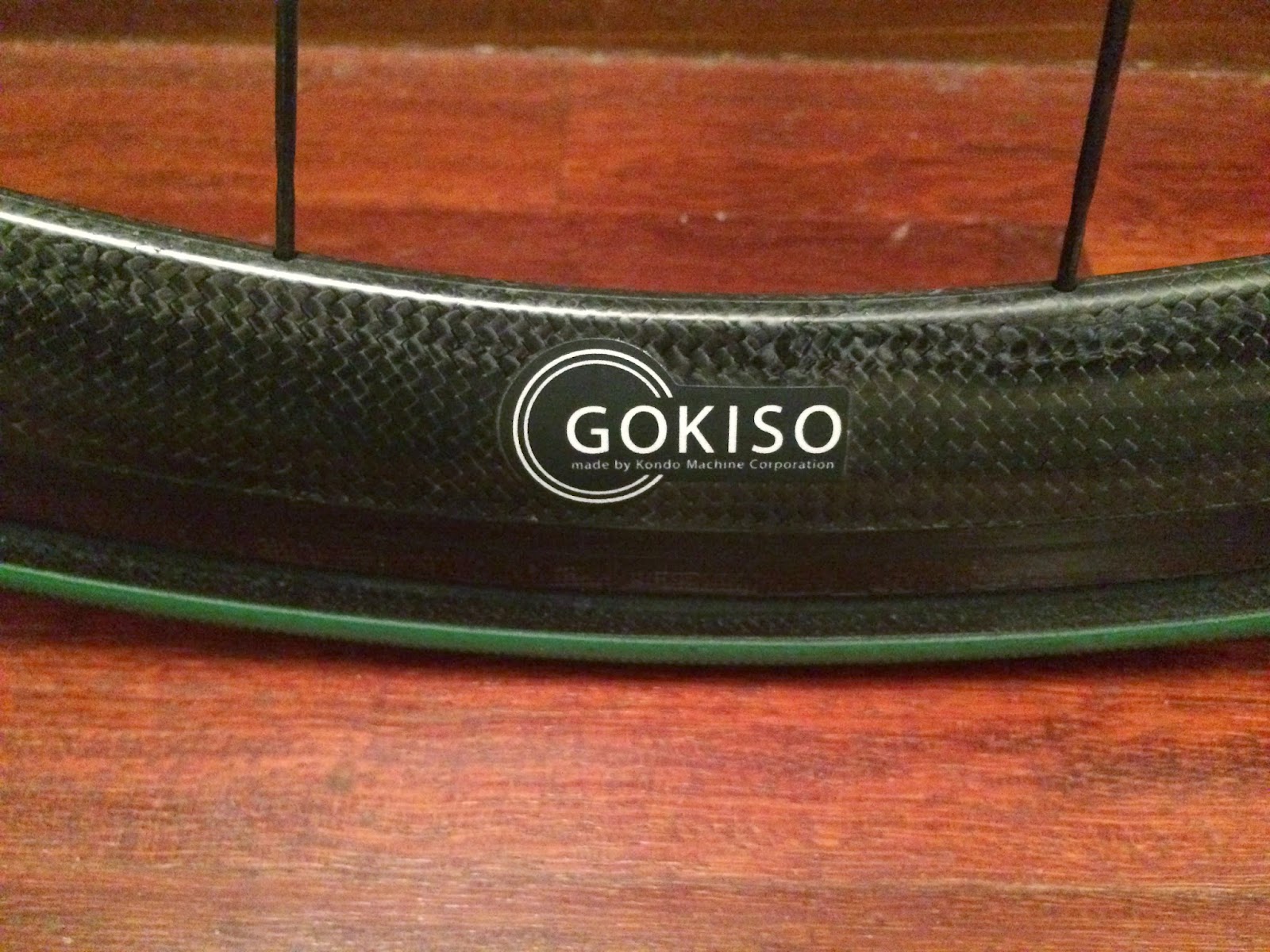
Small decal
Large decal
After 800 kms, the rims are still perfectly straight, perfectly balanced.  And they roll much smoother than any hubs I have ever used.

Here is the result of my amateur spin test on the front hub/wheel.  The wheel rotates nearly 10 minutes, so feel free to "fast forward" through the video.

Here is another amateur spin-test I found online, this one a comparison of a Gokiso wheel with an FFWD 60mm carbon rimmed wheel with DT Swiss 240S hubs.  This video is less than 2 minutes - at which point the competitor wheel has already stopped spinning, whereas the Gokiso has barely slowed at all from its initial speed.


Here are some other English language online references to Gokiso.


1.  Cycling Dirt – Gokiso at 2013 NAHBS


2.  2011 gizmag

3.  Bike Rumor -- 2013 NAHBS

4.  Cycling Tips -- 2014 Feb review (Australia)
http://cyclingtips.com.au/2014/02/gokiso-climber-hubs-review/

5.  Tokyo Cycling Club - Pro Cycling Mechanic - Gokiso / GS Astuto review
--------------------------------------
I will have more to say about these wheels as I use them over the coming weeks, months ... and years!

11 January 2015

Francois Pervis in the Keirin culture

For our French speaking members and friends, this documentary about the adventures of track World Champion Francois Pervis of France in Japan, notably his life in the "Keirin culture" of Japan.  A good view behind the scenes that will be appreciated by anyone who has raced at CSC Shuzenji or done laps at the "Kawasaki Bank" track on a Sunday afternoon.

Hat tip to MOB at Cyclitis, who found it. 

Hiroshi is frequently mentioning overseas demand for anything "Keirin" and the niche-strength of the "NJS" certification.  Maybe this kind of documentary is how the image is made?

The Japanese Keirin world has traditionally been very closed to foreigners.  I have never had much interest -- basically cyclists as the object of gambling, a substitute for horse and horse track betting. ... with all the opportunities for "fixing" the result that exist in other gambling, and more so.  But based on this video, there seems to be some interest in reform, as Japanese keirin riders, who once were competitive at international track racing, no longer make it onto the podium.  And of course, there is 2020 and the Tokyo Olympics, which gives 5+ years in which to make reforms and have something to show for it!

Miura 200km Brevet with fast bike and Gokiso wheels

I joined a Nishi Tokyo brevet today.  I want to get my 200, 300, 400 and 600km series done as soon as practical this year, since it is a prerequisite for PBP in August, and this was the first Tokyo area 200km in 2015 that I could register for that fit my schedule.  So I joined it even though the course, around the Miura Peninsula, would mean lots of traffic signals and plenty of traffic getting to Yokosuka and getting back from the coast and through town.

Mt. Fuji across the Sagami Bay from Miura, South of Hayama.
The start/goal is at the Konno Seisakusho/Cherubim shop in Machida.  For an early morning start (6AM today), train is not possible, and there is no free car park.  So in addition to the Brevet itself, I get to ride 50-55 kms round trip just getting to and from the event.  A 200 km brevet becomes 255-260km.  300km becomes 355km.  The Strava or ridewithGPS data is at the hyperlinks, and a map is below.

Today was a spectacular winter day. During the day it was warm, sunny and not very windy.  Wind surfers and sail boats were out.  Surfers as well ... in January!  Much nicer than December this year. But it was very cold in the morning at Machida (somewhere around -4 or -5 degrees C).

I made it to registration at Konno Seisakusho around 5:45AM, then on to the park a few blocks away for "bike inspection" and the start.  Of course, the 5:30AM "briefing" was long finished, and riders already were heading out onto the course, even as I went through registration. I saw my Kaminoge neighbor Kaz Tachikawa -- back on the bike after a 2013 injury that kept him out of London-Edinburgh-London and subsequent events -- and Joe Wein.

The rush to get to the start and then back onto the road had one benefit -- I was warmed up.  And I was on my fast bike -- the Canyon Shark with my Gokiso 38mm rimmed carbon clincher wheels, with the smoothest rolling hubs ... in the world, perhaps?  As a result, I ended up the 2nd finisher out of approximately 70 riders, even with a lunch stop and basically rolling home the last 75 kms of what one of the staffers correctly called a "beginners' course".

Less than one km from the start, on a downhill stretch, I zoomed past a group of 10-20 riders.  Then more.  Within 10 minutes I had moved from being one of the last starters (out of around 70), to being in the middle of the group.  After riding past more and more, I got stuck on the back of another 10 rider group, but there was too much traffic to pass.  So I bided my time until we turned North onto Tokyo Route 18.  Then, as the route bobbed up and down toward Onekansendoro then more hills, I passed everyone else within sight.  Hi Joe, and bye.  Bye Kaz.  As it turned out, by the time we got out along the Tamagawa and were headed down river, I had passed everyone except two riders at the front who I met at the first checkpoint.

Other than the nice weather, what was good about this event?

--The route through Yokohama was nicer than others I have taken, looping east of Yokohama Station and through Minato Mirai, then along the Yamashita Koen waterfront -- broad streets and very little traffic early on a weekend morning, with plenty of nice views.
Minato Mirai on a sunny Saturday morning
--South of central Yokohama, the route took the same Sangyo Doro as I rode with Eric and Seiichi last month ... but rejoined Route 16 much too soon, with its heavy traffic.  But once past Yokosuka, in southern Miura, we hugged the coast almost the entire way, which was beautiful.  And we rode through Misakiguchi and then on local roads, rejoining the main road (Route 27) only 6-7 kms later.
Along the coast!
Fast Gokiso wheels!
--"Magurodon" seafood lunch at Misakiguchi.
Organizers at the checkpoint in MIsakiguchi -- just across from 3 seafood restaurants.
--And after the milling crowds of Kamakura and Enoshima, and the broad coast road west to Chigasaki and beyond, the route North (from Samukawa through Ebina and then up to Sagamihara, took some very local, back roads.  The road surfaces were not great, but it was the lowest traffic, most interesting route I have taken through this area of sprawl.

The only negative was the trip down the Tamagawa, on the Kawasaki side road, together with plenty of trucks and impatient factory workers commuting in their big vans.

On the way back into town, I met Hara-san and [On]-san of Nihombashi Audax, doing a "test ride" for one of their upcoming events.  I rode with them all the way to the Tamagawa, chatting at each of the (many) traffic lights.  My next scheduled Brevet ... their 300km ride on February 21.  Looking forward to it.  楽しみにしています。

---------------------

Joe Wein's trip report is here.  His photos from the event are here -- more extensive than mine and some very nice ones.  Actual photos of other riders.

04 January 2015

Broken Things

Happy New Year
This is the second crank that broke on me - first was a Shimano Dura-ace hollow tech. This is from the commuter fixie. Replacement cost is going to push up my estimate of the price of the daily commute - currently 10 pence!


Christmas present to myself

I am getting tired of doing bike maintenance and building (if I were better at it I guess I would call it "wrenching") in the cold/hot garage in winter/summer without a good stand.  This TACX foldable stand is a huge improvement.

Now I just need to get an easily rollable mat to cover the rug so I do not get (more) grease and grime on it, before I am thrown back out into the garage.
Workstand - not telescope or anti-aircraft

01 January 2015

A Guide for Audax Staff in Japan - How to Distinguish between David and Jerome

The last Brevets of 2014 are long over, and the new year’s campaign will start in a few days.
If Jerome and I ride an Audax event together, then the staff can see us coming and just remember “David and Jerome” or, more likely, “Jerome and David”.   There is usually no need to distinguish between us.
But when only one of us rides an event, it helps to remember which one of us is David and which is Jerome.  This can be difficult for the typical Audax staffer – two foreigners, both from Setagaya area, both riding Audax events, both overweight (by Japan standards, at the least).  Goodness knows, it is difficult for me to remember Japanese Audax riders’ names, without meishi, seeing people only in “disguise” with helmets, sunglasses, etc., and as communications between riders are usually via Twitter, where people never use their actual names, but indecipherable “handles”.  It is harder even given the numbers of Japanese riders.
David - 7 Up Jersey, Giant TCR frame.  Jerome -- short shorts, Look 585 frame.  Circa 2008 
On R-Tokyo’s Ise 1000 Brevet in September, as I pulled into the checkpoint Southeast of Okazaki City in Aichi Prefecture, a familiar Saitama Audax-based volunteer whom I have met at numerous previous events waved a friendly greeting.  She next yelled out “Jerome-san!  Jerome-san!”  Then as I pulled in closer, she realized her mistake, and turned her back to me, literally, to hide her embarrassment.  I tried my best to pretend that everything was normal.
A few weeks later, as I rolled up a bit behind schedule to the start of the Nishi Tokyo 200 brevet, a Kanagawa Audax volunteer I have met several times – and last spoke with at the end of the Fleche in Kamakura in April – was working at the sign-in table.  She greeted me as “Jerome-san, Jerome-san” and started to look for Jerome’s sign-in.  I was in a cranky mood, having awoken earlier than I would like and hauled ass to get to the start in Machida, so all I could counter was a dead pan 「私はジェロームじゃない。デイビッドです。」(“I am NOT Jerome; I am David”.)  Again, it was an awkward moment.
So Audax staffers, here are some pointers.

Similarities

David and Jerome have both been known to elevate bicycles over head in a victory celebration, say at the top of Wada Pass, or Odarumi Pass.
David -- Cervelo frame, Assos Kazakh jersey; Jerome -- Look frame, short shorts and Credit Agricole sleeveless jersey
We both do some crazy rides, heading up Yanagisawa Pass or over Norikura in early winter. … or the mountain route through Yamanashi and Nagano at year end.
David -- Assos winter jacket; Jerome -- Look winter jacket
Jerome on Norikura in November.  Look jacket. Beeren bib shorts (with straps down?)


Jerome near Shibu Toge 2014
David at Shibu Toge 2014
We each have been known to sleep in public, on concrete or benches, during longer events.


We each will strike an occasional goofy pose -- signs of (too) long residence in Japan.

And yes, perhaps because we are both just a little bit above our ideal riding weight, we are both very strong riders in cold or wet weather!

Differences.  But there are some key differences, that will help a discerning staff member to distinguish between us.

Home Country

1.  Jerome – French, from the SW suburbs of Paris (15-20 minutes' by bicycle from the start of PBP).  France is the land of cheese and wine, Bernard Hinault, Laurent Fignon (departed) and of course the Audax Club Parisien.

2.  David – American, from Portland, Oregon, the home of Chris King, Vanilla Cycles and numerous independent framebuilders.  America is a nation of immigrants, the land of apple pie, baseball and Chevrolet; home of Lance Armstrong (cheater) and Greg Lemond (champion); and RAAM, usually won by an insane European.

So if you are not sure which one of us it is, just ask "what is your home country"?  If France - Jerome.  If America -- David.  Better yet, just ask "comment allez vous?", and if you get a reply pouring forth in French, it must be Jerome.

Dress

This is the easiest method for quick identification.  Jerome often wears “short shorts”.   David wears traditional bib shorts, typically Q36.5 or Assos brand. Here is an example:
Another view of Jerome's distinctive dress.

Likewise, David wears jerseys with regular length sleeves, even in the hottest of conditions.  Jerome, on the other hand, can sometimes be seen in sleeveless jerseys.
Indeed, Jerome can often be seen bare-chested, or in mesh top, in a restaurant as he dries his jersey on a chair.  Jerome wears a distinctive mesh top inner layer (referred to by him as the "Finnish Condom").  David typically keeps his clothing on while in restaurants. He does not have a"Finnish Condom" inner layer.

Indeed, this basic difference in dress can be the easiest way to tell them apart, since it persists even in winter in many cases, as in this early December photo from the top of Yanagisawa Pass in a recent year:
And even in the rare cases when Jerome is fully clothed, he favors a yellow "Beeren" jersey from his former Kobe/Sanda based club.
Egg


Around Water
Jerome – Can be seen nearly naked emerging from the waves, in the style of Ursula Andress or Halle Berry emerging in a James Bond film.  Jerome will typically jump in the first body of water -- river, lake or ocean -- on a hot day.  David MAY jump in an occasional swimming hole, but is likely to keep his (cycling) clothes on when doing so.
Jerome emerges from the Sea of Japan - Tour de Noto
Halle Berry
Ursula Andress

Thank you for your time, and goodbye until we meet on the road! 
Front view -- David on left, Jerome on right
Rear view -- Jerome on left, David on right.