31 July 2021

Olympic Rider Recon Ride #2

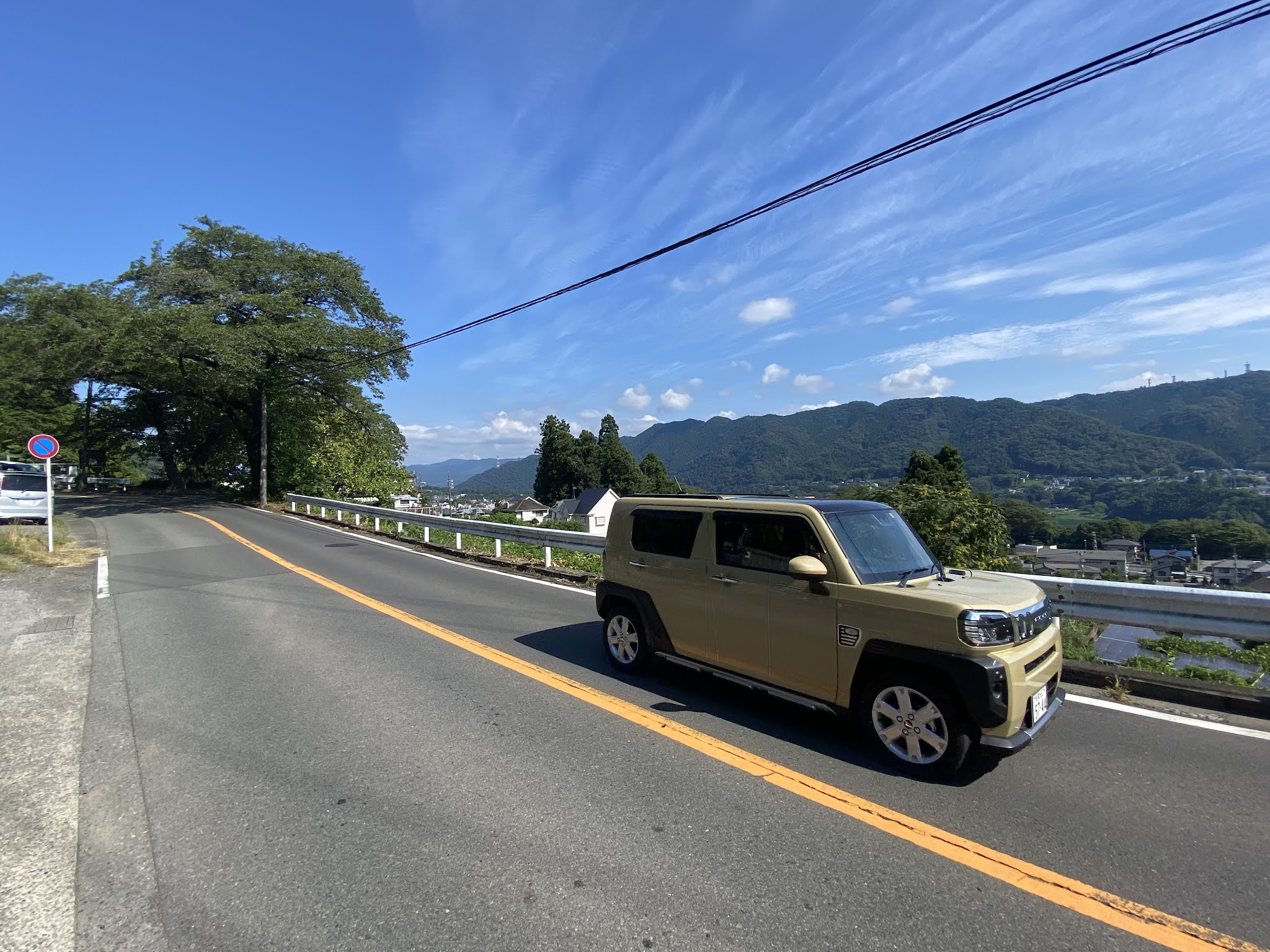
My second Olympic rider recon ride, Friday, July 23, started at Aihara near Sagamihara, went up Doshi Michi, over Mikuni Pass, and down to a station on the Odakyu Line near Odawara. It was another beastly hot day, but tolerable once up around or above 400m elevation. Doshimichi was a mob scene of local cyclists, motorbikers, and motor vehicles on the holiday weekend. Yamanakako was even worse. The only Olympians I saw were the Great Britain team (G. Thomas, T. Hart, and the Yates brothers?), heading down from Mikuni toward Yamanakako as I climbed, but not enough time for me to get out my camera or even confirm who was whom -- similar to my experience on Wednesday with the Slovenians!  I wanted to shout a warning to their trailing car "traffic jam ahead!" ... but they were gone by in a flash.

The climb from the South to Mikuni Pass was mobbed with at least 10x the riders I have ever seen there, mostly walking up the steep South side in the heat. Young, old, families, roadies, cyclotourists, and more.

My route


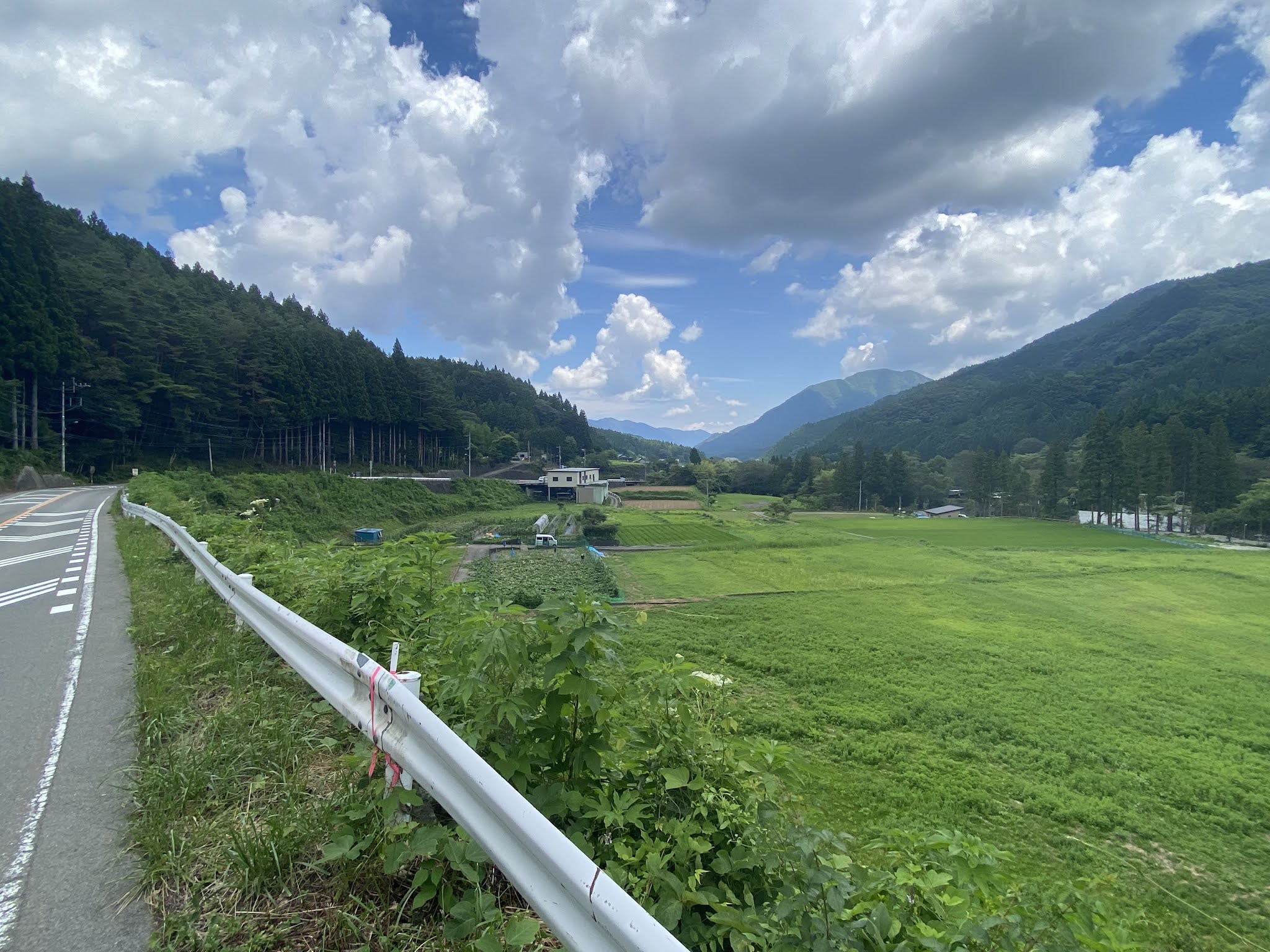
Detour to avoid the busy traffic around Tsukuiko

Lower Doshimich


The bridge at Ryogoku

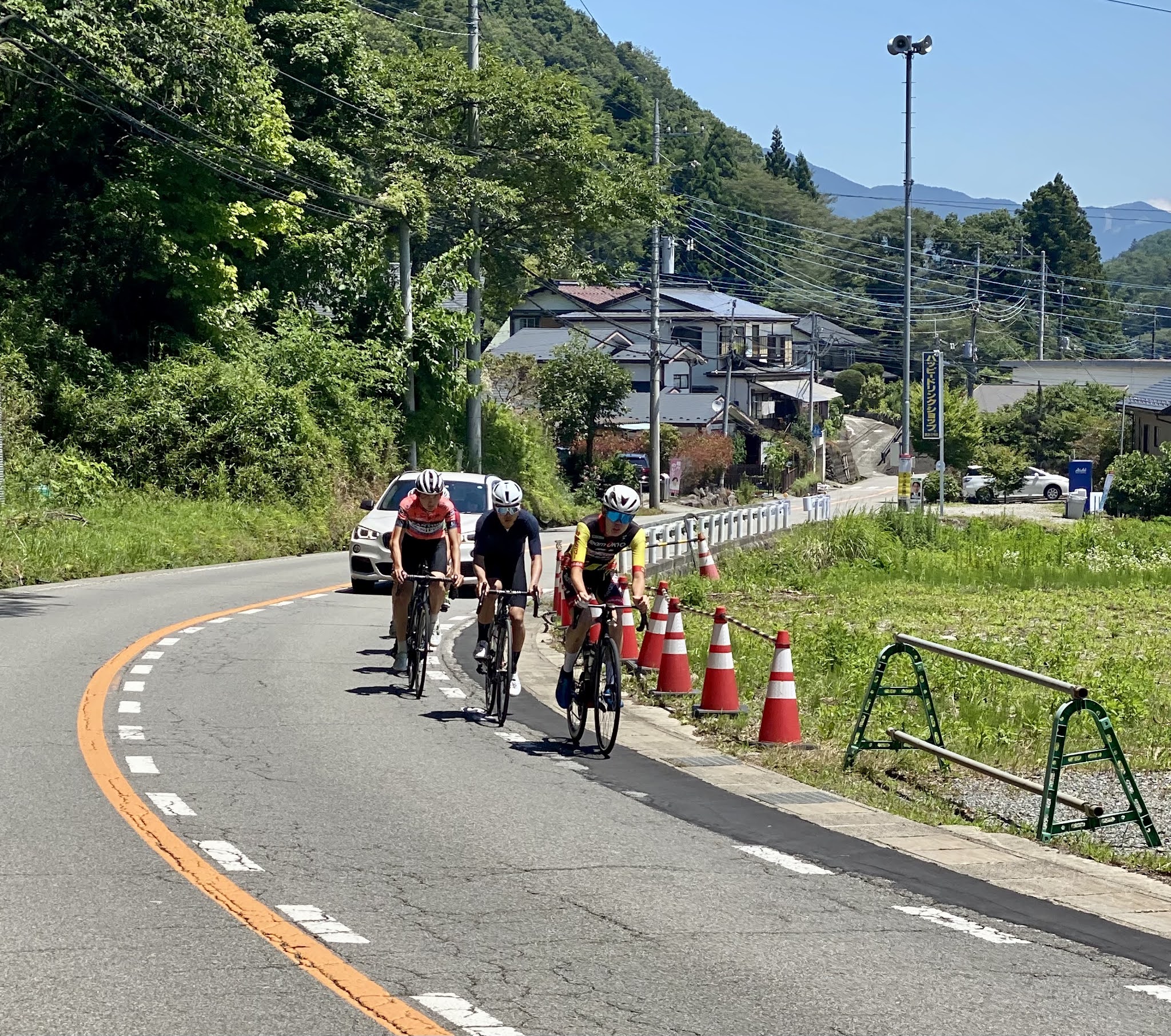
A local team rides up Doshimichi


Approaching the real climb

At the michi-no-eki


Endless line of cars trying to enter the michi-no-eki

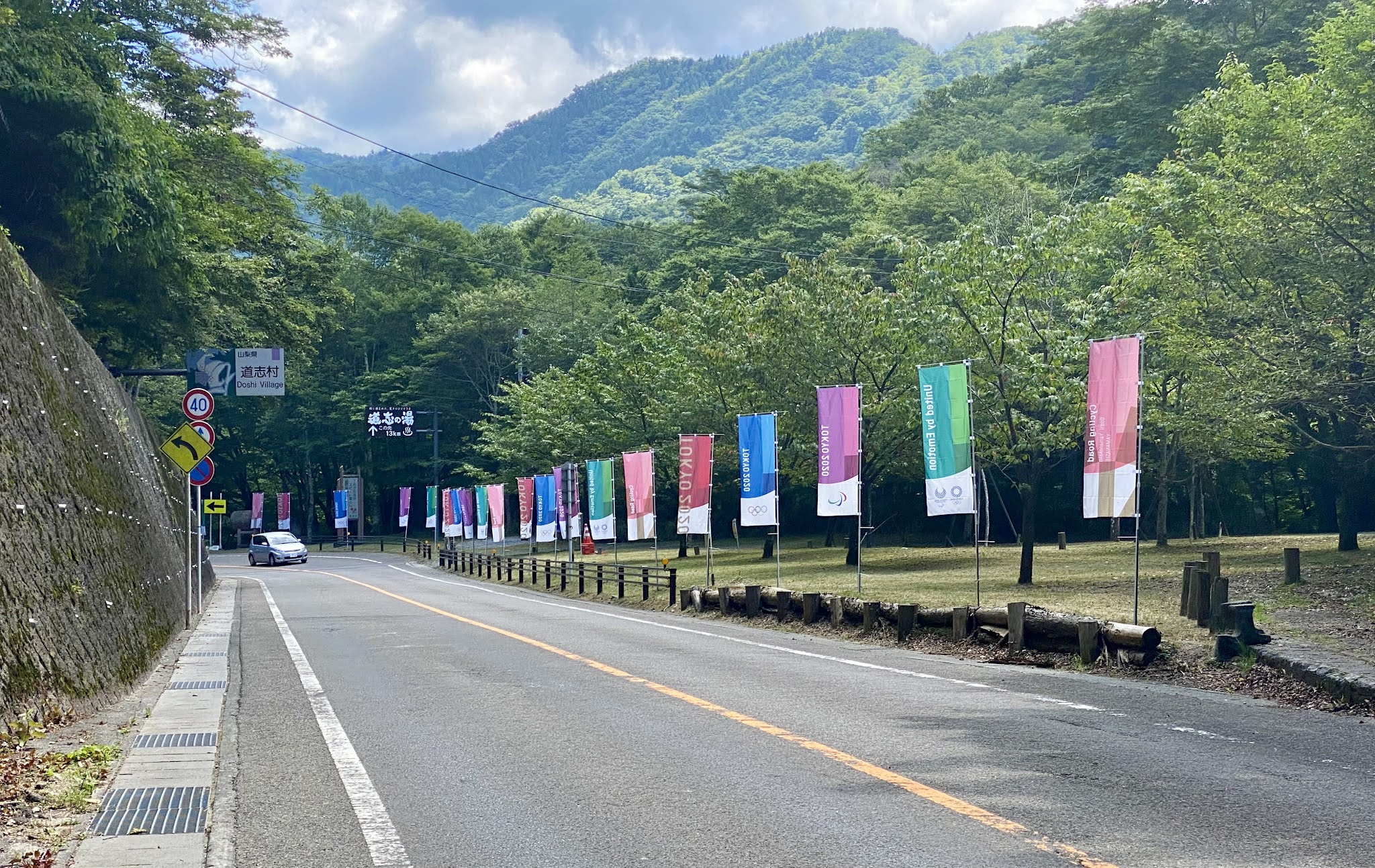
Upper Doshi

Memorably good steak sandwich here - Yamanakako at the end of Doshimichi

En route to Mikuni


Cyclists walking up the "donut" section of Mikuni


Heading down from Oyama/Ashigara toward Matsuda
Japanese harmony with nature, as the expressway in the sky frames the river and mountains.


Olympic Rider Recon Ride #1

My rides were not "course recon" but "rider recon", as in I was looking to catch a glimpse of the real riders doing THEIR course recon rides.

The first ride, Wednesday, July 21, started at Suruga-Oyama Station (home of the "Cyclegate Fuji" facility) and went over Kagozaka Pass, down Doshi Michi, and then across to Route 20 (Koshu Kaido) and Sagamiko Station. It was a beastly hot day ... but quite tolerable, even nice, for the middle 50% of the ride at slightly higher and cooler elevations.  I saw lots of Olympians, but snapped not enough photos. And on Doshi Michi it was mostly the women riders, as the men's race would focus on the climb to Fuji Skyline, and the other to Mikuni Pass.

My route

Olympic Mascots on the Oyama town hall

Hydrangea (ajisai) still lovely above 300-400m elevation

Shaded climb through Oyama

Mt Fuji - Sponsored by TEPCO

Mt Fuji - without the power lines. Approaching the Fuji Speedway area now

I am pretty sure this was on the TT course, just outside/below the Speedway.

On the climb to Subashiri

A park at Subashiri

Headed for Kagozaka. Three Slovenians whizzed by me heading down -- I only figured out who it was later when I investigated their national team kit.

At Kagozaka Pass

At the Doshi Michi end of Yamanakako

At Yamabushi Pass -- top of Doshi

That is Omar Shipira and another, male, Israeli cyclist training ...
She was in the breakaway 4 days later in the women's road race.

Friendly Australian Olympian
The whole team came by, including the men riding in a group of 4 that included Richie Porte and Rohan Dennis ... but i could not snap a photo before they rounded a bend.


The road is ready for ... spectators who would not show ... 

Many local teams were riding Doshi ...

The Michi no Eki

At the Doshimichi Micho-no-eki

The Japanese women Olympians (Eri Yonamine -- sponsored with Solestar insoles and NRC glasses courtesy of David Marx/RGT -- plus one)


Cycling Events at The Tokyo 2020 Olympics in 2021

The 2020 Tokyo Olympics are a troubled event.

It seems as if we have been waiting for them forever and a day. But they really should have been pushed back another year to 2022. … I guess the IOC takes the revenues from selling the TV rights, so it does not really care much if the host city (which gets the ticket sale proceeds) cannot allow spectators, or ends up with a public health crisis. If a few people die along the way, well, too bad, so sad. People died building the Golden Gate Bridge and other wonders of the world too. Isn’t the glory of the Olympics (and the gold … not the medals, the money) worth it?


So instead of a second postponement, we have a “no fun Olympics” -- an Olympics where no foreign visitors are allowed, no spectators can enter the venues, there is no chance to get selfies in Shibuya with athletes who are out and about seeing the sights after their event ends. No opportunities for cultural exchange, for the kinds of experiences I have heard people talk about from other Olympics. And, of course, the Prefecture of Tokyo will suffer under the debt burden for years, even decades. And many Japan-based businesses will bleed red ink, even face bankruptcy. 

Of course, the Olympics has faced challenges in the past. In 2012 in London, many English were disappointed when they all (at least everyone I know) entered the Olympic ticket lottery and came up empty, or with at best one random event about which they knew nothing. (Japan’s ticket lottery was pretty much the same, based upon my unscientific survey). But in London, once the Games got going, many people changed their minds and enjoyed the experience (again, based upon my unscientific survey). The 2012 Olympics (and Paralympics) were perhaps the best thing to happen to London in the past decade or more, despite the commercialization and corruption. 

But we are in a pandemic still. Tokyo entered a 4th “state of emergency declaration” earlier in July, and Covid-19 cases are steadily growing. On Wednesday, July 29, just 6 days after the opening ceremony, there were over 3800 new Covid-19 cases confirmed, a record for Tokyo, up from around 1150 two weeks earlier, 1800 one week earlier. Even worse, the Covid-19 PCR test positivity rate has soared from 5.1% a month ago to 18.0% -- levels never seen before in Japan.  So things will probably get worse before they get better. 

Thus, we face a very strong tension between (1) people enjoying the Olympics, and (2) avoiding a big disaster and an increase in deaths from Covid-19. No spectators are allowed in events in Tokyo. There is no public viewing on jumbo screens in public parks. Restaurants close at 8PM and do not serve alcohol (though many seem to be ignoring that request after the government was caught strong-arming financial institutions to cut off those who did not follow the "guidance" and their suppliers, and needed to back down). The athletes are like prisoners in the Olympic village, like ancient Roman gladiators who are let out only to compete, and who must leave the country two days after their last event. (Okay, perhaps that is a bit of an exaggeration.) Anyway, it is the #nofunolympics. 

Fortunately, road cycling events are about as Covid-19 safe as imaginable. Ireland reports that 0.1% of its Covid-19 cases have been transmitted outdoors. New South Wales, Australia, reports no confirmed cases of outdoor transmission. The original pandemic in Wuhan, China, saw only a single case of outdoor transmission – between two people who were talking to each other outside without moving for more than 20 minutes. 

Further, I am now fully vaccinated so, although the recent news about the Delta variant is distressing, at least I am better off, less likely to get infected (or pass on infection), much less likely to get sick or die, than I was two months back. 
So I could not help but get caught up in some of the Olympic excitement as I watched Strava and saw many of the world's top cyclists recording training rides from Gotemba. Even if there are no spectators allowed in any of the Tokyo venues ... surely a cycling road race along a 235 km course with which I am quite familiar would offer safe viewing opportunities?
My Olympic cycling experience involved the following:
(5) a very long day (leaving home 430AM, returning 1130PM) to ride to/from Hiratsuka (62km each way) and then trains to/from Gotemba, and shuttle buses to/from Fuji Speedway, to watch the women's and men's time trials. 
I had a great time. The races were spectacular. Watching the Olympians ride, even train, they looked like an entirely different species than the cyclists I am usually with and that we see riding on weekends around Tokyo -- so smooth, graceful, and fast. These events inspired me to ride more, and to come up with some new cycling goals for next year and beyond. 
I will post some photos or videos from each of these experiences as linked above. If you want race commentary, I have been enjoying, and highly recommend, Chris Horner's "The Butterfly Effect" on youtube. He can explain better than I how each of the road races and the time trials developed.

30 July 2021

On the Podium at Shuzenji!

The Olympic cross country mountain biking was held this week at the Japan Cycle Sports Center (CSC) in Shuzenji, on a devilishly steep constant up-and-down course carved out of the hillside and in part overlapping the infamous paved Shuzenji circuit. Yes, riders have died on this circuit — I specifically recall one who missed a turn and flew into a tree 15 years ago. Curtains. And Matthieu van der Poel took a bad tumble this week from his mountain bike.

Tom Pidcock rode brilliantly for the GB win that day, while the next day the Swiss women placed 1, 2, and 3 to sweep the medals!

I could not help but be reminded of Positivo Espresso’s brilliant podium finish at Shuzenji CSC in July, 2007, when a team of David J., Tom S., MOB, and I, achieved a 3rd place in the Men’s 4-person team 5-hour Enduro. It was a brutally difficult event, in sauna-like conditions. With the Tokyo 2020 Olympics this week, I think the plastic trophy that I still I hold in trust for my teammates may have just appreciated a wee bit in value. Maybe that’s not plastic? Maybe it is bronze!

The Positivo Espresso club (and blog) were established a few months later, November 2007, and, well, the rest is history!


22 July 2021

Cycling Amenities Growing in Japan ... Fuji Cyclegate at Suruga Oyama Station

Yesterday, as I did an "Olympic road racers recon ride" (they were doing recon for the race, I was doing recon to catch a glimpse of some of them) ... I was impressed by how much the selection of Doshi Michi and Mt. Fuji area as the site of the Tokyo 2020 (err 2021) road race seems to have made the region wake up and realize that they have lots and lots of people cycling there on weekends, and they ought to offer a bit of a welcome and acknowledgement.


I planned to hop the shinkansen to Odawara (634am departure/700am arrival) and go from there, ... but it was a beastly hot day yesterday, so I looked for a way to avoid slogging from Odawara up to Oyama. After I exited the shinkansen, I walked up the steps to the Odakyu Line. ... There was a 708am express (急行) leaving toward Shinjuku in a few minutes that would stop at Kaisei and Shin-Matsuda, saving me 10km of sea level riding by about 10 minutes on the train. I hopped on and got off at Shin-Matsuda ... and walked across the street to the JR station ... there was a 723am local heading in Gotemba/Numasu direction ... I had to fight through a crowd walking the other direction on the platform, but made it onto that train and got off at Suruga-oyama station (駿河小山駅) just after 740AM. The stop looked a bit closer to my destination, if lower, than the next one (Ashigara), and I have been through Ashigara several times so through I would try it.  This starting point put me at 275m elevation, ahead of the heat all morning heading toward 1130m elev, with the climb through field and forest via Oyama toward Subashiri. It also avoided the need to ride a few lower stretches on the shoulder of Route 246.

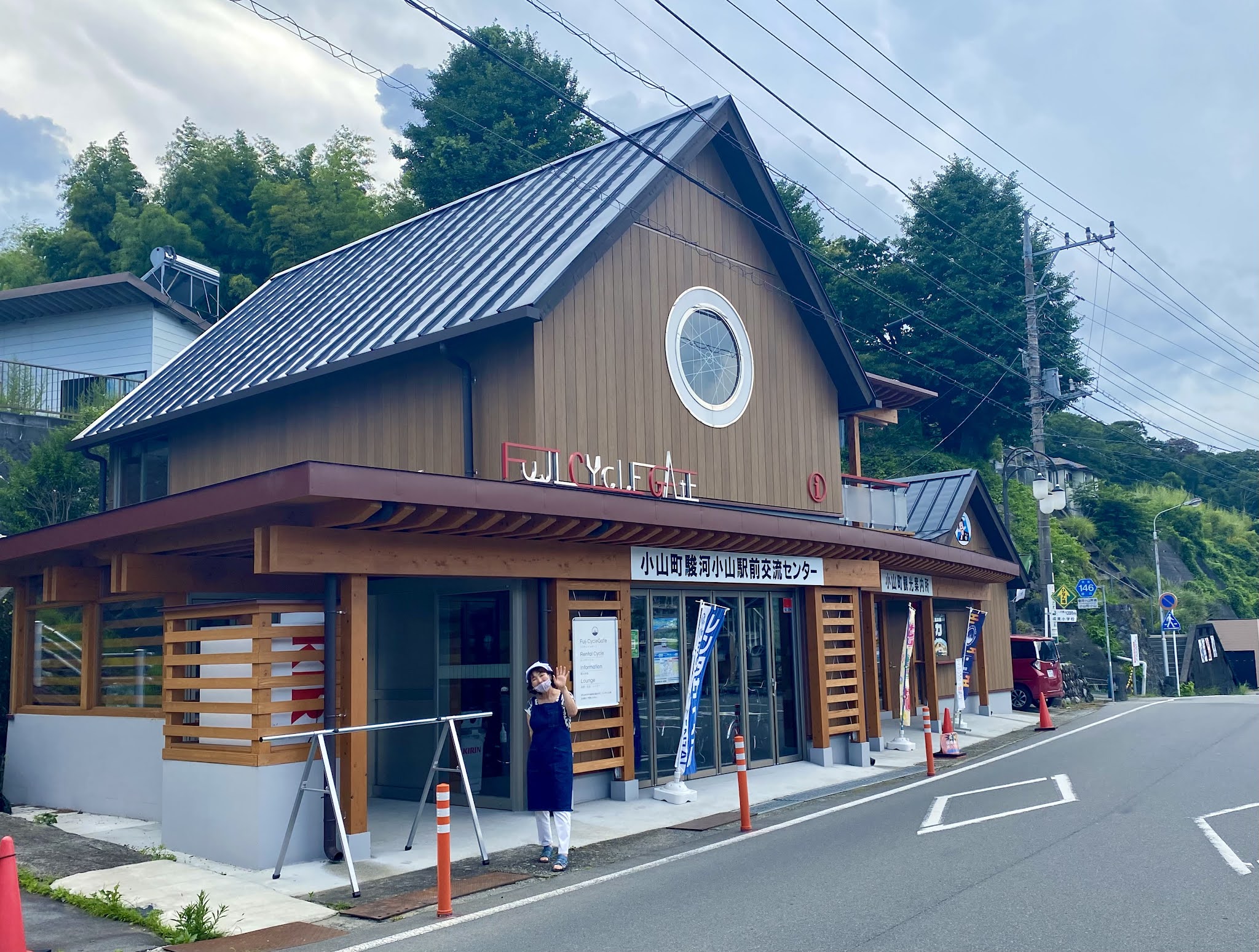
As I took my bike out of the rinko bag and put the wheels back on, a gentleman approached and introduced himself. He said he was from the local tourist association and pointed to a nice new wooden building across the street. He welcomed me and handed me a pin. He said "these are for cyclists who come here via train to ride". Indeed, the pin read "駿河小山駅輪行記念" -- Suruga Oyama Station Rinko Commemorative!!!  A badge designed just for me. Wow. I thanked him, completed the bike assembly, and headed out. As the only cyclist to exit the station that morning, I had mixed emotions. As I passed the empty building from which he had emerged, I could see it had a cycling theme and what looked like some kids bikes and mamacharis on display, as well as bike racks in front. It is the Fuji Cyclegate. Next time, I will check it out thoroughly. (There is apparently a direct train from Shinjuku to Gotemba that would stop here, for those of you not near Shinagawa).

Suruga Oyama Tourist Association Welcomes Rinko Cyclists!

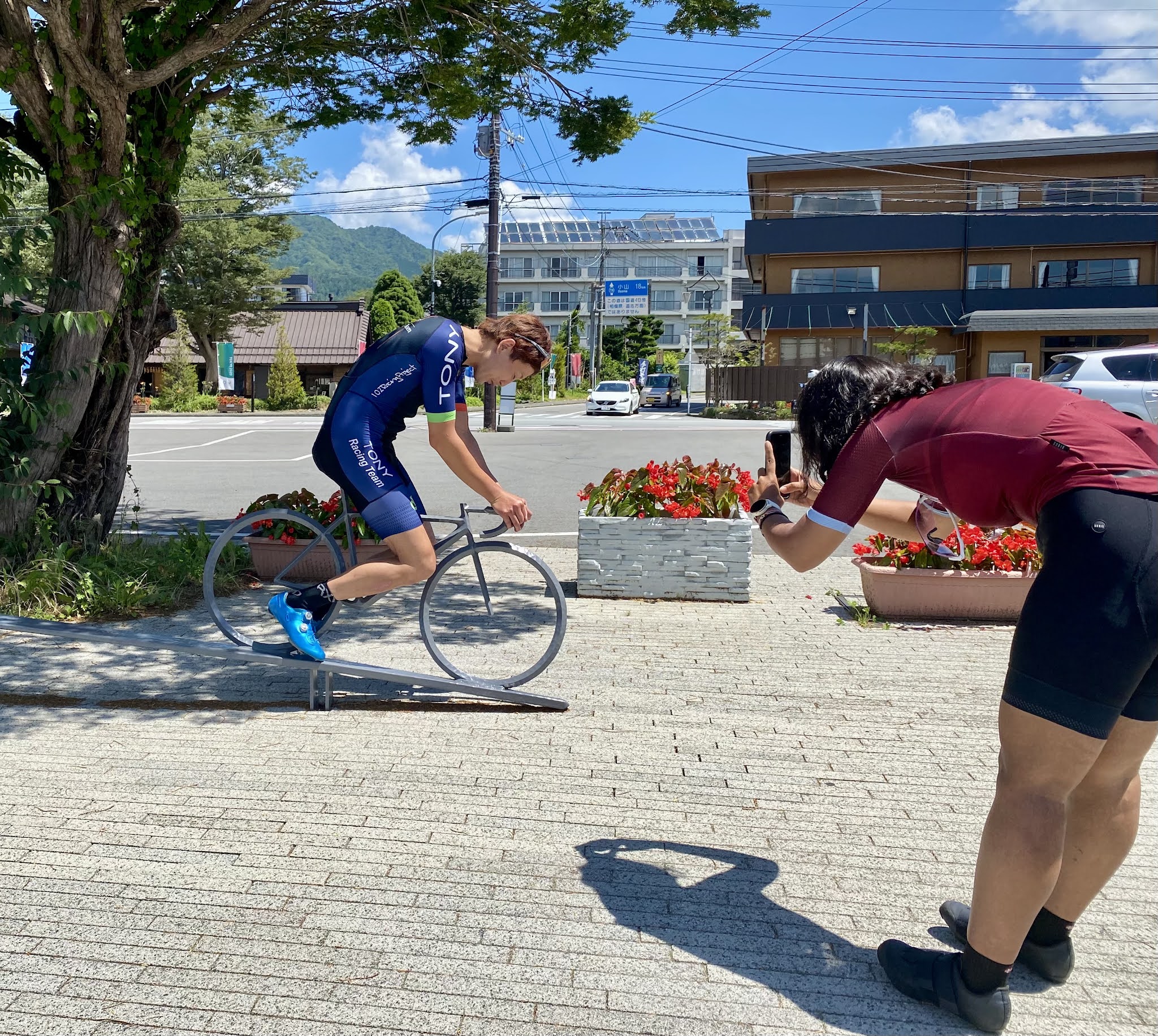
Up at Yamanakako, and on Doshi Michi, of course, there are now cycling themed cafes, sculpture work, every restaurant or store has at least one cycle rack ... and they will sorely miss the crowds that they expected for the actual Olympic events this weekend. 


At Yamanakako - end of Doshimichi

The bike's too small for him, ... and the seat looks a bit painful!


As I descended upper Doshimichi, I passed a small grassy area beside the road on the left side which had at least 20 wooden cycle racks in a few lines ... places for the spectators to park their bikes as they watched the race. ...  the empty racks a sad reminder of a no-spectator event. I hope those racks will get repurposed and donated to parks, stores, and cafes nearby. 

A newly opened establishment on Doshimichi, just a km below the Michi-no-eki.
It had VERY minimal food offerings and coffees, but a large section of frozen food cases with meat for a massive BBQ party. ... I hope that they up their game a bit so it is worth a food stop.

Postscript: I went back later in the week and rode in the opposite direction up Doshimichi, over Mikuni Pass (the easy side) and down to the Odakyu Line. I stopped again at Suruga Oyama to actually check out the rinko-rider facility. They have lockers to stow a change of clothes and free showers (available 8Am to 6PM), and even sell spare tubes for road bikes in their vending machine outside ... accessible 24-7 should you need one. And if you are a non-cyclist, they also have some rental bikes, helmets, etc. 

A good jumping-off point for riding near Ashigara or Gotemba. 


16 July 2021

Pogacar!

Tadej Pogacar has been a shoo-in to win the Tour de France since early in the race, and has never looked as if he even broke a sweat -- well, perhaps in the heat of Mt Ventoux, but not otherwise. He won the last two mountain stages in the Pyrenees easily. The 22 year-old is the fastest cyclist in this race. At the end of Thursday's stage 18 over the Col du Tourmalet and to a mountain top finish at Luz Ardiden, he had to get on the podium four times: stage winner, KOM leader (polka dot jersey), best young rider (white jersey), and of course overall general classification leader (yellow jersey). 

It is a super-human performance. There is something very special in that water they are drinking in Slovenia. Usually Tour winners are in the mid to late 20s. Heck, Chris Horner won the Vuelta at age 42. Have we ever seen any other cyclist so strong at this young an age? 

Now, someone get that boy a decent cyclist's haircut!


08 July 2021

The Alt Tour


This year's Tour de France had a very good first 9 days, with plenty of opportunity for the sport's brightest stars to shine ... van der Poel, Alaphilippe, Pogacar, Cavendish, van Aert, and on and on. Of course, these successes were mixed with more than the usual drama, crashes and disappointments.

But this year there is an "Alt Tour" that apparently is getting plenty of attention as well, as Lachlan Morton of team EF Education .. rides the entire Tour de France route including all of the "transfers" unsupported, bike packing it. Including the last "transfer" from the Pyrenees back toward Paris, which the regular riders will do by airplane, Morton will ride over 5000 kms. And he is sleeping outdoors. The Wall Street Journal has a good article today about how this may be where the sport of cycling is headed.  Indeed, most cyclists I know are more interested in ultra-endurance events like the Transcontinental, Transamerican, the Tour Divide, Everesting, RAAM, or maybe Audax events like Paris-Brest-Paris, London-Edinburgh-London, the occasional SR600, riding a gravel or bikepacking "all around" bike, rather than following the ProTour.  This is why Lael Wilcox, Fiona Kolbinger, or Lachlan Morton, can have large numbers of Strava followers, though not quite up there with Wout van Aert.

These ultra-endurance events are things we can contemplate doing ourselves, just a bit more slowly. And they are epic.

[Update: Morton arrived in Paris after 5500 kms of cycling in 18 days, four days ahead of the Tour.]