22 March 2022

Attack Mitsumine Shrine -- RAMAX Maximum Adventure Ride (and Hike); Served by a Robot

Bike & Hike

Jerome (in road shoes w/ cleat covers)

Nice view ... from 1200 meters elevation.

Saitama Audax brevets are usually named "Attack [place name]". Jerome's first 600km ride was, I believe, the 2011 version of "Attack Nihonkai" -- we rode from Iruma-shi (Saitama) to the southern outskirts of Niigata-shi on the Sea of Japan, and back. Yesterday, we were scheduled to ride the Saitama "Attack Ashitaka" (アタック愛鷹) 300km brevet. Mt. Ashitaka is on the southern shoulder of Mt. Fuji. The route for this event heads SW from Iruma through Oume, Takao, and Sagamihara cities, then climbs up to Yamanakako via Doshimichi, over Yamabushi and then Kagozaka Passes, descends to Gotemba, then goes around the large volcanic cone-shaped Mt. Ashitaka by climbing up to Fuji Safari Park and then descending the far side down to the Sagami Bay ... before returning all the way to the start in Iruma. Indeed, this was the same course that Jerome and I rode last October.  I was definitely out of shape then, and there was a lot of climbing (and a couple hours of cold hard rain). It took me 19 hours out of the 20 hr time limit to finish. I was hoping we could shave an hour or more off that time.  

This weekend, Jerome had done another long ride on Saturday (200km plus more to/from the start/goal), so he was hoping to string two one-day rides together as preparation for a multi-day event like Cascade 1400.

We got to the start under Toyomizubashi in Iruma around 630AM via Jerome's car ... and no one was there. Checking the organizers' website, we saw a notice from nearly two weeks ago that the event had been postponed ... just like last weekend's 200km brevet by a different organizer, and Jerome's 400km Chiba ride last month. Other audax events have gone ahead without postponement ... indeed, I had checked the event's webpage, even downloaded the most recent cue sheet, just the day before, but I had not checked the general Saitama Audax "news and events" page where I would have found the notice. After apologizing to Jerome, we discussed what we would do. There we were in Iruma, 50km NW of our typical starting point, before 7AM on a Sunday of a 3-day holiday weekend. We quickly dismissed the idea of riding the 300km Mt. Ashitaka course. It passed many areas that are within riding distance of our homes. If instead we headed further west or northwest, we could ride territory that is out of reach for a typical day ride from west central Tokyo.

I suggested we head west toward Chichibu, go over one of the passes that avoids the tunnel on Route 299 (Shomaru Pass or Karibazaka Pass), then try Mitsumine Shrine to the far WSW of Chichibu City. If we got through with that string of climbs quickly (midday) and the weather held ... we might even try Saitama Route 210 through the wilds of deep western Saitama to Shigasaka Pass, and return back. We had never done Mitsumine, nor Route 210, by bicycle. (I had been to the shrine once by motor vehicle, as 99% of the arrivals travel).

Leaving Rte 299 for the climb to Shomaru Pass

RAMAX leaning

Jerome arrives at Shomaru Pass

Jerome was slow starting out, no doubt due to his long ride on Saturday. I had the rare experience of easily leading him up the Shomaru climb and waiting at the top. We quickly descended into Chichibu City and found a Gusto family restaurant for breakfast along our route. We ordered a "volume" breakfast set from a touchpad at the table. A robot brought our food. It thanked us after we took our trays from its shelves, then happily returned toward the kitchen area.  This was a new experience for both of us. Wow, I thought, I had no idea Gusto was using robot servers. I felt out of date, behind the times. The only human interactions were when we entered the restaurant (someone told us to sit anywhere we liked), and when I paid.  I asked the employee how long they had been using the robot. She hesitated and seemed to be considering carefully the right response. "Nine days", she finally said.  Okay, at least I did not feel so behind the times anymore.

Serving robot leaves after thanking us.

We headed WSW taking a parallel road to Route 140 through much of SW Chichibu City. It had almost no traffic. Eventually the road ended and we rejoined Rte 140. A bit further on we pulled into the Arakawa michi-no-eki for a restroom break. As I returned to the bicycles, Jerome was talking with a woman cyclist. she had an Audax reflective vest, and a reflective triangle "slow vehicle" symbol as well. She told Jerome she had just come from Mitsumine Shrine. She was doing a Nihombashi Audax 300km ride that had NOT been cancelled. (Instead, they stretched out the start times to avoid any crowd or gathering at the start/goal.) She had started alone or nearly so in the middle of the night, ridden from central Tokyo, climbed Mitsumine Shrine (elev ~1000m) in what must have been quite cold temperatures and was on her way back. Respect. 

We saw a few other Nihombashi audax riders headed back as we continued toward Mitsumine. But we had a different plan. Mitsumine can have heavy traffic on a narrow road. So some riders take a different route on the other (NE) side of the mountain all the way up to around 1220m elevation, through a short tunnel, and descend to the shrine at just over 1000m.  Indeed, this route has even been used for a hill climb race at times in the past. Our plan was to take this rindo, then after a quick lunch at the shrine, to descend the main road.

Onto the climb - beautiful and empty road.

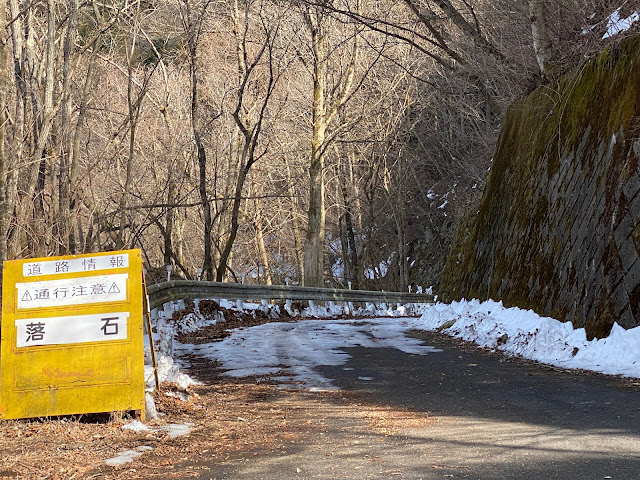
We found the turnoff and started the climb. Jerome lagged -- unusually -- his fatigue from the day before still showing. It was a lovely road -- wide, empty, and not TOO steep -- all the way up a valley to a "fishing spot" (釣り場) that had a parking lot full of cars. From there, the road turned up steeply and was blocked by some "no way through" signs and pylons. On the left side, however, there was a note that visitors to Taiyou-ji temple should move the barriers and proceed. 
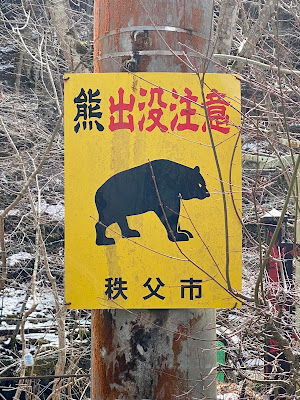
Lots of these signs up here.

On the left side is the note that visitors to Taiyou-ji may proceed.

A nice spot to rest and wait a bit for a tired Jerome

I rode to the next switchback, where there was a babbling brook and I could wait for Jerome in the sunlight. The next segment was to the turn off for Taiyou-ji. Here was another gate across the road we would take. There was a helpful sign that the road led to a trailhead for the climb up Mt. Kirimogamine. 


We continued, but soon found sections where the road was covered with snow, only tire tracks exposed. We could ride in the tracks, but needed to be careful and watch for icy patches. In some places, the snow was a bit deeper and crustier, and so riding into the edge of the track would be dangerous. We proceeded slowly, walking at times.


No more tire tracks ... only an animal.

Finally we passed the Kiromogamine trailhead, marked by a small gazebo/picnic table. The tire tracks ended here and the road headed around a bend so it was on a north facing slope that did not get sunlight. On the next snowy section there were only ... animal tracks. Deer? I saw three further up the hill. Bear? We saw MANY bear warning signs but no bears... perhaps the local bears were still hibernating. Or else they had awoken and were very hungry?

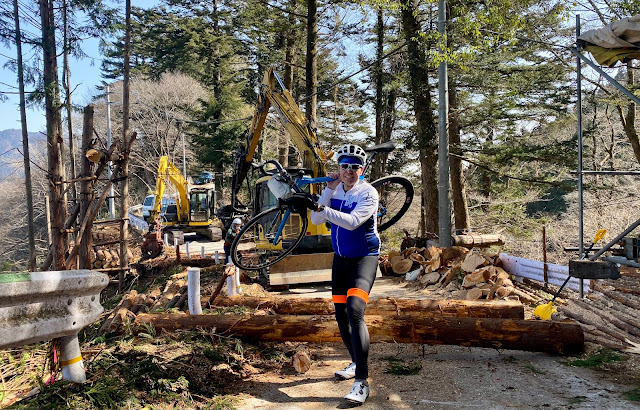
From here, the last 2+ kms to the tunnel through the mountain, we would walk the entire way, sometimes pushing and sometimes carrying our bikes where the snow got deeper.  


More animal tracks

I was glad to have MTB shoes. Jerome, meanwhile, had road shoes with rubber covers on his Look Keo cleats. Not ideal for this long a walk! But we made it. It was a long traverse, it was cold at 1200m elevation in the snow, it was not so easy to walk carrying a bike. But it was never so far, nor so cold, nor so hard that we considered turning back. The vista was spectacular, its own reward. I am afraid that the average speed for our ride ... dropped pretty precipitiously on this climb. On Strava I could see that I was the third fastest to do the climb this year ... out of three. The other two were recorded in early January, before the snowfall, and must have just ridden up at a good pace.

Once through the short tunnel, we could quickly descend the rindo to Mitsumine. There were plenty of snowy stretches still, but on this side the snow on the road was wet and at most a few centimeters deep. We could ride through it downhill being careful not to go too fast, nor to brake or turn suddenly. We knew we were approaching the shrine when we came to another closed gate ... and a huge parking lot full of cars. 

Outer gate to the Mitsumine Shrine complex

We went up the path toward the shrine entrance and found a cafeteria full of visitors. There were three bicycles together out front. No audax rear-triangles, but they looked as if they might be part of our extended Audax family.  Sure enough, we entered to find Messrs. Minoda (Aoba organizer), Tachibana (Gunma organizer) and Shimura. Shimura-san's bike was a beautiful titanium SEVEN, with his name painted on the top tube. Minoda-san we have known a long time from Aoba rides and as a local -- I would come across him on his daily commute down (then up) the Tamagawa Kawasaki occasionally when I lived near Futako Tamagawa. Tachibana-san I've also met before on rides. I follow him on Strava and am always amazed to see him racking up 200km+ rides on a typical weekend. He has already gone over 9,000 kms this year ... a significant share of that on Zwift.

Messrs Shimura, Minoda, and Tachibana

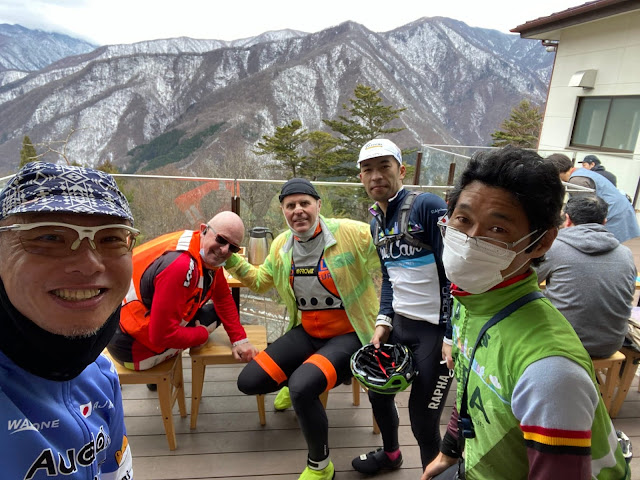
On the veranda

I think Jerome and I burned a few more calories than they did on the climb!

Jerome and I could only get a seat quickly on the veranda outside ... but we could warm ourselves by the wood stove inside then sip hot tea as we waited for our food, and were relieved that the glass wind barrier kept it quite warm even on the veranda outside of the restaurant. The other three audax riders said farewell and headed down the hill and we relaxed and finished our meal. 

We got on our bikes and started down the hill ... first passing what seemed like at least a kilometer long line of cars waiting patiently to enter the parking lot. I was glad we had come up the rindo, and very glad not to be arriving there by motor vehicle. Most of the descent was fast ... switchbacks that were long enough to gather up good speed yet still brake in plenty of time for the curve.  On the RAMAX, I could descent with confidence, the disk brakes working like a charm. After we were more than halfway down, the road narrowed. At points we waited behind a car that had stopped to let opposing traffic pass. Jerome said "they need a more powerful politician." Indeed, this route gets enough traffic so it would seem to merit some sky bridges like Yanagisawa Pass on Route 411! 

I'm thankful I did not drive here.

In any event, at the bottom of the hill, there was a red light and a line of cars, just before the road narrows to a single lane to cross over the spillway of a dam. Jerome went ahead and I followed. We were almost across when the line of opposing traffic came at us ... but there was plenty of room for two bicycles to slide by without inconveniencing them. We saved at least 5 minutes right there. Further down the hill we can to another long 3-way traffic signal ... and were able to move by the cars, to the front of the line ... and there we met the three riders who had left at least ten minutes ahead of us. 

I'm on the drops in front.

The five of us rode together to Chichibu. Jerome and I could hang with them well on the gradual downhill ... but we lost contact on the flat stretch going into town, riding along a line of cars. Those guys are all very strong riders! We caught them again ... as they waited at a light, and said our farewells. They were heading back to town via 299 and Yamabushi Pass. We were heading in a large arch to Yorii and then down along the east side of the mountains back to Hanno/Iruma.

The rest of the ride was ... around 25 kms arching to the north/east, parallel to the Arakawa as it flows from Chichibu City through Nagatoro and to Yorii, then another 40+kms to the southeast via Ogawamachi, Ogose, Moroyama, Hidaka, Hanno, and finally to Iruma. By far the longest stretch was heading southeast on Saitama Route 30, a very familiar road. Finally, we turned off onto Saitama Route 262 for the last stretch into Iruma ... the short ups and downs on this stretch reminded me of past Saitama brevets starting at Toyomizubashi, even that 2011 "Attack Nihonkai".  

Across the road from our convenience store food stop in Chichibu City

Near dusk, passing Yorii

We made excellent time on the last 65kms ... with Jerome pulling or at least leading much of the last 40 from Yorii back to Iruma, because he had his iphone attached to his handlebars and had the route visible, whereas I did not have it in my Wahoo. But other than a brief stretch where I felt as if I were "riding-while-digesting" after food stops in Chichibu City in both directions, I felt pretty strong the entire day. The RAMAX is now officially dialed-in and is very comfortable. With the Panaracer Gravel King 700x28 tires, it both climbed and descended very nicely. With a 120mm stem, my body position is just right. Nothing ached after 185kms and 2300m of climbing. The bike continued to feel comfortable for the long cruising stretch back to Iruma.  The only pain I suffered alld ay was some "hot foot" later in the ride, but a minor tweak to the location of the right shoe's cleat seemed to resolve that entirely.

The RAMAX model name means "Randonneuring Adventure MAXimum" ... and today we did our best to live up to that.


16 March 2022

Yanagisawa Pass - First Adventure on the RAMAX

The RAMAX ... looking down at Enzan/Koshu


The sky bridges of Route 411 just SW of Yanagisawa Pass

Jerome and I had planned to join a 200km R-Tokyo brevet on Sunday March 13, part of our qualifying for Cascade 1400.  That was postponed when Kanagawa prefecture extended its "manenboshi" (prevent the spread) anti-Covid-19 measures. Different Audax clubs have different rules about Covid-19, including some rides that have been adjusted to allow a start at any point during a one week timeframe, avoiding any crowds or groups, and so can proceed during "manenboshi". But this R-Tokyo event was supposed to be a traditional brevet with everyone starting on Sunday morning 7AM (in waves 5 minutes apart). So it was postponed to a date TBD.

Jerome rode on Saturday ... so I headed out Sunday morning early with the goal to do a good training ride, at least as much work as the 200km R-Tokyo event (a mountain-free course full of short up/down sections along the eastern edge of the Saitama hills from Kawasaki to Yorii and back). Peter J. had recently ridden over Yanagisawa Pass ... which got me thinking that I had not do so in several years. It is one of the true long climbs in Kanto, to a peak at just under 1500 meters elevation and with lots of repeated up/down in between Okutama-ko and the beginning of the real climb just west of Tabayama. In summer, there are enough sun-exposed stretches that it can be unpleasant, but on a mid-March day, it would be perfect.

This was my first real ride on the RAMAX "(Randonneuring Adventure MAXimum") bike. I had the "loaner" wheels, including the very colorful rear rim, and had not yet changed the Challenge Gravel Grinder tires. They seemed to roll smoothly on my way back to Takasaki a few days earlier -- and they are excellent tires for their intended purpose! Based upon bicyclerollingresistance.com, however, it looked as of they would add 10-15 watts per wheel of rolling resistance riding on a smooth road, as compared to the types of "slick" wheels I would typically ride.  And each one weights 415 grams, plus tubes, so heavier as well. But, I thought, what if I have the energy for a rindo detour onto gravel -- perhaps they would come in handy? And I was not out to--nor in condition to--break any records, so did not mind the marginal loss.

The bike performed well. I like the handling as I climb, especially the neutral, solid feeling as I get off the seat and work the pedals (not quite "dancing on the pedals," but close). I tweaked the seat position -- a bit higher and farther back -- to get closer to ideal.  After the ride, I swapped out the 110mm stem for a 120mm one, moved the seat a wee bit forward, and now it is juuust right.


End of the Tamagawa Path - Hamura, Almost to Oume

It was an uneventful ride up the Tamagawa to the end of the path just before Oume. There was a large group of men standing in the river, some fishing, some watching. I don't recall seeing this kind of spectacle at this spot before. I continued on after filling my water bottles and consuming banana from my back pocket.

Curbside dining in Okutama Machi (in front of Daily Yamazaki)
I stopped again at Okutamamachi near the Station -- last convenience store until Enzan, if memory serves. I chatted briefly with another rider who I had been playing leap frog with. I got the only onigiri in the Daily Yamazaki store, heading out just before he came in.  An hour or more later, as I left Yakyutei at the far end of Lake Okutama after a bowl of udon, the same rider was again approaching.

Entrance to the Nokogiri Climb off Route 411.

The traditional food stop at west end of Lake Okutama

Hazy sunlight at the west end of Lake Okutama

I liked the mix of traditional house, laundry drying, and construction equipment here.

The weather by now was warm enough that I pulled down my arm warmers/covers -- just riding with short sleeve jersey and bib shorts, and changed to the half-finger gloves for the first time this year.  Tabayama was looking very relaxed, people eating lunch on the terrace overlooking the river, flags flapping in the breeze (that seemed, now, as if it might push me a wee bit up the hill). 

Tabayama Michi-no-Eki

Tabayama - onsen from michi-no-eki

Finally on the real climb

A short rest around 1150m elevation ... 

Then I was onto the climb - nearly 800 meters up from here.  There was ongoing highway work on each side of Yanagisawa Pass ever since I first climbed it nearly 15 years ago. I remember climbing Yanagisawa with Jerome in 2009, our last massive training ride before Transalp (we tacked on Odarumi -- nearly 2000 meters elevation gain from Enzan to the top AFTER Yanagisawa on that hot day). I remember riding Sasago/Kamihikawa/Yanagisawa Passes as a series in the other direction once while training for Transalp in 2009, and again in 2011. And I remember riding this pass in the first brevet I ever joined, a 400km Kanagawa Audax event in late 2009. Well, the last tunnels and skybridges are now done and the only work in progress is some minor curve/shoulder improvements that does not involve a tunnel or bridge.  There was at least one tunnel on each side of the pass I have not gone through before ... how many years since I took this route? At least 3 or 4 years. Too long. I should do it at least yearly. 

I climbed slowly. I need to do a lot more rides like this if I am going to be in shape for Cascade 1400. 

At the pass ... I did not stop for food here today, though we often do.

No view of Fuji today ... and a decidedly unfriendly sign warning that for non-customers
the parking (even for bicycles) requires payment. Reminiscent of Wada Pass in the old days.

The descent into Enzan was fun as always. Perhaps I went a bit slower than normal, cautious during my first long descent on the RAMAX. But I felt confident the entire time. I turned left to join a road that goes diagonally down to the "Fruit Line" and continued (up and down and up and down) on the Fruit Line past Katsunuma and to Route 20 (Koshu Kaido). Then I did another climb to the entrance of Sasago Tunnel. I thought about a side trip on the deserted old road over Sasago Pass, as when Jerome and I did this combination of passes in 2016 ... but prudence is the better part of valor. Through the tunnel, I made a fast descent to Otsuki, grabbed some tasty Family Mart "nama pasta", and went fast again to Uenohara. 

At 182 kms, I thought about continuing to Takao to clear 200 ... or riding home from Mitaka or similar to Takanawa, also to get an extra 20kms. But I noticed that somehow three spokes on the non-drive side of the loaner rear wheel had gotten so loose that the spoke nipples had dropped off and into the wheel well. The wheel still felt rock solid ... but there is a limit to the number of spokes you can lose without the wheel becoming dangerous!  I should have checked the wheel's spoke tension before riding it. But I had gotten AT LEAST as much work in as if I had done the 200km brevet course east of the mountains, so I was not going to sit in the dark, take the tire and rim tape off, try to fish out the spoke nipples and re-tension it. Instead I declared my mission accomplished, hopped the train home, and fixed the wheel the following day.


15 March 2022

New Bike Day -- RAMAX, a Very Modern and Beautiful Titanium Frameset

Obligatory new bike photo.


Nearing Takasaki, along the Usui River

On Wednesday, March 9, I went to GS Astuto in Matsuida, Annaka City, Gunma. The plan was that I would ride my Renovo there from Takasaki and Tim Smith, with a bit of help from me, would take the Ultegra Di2 disk brake groupset off of the Renovo and install it on a new frameset, a titanium RAMAX (Randonneuring Adventure MAXimum), that I would ride home. 

The RAMAX frameset is Tim's design and incorporates everything he has learned from more than a decade of designing the Astuto titanium frames and accommodating the latest updates in components and styles of riding. He told me that his idea was to "future-proof" the design so it is versatile and works with the latest components and any coming down the pike in the next few years.

My last new frameset purchase (aside from the Pelso recumbent) was in 2015. Things have changed a lot in seven years. Back then, there was almost no "gravel bike" or "all road bike" category. Clearance for wide tires on a road bike, even an endurance road bike, meant 700x28mm or maybe 700x30mm tires, not 650Bx50mm. Disk brakes were on the way in, but still in a distinct minority. Axles were mostly QR (quick release), not the beefier 12mm thru-axle. Rear wheel spacing was a standard 130mm. Electronic shifting was still a limited, high-end option. Large diameter press-fit bottom brackets had started to proliferate, bringing with them problems of poor fit that had yet to find a solution.

Tim unwraps the frame

GS Astuto headbadge

Lovely curves, fender attachment

Beautiful welds. 

I love my current titanium frameset, the Ti Travel Bike with S and S couplers. In fact, I am planning a major component makeover for the bike's second decade. But I got that frame from Tim/GS Astuto in 2012, an early vintage. The Ti Travel Bike is designed for rim brakes, a mechanical (but not Di2) groupset, it has a standard BSA threaded bottom bracket shell, and can fit only 25mm or 26mm wide tires in the rear, not 28mm or wider. The RAMAX is made from the same raw material, but a different beast.

Titanium has long been considered a highly attractive material for bicycle frame tubing. Larger riders, especially, praise the "lively ride feel" of titanium frames -- which can be quite similar to the feel of the best steel frames. It is far lighter than steel for the same tensile strength, and far stronger and much more resistant to metal fatigue than aluminum alloy. Titanium is highly resistant to corrosion -- another advantage over steel frames -- such that the frames do not need to be painted.  And titanium can get banged up a bit without generating that gnawing feeling in the pit of the stomach one gets on a carbon frame that has taken impacts. The combination of resistances to metal fatigue and corrosion make titanium the best candidate for a "lifetime frame".

But titanium tubing has undergone a revolution in the past decade. Titanium historically was a difficult (and expensive) metal to form into tubes of various shapes. So a typical titanium bike in 2012 (e.g. the Ti Travel Bike) had round tubing for its four main tubes -- head tube, top tube, down tube, and seat tube. Round tubing may not offer as good ride qualities, or power transfer/stiffness, as other shapes. This practical limitation was removed with the invention and gradual expansion since 2012 of "hydroforming" techniques that allow fabricators to make tubes of various shapes more easily and economically. The RAMAX takes advantage of this with an ovalized down tube and seat tube that attach (are welded) to the bottom bracket shell in shapes that offer far greater lateral stiffness. This offers a feeling of stiff power transfer I have only before felt on a carbon-frame bike. The RAMAX top tube has a nearly flat top side -- aesthetically very pleasing and also offers increased lateral stiffness. 

Headset cups are set in now.

The RAMAX seat and chain stays offer clearance for up to at least 650Bx48mm tires (perhaps 50mm?). The head tube is a larger diameter and will accommodate different diameter fork crowns depending on the headset used. The all-carbon fork also offers lots of clearance for tires, looks lovely and while noticeably beefier than that on, say, my old Canyon Ultimate CF, is far less heavy and more graceful than some of the early disk brake CX carbon forks.  The BB shell is T47 -- the logical answer that gives the "best of both worlds" -- the larger diameter of those troublesome press-fit designs, the stability and easy installation/removal of a threaded BB, and adaptability to many different crankset standards.  The frame is designed for thru axles, which are now widely favored over QR skewers for off-road applications such as gravel and are safer and work better with disk brakes as well. (Most disk brake road bikes now come with thru axles -- some hubs have end caps that can be replaced to accommodate either QR or thru axle ... but not all, and certainly not older hubs.)

I made a new friend -- Latte.

My wheelset on the Renovo (Velocity Aileron rims) is a disk brake set with hubs designed for QR skewers (not adaptable to thru axle), ... so Tim lent me a similar set of Ailerons with thru axle hubs. He is building me another set, as soon as I can get a dynamo hub with thru axle for the front wheel. ...  I will use the Renovo wheelset as a backup for the Pelso (which is QR drop outs/disk brake).

The RAMAX has a "direct mount" for its rear derailleur. This is a Shimano design that works with their newest derailleurs. It offers a very solid and secure connection and should avoid the typical derailleur mis-alignment issue from a minor bump of the derailleur somewhere along the way, in transit by rinko bag perhaps. (SRAM does not use "direct mount" but apparently has its own similar "universal derailleur hanger" design in the works). The direct mount cannot be used with an older "classic" derailleur. In building up the bike, this was the one place where my ca. 2014 Ultegra Di2 groupset would not work on the bike. Instead, I swapped my Ultegra Di2 rear derailleur for a GRX direct mount version Tim had on one of the Astuto bikes. He tells me he has use for the Ultegra derailleur on a bike that has a "classic" derailleur hanger. After a firmware upgrade, the GRX/Ultegra Di2 combination worked (and works) perfectly.

The disk brakes ... well, Shimano hydraulic disk brakes are very nice.  They are a bit heavier than rim brakes, and not as easy to fix if there is a problem at roadside on a cold, wet night, ... but they work beautifully and, set up properly, can work without adjustment for a long, long time. They are far better in the rain than the typical rim brake set up. They also solve the problem of a heavy rider melting rims on a carbon clincher with rim brakes. And with a hookless set of disk brake-specific carbon rims, the weight differential disappears.

How does it ride? Well, my first impression is that it will be an extremely capable, balanced, and comfortable bicycle! It feels light and quick, even with the 700x36mm somewhat knobby gravel grinder tires. The BB is 1~2 cms higher off the ground than on a road bike -- not just the fatter tires, but also a bit of CX/gravel design? The seat, bars, etc. are all similarly higher. As mentioned above, the bike feels very responsive and alive. And it also feels ultra-solid and reliable in corners (this could be the wide Aileron rims and Challenge tires ... but it is the whole system). I suspect that, with time, this solid feeling will add to my confidence and I may find myself going downhill a bit faster, laying off the brakes a bit more, than in recent years. 

I will get the bike dialed-in over time. I will eventually have a front hub with an SP Dynamo for 24x7 lighting. And I will have lots and lots of opportunities to ride it in coming months and years. I'm looking forward to it!


07 March 2022

Start of Spring Training - Tokisaka Pass and Nokogiri Mountain

After not much cycling in January and even less in February when at least I swam over 75 kms), Spring training started with a short Onekan ride on Thursday morning, and a somewhat longer, much harder, classic ride up the Akigawa to Tokisaka Pass, then over Nokogiri and back from Okutama-machi to Oume. 

Looking back from Nokogiri (elev ~1000m)

I met Peter J. at "the toilets" (aka Komae-Shi Nishigawara Park) at 730AM. We headed up the Tamagawa, crossing at Route 16, continuing past the Takigahara baseball fields, then up the Akigawa via Mutsumibashi Dori. After a food stop at the Family Mart on Hinohara Kaido just before Tokura, we continued to make decent time to the "T" intersection at Hinohara Village Hall (Mura Yakuba). 


Tokisaka is a lovely climb -- very low traffic (except some places where hikers were walking on the road), varied gradients, varied scenery, and a real reward at the top.  The 300m vertical gain are enough so that, even if you need to turn around and head for home, you can feel like you did some real work. 

We chatted with some hikers, cyclists, and a couple who had arrived by car. Two young women hikers took Peter and my photo, and we took their photo.  We offered the same service to an older male hiker, but he declined. 


Just after the pass, there was a bit of an obstacle course. The first part was a logging operation that stretched entirely across the road.  But the loggers did not seem to mind our marching through carrying our bikes.


Then there were more obstacles --  a big mound of gravel at the beginning of the descent, snowy/icy areas, rocks in the road of all sizes and shapes. A lot more walking was required than the last time I went down this hill. And I still hit a smaller but sharp rock and got a flat.

Eventually we were down this descent and headed back along the Kita Akigawa to the turn-off for Nokogiri. After a gentle climb for the first few kms, the route became steep and the surface very bad -- lots of gravel and other crap entirely covering the road surface. Peter continued to ride ... but I walked quite a long way. I was slower, but not THAT much slower than if I had ridden. At some points there was snow and ice.  Anyway, it was a slog. I remounted and rode a few kms, but needed to walk again high up for at least 5-10 minutes. Finally, we could see the top, then look down from it!

That visible roadway is just one short switchback from the top.

We relaxed a bit at the top -- not TOO cold. I worried that we might need to return down the south side, if the north had more snow. Peter said a motorcyclist he had spoken to informed him that the north side did NOT have snow or ice, except the first few hundred meters. That proved accurate. 

The north side - snow/ice for a few hundred meters, then relatively clear.

It was still a slow descent, sitting on the brakes way too much, trying to be sure to avoid any rocks and handle the steep, technical sections without coming off the bike (it reminded me of the Gunma descent where I DID come off the bike in September 2020 and broke my collarbone ... at least this time it was dry weather and still hours of daylight).

We ate in Okutama-machi, just across from the train station at the "Hikawa Service Station". a lunch place with soba/udon and a delicious ki-no-ko-gohan (mushroom rice).

After lunch, I never really got my engine restarted. I made decent time with Peter back to Oume, but felt the jet lag from last week's travel and waking up at extremely early hours since. I hopped the train. Including the ride from Yotsuya home, the total was around 116kms, with just under 1500m elevation gain. The average speed was very slow due to all that walking and crappy road surface. 

But it was a lovely day on the bike. If I can do a ride of this difficulty, or greater, every week for the next few months, while interspersing some longer brevets (200, 300, 400, 600, and a couple others), I hope I will be able to get ready for Cascade 1400. 


06 February 2022

Good Luck to the Speedskaters, from Primoz Roglic

And remember, if you don't succeed, you can always try another sport.
(This is more words than anyone has ever heard him speak in English before ... even though it is only 2 1/2 minutes long.)

03 January 2022

A cyclist/photographer in Sussex

There are some remarkable photos in this NY Times feature -- travel during the pandemic without leaving your home, through photography. These were all done by Roff Smith, on a bicycle, all within 12 miles of his home. 

https://www.nytimes.com/2021/04/05/travel/sussex-bicycle-portraits.html?referringSource=articleShare

He also posts these on Instagram as well: