04 March 2019

Tour de Tasmania Day 0 - MONA

Is it art?*
(Roman Signer's "Fahrrad mit Farbe")
After I got my bike assembled and ready, I needed to deliver my bike suitcase to one of the organizers--my no-frills backpackers' hotel refusing for lack of room to store it for the eight days I would be on the road. Fortunately, Gavin, one of the Hobart-based rider/volunteer staff for TdT, works at a firm that had just acquired a small office building only a few blocks away with plenty of storage in the former Hobart branch of the Australia Cancer Council--the very sign still on the building a reminder to wear sunscreen while riding under the sunny clear, deep blue high UV skies of Tasmania! Hobart is a city of a few hundred thousand population, and the downtown is relatively compact and walkable so it was easy to drop off the suitcase.

When we met, I mentioned to Gavin that my plan was to go to The Museum of Old and New Art (MONA). A friend in Tokyo had told me about visiting MONA last year--open since 2012, the museum immediately became a leading tourist destination in Hobart, indeed, all of Tasmania.

Gavin said, "so you'll head out the bike path along the shore to the museum?"  "Sure", I replied, not having known that there WAS a bike path. It looked as if the museum was about 12-13kms from the central business district. There was a boat/ferry option, but I had just missed one, and I really wanted a "shake down" spin before starting the 200k the following morning.

I had some trouble finding the path downtown, and ended up on a major route that went up steeply nearly 100 meters over a little bump, then down again the other side. Finally I intersected the bike path, a paved "rails-to-trails" route alongside remaining train tracks that has the benefit of climbing and descending at only 1-2% grade.
My mistake -- missed the bike path and instead climbed this little bump en route to MONA
MONA is a major institution that is owned by and houses the contemporary art collection of Hobart-born David Walsh. The collection includes many major artists of the past quarter century and more. This is not a museum designed or run by a committee, but implements the vision of a single person. It is what David Walsh thinks a museum should be. When it first opened, it was said to focus on the themes of "sex and death", but more recently seems to have diversified.
If you enter by land ...
If you enter by sea ...
Or, looking from the boat's perspective based upon a photo from the MONA website
I entered the museum grounds through the Moorvilla vineyard along a beautiful tree-lined road through vineyards, climbed another short steep hill to the parking area, and looked around for the entrance. There were people eating outside, some others sitting in a large meadow waiting for musicians to appear on a bandstand (or maybe just enjoying the beautiful day), there was even a group dining who were all dressed in beige and brown earth tones, as if they were extras from the birthday party in "Breaking Bad" at Gretchen and Elliott Schwartz' house where Walter and Skyler White show up and are the only ones at the party who did not "get the message" to dress in earth tones.
The actual museum entrance is somewhere down there on the left side ...
Eventually I found my way toward the museum entrance, down the sea-side of the hill. First I needed to cross the "tennis court". Why is the entrance so confusing? Apparently it is far less so if one arrives "by sea" instead of "by land", but still, was this intentional, to stir confusion and a bit of tension before the visit?  The very act of walking ACROSS a tennis court instead of going AROUND it, breaking through the lines near the net, seems to invite tension and rule-breaking. The queue that one often sees form on the other side of the court is ... not for entrance to the museum, but for the boat ride back to town.
Amarna, James Turrell
Sky on display within the frame
Finally I found the unmarked entrance (through which people were exiting), the ticket desk, then as instructed walked down a spiral stair to the very bottom floor (B3), and emerged to the "void bar" where I had the opportunity to purchase an alcoholic beverage.  I opted for one of the many varieties of "Moo Brew", the beer that formerly brewed on-site, now nearby, and also is owned by Walsh. As I wandered around and sat in a comfy chair to finish the beer, the woman next to me told me she was sitting to get her seat for the 1PM concert. The group performing, Zahatorte, was from Kyoto. I saw most of the exhibits on the lowest floor, then came back for the concert and watched the entire first set -- the music was fun, and the musicians looked as if they were enjoying playing it.
"Kitten trophy rug", Julia deVille
Maybe Don Jr. and Eric Trump can bring one back from their next hunting trip?
I guess the entrance confusion, followed by the very relaxed environment of the interior, is intentional. Did I mention how David Walsh made his money?  Apparently he did so as a professional gambler, using his background in mathematics.  He teamed with a partner named Kaiser Soze and they somehow figured out how to systematically make hundreds of millions of dollars (or more) from gambling. (Actually, Walsh's business associate was named Zeliko Ranogajec, not Kaiser Soze.)  But it is like something straight out of a movie, maybe Ocean's Eleven?
Selling beer, somewhat randomly
The bar at the B3 entrance, and concerts both inside and out on weekends, plus the entrance confusion, all tell you "this is not a normal museum, even for contemporary art".  I guess a few other things do so as well. But by and large, once you get inside, it is a well-done museum of contemporary art.
"Cloaca Professional" by Wim Delvoye -- a poop making and emitting machine
A few of the memorable works are mentioned with photos ... but you should go. I am not going to post photos of the 152 porcelain casts of women's genitalia, ("Cunts and other conversations", by Greg Taylor and friends), for you. There was some other X-rated art as well. This is not contemporary art designed to hang in law firm conference rooms. It does address sex, death, and more. Nor can you get the impact of Turrell's "Beside Myself" or Yves Klein's "Pigment Pur" unless you walk through them.

Hobart is a nice, manageable town and Tasmania has plenty of beauty, some good food and drink, hoppy things, and history. You may not see any Tasmanian tigers (no one has in over 100 years), but you can still see Tasmanian devils, and wombats, echidna (Australian porcupines) and Australian possums (furry tailed criters, much cuter than American possums), and wallabies, lots of wallabies. And if you cannot go, you should check out MONA's website, which has lots of information available. If you do go, you should check out the website even more thoroughly, so you can prepare (unlike me).
Accumulation of Brass wheels, by Arman

Rotorelief, Marcel Duchamp
(his most famous work, a bicycle wheel and fork embedded in a stool, is not at MONA)
Untitled (White Library), Wilfred Prieto
Invites you to ... fill the pages?

Tim
Tim is on display six months each year.
When he dies, the tattoed skin will be removed and delivered to the work's owner, the art reaching its final stage.
Beside Myself, James Turrell
From the exhibition Your Shadow Rising, Toby Ziegler 
Link to video: https://youtu.be/ykjg9PG1XQg


Zahatorte concert!
Link to video:  https://youtu.be/wGK9ImVbnnc

An entire wall!
of plastic bags full of water ... from the exhibition "Zero"
Reaction: "I could do this!"
Untitled -- ropes hanging from hooks. Reaction "I've done that one!"
Goldfish in bowl of water with knife, on chair. I could do that! (but gotta feed the fish!)
Link to video (proof of life): https://youtu.be/puBPMhMZiNQ

Bounty, (Hobart-based artist) Patrick Hall
Wooden cabinet with ship sailing on a sea of bones ... 

From the bike path on my way back to city center.
I wish I could have spent more time at MONA, and I regretted not having prepared more in advance.  But I needed to head back to town so I would not be too rushed at getting to the pre-ride dinner, where I met the other participants for the first time. A few -- Mark Thomas aand Rick Blacker from Seattle, Warren Page from NSW, and Peter Heal from ACT, who was volunteering to staff the ride -- I knew. Everyone else was new to me.  In any event, it was a pleasant evening and we were all off to bed early, ready for the next day's ride.

... more about the actual rides later (which were great, thanks to careful planning, generous volunteers and a great natural setting), but first I must do some more urgent tasks in the real world.

*As for the bicycle with rope displayed at the top of this post, MONA has a nice feature by which you get information about the works via a smartphone-like device. You can save your visit and the works you saw, and read more about them later. MONA's explanation of the work follows:

Signer’s title Fahrrad mit Farbe, in English, is ‘Bicycle with paint’. That’s it. He’s the master of understatement.
He makes everyday objects do unexpected things. He explores cause and effect. His materials are simple. His processes are simple. ‘Since art is a game’, Signer says, ‘I have no use for assistants’. But his work is ‘inexplicable’—by which, he means, it is difficult to prove that what he makes is art.
Aesthetic theorists have pointed out that any attempt to define art requires a ‘family resemblance’ approach: with art as a wide-ranging ‘family’ in which there are many overlapping similarities and yet no rigid definition that includes everything we consider art to be while excluding everything we don’t. Perhaps Roman Signer knows that the Austrian-British philosopher, Ludwig Wittgenstein, famously used games to explain this family resemblance concept. So, to take just a few examples: poker, football, Monopoly, mahjong, Grand Theft Auto, billiards, blind man’s buff or this little piggy are all recognisably games, even though there’s no single element common to all—some are solo pursuits, some team sports using sticks or balls, some use words and numbers, some are played by adults, others by children, some have only been played recently, others are ancient; yet overall there are many overlapping similarities that make them all games.
This was Wittgenstein’s ultimate proof of the complexity of language. In the same way there are countless kinds of art, including, in the case of Roman Signer, bicycles with paint: a painting, a sculpture, and an action or ‘happening’ all at once.1 But for Signer himself, any looking for art’s ‘definition’ is pointless.
1. Ludwig Wittgenstein, Philosophical Investigations, published posthumously in 1953; I believe the theory was first applied to the visual arts by Morris Weitz, ‘The Role of Theory in Aesthetics’ in The Journal of Aesthetics and Art Criticism, 15, 1, September 1956, pp. 31–32.

16 February 2019

Tour de Tasmania Day 0 - Before and After

Before
After a perfect overnight night flight from Haneda Airport (emergency exit row window seat in economy class, leg-room, totally exhausted and already fed upon boarding, 5.5 hours sleep then just enough time to see BlacKkKlansman!) a half-day layover in Sydney (coffee on the veranda at Luke and Hisae Nottage's house overlooking a small valley, body surfing, lunch and a beer at Wanda Beach/Cronulla Beach), I arrived in Hobart late Friday evening.
After
I checked into my hipster no-frills lodgings at The Alabama Hotel (cheap, view of brick wall outside window, shared bathroom, no luggage storage permitted even though I return in 10 days for another 2-night stay,  ... but comfy bed, quiet, trendy furniture in the lounge, they "love art!" and are highly ranked on all the online services, and hey, it is "high season" so they don't need to do any more).
Cronulla Beach - Sydney southern suburbs
Last night I tried to assemble Voyage, Voyage, but the bolt that secures the headset cap to the internal expander plug was stuck into the upper part of the expander plug assembly, so that when I unscrewed the bolt, the entire top part of the pressure plug came out, and the lower part (a kind of nut) dropped down the inside of the fork crown. I managed to take out and disassemble the pressure plug but did not have a pliers that would give me a decent grip to undo the stuck bolt and allow reinstallation (sorry if that is gobbledygook for most of you).  So in the end I just waited for the morning to get a tool.

Of course, the millenial proprietor at the front desk said that they did not have a pair of pliers anywhere in the hotel. (I guess they outsource 100% of the maintenance, or they just stiff-arm guest requests? Well, for the price of A$100 a night (US$75) I cannot really expect more.) 

I took the stuck bicycle part with me to breakfast, and at the coffee place around the corner -- not one of those fancy coffee places all over this country and, now, the world, but a basic "lunch stop" run by South Asian immigrants -- they were so incredibly nice when I ordered that I just asked "could I borrow a pair of pliers for a few seconds?"  The older member of the crew (Dad?) went in back and brought out a large, beautiful pair of pliers, perfect size to grip the outer edge of the part and hold it firm so I could use my allen/hex wrench to get the bolt unstuck in 5 seconds. As they say in the musical Hamilton, "Immigrants -- They get the job done!" (Quite similar to my experience in other countries, memorably France.)

Voyage, Voyage now has wireless electronic shifting SRAM Etap -- NO SHIFTER CABLES. This makes it a joy to assemble and disassemble, and very easy to just take off the rear derailleur and store safely during transit. Now, if only it will work reliably for the entire event ... Fingers crossed.

09 February 2019

Clever, very Clever

Crossing the Hawthorne Bridge (by foot!) 
In Portland to see family, I visited Clever Cycles yesterday. I like this shop because it is not the "same old" gear one finds most places. They feature cargo bikes ... which are actually quite common on the bike lanes of Portland.


I have been using the "Rain Legs" rain chaps I got there for about 5 years, and wanted to get another pair. This time, instead of black with reflective tabs, I got a reflective pair -- almost as reflective as the Proviz clothing that David Marx/RGT distributes in Japan.

Just how reflective are they? Let's try a flash photo:

Anyway, without a bicycle I walked a long way, and enjoyed Powell Books. But I really need a bike to enjoy Portland!

31 January 2019

Viviani wins!

The Cadel Evans Great Ocean Road is the biggest one-day cycling race in the Southern hemisphere. This year was a bunch sprint finish, with the winner the great Italian sprinter, Elia Viviani.

Of course, Jerome and I remember him as a 22-yr old future star who appeared and dominated at the Track Party in Shuzenji when the velodrome there opened back in 2011.

29 January 2019

Free camping and hot springs in japan

A useful resource. Found this link via a video and some comments posted on the Japan Cycling Navigator FB page. I am not sure how updated or accurate, but it looks extremely helpful for anyone trying to bikepack through Japan.  (I would probably save the weight of the tent and just reserve beds and onsen, ... but I suppose once in awhile a camping trip might be fun, not to mention inexpensive.)

Note that the list includes mostly free onsen, and an odd colleciton of non-free ones that show a $ sign and different icon. The list does not seem to include the numerous free "foot soaking" onsen (ashi-no-yu) one finds in onsen towns. And I think any good list needs to include hi-gaeru (day) onsen and "kenko-land" type facilities which can be quite modest in cost (or not), since those often have great facilities for napping or even in some cases allow overnight sleeping indoors without tent or sleeping bag.


28 January 2019

New bottle cages


My old carbon Eline cages on the Sky Blue Parlee had both broken over the past few months, one in November and the other over the year-end. These super light cages served me well -- I have another two on the Ti Travel Bike that are still functional. They grip bottles well, and have lasted at least 5-6 years. They did not start service on the Parlee, but were transferred when I built it up.

I tried to epoxy them together, but that did not hold. So I stopped by Nalshima in Tachikawa yesterday to get replacements. I found some slightly heavier Eline cages there, with rubberized plastic surface, far cheaper (on closeout sale -- only one of each in stock). I replaced them in the parking lot outside the shop, did a "KonMari" -- thanked the old ones for their service and handed them to a Nalshima staff member who had come outside to ask if I needed tools ... and who even filled my water bottle. What service!

I also bought a nice Cateye rear light that goes well on a seat stay, uses traditional AAA batteries (I don't want another USB item to charge during rides, should last several nights on a single set of batteries on the "solid" instead of flashing setting, has an "auto" feature that should turn on when I ride in tunnels, and will replace others that have failed or are no longer reliable.

Some will say "what's this, the bottle cages do not match"! 
My answer: True, but my bottles do not match either, so if I keep them full, no one will notice. The price was too good to refuse. And one of them can double as a third "under downtube" bottle cage on the Ti bike in a pinch.

North Fork Akigawa in late January?

Bright sun, dark shadows. Akigawa Keikoku in Winter.

Sunday was a blustery sunny winter day in the Kanto (Tokyo) region. I was up fairly late on Saturday because of an event, so did not want to wake at 6AM to get out of the house by 6:40AM and to the Tokyo Cranks rendezvous at Futako Tamagawa. Instead I left home around 7:40AM and went direct to the Cranks' end-of-ride coffee location at the Seijo Gakuen Mae Starbucks. After coffee, conversation and a chocolate scone, Nils and I headed up the river.
It may be January ... but already Valentine's Day at Starbucks
"Have a good time"?!
I guess they wore out "have a nice day"?
We rode into a headwind, crossed the Tamagawa at Route 16, and headed out the Akigawa and the Mutsumibashi Kaido to Itsukaichi. This is mostly a flat ride, elevation gain only very gradual heading upriver and inland, so that after nearly 60 kms from my home, we were at just over 200 meters elevation at Musashi Itsukaichi. Nonetheless, the headwind made it hard work pretty much the entire way. We stopped at a 7-11 in front of the train station there and Nils headed back to town. I continued up the Akigawa and entered the Akigawa Gorge (秋川渓谷). I was thinking of going up the climb to Tokisaka Pass, and marveled that it was actually warm enough for me to be heading into the mountains in late January. By now it was after 11AM, and the sun was over the edge of the valley, so there was no danger of ice. I do not think I have ever ridden the Akigawa in late January.
This was once "Motojuku" or "Honjuku" ... now Tachibana bashi.
And Tomin no Mori is now "Forest of Tokyo Citizen"??
The Akigawa is almost dry, just a little flow of water.
Usually I photograph this view with lush greenery and plentiful water in the river ...

In the end, instead of doing the short steep climb to Tokisaka Pass, I just went up the Kita Akigawa (North Fork) to the end. It is maybe 12 kms from the Hinohara Village Office and the Tachibanabashi "T" intersection (the intersection formerly known as 本宿 - motojuku or honjuku) to the end of the main road up the North Fork, where it splits into three smaller roads. But this takes one from 275m elevation up to around 600m, as high as Tokisaka.
The bike pointed right, toward the Kobayashi House and its tiny "monorail"

From this sign, it appears there are some giant white toilets in this region.
Route 205 looks like Kazahari Rindo ... no cars past the mushroom center.

Only 3.9 kms to the Hinohara mushroom center ... and 350 -- 400 meters up? Not today.

Looking back down the North Fork route.
I did a further 1.5kms and 100m elevation up a narrow road (Route 67 on the map) to the parking area for visitors who hike to the Kobayashi House, a 重要文化財 (important cultural artifact) that is up on the mountainside here, from the 18th century. The trails all looked closed off, and the tiny "monorail" was obviously not running in winter.
At the parking lot for the Kobayashi House

I wanted to take the 3 minute hike to Amago Falls ... but the trail was blocked off for repairs.
I turned around and headed for home. My second snack stop was in Itsukaichi, at the Family Mart on Hinohara Kaido between the police station and the Tokura "last" 7-11. As I was leaving, in came Hara-san, an Audax regular. He said he was only 40kms into his ride, having come from Suginami-ku. At that point I was nearly 100kms in and my mind was focused on getting home, so we just exchanged a few words and I headed on. I quickly regretted not having asked him about his 2019 plans, PBP? Other events? But it was too late and I was not going back. 

Crosswind along the Tamagawa
There had been a headwind all the way up the river, and head/cross winds out to Itsukaichi. Fortunately, on the way home the wind was at my back (or side), and I made good time.

In the end, I was back home by 430PM, having done 154kms, with the 45-minute morning coffee stop and 3 other convenience store stops.  I never pushed into the red zone, but I did push and felt pretty strong the entire ride. Not bad. Not bad at all. Strava feed is here.


25 January 2019

Please be safe out there.

At least the deer was able to run away ...

22 January 2019

Long distance bug


I've got the long distance bug. Maybe it is just the lethargy of winter. Or maybe it is being a slow, heavy, aging roadie, so that the only cycling I can hope to do that impresses anyone is to just keep riding and riding when others quit? Maybe it is a memory of the joy of going under my own power to distant places, or of riding at night, with the stars visible, little or no traffic, in a world that seems welcoming and forgiving. Maybe it is the "Assynt" mode -- the drama of riding in inclement weather, pouring rain and gusting winds?

Anyway, whatever it is, I've got the bug. Paris-Brest-Paris awaits, again. Tasmania awaits, the 600 there perhaps as much or more of a challenge than PBP, coming after 200, 300 and 400km warmups, and lots of hills. But I have done PBP before. I checked that box on the bucket list. Yes, I want to go back. But I don't want to just go back. I want to think about the next big ride, for 2020, or even beyond.

Last week the bug had me watching a video about Lael Wilcox of Alaska, winner of many ultra-endurance events including the 4200 mile Trans Am Bike Race (unsupported race across the USA) and the Tour Divide (unsupported from Canada to Mexico in the Rocky Mountains. In the video she gets second place in a ride across Switzerland -- only 1000 kms but 30,000 meters elevation gain, the tough sections on trails where you need to push the mountain bike up. She doesn't look so tough ... but races against, and beats, the toughest guys.

This week it was the report of Michael Broadwith's 2018 record for an end-to-end ride of Great Britain.

Would I ever try one of these? RAAM as a team requires big financial resources, and does not have the challenge of a solo event. And RAAM solo is way too hard for me. I would need to gain a huge amount of speed and endurance to even consider it.

How about the Transcontinental? It is a race across Europe, from the Black Sea to Brest in France, you are free to choose your own route as long as you go through a limited number of controls (generally at the top of high passes). But it is already full up for 2019, and it is run from Friday 26th July 2019. And I'm already doing PBP -- which ALSO ends in Brest.

Maybe the Transpyrenees? This is much shorter, only 950 kms, 24,000 meters of elevation, with an absolutely extraordinary course that includes 30 mountain passes, and will be run for the first time from the 4th of October this year. That does not quite fit my work schedule.

Then again, there is another new race for 2019, Bike Non-stop. Very similar to the Trans Am, it is from Portland, Oregon to Washington D.C. -- two very familiar places for me! Only 3500 miles, it is shorter than Trans Am. The TransAm is a true ocean-to-ocean route, instead of city-to-city, and it takes perhaps more scenic touring roads, more national parks, and takes a bit longer. Bike Non-Stop would probably argue that its route is just as scenic. starts on May 26, 2019 (the same as my college reunion). The beauty about events like TransAm and Bike Non-stop is that unlike RAAM or Transalp, they do not have time cutoffs, so even slower, persistent riders can try them. And they are unsupported.

Okay, none of these events is consistent with my work schedule this year. But some future year ... riding across the USA is definitely on my bucket list, and I best not wait TOO long. Maybe I will do a Pactour ride across the USA ... including the support, the spartan (Motel 6 type) accommodations, and moving at a faster pace? They will do a Southern Transcontinental in September 2020 ... but it does not finish until October, long after my university's start date, and I would strongly prefer to ride a northern tier, because the South is so dangerous for cyclists.

Someday ... and okay, as I was watching a video about the Transcontinental, I noticed they were climbing the Bielerhöhe Pass ... ahh, we did that in Transalp 2009 and 2011, and the descent to the east down the Silvretta Strasse was so, so fast and untechnical and wonderful. Maybe I will do some cycling in Europe before PBP, just to get into the mountains!

*The photo at the top of this post is a screen shot of a portion of a photo from the TransAm bike race website. Lower resolution and only a part of it ... fair use? The closest I could come from my own is this one from Cascade 1200 or maybe some of these from Cycle Oregon (but too many cyclists in that event).

Shimano 6800 right brifter repair

A few weeks back, I was in the embarrassing situation of having several of my bicycles out of commission at the same time. Voyage Voyage (Ti Travel bike) had been disassembled for installation of SRAM Etap drivetrain; the Sky Blue Parlee's right shift cable had broken; by 2012 Canyon CF had gone onto the trainer for Powercranks ...

I first tried to fix the shifter cable, as that was the fastest to get back in service.  But when I tried to install the new cable, it seemed that there was still some cable and the cable head stuck inside, and the shifter would go more than one click toward the big cassette. I quickly removed the new cable (fortunately it was still removable and unblemished).

In the end, I removed the shifter from the bike, and ended up taking off all the visible screws and covers until I could find the problem. There was an inch-long piece of frayed cable still in place. Once that was removed, it was easy to put the parts back on. And now I know that I could have left alone the front portion of the component (I removed 5 screws in total) and done this with only a single screw removal -- the one that secures two plates on the bottom of the brifter near where it attaches to the handlebars. Unfortunately, I could not find a good youtube video for repair of THIS model of Shimano brifter.

The Shimano Dura Ace 9000 / Ultegra 6800 are reported to have a common issue with cables fraying and breaking in two ... but at least they are repairable, unlike some earlier generations of brifter!
The culprit.

21 January 2019

Land's End to John o'Groat's

I just enjoyed watching this short (12 minute) Damon Peacock film about the 2018 attempt by Michael Broadwith to beat the record for riding the entire length of Great Britain from South to North (Land's End to John o'Groat's). Peacock has done similar short films about PBP, LEL and other events I have actually joined.

Broadwith beat the old record by more than 30 minutes, finishing the 1347.81kms (and 8,756 meters of elevation gain) in 43 hours 25 minutes and 13 seconds.  This included some stretches of heavy, cold English rain, and other stretches of what looks like extremely heavy -- even dangerous -- traffic. Vased on the Strava result that he spent only ONE HOUR in total off of the bicycle during the entire trip. Incredible. He seems to eat/drink lots of cans of cold tomato soup. Hydration, salt, some carbs, and it does not bother his stomach. I think tomato soups and sauces can sometimes be too acidic to recommend ... but cold soup is a very good idea to eat on the bike.

He set the UK 24 hour distance record 505.511 miles (or 816.760 kms) and made the Strava KOM on seven climbs during this effort.

The star of the film may be his wife, who led the support team. One key moment is at around 4:30 into the film -- one can hear a crying 8-month old daughter audible in the van.  At this point, soaking wet, cold, tired, Michael pulls over and asks for 5 minutes off the bike.

His wife's response: "Really? No. Why do you need a five-minute stop?"

He says that his hands are freezing, and she changes his gloves, opens and hands him a can of tomato soup, and quickly sends him on his way ... maybe a 3 minute stop?

Late in the ride he struggles with Shermer's Neck -- that syndrome when the neck muscles sometimes get so tired a rider can no longer hold up his or her head. The team try various solutions, including a neck brace offered by a local hospital en route ... but in the end Broadwith just props his head up with one hand, or rides upright balancing his head on his neck toward at the end of the saga. This is why you don't want to ride for 43 hours straight.


From End to End. from Damon Peacock on Vimeo.

A Road.cc report from last year can be found here.

His Strava recording is here. Note the strava profile bio: "The one with the legendary wife."
(and, in much smaller print below " ... the ever patient daughter and the amazing, amazing support crew.")


11 January 2019

"No Photos!" Ride on Nishi Izu Celebrating Fukuzawa-sensei's Birthday


January 10 is the birthday of Yukichi Fukuzawa, founder of the university where I teach and the gentleman whose visage adorns the 10,000 yen banknote. So the university is closed on January 10. Happy Birthday, Yukichi!

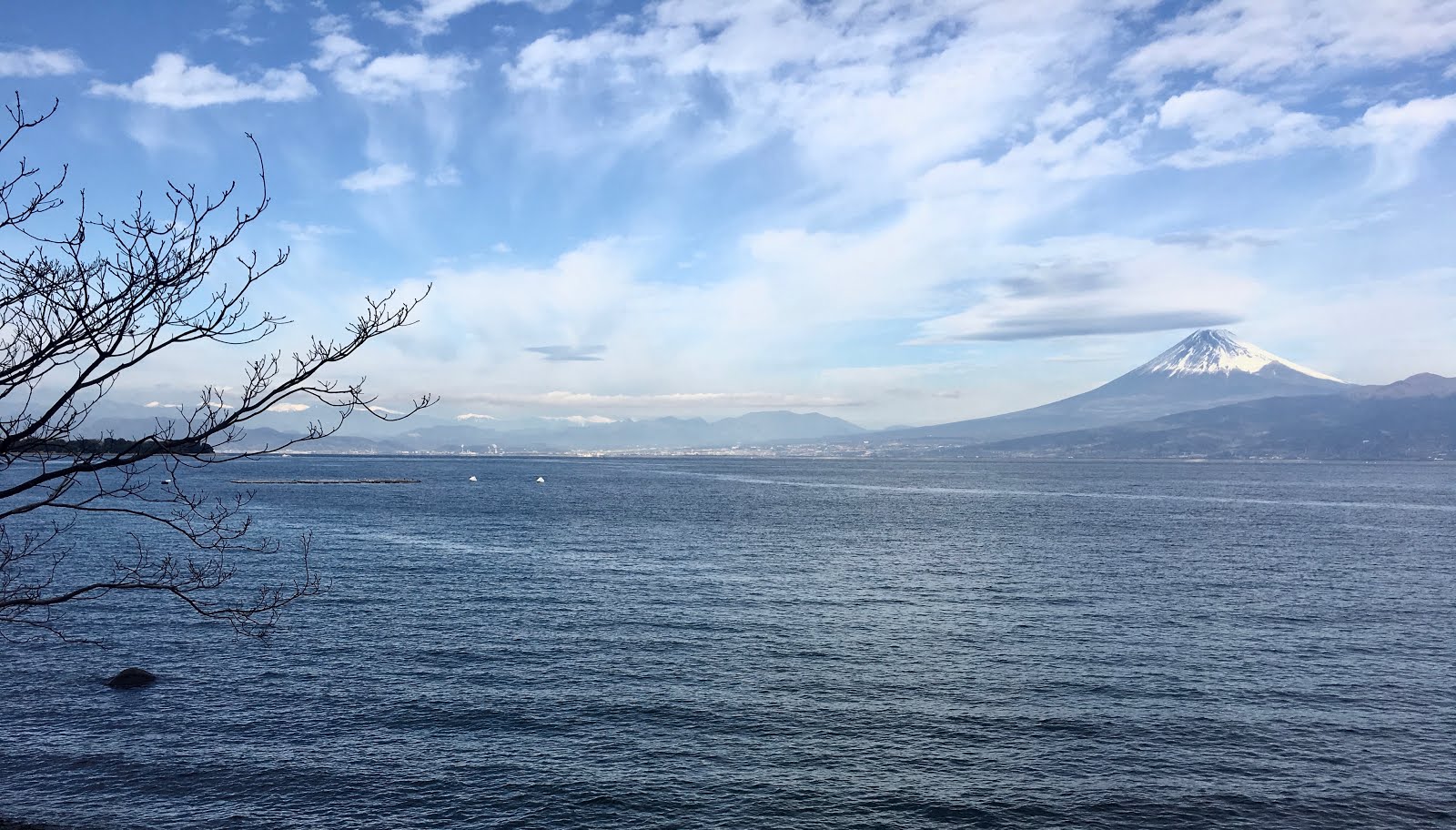
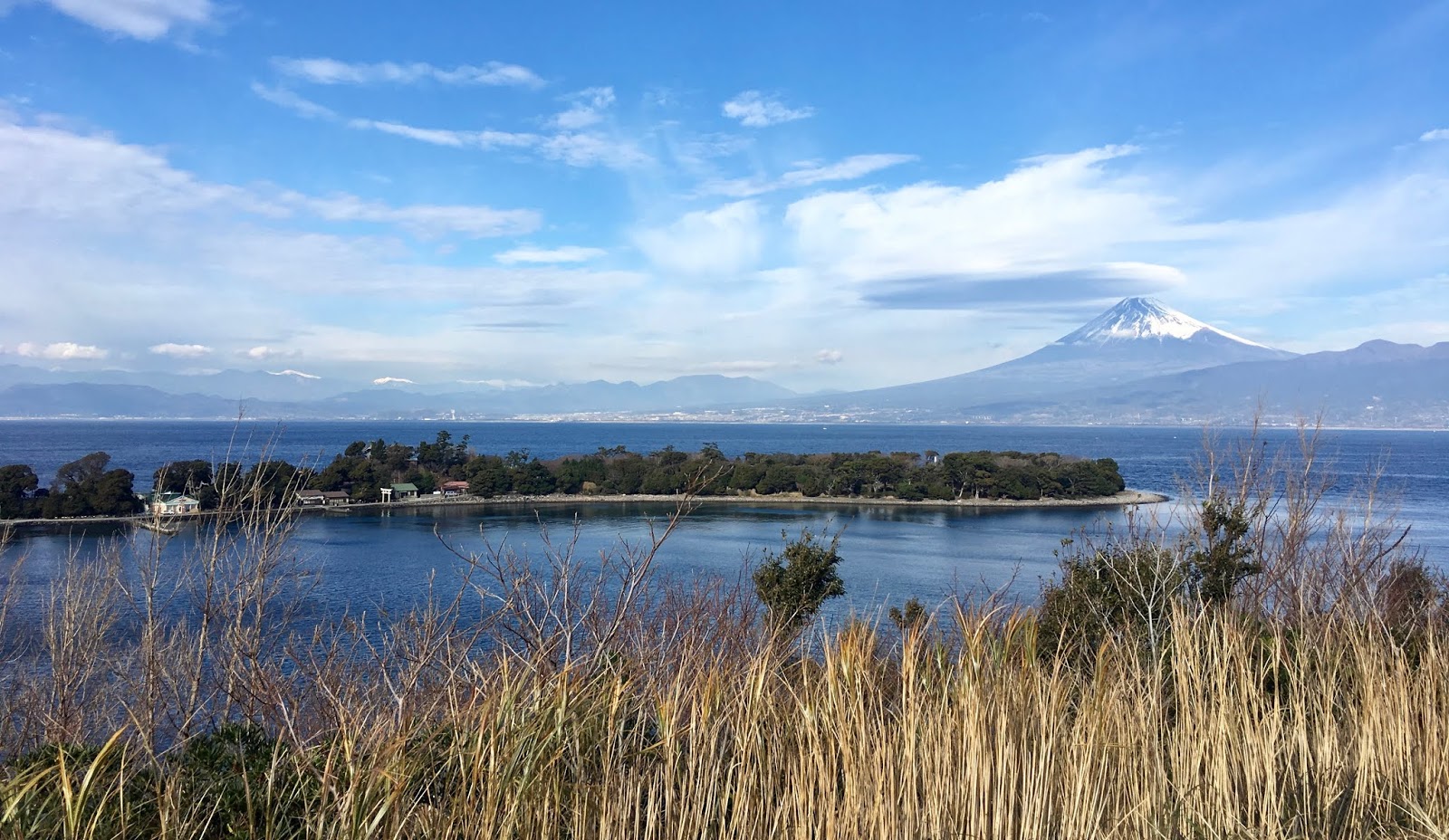
I have time conflicts and cannot ride this weekend, so I decided to seize the opportunity of the local holiday, ignore the stacks of papers to grade and other work not yet done, and instead take a training ride with a bit of climbing. I hopped the shinkansen from Shinagawa for the 45-50 minute trip to Mishima at the NW corner of Izu Peninsula. It seems like every time I go here, I get bogged down taking photos of Mt. Fuji in the distance across the bay. It is irresistible. It happened to me when I rode this coastline before Christmas, and every time I can remember before. So I have plenty of photos of Mt. Fuji from this route. Do I really need more of these photos? No! I need to FOCUS on getting in shape for Tasmania and PBP.

So today I was determined -- minimize the photo stops, get in a quick ride, if possible a loop out along the coast to Toi Onsen, then Route 136 east over the pass (well, not the real pass, but the tunnel at 500m elevation that cuts through the line of mountains above west Izu's coast), and the long gradual descent to Shuzenji, and back North along the Kano River to Numazu/Mishima, and get back to Tokyo mid- or late-afternoon!

I did quite well, really, for awhile. I was able to resist any photos for the first 25+ out of nearly 110 kms, until I stopped to remove my top layer jacket. This was not even a photo stop, right? It was a stop to remove excess clothing before the climbs to come. Doesn't count! And the photo was, well, spectacular, but not up to par for this course. Too little variation between the color of the water and the sky -- just different shades of blue, yawn -- too little snow on Fuji, nothing interesting on the water. I won't even post it in large size. If you read this blog, you've seen it before.

Then another quick stop for a bathroom break on a side-spur of a road, where the clouds and trees merited a photo. Also not a real photo stop. But the sky and trees were getting a bit more interesting.

Then I lost it. I took some photos briefly on the hill above Osezaki. One quick photo stop.


Then another one looking back after the first climb. Wow. I thought Fuji would be gone, around the corner from here, but there it was ... and an interesting foreground too, the village of Ita (井田).

Then more photos just after Heda. Last June (broken crankarm ride) and in December, I had not made it to this hill just past Heda ... and the mountain is perfectly framed ... and surely this is the last view of Fuji I would get from along the coast. So just for old times sake ...


Then I climbed more, longer hills on the 15kms between Heda and Toi. I was pretty much alone. The only roadies I had seen were far north and heading home to Numazu. I saw at most ten moving vehicles on this entire 15km stretch, mostly locals in "kei" trucks. As I emerged on the South side of one of the tunnels, a blast of wind hit me. There were whitecaps below -- and the wind and waves were coming not from within a protected bay, but straight from the Pacific to the South.

I remembered Assynt, the Rapha image film of hard men riding in rough weather in northern Scotland under dark clouds, rain spitting at them as the entire branding campaign "jumped the shark". I could almost hear the deep sonorous Scottish accent announcing "the shipping forecast ... there are warnings of gales". Could I, here on the rugged west Izu coastline, be livin' the Rapha dream lifestyle?  I checked my clothing. No Rapha. And even worse, the pavement was dry, and the wind quieted as I descended. Disappointed, I continued on.
Sun reflected on the ocean through a break in the clouds


A few kms before the center of Toi, there is another small town, Odoi. As I passed and rounded a corner toward Travellers' Point (旅人岬), the wind hit -- full force!  I was standing up and on the bike and barely advancing on the pedals. There was an old lady walking at the side of the road, leaning steeply into the wind as she edged ahead slowly. .... and I edged past her on my bicycle. We silently acknowledged each other's efforts. Now that was more like it! And I remembered, yes, under my shoes, inside my "windblock" shoe liners, yes, I was wearing Rapha socks! Ahhhh.

Anyway, soon I was at Toi Onsen. I checked out the foot bath, the tourist info place (typically, they did not steer me toward any one restaurant, but just gave me a map and circled the places they thought were open). I ended up getting a rather basic and slightly expensive "mixed fry" teishoku lunch. This stop put me way behind schedule.


The climb was steeper than I remembered. The last time I did this climb was with Steve Ridgely back in April 2015 on the R Tokyo 400km brevet. That time it was already dark, and I was exhausted, so it seemed like a hard climb. This time it was mid-afternoon daylight, the road was dry, and there was even a tail wind at points. Yet, it was still a hard climb. 500 meters up over 8kms. There is some variation, with a few stretches in the 10% range and some nearly flat. Anyway,  it was good exercise.
Starker than in April 2015 when many trees on the hillside were flowering.
The east side of the hill is far more gradual.

I could enjoy a nice 13km descent to Baird Beer's brewery along the river just south of Shuzenji, where I stopped off to say hello to my friend from the Chicago alums group, Baird business manager John C. My plan for Olympic cycling involves the velodrome at Shuzenji and the Baird Beer brewery tap room, restaurant and campsite in the valley nearby. Further behind schedule.

Bike leaning

River and very blue sky without bike leaning
Then, inevitably, irresistibly, Mt. Fuji showed a different face, with different foreground, light, clouds, pastel instead of deep blue sky, ... and I took even more photos en route back to Mishima!

Finally, I hopped the train and was back in Tokyo just after 6PM.


Strava track available here (minus the first couple kms).