07 March 2019

Tour de Tasmania Day 3 -- 300km from Freycinet Peninsula to Deloraine via Beaconsfield


I had a good feeling at the beginning of the 300k ride. I had been exhausted on the 200k, accumulated jet lag from the Portland-Tokyo-Sydney-Hobart economy class trip with a whirlwind 48 hours in Tokyo and afternoon of bodysurfing and eating near Sydney. But completion of one ride, and two more nights of good rest, with beautiful cool, clear weather, had me eager to ride.

Also, the 200k was, for me, a kind of "warm up".  I had already done a 200k in January, and main goal for me this week was to qualify for PBP, or at least get as many as possible of the 300, 400 and 600k rides done. I knew the 600k would be very hard, but if I could complete the 300k and 400k rides, I would consider the trip a success.

The day before, Mark Thomas of Seattle showed some of us an iPhone app called "Epic Ride Weather". If you link it to your ridewithgps.com route, input your anticipated overall speed (including rest stops), and your start time, you get a chart of temperature, precipitation forecast, the elevation profile, and most important, a map with wind arrows showing the likely strength and direction of the wind for your entire ride. This app was extremely helpful during the rest of the Tasmania trip -- in giving me the courage to leave in my drop bag gear like rain pants and my coldest weather clothes, as totally unnecessary. Before sleeping, I checked the app and confirmed we would expect dry weather, hot in the afternoon, with relatively stiff headwinds during the 100k+ stretch heading near due west the first half of the ride.
One of the Aussie riders had this amusing reflective vest ... designed with its check pattern to fool
a casual glancing driver into thinking it is a "police" vest. No, just a "polite" vest.
And plenty reflective.
At 4:50AM (on schedule!), I was the first of the riders to show up at the pre-ride briefing for the 5AM start. We started a few minutes after 5, and I followed the "fast group" as we headed out back up the peninsula. I lost the back of the lead group after 5kms or a bit more, and was alone. My dynamo light flickered -- maybe a loose connector -- and I stopped to adjust it. I expected the next group of riders to catch me, but I could still barely see their headlights to the rear as I started back up and got to speed. The light still flickered once in awhile, but the surroundings were getting a bit lighter anyway, and it was a wide open road with no traffic.

My last view of Freycinet Peninsula. Glorious in the dawn pre-sunrise, with a vineyard in the foreground.
I was still alone when I turned left and onto the main Tasman highway (A3).

I was still alone as I climbed the north side of "Cherry Tree Hill" (still no cherry tree in evidence). I stopped to take a photo of a spectacular vista at dawn, and could see a few lights of cycles behind me starting the climb, at least 4-5 minutes back. Again, I was starting too fast. ... but no reason to slow down descending the other side of the hill, and the wind was not noticeable as I pushed on, all the way to the right turn off the main highway and onto Lake Leake road.
Lots of bumps in the flat sections that don't show up on a 300k profile.
My Wahoo GPS showed 3500m of elev gain; actual was around 3200-3300m.
As I stopped for an energy bar and a photo, I was still alone.  I was looking straight at the long climb from sea level up to 600 meters elevation, and it was barely visible, the hill was so broad and the climb so steady and gradual. Now surely I would be going straight into the wind and begin to suffer.
That is a climb from sea level to 600m elevation ahead ... though you wouldn't know it!
But soon the trees and the gradual slope blocked the wind -- it was not noticeable during the climb. I passed Scott on the climb -- he had pulled off and was struggling with his seat post clamp (later fixed at the Control temporarily with zipties and then replaced in Launceston). I kept expecting others to pass me. I must have been climbing well since I stayed alone pretty much all the way to the control at Lake Leake. Wow. Done with the big climb. Others, including the Mark/Catherine/Rick/Kevin posse rolled into the control before I left, but I was way ahead of my plan and further ahead the time cutoffs, despite having made the big climb and ridden a nice chunk of the "upwind" section, so could relax a bit.
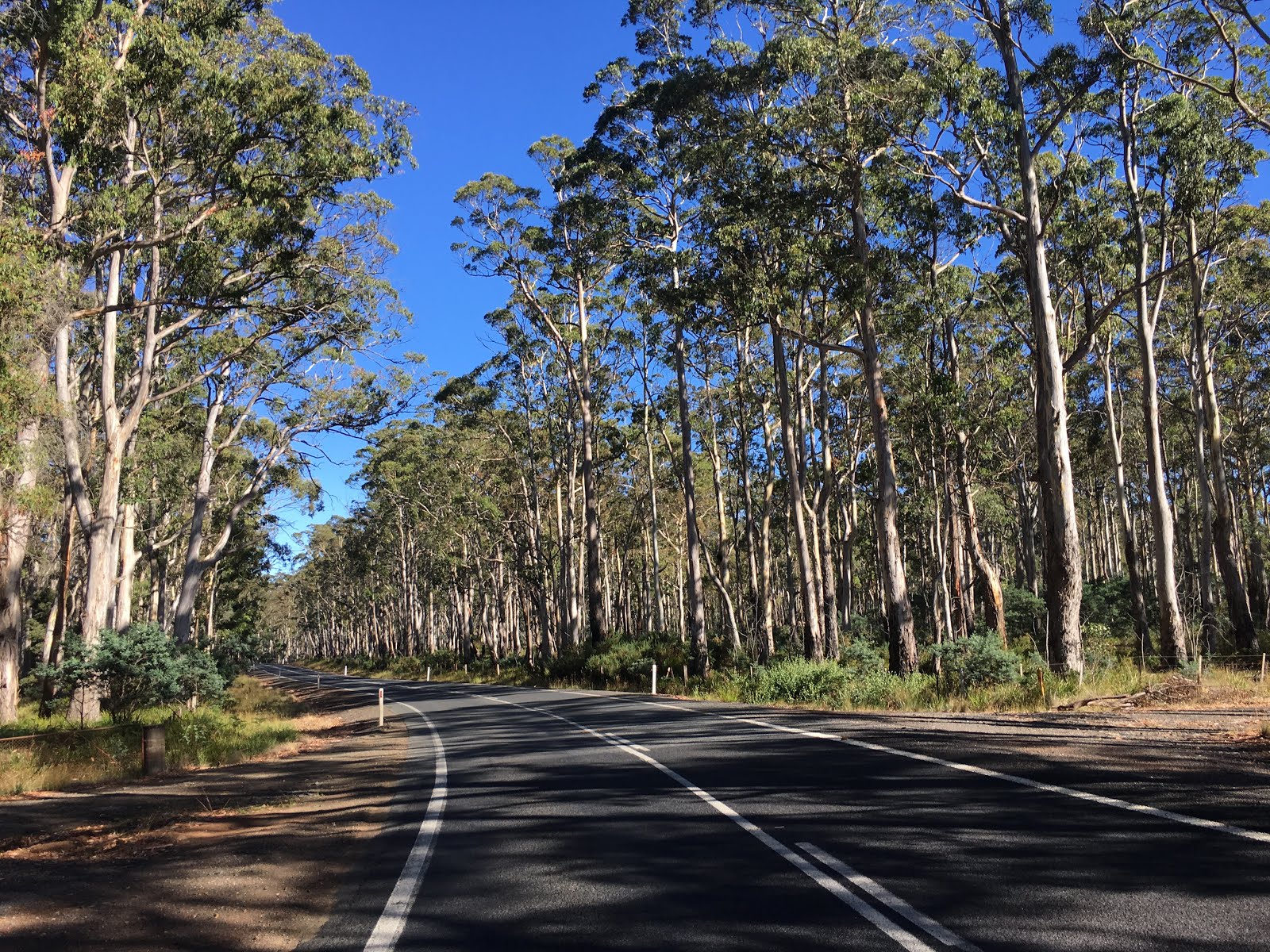
Glorious eucalyptus forest under blue skies after the Lake Leake control.
On the next stretch, I rode with Fred some, though he is a lot faster uphill and in general, and with my weight I am faster downhill into a headwind, so it was not easy to stay together. In the end he went ahead as I fell back on a short climb, and he stayed ahead but within view after we descended to Campbell Town, where there was a cafe, and we joined others who were pulled over and eating (or in line to order).
Near Campbell Town
I left the cafe relatively quickly and turned toward Cressy. The next stretch was a long hard slog into the wind, but quite scenic with rolling fields, a few rivers even, and little traffic.

Eventually I slowed to a crawl in the headwind. Soon Tom (a government economist in Canberra and PBP veteran ... my roommate in Deloraine) and Fred pulled up. Tom suggested I work with them, which I did for the next 30-40km of the ride nearly to Cressy.

After another stop in Cressy, I ended up with Fred and Errol heading north toward Longfort and down the hill into Launceston. I wanted to call it "Lance - town" (hey, it has a bunch of bike shops, and the Velo Vineyard is just out of town 10kms or so to the NW), but the locals tell me it is pronounced "Lon-Chess-Ton", and I got a somewhat chilly reaction when I voiced my "Lance-Town" idea. I guess Lance is still a dirty word in cycling circles.

After a rest on a grassy triangle of park (at my insistence), we headed out of town to the NW on a major road, the A7. It was after-school rush hour, with lots and lots of cars, and massive private tour buses that were serving as school buses. The buses were particularly rude. One pulled out in front of me forcing me to slam on my brakes. Others roared by. But before long, at Exeter, we left the A7 for a much quieter road along the beautiful inlet that runs from the coast all the way to Launceston. We stopped at a hotel / bar for something cold (and non-alcoholic) to drink. Tom had rejoined, then Pauline arrived. After we departed, Tom and Fred went ahead, and I rode with Errol and Pauline. Soon my stomach acted up a bit, and we stopped to rest again and enjoy the view. It was a lovely afternoon ... but miles to go before we could sleep.
Looking back toward Launceston
Pauline rests -- trying her first 300km ride ever
Errol, the veteran rider, had committed to see that Pauline made it to the finish
We finally turned away from the inlet and soon were at the Beaconsfield control. Tom and others were already there. Tom had ordered a pizza from the place up the road. I followed suit. Tom's arrived and he shared it generously. I got two pieces of the large pie. So when mine (small, olives & cheese) arrived, I could also share it generously. Mark's posse had arrived. The vegans were especially happy, as they Tom's had been a tropical - bacon and pineapple - pie. The food was a godsend. Scott and Tara pulled in -- they had fallen back with Scott's detour to four bike shops to get a seat post replacement in Launceston.

Beaconsfield control - Tom, Fred, Rick, Catherine, and my feet

Andrew warned us that there were hills ahead. Deloraine was not more than 200-300 meters elevation. But Andrew warned us that we had at least 600 meters of climbing to go - up, up, up, down, up, down, up ... over the remaining 65km. My Wahoo ride track showed nearly 1000 meters climbing on this stretch.

But it was a glorious last stretch.

It was 7PM or so, and the deadline was 1AM. Even going slowly we could finish easily in 3 or 4 hours, with 2 or 3 to spare. There was no reason to hurry. I let others go ahead and decided that I would take it easy, already trying my best ... after the top of the first hill, to make it a "recovery ride" with a view to the 400k two days later. The sun was low in the sky, the countryside was beautiful, the grazing animals looked happy and well-fed. The farms looked prosperous. This reminded me of dusk some dusk rides in Japan through comfortable farmland nestled in the hills -- satoyama - with bubbling streams and lights beckoning from farmhouse windows. Scott zoomed by, and after a few more steep "dips", he was gone.

I caught up Mark as he rode back up a seep hill to get a photo of some scarecrow-like figures perched on equipment at the entrance to a farm. He lent me his lockring wrench so I could firmly tighten my couplers, one of which had come loose. He was quickly far ahead, rejoining his posse.
Mark's group of four just ahead, and Pauline, Errol and Fred at the near the top of this little 10% rise.
Looking back toward Beaconsfield

The moon creeps over the horizon.

Brilliant landscape lit by the moon.
Haunting moonscape.

I passed Errol, Fred and Pauline, who were pulled over at a restroom and adding clothing. I could see Mark's group ahead, but could not approach them. Soon Fred again passed by me. Errol was sticking back with Pauline, who had said she is not comfortable riding alone at night (and had never ridden further than 200km before).

As I made a right turn onto Birralee Road, Andrew was parked on the shoulder watching over us. I pulled up and knocked on his car window. "Thank you!", I said. "What a wonderful route! And riding in the early evening cool and quiet, in this environment ... it just doesn't get any better than this!!!"

From here, the ups and downs were much more gradual.  Shortly before entering Deloraine Tara zoomed by. I could not keep up, and she disappeared up the street ahead. ... I remembered that our lodgings were at the far end of town, out of town, from our pre-ride briefing.

After checking in and a quick shower, I headed over the the restaurant for dinner, a beer, and a banana split reward.


05 March 2019

Tour de Tasmania Days 1 and 2 (200km and Freycinet rest day)

Tour de Tas 200k - 2300m of elevation gain, in small bites.
Riding in Tasmania looked like this. Not in Japan anymore!
We headed out of Hobart at 6AM on Sunday February 17, over the main bridge toward the airport, about 25 riders, riding in a double line to "own the lane" and ward off traffic (with Gavin as our guide), then after the bridge shifted to the shoulder of the major road, then after a few kilometers turned off to a secondary road without significant traffic.  We saw no heavy traffic again until Launceston, two and half days later.
Cloudy skies on the approach to Orford. Pauline out of Canberra/ACT stops briefly.
This was a relatively hilly 200km, with many hills in the first half, then headwinds on the flatter section, then a short "Cherry Tree Hill", another flat stretch with tailwind as we came back South down the Freycinet Peninsula, and a set of very, very nasty short hills to get to the finish at a light house in the national park. 

Slight rise ... but with a headwind and a 5% grade, I find myself slowing to a near crawl

Looking back down that rise
The morning riding was cool, afternoon hot, but not outrageously so, and the finish again cool. The hills were, well, steep, but not so high. The riding country reminded me a lot of California, and of other countryside in southern NSW I have seen on other trips to Australia. 
On the coast!

Spiky Bridge ... aptly named for its spikes

Andrew, Tom and others at the Swansea control

Tasmania has more roadkill per km than any other part of Australia.
Mind the critters, especially from dusk to dawn!
I made it to the Orford Control by 930AM, ahead of plan (to the extent I had a plan) ... but stopped at a cafe up the road for a sandwich and coffee, so did not leave until 10AM. It was getting warm. We were out of the hills, but into the headwinds.

I was pretty much exhausted by the time I got to the Swansea Control, and the section after Swansea was very hard for me. It was a huge relief when the road turned south and the wind to my back on the peninsula. Andrew, the lead organizer, had warned us that there was a nasty hill in the national park, over 20% grade, and we might choose to walk up it. There were actually several hills with 13-15% sections, and then the 20% one.  I walked up one of the earlier candidates, and the actual 20% one. Still, at that point we could have walked all the way to the lighthouse and still made the time cutoff, so we could take our time, and once we got there, enjoy the view.
End of the 200k! View from the lighthouse, our reward.

Mark Thomas, Seattle, and Catherine Shenk, Colorado (in her Proviz reversible vest)
 Our lodgings were shared cabins in a camping/vacation facility. My cabin-mates were Scott and Tara, from Queensland, and Wolfgang, from Dusseldorf/Munich. Tara educated me about the local wildlife. Wolfgang was quiet, but responded to questions. We had all all-rider group dinner, slept, and enjoyed a free day.

On the free day, I went with Fred, a Seattle-based randonneur to see one of the most iconic beaches in all of Australia -- Wineglass Bay Beach. We left our bikes at the trailhead, and did a 13km loop hike through a saddle between to of the mountains, down to the beach, across the isthmus and back. It was a great hike -- spectacular views, clean air, deep blue water, white sand, wallabies, and more. Fred was very good company -- he grew up in Washington DC, Dupont Circle, and knows a lot about bikes, among other things, and offered a bit of a window onto the Seattle randonneur and gravel bike culture. He also brought some beers and a large towel to the beach ... I had water only and an onsen towel.


Second live wallaby of the trip. I soon lost count.

04 March 2019

Tour de Tasmania Day 0 - MONA

Is it art?*
(Roman Signer's "Fahrrad mit Farbe")
After I got my bike assembled and ready, I needed to deliver my bike suitcase to one of the organizers--my no-frills backpackers' hotel refusing for lack of room to store it for the eight days I would be on the road. Fortunately, Gavin, one of the Hobart-based rider/volunteer staff for TdT, works at a firm that had just acquired a small office building only a few blocks away with plenty of storage in the former Hobart branch of the Australia Cancer Council--the very sign still on the building a reminder to wear sunscreen while riding under the sunny clear, deep blue high UV skies of Tasmania! Hobart is a city of a few hundred thousand population, and the downtown is relatively compact and walkable so it was easy to drop off the suitcase.

When we met, I mentioned to Gavin that my plan was to go to The Museum of Old and New Art (MONA). A friend in Tokyo had told me about visiting MONA last year--open since 2012, the museum immediately became a leading tourist destination in Hobart, indeed, all of Tasmania.

Gavin said, "so you'll head out the bike path along the shore to the museum?"  "Sure", I replied, not having known that there WAS a bike path. It looked as if the museum was about 12-13kms from the central business district. There was a boat/ferry option, but I had just missed one, and I really wanted a "shake down" spin before starting the 200k the following morning.

I had some trouble finding the path downtown, and ended up on a major route that went up steeply nearly 100 meters over a little bump, then down again the other side. Finally I intersected the bike path, a paved "rails-to-trails" route alongside remaining train tracks that has the benefit of climbing and descending at only 1-2% grade.
My mistake -- missed the bike path and instead climbed this little bump en route to MONA
MONA is a major institution that is owned by and houses the contemporary art collection of Hobart-born David Walsh. The collection includes many major artists of the past quarter century and more. This is not a museum designed or run by a committee, but implements the vision of a single person. It is what David Walsh thinks a museum should be. When it first opened, it was said to focus on the themes of "sex and death", but more recently seems to have diversified.
If you enter by land ...
If you enter by sea ...
Or, looking from the boat's perspective based upon a photo from the MONA website
I entered the museum grounds through the Moorvilla vineyard along a beautiful tree-lined road through vineyards, climbed another short steep hill to the parking area, and looked around for the entrance. There were people eating outside, some others sitting in a large meadow waiting for musicians to appear on a bandstand (or maybe just enjoying the beautiful day), there was even a group dining who were all dressed in beige and brown earth tones, as if they were extras from the birthday party in "Breaking Bad" at Gretchen and Elliott Schwartz' house where Walter and Skyler White show up and are the only ones at the party who did not "get the message" to dress in earth tones.
The actual museum entrance is somewhere down there on the left side ...
Eventually I found my way toward the museum entrance, down the sea-side of the hill. First I needed to cross the "tennis court". Why is the entrance so confusing? Apparently it is far less so if one arrives "by sea" instead of "by land", but still, was this intentional, to stir confusion and a bit of tension before the visit?  The very act of walking ACROSS a tennis court instead of going AROUND it, breaking through the lines near the net, seems to invite tension and rule-breaking. The queue that one often sees form on the other side of the court is ... not for entrance to the museum, but for the boat ride back to town.
Amarna, James Turrell
Sky on display within the frame
Finally I found the unmarked entrance (through which people were exiting), the ticket desk, then as instructed walked down a spiral stair to the very bottom floor (B3), and emerged to the "void bar" where I had the opportunity to purchase an alcoholic beverage.  I opted for one of the many varieties of "Moo Brew", the beer that formerly brewed on-site, now nearby, and also is owned by Walsh. As I wandered around and sat in a comfy chair to finish the beer, the woman next to me told me she was sitting to get her seat for the 1PM concert. The group performing, Zahatorte, was from Kyoto. I saw most of the exhibits on the lowest floor, then came back for the concert and watched the entire first set -- the music was fun, and the musicians looked as if they were enjoying playing it.
"Kitten trophy rug", Julia deVille
Maybe Don Jr. and Eric Trump can bring one back from their next hunting trip?
I guess the entrance confusion, followed by the very relaxed environment of the interior, is intentional. Did I mention how David Walsh made his money?  Apparently he did so as a professional gambler, using his background in mathematics.  He teamed with a partner named Kaiser Soze and they somehow figured out how to systematically make hundreds of millions of dollars (or more) from gambling. (Actually, Walsh's business associate was named Zeliko Ranogajec, not Kaiser Soze.)  But it is like something straight out of a movie, maybe Ocean's Eleven?
Selling beer, somewhat randomly
The bar at the B3 entrance, and concerts both inside and out on weekends, plus the entrance confusion, all tell you "this is not a normal museum, even for contemporary art".  I guess a few other things do so as well. But by and large, once you get inside, it is a well-done museum of contemporary art.
"Cloaca Professional" by Wim Delvoye -- a poop making and emitting machine
A few of the memorable works are mentioned with photos ... but you should go. I am not going to post photos of the 152 porcelain casts of women's genitalia, ("Cunts and other conversations", by Greg Taylor and friends), for you. There was some other X-rated art as well. This is not contemporary art designed to hang in law firm conference rooms. It does address sex, death, and more. Nor can you get the impact of Turrell's "Beside Myself" or Yves Klein's "Pigment Pur" unless you walk through them.

Hobart is a nice, manageable town and Tasmania has plenty of beauty, some good food and drink, hoppy things, and history. You may not see any Tasmanian tigers (no one has in over 100 years), but you can still see Tasmanian devils, and wombats, echidna (Australian porcupines) and Australian possums (furry tailed criters, much cuter than American possums), and wallabies, lots of wallabies. And if you cannot go, you should check out MONA's website, which has lots of information available. If you do go, you should check out the website even more thoroughly, so you can prepare (unlike me).
Accumulation of Brass wheels, by Arman

Rotorelief, Marcel Duchamp
(his most famous work, a bicycle wheel and fork embedded in a stool, is not at MONA)
Untitled (White Library), Wilfred Prieto
Invites you to ... fill the pages?

Tim
Tim is on display six months each year.
When he dies, the tattoed skin will be removed and delivered to the work's owner, the art reaching its final stage.
Beside Myself, James Turrell
From the exhibition Your Shadow Rising, Toby Ziegler 
Link to video: https://youtu.be/ykjg9PG1XQg


Zahatorte concert!
Link to video:  https://youtu.be/wGK9ImVbnnc

An entire wall!
of plastic bags full of water ... from the exhibition "Zero"
Reaction: "I could do this!"
Untitled -- ropes hanging from hooks. Reaction "I've done that one!"
Goldfish in bowl of water with knife, on chair. I could do that! (but gotta feed the fish!)
Link to video (proof of life): https://youtu.be/puBPMhMZiNQ

Bounty, (Hobart-based artist) Patrick Hall
Wooden cabinet with ship sailing on a sea of bones ... 

From the bike path on my way back to city center.
I wish I could have spent more time at MONA, and I regretted not having prepared more in advance.  But I needed to head back to town so I would not be too rushed at getting to the pre-ride dinner, where I met the other participants for the first time. A few -- Mark Thomas aand Rick Blacker from Seattle, Warren Page from NSW, and Peter Heal from ACT, who was volunteering to staff the ride -- I knew. Everyone else was new to me.  In any event, it was a pleasant evening and we were all off to bed early, ready for the next day's ride.

... more about the actual rides later (which were great, thanks to careful planning, generous volunteers and a great natural setting), but first I must do some more urgent tasks in the real world.

*As for the bicycle with rope displayed at the top of this post, MONA has a nice feature by which you get information about the works via a smartphone-like device. You can save your visit and the works you saw, and read more about them later. MONA's explanation of the work follows:

Signer’s title Fahrrad mit Farbe, in English, is ‘Bicycle with paint’. That’s it. He’s the master of understatement.
He makes everyday objects do unexpected things. He explores cause and effect. His materials are simple. His processes are simple. ‘Since art is a game’, Signer says, ‘I have no use for assistants’. But his work is ‘inexplicable’—by which, he means, it is difficult to prove that what he makes is art.
Aesthetic theorists have pointed out that any attempt to define art requires a ‘family resemblance’ approach: with art as a wide-ranging ‘family’ in which there are many overlapping similarities and yet no rigid definition that includes everything we consider art to be while excluding everything we don’t. Perhaps Roman Signer knows that the Austrian-British philosopher, Ludwig Wittgenstein, famously used games to explain this family resemblance concept. So, to take just a few examples: poker, football, Monopoly, mahjong, Grand Theft Auto, billiards, blind man’s buff or this little piggy are all recognisably games, even though there’s no single element common to all—some are solo pursuits, some team sports using sticks or balls, some use words and numbers, some are played by adults, others by children, some have only been played recently, others are ancient; yet overall there are many overlapping similarities that make them all games.
This was Wittgenstein’s ultimate proof of the complexity of language. In the same way there are countless kinds of art, including, in the case of Roman Signer, bicycles with paint: a painting, a sculpture, and an action or ‘happening’ all at once.1 But for Signer himself, any looking for art’s ‘definition’ is pointless.
1. Ludwig Wittgenstein, Philosophical Investigations, published posthumously in 1953; I believe the theory was first applied to the visual arts by Morris Weitz, ‘The Role of Theory in Aesthetics’ in The Journal of Aesthetics and Art Criticism, 15, 1, September 1956, pp. 31–32.

16 February 2019

Tour de Tasmania Day 0 - Before and After

Before
After a perfect overnight night flight from Haneda Airport (emergency exit row window seat in economy class, leg-room, totally exhausted and already fed upon boarding, 5.5 hours sleep then just enough time to see BlacKkKlansman!) a half-day layover in Sydney (coffee on the veranda at Luke and Hisae Nottage's house overlooking a small valley, body surfing, lunch and a beer at Wanda Beach/Cronulla Beach), I arrived in Hobart late Friday evening.
After
I checked into my hipster no-frills lodgings at The Alabama Hotel (cheap, view of brick wall outside window, shared bathroom, no luggage storage permitted even though I return in 10 days for another 2-night stay,  ... but comfy bed, quiet, trendy furniture in the lounge, they "love art!" and are highly ranked on all the online services, and hey, it is "high season" so they don't need to do any more).
Cronulla Beach - Sydney southern suburbs
Last night I tried to assemble Voyage, Voyage, but the bolt that secures the headset cap to the internal expander plug was stuck into the upper part of the expander plug assembly, so that when I unscrewed the bolt, the entire top part of the pressure plug came out, and the lower part (a kind of nut) dropped down the inside of the fork crown. I managed to take out and disassemble the pressure plug but did not have a pliers that would give me a decent grip to undo the stuck bolt and allow reinstallation (sorry if that is gobbledygook for most of you).  So in the end I just waited for the morning to get a tool.

Of course, the millenial proprietor at the front desk said that they did not have a pair of pliers anywhere in the hotel. (I guess they outsource 100% of the maintenance, or they just stiff-arm guest requests? Well, for the price of A$100 a night (US$75) I cannot really expect more.) 

I took the stuck bicycle part with me to breakfast, and at the coffee place around the corner -- not one of those fancy coffee places all over this country and, now, the world, but a basic "lunch stop" run by South Asian immigrants -- they were so incredibly nice when I ordered that I just asked "could I borrow a pair of pliers for a few seconds?"  The older member of the crew (Dad?) went in back and brought out a large, beautiful pair of pliers, perfect size to grip the outer edge of the part and hold it firm so I could use my allen/hex wrench to get the bolt unstuck in 5 seconds. As they say in the musical Hamilton, "Immigrants -- They get the job done!" (Quite similar to my experience in other countries, memorably France.)

Voyage, Voyage now has wireless electronic shifting SRAM Etap -- NO SHIFTER CABLES. This makes it a joy to assemble and disassemble, and very easy to just take off the rear derailleur and store safely during transit. Now, if only it will work reliably for the entire event ... Fingers crossed.

09 February 2019

Clever, very Clever

Crossing the Hawthorne Bridge (by foot!) 
In Portland to see family, I visited Clever Cycles yesterday. I like this shop because it is not the "same old" gear one finds most places. They feature cargo bikes ... which are actually quite common on the bike lanes of Portland.


I have been using the "Rain Legs" rain chaps I got there for about 5 years, and wanted to get another pair. This time, instead of black with reflective tabs, I got a reflective pair -- almost as reflective as the Proviz clothing that David Marx/RGT distributes in Japan.

Just how reflective are they? Let's try a flash photo:

Anyway, without a bicycle I walked a long way, and enjoyed Powell Books. But I really need a bike to enjoy Portland!