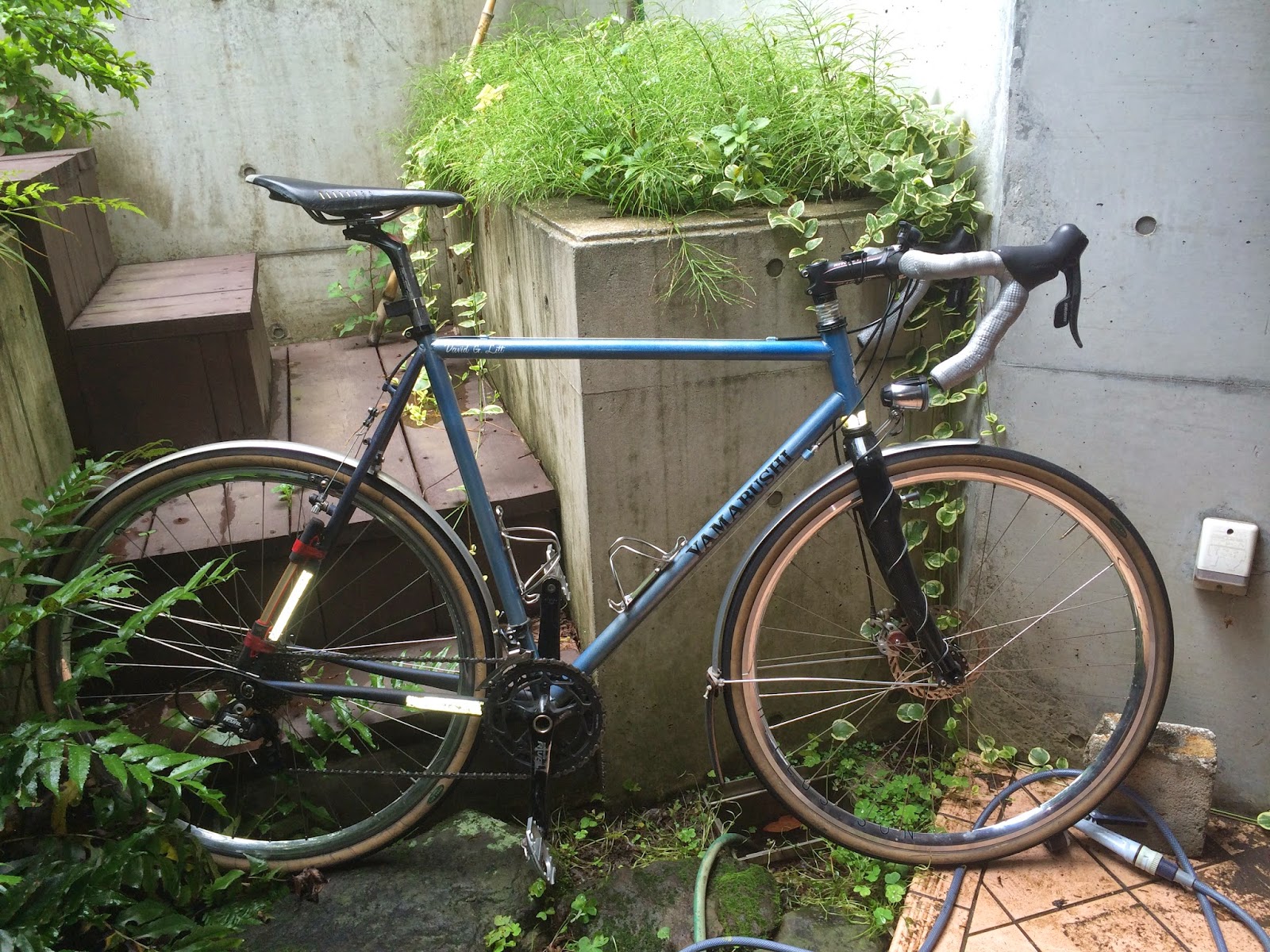
21 July 2014

Tea House at Tokisaka Pass -- 峠の茶屋

This weekend I was out of town Saturday night/Sunday WITHOUT my bicycle, so I needed to get in a ride on Monday.  The weather was humid, but only about a 7 of 10 on the TOS (Tokyo Oppressiveness Scale).

Clouds keep the heat down a bit ...
The last few weekend rides I have headed out Onekan, so this time I decided to head for Itsukaichi. Time was limited, and I wanted to get in at least a little bit of a climb, so I turned right at Motojuku for the Kita-Akigawa, but quickly veered off the road and into the Yamabiko no Taki entrance road/parking lot and the climb for Tokisaka Touge and the famed "Touge no Chaya".

The climb is 3.8 kms and 300 meters up (or more).  This gets one almost as high as the entrance to Kobu Tunnel, but with about 15 kms less riding.  And the reward is a great view and a nice rest area.  Only 3-4 cars to pass on the road going up and again coming down.  Only 4-5 cyclists at the top and 2 sets of 2 hikers each.   A hidden gem.

Of course, I could not help but remember climbing this hill with MOB, DJ and Juliane back in ... October 2006.  More fun to do with friends than alone.  Have I been up it since?  Maybe once or twice, but a 2006 was pre-Positivo Espresso era, and the photos have never made it onto the blog.  A few are included at the bottom.
Shrine at Tokisaka Touge
Looking down at the North Akigawa valley

Panorama, including resting cyclist
Two cyclists took a great interest in my Ti Travel bike.  It was the first time they had seen a Ti bike with couplers. They were riding the usual carbon Ridley or De Rosa, though one said he also had a Ti Lynskey.


On the way up the river, I passed this guy on a moving carnival ride.  Its horn was honking, propeller spinning, all driven by the movement of the bike or the wind.


All in all a very nice ride.

Juliane tired?
MOB critiques DJ's ride and DJ takes the criticism to heart.

The Chaya has a delivery vehicle (the one in the back).

messenger?

19 July 2014

More Q36.5 -- Beautiful Base Layer

On my stop at the RGT global import and logistics center, I got an opportunity to see (and touch) the full line of Q36.5 cycling clothes that David Marx is now importing and distributing in Japan.  It drove home to me how extraordinary this entire collection is -- designed by someone who understands precisely the needs of cyclists and the limits of new materials and the latest in high tech machinery for the clothing industry.  I love the bib shorts, jersey and socks I am already using, but had not yet gotten a full explanation from David of the design features and thought that went into the collection.

One perhaps minor example of the great thought Luigi Bergamo has put into these clothes:  No labels! The information that would otherwise be placed on a scratchy label -- which most people would cut out, leaving an uneven seam or potentially damaging the clothes -- is instead woven into the items themselves in an unobtrusive location.

I will get more Q36.5 clothes as they become available in my size for winter or next spring. Each item had something special -- to help achieve ideal movement and temperature control -- with lighter, thinner, more durable material than previously possible.  I cannot wait for cold weather to try the Baselayer 4 with the integrated hood and gloves, or the hybrid "Que" early winter jacket/jersey.

The only piece I brought home with me yesterday was a simple short sleeve L2 baselayer (>15 degrees C).  The material is all synthetic, but it feels luxurious to the touch, and has an incredible degree of stretch, so I felt comfortable that even my barrel chest and non-cyclist physique will be fine in the L/XL size.


Plenty of loft and breathability -- honeycomb knit shown on the upper back

No label needed.  Size L/XL.  Made in Italy.
44% polypropylene, 44% polyamide, 12% elastane.
David M. asked me to mention that Q36.5 Japan's Facebook page is here:

https://www.facebook.com/pages/Q365-Japan/225019294362467


RGT Global Headquarters - Parlee on Display and Z5i Test Ride

On a return trip back from Kansai to Tokyo yesterday, I took a short detour to visit the global headquarters of RGT Enterprises in Gokiso, Nagoya and got a tour from its CEO David Marx.

RGT is importing the highly-regarded Parlee carbon bicycles into Japan, and David showed me 3 of them on display.  All were beautifully built up with Campy Record groupsets and spectacular Gokiso wheels (especially the spectacular Gokiso hubs that GS Astuto, Gunnar and others rave about), and Enve handlebars to match their Enve forks.

In addition to David's custom built carbon bike (with various over-the-top components including the super light C-Tecs carbon seatpost), he had bikes featuring the Z5 SLi and Z5i "off the rack" frames on display.   The custom frames are all hand made in America, while the Z5i, Z5 SLi and ESX monocoque frames come from "Asia".

The Parlee frames are beautiful in their simplicity and elegance, and the build reflects this -- nothing extraneous.  Black bar tape.  Black Supersonic Conti racing tires.

I am not the most perceptive or sensitive rider when it comes to assessing different ride qualities, and I test rode in street clothes/street shoes with flat pedals.  That said, I could validate that the Z5i is beautifully balanced, the ride silky smooth and lively.  I rode in a rough orbit around the RGT building, working outward until I was doing a decent-sized rectangle on streets of various sizes and traffic levels, with even a few very short hills and tight corners.  I wanted to ride more -- to point the bike back toward Tokyo or at least to the hills in east past Inuyama.  But in my street clothes, street shoes and with the oppressive July humidity, prudence seemed the better part of valor and I returned to earth instead of reaching escape velocity.

The Z5i feels like a much more refined machine than I am accustomed to -- very fast, immediately responsive, and very comfortable.

Parlee Z5 SLi

Gokiso wheels with aluminum shell hubs; matching blue
David M's custom Parlee -- I did not even ask whether Z0, Z1 or Z2/Z3.  Cannot afford to start that kind of bike lust!
(Parlee's ESX aero frame sits in the background on the chairs, ready for its build).
Enve fork, Gokiso wheels with Ti 6AV-4V hub shell and P5 ceramic bearings.
Clean cockpit

For a bit extra if you do not like basic black -- a wide range of colors
The Z5i I test rode.  Is that a "no bicycle parking" sign on the pavement?
David M. asked me to mention that the Parlee Japan Facebook page is here: https://www.facebook.com/Parleejapan.

13 July 2014

Audax Bikes -- Japan vs International

Plenty of Audax-equipped bikes were on display at the Kitami rest area after H1200 was cancelled.

At this link you can see plenty of different bikes and cockpit setups.  Bear in mind that these photos were taken AFTER 500 kms of riding and almost a foot of rainfall.

Some surprises -- very few Japanese participants use "real" fenders.  Many use none at all, and some use simple clip on blades.  Also relatively few dynamo hubs ... surprising given their predominance on shopping and city bikes in Japan.  Indeed, most Japanese Audax riders use regular carbon framed road bikes, regular 700x23 tires, and just pile on some extra bags and a cockpit crowded with computer, GPS device and lights.

Here are two bikes of foreign participants -- both Titanium with SandS couplers, similar to my Audax travel set-up.  This is definitely the consensus approach for riders who do multiple 1200s and want to avoid excess baggage charges.
Lothar's bike.  Ti Seven with SandS couplers.  Brooks saddle; bags off at this point.  R23 rear rim with wider tire, RR415 front rim.  Bar end shifters.
Vincent's travel bike.  Ti Hampsten with SandS couplers, HED Belgium rims and 700x28 Conti 4 season tires.
Bags off at this point but visible in my other post.
Another interesting entry was that of Taiwan rider Nancy.  An Independent Fabrication frame and really cool carbon aerodynamic-shaped rear carrier.  I asked here where she got it and if it was expensive.  She said a friend had made it for her, custom-built and sized for her frame.  Oh well.
First Independent Fabrication frame I have seen in Asia ...
Rear carbon carrier custom built -- with integrated rear carbon fender!
Remember, the full set is here.

Hokkaido 1200 -> Hokkaido 483; H2O Version

Jerome and I arrived in Sapporo on Wednesday afternoon, and were greeted by dark storm clouds and rain-- the influence of massive Typhoon No. 8 felt thousands of kilometers ahead of the storm itself.  The typhoon was forecast to land in Kyushu and move along the islands of Shikoku and Honshu to the East, approach somewhere near Tokyo, then head off into the Pacific Ocean, far to our south.


By late afternoon we had made it to the start/goal location, at "Satoland" in NE Sapporo.  We met many old friends -- the more devoted Japan Audax riders who tend to show up for the longer, crazier events, and the event organizers who included both AJ Hokkaido and Japan Audax leaders.  Lots of familiar faces from the 2012 Tohoku 1700 brevet week.  Kiwa-san of AJ Hokkaido, who rode Rocky Mountain 1200 far faster than I, greeted me.  Inagaki-san shared his meticulous ride plan -- always a source of useful information, sometimes critical to success.  Take Kawano, of Audax Saitama, who volunteered for the first 600km ride Jerome did, back in 2011.  Maya Ide, who organized the Fleche this year, and was on duty to help the foreigners.
  

There were also a number of non-Japanese riders.  Mostly a big group from Taiwan (including Yiping, who stayed in the same hotel as me at PBP), but also some Germans, Australians, and others.  A few whom I met and spoke and/or rode with included:

--Lothar, a German who lives in the U.S. and, according to Maya Ide, was the person responsible for bringing Audax events to Korea when he lived there at one point; 

--Vincent, a Nigerian who is a doctor in, and longtime resident of, the Seattle, Washington area.  He is a very active member of the Seattle International Randonneurs.  Vincent had just completed a 2100 km event in Sweden, and rides multiple 1200km events every year in the U.S., Australia, Europe and elsewhere.  He did the "pre-ride" for the 2012 Cascade 1200.

--Alexander (Alex) Neumann, a German who was at Schwalbe Tour Transalp in 2009, when Jerome and I rode, at the Rocky Mountain 1200 in 2012, and London-Edinborough-London in 2013.  Alex organizes rock music festivals and fundraises for charities when he is not riding his bike. 

--Peter Heal, an Australian who rides a recumbent and, according to Vincent, holds some kind of record for the fastest time crossing the Australian continent via bicycle.
The traditional pre-ride briefing, on a grander scale
In any event, we were off and on the road at 8:40PM.  The roads were wet with plenty of big puddles of standing water and rain off and on, harder then lighter.  After a few kms of turns we eventually joined Route 275 headed to the NE, and enjoyed a tail wind for the next 50 kms.  Riding in a group, often with Jerome, Vincent, Asano-san from Audax Saitama and a number of the Taiwanese riders, we made great time.  Jerome pulled most of the time, though I spelled him once in awhile.  We were at the first control point (100.6kms) before midnight.

The rain picked up, and the wind shifted so it was mostly cross- and head- rather than tail-wind.  No more riding in a big group, but Jerome, Vincent and I stayed together.  It turned into a long slog, especially when we needed to fight the wind.  I fell back and only caught Jerome and Vincent when they waited.  In any event, we got to the second control at Lake Kanayama, in the wee hours before dawn.  Light food was served and we could take a "power nap" in a darkened room, then up again in 25 minutes to continue.
Vincent

Jerome, post power-nap

Lake Kanayama -- a brief respite
It was already light out, of course, just after 5AM, and I saw a group of about 10 tiny, tiny deer scurrying through a field as we passed between them and the Lake a few minutes after the control point.  The rain stopped for long enough that the pavement started to dry ... and then it started to rain again, hard.

I struggled mightily on the climb to Karikachi Pass, Elev 644 meters, no power.  Bonking?  Or just fatigued from an overnight ride of around 200 kms at this point?  I ate one bar after another, and the banana I had brought along from Lake Kanayama.  In any event, Jerome and Vincent waited for me at the top -- joined by a number of other riders.  I just rolled on and started the descent, worried that I had consumed nearly all my food on the climb and unsure where we would find the next services.
Karikachi Pass, Elev 644m.  Highest point of the ride.  High point?
Descent into rain and clouds ahead


We finally found a "Seikomart" in Kuttari, about 22 kms from the top of the pass.  Even pasta and other convenience store food did not restore me, and Vincent and Jerome again quickly went ahead on the short climb out of the town.  After about 10 minutes, Goto-san of Kinki Audax went by with her 2 riding partners.  She was waving a wallet, asking if it belonged to me.  No. Must be Jerome's.  (In fact, it was Vincent's).  This sprint up the hill by Team Goto was above and beyond the call of duty, and took a lot out of them.  Indeed, I passed them later on.  

We had several long stretches of straight roads.  We would go to the North many kilometers, into a headwind and with a seemingly endless 1, 2 or 3% uphill.  It was a challenge even to keep at 20 kph.  Then we would turn East for another long stretch, wind from the side/rear, and a long 1 or 2% downhill, much better!  Then north again, and the same slog as before.  Why isn't this area flat?  Why does it slope down to the South and East?  This entire area was agricultural -- fields with a wide range of crops, and dairy farms of Tokachi.

Jerome, who recently worked on a cheese "joint production" venture for a France-based cheese company in Hokkaido, said the Tokachi area is Japan's leading dairy region, but each farm has an average of only 15 cows.  Hardly critical mass or economically viable.

The worst of the rain came as I passed Lake Ashoro and descended a hill into the town of the same name.  I rode through the town another 4 kms to the control (another 7-11 convenience store), where Jerome and Vincent were waiting.  They were surprised to see me only 10 minutes or so after they arrived -- a sign of my on-the-bike recovery somewhere after Kuttari.  Jerome insisted it was time for a proper lunch, rather than more convenience store crap.  So we rode all the way back through town to find a restaurant that served steak, among other things, and could handle 3 soaking wet cyclists.  They found some chairs we would not destroy with our dampness, and bought is bath towels as well to help dry out.  The food was good and the detour of only an hour and 8 kms extra riding was a reasonable trade-off for the warmth.

We headed out again and passed the control point a second time.  We arrived together at Rikubetsu, where Jerome and Vincent stopped for some liquids at a convenience store. I continued and started the next very gradual climb, to Misono Pass.  After more 1-2-3% climbing on Route 242, the route turned onto Hokkaido Route 113.  I welcomed the real climb of 6-8% gradient, since it suggested I could get to the top in only a few kilometers, as proved to be the case.  Then it was a very nice, easy descent from the pass down into Kunneppu, and a turn to the East and down the valley to Kitami.  Great, the Kitami control was our target for our first real sleep.  We had beds waiting, food, our drop bags with dry clothes and extra chamois cream -- everything we needed. 

As it turned out, the control point was located at least 5 kilometers to the SSE of Kitami, and required us to pass through most of the city, then ride up a small valley to the base of a ski area.  My pace slowed noticeably on this valley.  But it was around 5:30PM when I arrived, only slightly off my long-term ride plan.  Jerome and Vincent arrived around 15 minutes later.  They make a great riding pair, whereas on these long rides I like to trade off between riding with others and alone and without worry or pressure about pace.  In fact, I think Vincent might have persuaded Jerome to get some fenders on his next bike, so he can ride these events with SIR without being treated as a leper ... 
From Sapporo to the Kitami Control Point
Maya Ide was one of the staff working the control reception, and she warned us that the Japanese weather service had issued warnings for the area we were about to ride through -- strong winds, heavy rains, and lightning.  The typhoon had accelerated and its remnants would pass much closer to the eastern tip of Hokkaido (Cape Nosappu) than earlier predicted.  We could continue, but at our own risk, and should be on watch for dangerous conditions.  Of course, we would have a vicious headwind for much of the next 200 kms to the Cape and turn-around.

We decided to get a decent sleep, wake at 1030PM and leave the control at 11PM.  I was assigned a tatami room with Lothar and Alex.  They said that they would wake at 830PM, and in fact Alex said later that Lothar's alarm had gone off before 8PM.  I slept through it all and got up as planned at 10:30PM.  4.5 hours of sleep = 3 REM cycles.  After another quick bite to eat and some preparation, and I was ready to go.  At 11PM Vincent and Jerome looked in no hurry.  Same at 11:05PM.  So a few minutes later, around 11:10 I announced to them that I would head out first.  I think by now they expected this.  They would catch me eventually, no doubt.  According to Jerome, they did not leave until 11:30PM, and only Vincent caught me, a few minutes before the top of Bihoro Pass.

In any event, it was a fast ride from the Kitami control to Bihoro town, then a stop for coffee at a 7-11, and the wee hour climb to Bihoro Pass, around 500 meters elevation.  The climb was not steep, and the road was good, despite rivulets of water.  At one point I saw a large white-bottomed deer that raced away from me along the road.  This seemed a different species from the miniature animals of the prior morning.
From Kitami Control to Bihoro Pass ... and back again
I was alone most of this stretch, but could often see a red tail light of the cyclist ahead, providing a goal for me to reach and pass.  It seemed as if I passed at least 10 riders between the control and Bihoro town, and another 10 between the town and the pass.  I think many of them were the same people, as my coffee stop gave up any time advantage I might have gained.

It was around 1:45AM by the time I got to Bihoro Pass, amid sheets of rain.  I was surprised to see a big group of riders at the pass-side parking lot and facilities.  One of the organizers waved me off the road, and we were given the bad news.  The police had closed roads around Nemuro/Cape Nosappu due to the storm, and so we could not continue.  The Hokkaido 1200 was officially cancelled.  The mood was surprisingly festive, riders enjoying each others company and having fun battling the elements.  Somehow it was OK not to finish since the organizers had made this decision -- or rather had it made for them by the police and public safety authorities.

Huddling in the vending machine lobby at Bihoro Pass

Party at the Pass!  Close that door.  No, it is automatic -- do not touch it, just get out of the way!

Heated mens room!
Sorry, but you cannot go down the SE side of the hill.  But still smiling in the wet, dark and cold.
We chatted with the other riders at the pass for awhile, then headed back toward Kitami for more sleep. Others who waited longer said there was a spectacular view after dawn.

The rain had stopped to the NW by the time we approached the control, and we even saw blue sky at time!  Of course, when I next saw a weather forecast on TV, the total expected rainfall for Thursday to Saturday morning for Hokkaido was supposed to be over 300 millimeters.  That is 30 centimeters, or ONE FOOT of rain.
Some riders decided to head back to town by bicycle, via Asahikawa to shave off a bit of distance (and add some climbing) on the return.  Higuchi-san, Aichi-based member of our Fleche team, said he was heading for Cape Nosappu.  The storm was long gone by Friday afternoon, and he wanted to at least see the "eastern end of the world" as the ride promotions had promised.  

But we decided to head back by van to Sapporo, no interest in a long meandering ride after nearly 500 kms of the event and then the letdown.  I rented a van and we drove back to Sapporo with Alex, Vincent and Jerome and our bikes.  We drove over beautiful Sekihoku (Rock-North) Pass. We picked up Vincent's gear that the Sapporo Nada Inn, then stopped at the Sapporo Beer Garden for 100 minutes all-you-can-eat/drink "Genghis Khan" grilled lamb, vegetables and beer, then it was back to Satoland for bike dis-assembly, packing and sleep.  On Saturday morning we awoke early, headed to New Chitose International Airport, dropped off the van and hopped our flights back to Tokyo.
Two Positivo Catteni riders join us for a photo as we near the end of our Genghis Khan feast.
It was a huge let down to have the ride cancelled ... but still a great adventure, with new friends made along the way!  I cannot wait for the next event! And of course, we will look forward to seeing Vincent, Alex, Lothar, Peter, Yiping and the Taiwanese team and all our Japanese friends next year at PBP.

09 July 2014

Planning Ride Strategy

Jerome finally gets down to planning his H1200 ride using the latest in analytical software tools.

08 July 2014

H2O on the H1200?

I packed my bike and gear for the Hokkaido 1200 on Monday night.  Off on Wednesday morning for a 9PM start from Sapporo.  Ready to go.


Meanwhile a major typhoon is approaching west Japan and will be much closer by Thursday.  We will definitely catch a bit of rain and maybe a bit of wind on the H1200.  What would a 1200 km randonee be without some rain?  Boring.  And we need to remember that wind and rain give Jerome and me an advantage over skinnier Japanese riders.

06 July 2014

Giant Bike Shop at Night

One of many shops in my neighborhood I have never managed to buy at ... but it does look nice at night, nestled between the Futakotamagawa train station and the bridge over the Tamagawa.

Last Ride before Hokkaido 1200

As Saturday rain turned to Sunday humidity, Jerome and I took a 100 km half day ride to stretch our legs before Wednesday night's start for H1200.  Both of us were a bit bleary-eyed from middle of the night/early morning World Cup matches, we have both gained a few kgs over past months, and Jerome was still suffering from jet lag having returned from Europe last week.   Plus, we need fresh legs from Wednesday evening for H1200.  So we took it easy today heading out Onekan and the Tank Road, around Tsukui-ko counterclockwise then back via Yaen-Kaido.


The weather was not too hot, but the humidity seemed to defeat my cooling system.  As we left Route 413 and headed around the North shore of Tsukui-ko, we passed the newly opened section of the Ken-o-do expressway, which takes long distance traffic AROUND Tokyo instead of THROUGH, and now is open all the way from the Tomei Expressway to the Kanetsu and Tohoku Expressways.  We marvelled at how quiet the traffic noise was, barely audible as we rode adjacent, thanks to the noise barriers.  Very impressive.
Noise barriers on the Ken-O-Do expressway 
How to build an expresway through a neighborhood without destroying it.
Today Jerome rode in his "short shorts" and sleeveless top -- the look that only he can pull off.  He has added some new reflective tape to his bicycle, and more important, could be seen (and distinguished from other road cyclists) from at least 500 meters back, because of his new reflective triangle attached to triathlon belt, signalling a "slow vehicle".

To quote a Pennsylvania state traffic safety website:
  • Vehicles designed to travel 25 mph or less and horse-drawn vehicles are required by law to display a florescent orange triangle surrounded by red bands. When you see this symbol on the rear of any vehicle, slow down immediately and maintain a safe following distance.
Jerome often exceeds 25mph (approx 40 kph), and while he sometimes has been compared to a galloping horse, one does not pull his bicycle.  Nonetheless, the admonition to drivers to "slow down immediately and maintain a safe following distance" is welcome.


Stay tuned for reports on the big ride of the summer -- H1200!

05 July 2014

New Aero Frame ... or This Cheaper Alternative

This video (hat tip to TCC) ends one old debate among cyclists.  Rainy day here in Tokyo, so will need to feed my habit with some maintenance, prep for H1200 and some time online.

Also, the Tour of Yorkshire starts this weekend, though for some reason on the Presentation broadcast on Japanese cable TV late last night they were speaking French?   It felt a bit as if I had woken up in an alternative universe in which the Brits had lost the Battle of Agincourt.

29 June 2014

Body Heat

A report came out last week indicating that, by the end of the 21st century, climate change could make it too hot on many days to engage in strenuous exercise outside in large parts of the United States without death.  With the air temperature over 95 degrees fahrenheit and high humidity, the body cannot cool sufficiently, heat stroke or heat exhaustion and death result.
Beautiful clear air after much rain.  The Tamagawa path.  Air like a brick.
Of course, the group behind the report is just a bunch of crazy left wing environmentalists with Risk Committee and Co-Chairs such as George Schultz (Secretary of State to President Reagan), Hank Paulson (ex Goldman Sachs CEO, Secretary of Treasury to George W. Bush), and Olympia Snowe (former Republican Senator from Maine).

It has been cool and wet recently in Tokyo, but today, just as I headed out for a mid-day spin, the sun shown through clouds, temperatures soared and humid air was like a brick.  If this is what Risky Business is predicting for much of the world during much of the year 50~75 years from now, I don't like it at all.

But I needed to get in a decent ride.  Two weekend "make up" classes for each of the two courses I have been teaching at Keio, and lots of rain, have kept me away from the bike far too much.

Also, I just did a major makeover of Voyage Voyage (the Ti Travel Bike to get it ready for Hokkaido 1200 -- finally moving over my Shimano 7800/6600/6700 and "Retroshift" components, redoing the bar tape, etc.  I rode it to work on Thursday, made some significant Retroshifter adjustments, and was glad to find the adjustments worked and shifting is smooth.   I can understand why Hiroshi does not like the Retroshift, but now that I have gotten used to them, I do not mind them at all.  I think having large hands, which can envelope the shifters and brake lever, helps.  I have no worries about shifting vs. braking -- it is easy to do both.  And if I should ever break a cable, it will be easy to replace.
Voyage Voyage is ready for the Hokkaido 1200.  2 x1 liter water bottles and tool kit in the 3rd bottle carrier.  
I made it down Onekan and the "Tank Road", and back again.  There were plenty of other roadies out, taking advantage of the rare sight of dry pavement and blue sky to get in a ride.  At a convenience store stop just after the turn-around, a number of us shared complaints about the humidity as I ate some ice cream and refilled my bottles (with the remainder of the water going onto my head or down my back for cooling effect).
Hydrangeas along the tank road
End of the (Tank) Road looking out to the NW
Of course, a few hours after I returned home, a thunderstorm rolled through, the streets were damp again and the temperature mercifully cooled.

New Look for the Yamabushi

The Yamabushi looked great (to me at least) with deep rim carbon wheels and black Schwalbe Ultremo ZX fat (700x28) tires.

But with my new H Plus Son shiny rimmed wheels, it was time to try a new look.

I tried the new wheels on the Yamabushi, with some Schwalbe Durano light beige colored tires, and my Brooks B-17 saddle.
Yamabushi with Schwalbe Durano tires and Brooks B-17 saddle
The Durano tires ... I found provide a very thick, clunky feeling.  They are heavy, not supple, and offer little road feeling.  The Brooks Saddle, is nice, but wider than my standard Fizik Arione.  And the faux carbon bottle cages, which at least made some sense with carbon rimmed wheels, now look totally out of place.

So I replaced the Durano tire with a pair of Grand Bois 700x30 tires I have only used once -- classic side wall and black tread, and a very comfortable ride that still offers plenty of road feel.  I went back to the Fizik saddle, and finally, got a very nice pair of Arundel stainless steel bottle cages.
Grand Bois tires and Fizik Arione saddle 
Arundel bottle cages -- very nice!

Rear wheel -- 

and Front Wheel

Matching headlight -- brushed aluminum finish fits the fender, rim etc.
Now the Yamabushi is a fast, fun, comfortable and good looking bike!  Again!

For a post from another Tokyo based expat's blog showing alternatives for stainless bottle cages, see this.


24 June 2014

Cycle Race in Sarajevo to Commemorate the 100th anniversary of WWI

Watching a bit of the FIFA World Cup very late at night or early morning here from Tokyo, one cannot help but reflect on the power of sport to channel international competition in a healthy direction.  I turned on the TV very early this morning to check in and see Brazil and Cameroon battling it out on the field.  Brazil is victorious, but there are no serious casualties.

Then I switch to NHK and see reports of Chinese vessels ramming into a smaller Vietnamese boat in the Tonkin Gulf, where a fleet of over 100 Chinese vessels is engaging in "self help" and aggressively staking out turf in an attempt to drill for oil offshore, in waters that China claims, as does Vietnam.  The next report is about similar disputes between China and the Philippines over the Spratly islands, where China is doing landfill on some tiny sand atolls, apparently in an effort to expand them eventually into an airfield.

Then I am reminded of the role that cycling can play. 

The linked BBC,  Guardian and Balkan Insight stories report a UCI- and Tour de France-sponsored race in Sarajevo on Sunday, to commemorate the 100th anniversary of the start of World War I, with the assassination in Sarajevo of Archduke Franz Ferdinand on June 28, 1914 starting the most awful "war to end all wars" ... until the next one.

The assassination in Sarajevo on June 28, 1914 occurred just as the Tour de France was underway.   The Tour was completed, then on August 3 Germany invaded France.  By the time the war was over, 3 winners of the Tour had been slain, along with millions of others.

The 2014 race saw both Bosnian and Serbs join -- and was won by a Slovenian, with an Italian in second.

This international aspect is one thing I enjoy about randonneuring.  Even at the Japan Audax Fleche every April, there are some participants from abroad -- Seattle International Randonneurs and Taiwan randonneurs.  Of course, the "sport" originated and is administered from France, so Jerome is welcome at all Japanese events as a special guest!  At an event like the Cascade 1200, there are riders who have come from many countries.  And at PBP or LEL, the entire world seems to be riding.

Our own David J. in 2012 rode with his father in a commemoration of the 1955 "Peace Race", an early exchange in sport during the area before "detente" had come to prevail over a very cold war in Europe. 

And my long-time friend, Mike Sata, is the proud sponsor of an annual cycling Peace Rally in Chailly, Burgundy, France, which will celebrate its 10th anniversary on August 2, 2014.  (Rumor has it that both Bernard Hinault and Francesco Moser will be among the riders).

Such sport and cultural exchanges help to build friendships.  They help us to see citizens of other nations not as potential enemies, but as people with the same hopes and concerns as we have.  Such friendships are started by participating in these kinds of events -- a sister city exchange or an Audax event in a neighboring country.  They are maintained through volunteering in the organization that sponsores and renews the event.  

It is only through sustained, privately-maintained friendships across borders that we can hope to head off the next great conflagration.

16 June 2014

News Flash -- Jerome Completes SR600 Fuji Course Within Time Limit!

Jerome reports that he has successfully completed the SR600 Fuji course in just under 51 hours -- with an hour to spare!

He has beaten this demon!

... Now he can do an "official" run to be listed among the finishers.  And I will need to try it as well again this year.